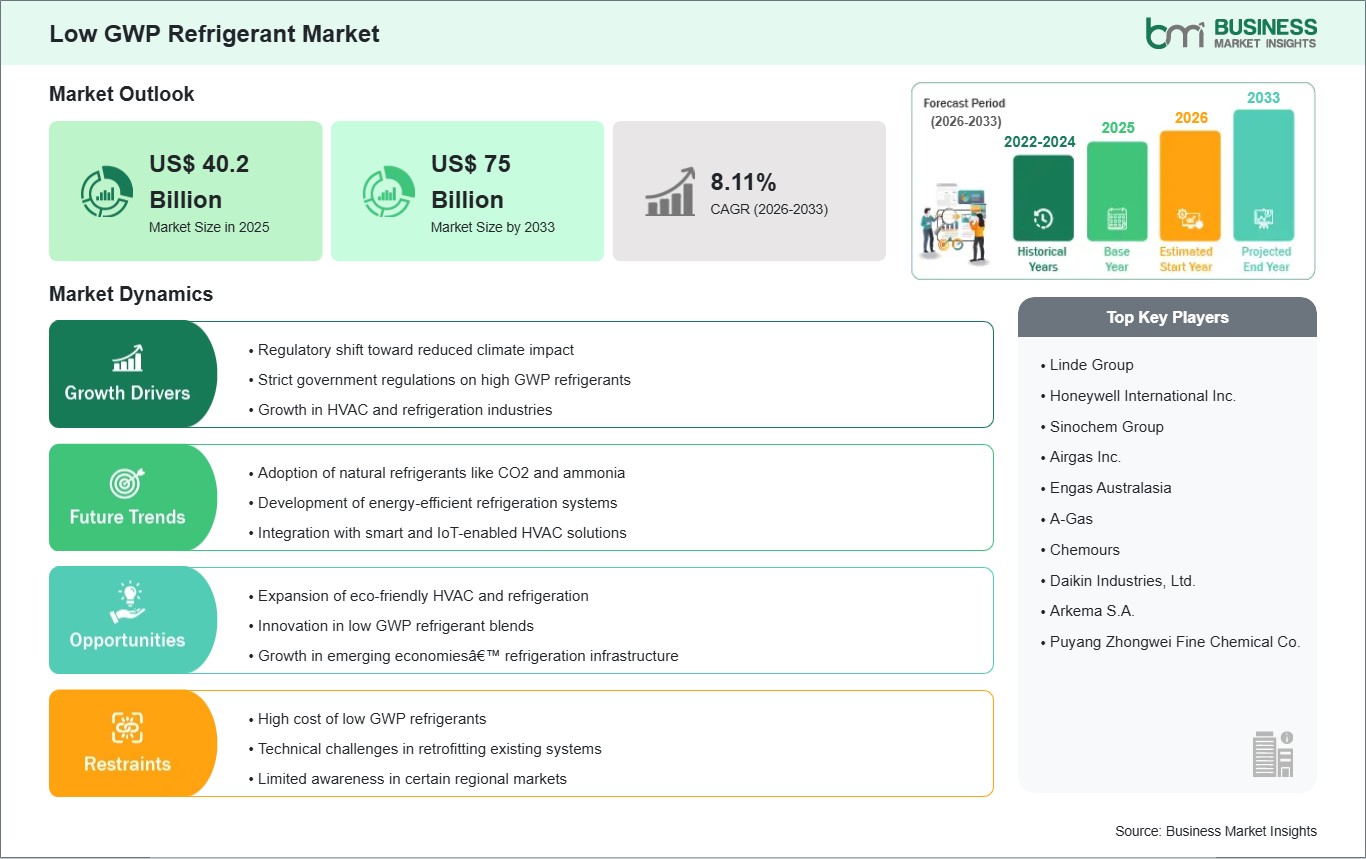
The Low GWP Refrigerant Market size is expected to reach US$ 75 Billion by 2033 from US$ 40.2 Billion in 2025. The market is estimated to record a CAGR of 8.11% from 2026 to 2033.
The low GWP (Global Warming Potential) refrigerant market is growing rapidly around the world as governments and industry accelerate the shift to environmentally sustainable cooling solutions. Low GWP refrigerants replace traditional hydrofluorocarbons (HFCs) with substitutes that reduce greenhouse gas emissions while providing energy efficiency in air-conditioning, refrigeration and heat pump systems. Major technologies include hydrofluoroolefins (HFOs), natural refrigerants (such as CO₂, ammonia and hydrocarbons), and engineered blends tailored to meet specific performance requirements. Growing adoption of these products is driven by regulatory requirements such as the Kigali Amendment to the Montreal Protocol and regional phase-down programs for HFCs, particularly in commercial and residential HVAC systems, industrial refrigeration, and automotive air conditioning.
The focus of technological innovation is on maximizing thermodynamic performance while minimizing the flammability risk and compatibility with existing equipment to lower retrofit costs. Companies are investing heavily in R&D, forming strategic partnerships with Original Equipment Manufacturers (OEMs), and establishing training programs to ensure the safe utilization of their products. Additionally, the need to meet sustainability and energy efficiency objectives is driving product development and positioning low GWP refrigerants as key facilitators of decarbonization in cooling applications. Companies that provide high-performance, environmentally-compliant refrigerants with application-specific technical assistance will have a competitive advantage in this rapidly changing marketplace.

Key segments that contributed to the derivation of the low GWP refrigerants market analysis are type and application.
The worldwide refrigerant market, including those that are low GWP, is greatly influenced by the growing pressure of regulations to reduce GHG emissions to help prevent further climate change. The regulator or environmental agency is helping phase down high GWP refrigerants (like some HFCs) in favour of lower GWP alternatives. As manufacturers, equipment manufacturers and end users see these regulations, they will continue to move toward environmentally friendly refrigerants. The regulations that apply to commercial refrigeration, residential refrigeration, air conditioning and heat pump applications require compliance with governmental mandates to reduce GHG emissions to help protect the environment and, therefore, have driven many companies to adopt low GWP refrigerants as part of their regulations and meet carbon-neutral goals as well as environmentally-friendly energy efficiency standards.
Therefore, the demand for compliant refrigerants by companies will result in increased market growth and consistent demand for these types of refrigerants. Additionally, international agreements and national regulations will continue to result in a global harmonised standard for refrigerants, which will further motivate companies to adopt low-GWP refrigerants. Companies are also trying to show their commitment to being good stewards of the environment and following the direction of ever-changing environmental regulations. Low GWP refrigerants are in high demand, ensuring that low GWP refrigerants will continue to be essential in providing climate-conscious HVAC and refrigeration solutions globally across multiple segments.
Innovation in eco-friendly refrigerants and associated HVAC technologies is creating significant opportunities for market growth. Manufacturers are developing new formulations that maintain thermal performance and system efficiency while minimizing environmental impact. These advances enable the replacement of traditional high GWP refrigerants without compromising safety, performance, or energy efficiency. Equipment designers and end-users are increasingly integrating low GWP refrigerants into new HVAC, refrigeration, and cold chain systems. The development of solutions that optimize energy consumption, enhance system reliability, and reduce leak risks is encouraging wider adoption in both commercial and residential sectors.
This focus on environmentally sustainable performance is creating a competitive advantage for manufacturers and system integrators. Additionally, the industry is exploring next-generation refrigerant technologies, including blends and natural refrigerants, to meet evolving market demands. Collaborative efforts between chemical producers, equipment manufacturers, and regulatory bodies are enabling scalable adoption. These advancements, combined with growing awareness of energy efficiency and climate impact, are positioning the low GWP refrigerant market for sustained global growth and innovation.
The low GWP refrigerants market demonstrates steady growth, with size and share analysis highlighting evolving trends and competitive dynamics among key players. The report examines subsegments categorized within type and application, offering insights into their contribution to overall market performance.
By Type, the hydrocarbons subsegment dominated the market in 2025, driven by excellent thermodynamic properties and high energy efficiency in refrigeration and air conditioning systems.
Based on Application, the commercial refrigeration subsegment dominated the market in 2025, supported by rising demand in supermarkets, retail cold displays, and centralized refrigeration units.
| Report Attribute | Details |
|---|---|
| Market size in 2025 | US$ 40.2 Billion |
| Market Size by 2033 | US$ 75 Billion |
| Global CAGR (2026 - 2033) | 8.11% |
| Historical Data | 2022-2024 |
| Forecast period | 2026-2033 |
| Segments Covered | By Type
|
|
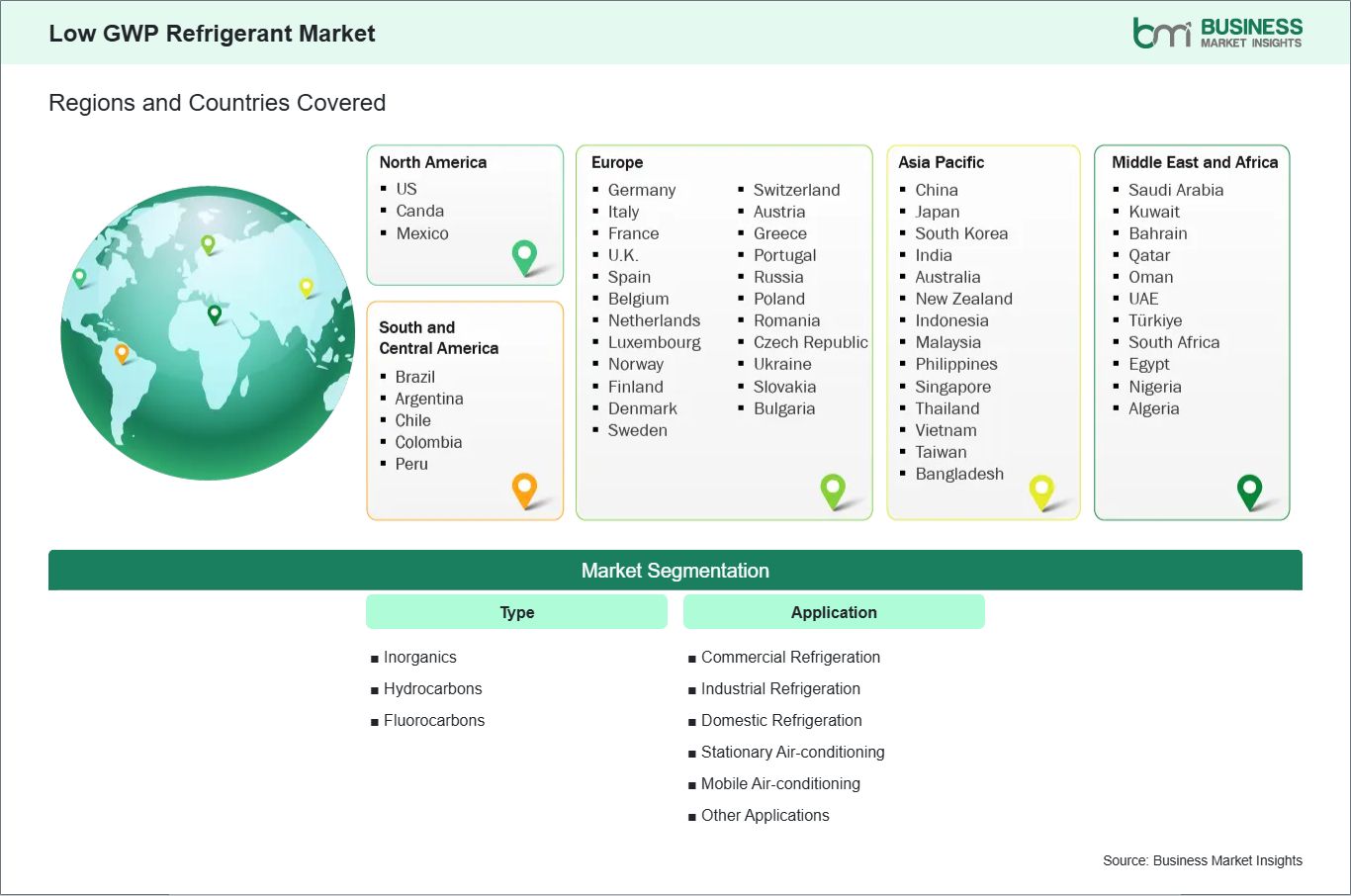
Regions and Countries Covered
| |
| North America | US, Canada, Mexico |
| Europe | Belgium, Austria, Finland, Denmark, Greece, Poland, Romania, Russia, Ukraine, Czech Republic, Slovakia, Bulgaria, Italy, Luxembourg, Germany, Switzerland, France, Netherlands, Norway, Portugal, Spain, Sweden, United Kingdom |
| Asia-Pacific | Australia, China, India, Japan, South Korea, Indonesia, Malaysia, Philippines, Singapore, Thailand, Vietnam, Bangladesh, New Zealand, Taiwan |
| South and Central America | Brazil, Argentina, Peru, Chile, Colombia |
| Middle East and Africa | Bahrain, Kuwait, Oman, Qatar, Saudi Arabia, United Arab Emirates, Turkiye, South Africa, Egypt, Algeria, Nigeria |
| Market leaders and key company profiles |
|
The "Low GWP Refrigerant Market Size and Forecast (2022 - 2033)" report provides a detailed analysis of the market covering below areas:
The geographical scope of the Low GWP Refrigerant Market report is divided into North America, Asia Pacific, Europe, Middle East & Africa, and South & Central America. North America held the largest share in 2025.
Regional adoption of low GWP refrigerants is influenced by regulatory mandates, industrial growth, and climate control requirements. North America leads due to stringent environmental regulations, early HFC phase-down initiatives, and widespread adoption of energy-efficient HVAC systems in commercial, residential, and automotive sectors. The U.S. and Canada are investing heavily in natural refrigerants and HFO-based solutions for industrial and commercial applications.
Europe is another mature market, driven by EU F-Gas regulations, stringent carbon reduction targets, and adoption of low-emission cooling solutions in Germany, France, and the UK. Asia Pacific is witnessing rapid growth, particularly in China, India, Japan, and South Korea, where rising urbanization, industrial refrigeration demand, and increased air conditioning penetration are accelerating the shift toward low GWP alternatives.
Middle East & Africa is gradually adopting environmentally friendly refrigerants, primarily in commercial and industrial systems, supported by sustainable building initiatives and climate-conscious policies.
South & Central America, led by Brazil and Mexico, is expanding adoption through modernization of refrigeration and HVAC infrastructure. Across all regions, compliance with environmental regulations, energy efficiency, and safety considerations remain key factors driving the adoption and development of low GWP refrigerants.

The Low GWP Refrigerant Market is evaluated by gathering qualitative and quantitative data post primary and secondary research, which includes important corporate publications, association data, and databases. A few of the key developments in the low GWP refrigerant market are:
The Low GWP Refrigerant Market is valued at US$ 40.2 Billion in 2025, it is projected to reach US$ 75 Billion by 2033.
As per our report Low GWP Refrigerant Market, the market size is valued at US$ 40.2 Billion in 2025, projecting it to reach US$ 75 Billion by 2033. This translates to a CAGR of approximately 8.11% during the forecast period.
The Low GWP Refrigerant Market report typically cover these key segments-
The historic period, base year, and forecast period can vary slightly depending on the specific market research report. However, for the Low GWP Refrigerant Market report:
The Low GWP Refrigerant Market is populated by several key players, each contributing to its growth and innovation. Some of the major players include:
The Low GWP Refrigerant Market report is valuable for diverse stakeholders, including:
Essentially, anyone involved in or considering involvement in the Low GWP Refrigerant Market value chain can benefit from the information contained in a comprehensive market report.
Please tell us your area of interest
(Market Segments/ Regions and Countries/ Companies)