
Lithium Ion Capacitor Market Outlook: Size, Share, Trends, Growth Analysis, Competitive Landscape & Forecast, 2026-2033

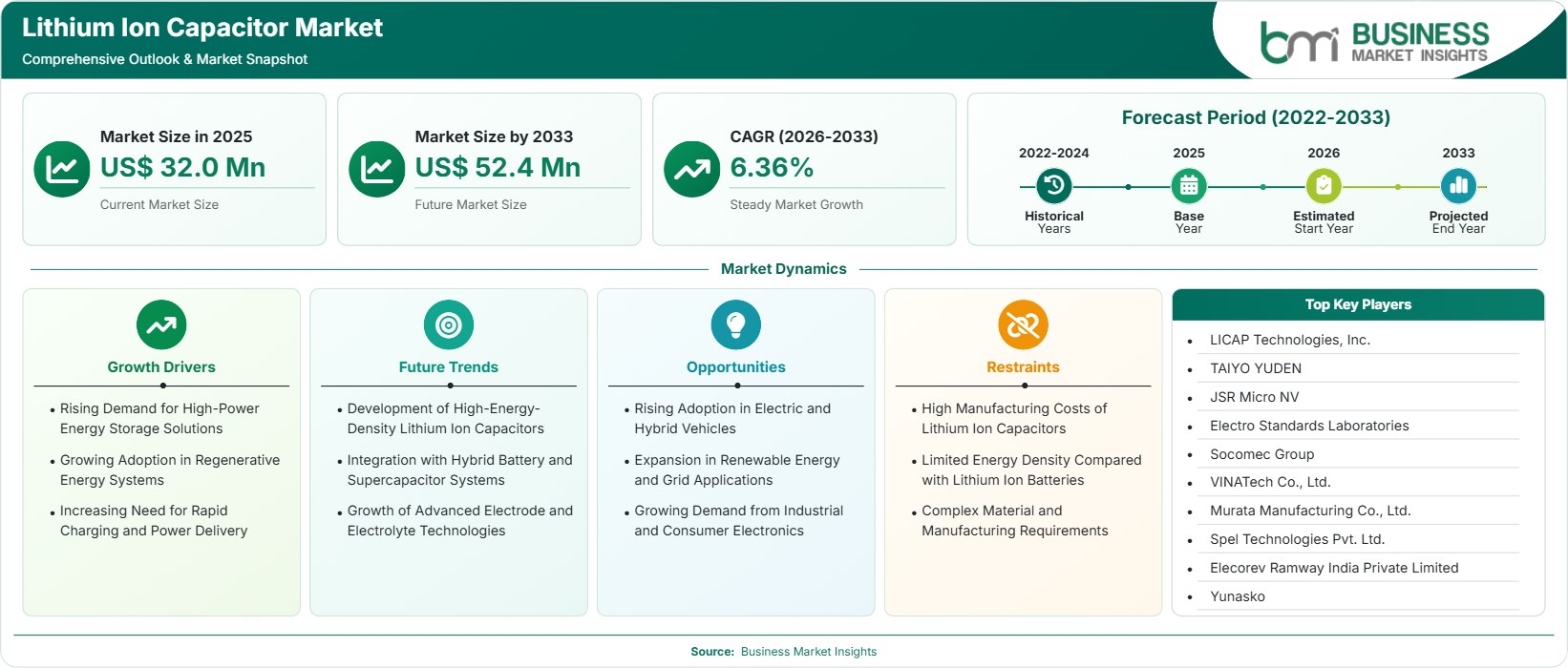
The Lithium Ion Capacitor Market size was valued at US$ 32.0 Million in 2025 and is projected to reach US$ 52.4 Million by 2033, growing at a CAGR of 6.36% during 2026–2033. Growing demand for fast-charging energy storage systems, increasing renewable energy integration, expanding industrial automation, rising investment in grid stabilization technologies, and advancements in hybrid capacitor architectures are supporting market expansion.

Report Coverage
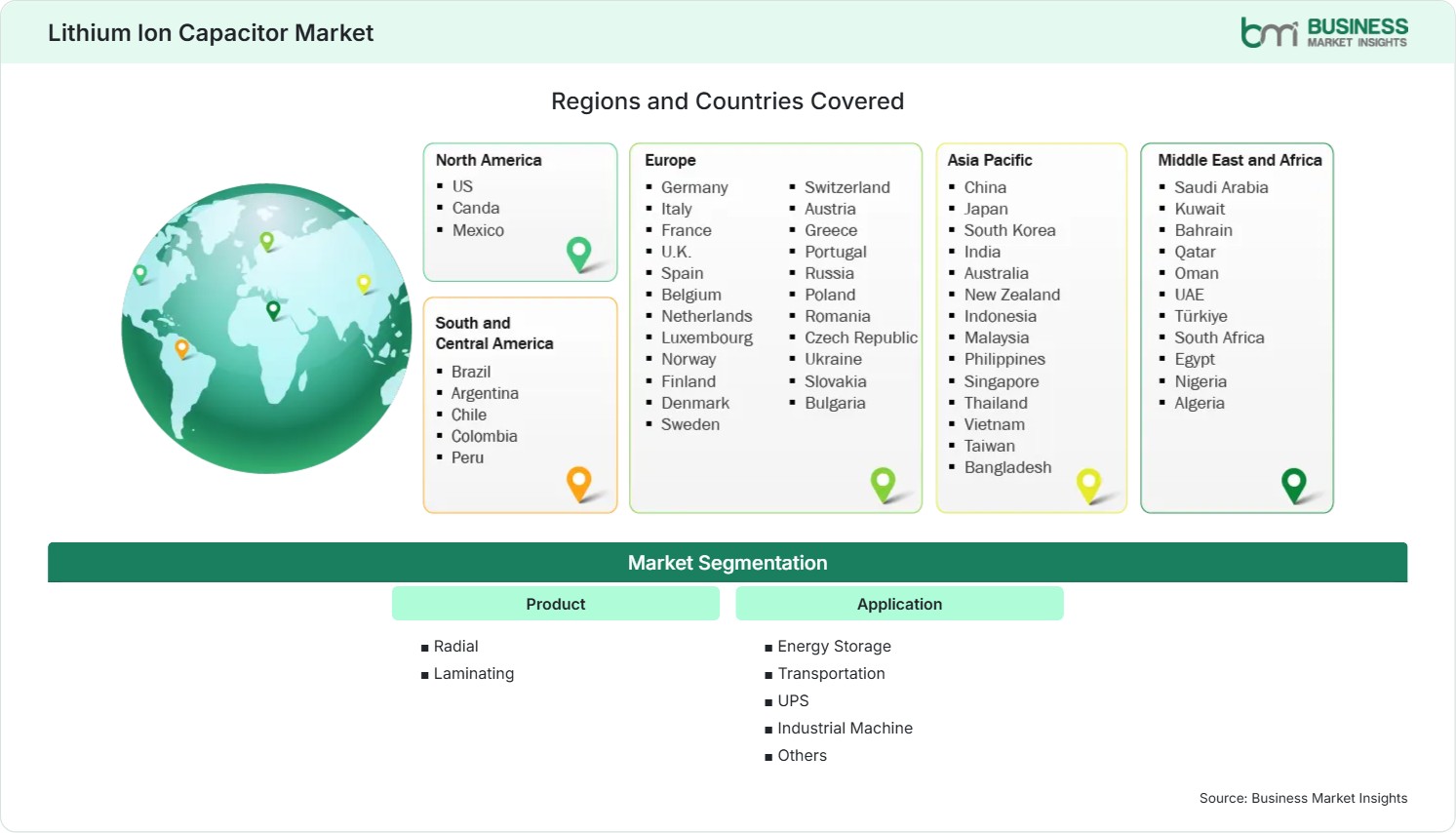
  • Product: Radial, Laminating
  • Application: Energy Storage, Transportation, UPS, Industrial Machine, Others
US$ 32.0 Mn Market size in 2025
US$ 52.4 Mn Market Size by 2033
6.36% CAGR, 2026 - 2033
2026-2033 Forecast Period

01 AI Overview

Lithium Ion Capacitor Market Summary

  • North America Region: North America holds a market share of 32%–36% in 2025 and is projected to grow at a CAGR of 5.5%–6.0% during 2026–2033. Growth is supported by grid modernization, renewable energy integration, industrial automation expansion, advanced energy storage deployment, data center investments, transportation electrification, smart infrastructure development, power quality requirements, energy resilience initiatives, and technological innovation activities. The U.S. remains the dominant market due to advanced energy storage adoption and industrial energy efficiency investments, advancing at a CAGR of 5.7%–6.2%.
  • Fastest Growing Region: Asia Pacific accounts for 36%–40% share in 2025 and is expected to register a CAGR of 7.2%–7.8% through 2033. Growth is fueled by electronics manufacturing expansion, renewable energy investments, industrial development, electric mobility adoption, advanced storage system deployment, capacitor technology innovation, infrastructure modernization, production capacity expansion, energy efficiency initiatives, and growing demand for reliable power solutions.
  • Leading Segment: Radial represents 58%–62% share in 2025 and is anticipated to grow at a CAGR of 5.9%–6.4% through 2033. Demand is supported by compact design advantages, established industrial applications, energy storage deployment, transportation sector utilization, reliability benefits, ease of integration, strong operational performance, and broad compatibility with existing electronic systems.
  • High Growth Segment: Energy Storage captures 30%–34% share in 2025 and is forecast to expand at a CAGR of 7.4%–8.0% during 2026–2033. Expansion is driven by renewable energy integration, fast charge-discharge capabilities, grid support applications, power stabilization requirements, energy efficiency initiatives, distributed energy systems, industrial storage deployment, operational reliability needs, and growing sustainability objectives.
  • Key Market Opportunity: Increasing deployment of hybrid energy storage solutions that combine batteries, capacitors, and advanced power management systems is creating opportunities for enhanced energy efficiency, grid resilience, and industrial power optimization.
  • Major Market Players: LICAP Technologies, Inc., TAIYO YUDEN CO., LTD., JSR Micro NV, Electro Standards Laboratories, Socomec Group, VINATech Co., Ltd., Murata Manufacturing Co., Ltd., Spel Technologies Pvt. Ltd., Elecorev Ramway India Private Limited, and Yunasko.
02 Strategic Insights

Lithium Ion Capacitor Market: Strategic Insights

Lithium Ion Capacitor Market Strategic Framework
FREE PDF
Request your free sample
Request free sample
03 Stakeholder View

Key Takeaways

  • The lithium ion capacitor market ecosystem is increasingly centered on advanced energy storage solutions that bridge the performance gap between conventional batteries and supercapacitors, creating opportunities across industrial, transportation, and grid-support applications.
  • Energy Storage remains the most attractive application area due to growing renewable energy integration, distributed power systems, and demand for rapid charge-discharge technologies capable of supporting grid stability.
  • Manufacturers are focusing on electrode material innovation, enhanced cycle life, and higher energy density designs to improve product competitiveness and expand addressable applications.
  • Asia Pacific continues to offer the strongest regional investment opportunity owing to robust electronics manufacturing activity, renewable energy deployment, and increasing electrification across industrial sectors.
  • Strategic partnerships between capacitor manufacturers, energy storage providers, and industrial equipment suppliers are becoming increasingly important for technology commercialization and market penetration.
  • Sustainability objectives and energy-efficiency regulations are encouraging adoption of advanced storage technologies that improve power management and operational reliability.
04 Geographic Outlook

Lithium Ion Capacitor Market Regional Highlights

North America Lithium Ion Capacitor Market

North America accounted for 32%–36% of global revenue in 2025 and is expected to grow at a CAGR of 5.5%–6.0% through 2033. Market expansion is supported by increased investments in grid modernization, renewable energy integration, and industrial automation. The Lithium Ion Capacitor Market share remains significant in the region due to strong adoption of reliable energy storage systems across commercial and industrial facilities. Growing deployment of backup power systems and smart infrastructure further supports demand.

  • Grid modernization programs continue to strengthen demand for high-performance energy storage technologies capable of supporting power quality and resilience objectives.
  • Industrial automation initiatives increase the need for rapid energy delivery systems that ensure operational continuity and equipment protection.
  • Growing renewable energy installations are encouraging the deployment of energy storage technologies for efficient power balancing and stabilization.
  • Data centers and critical infrastructure operators increasingly adopt advanced energy storage systems for backup and peak-load management.
  • Technology innovation and research investments continue supporting commercial adoption across multiple end-use sectors.

US Lithium Ion Capacitor Market

The United States represents 76%–80% of North American demand and is anticipated to grow at a CAGR of 5.7%–6.2% through 2033. Strong industrial demand, investments in renewable energy infrastructure, and increasing deployment of energy storage systems support lithium ion capacitor market growth. The country also benefits from technology development initiatives and expanding use of advanced power management solutions.

  • Growing renewable energy projects are increasing demand for efficient power storage and stabilization technologies.
  • Industrial facilities continue investing in advanced energy management systems to improve operational efficiency.
  • Data center expansion supports adoption of backup energy storage technologies with fast-response capabilities.
  • Research and development activities remain strong across advanced capacitor and energy storage technologies.

Europe Lithium Ion Capacitor Market

Europe held 22%–26% of global revenue in 2025 and is projected to register a CAGR of 5.8%–6.3% through 2033. The lithium ion capacitor market growth is supported by sustainability initiatives, industrial electrification, and renewable energy deployment. Germany remains the leading market due to its advanced industrial base, while Spain is among the fastest-growing countries with a CAGR of 6.5%–7.0%. Energy transition objectives continue creating demand for innovative storage technologies.

  • Renewable energy expansion drives demand for energy storage systems that improve grid reliability and efficiency.
  • Germany maintains leadership through strong industrial automation and energy technology investments.
  • Spain benefits from increasing renewable power installations and storage infrastructure development.
  • Electrification initiatives across transportation and industry support technology adoption.
  • Energy-efficiency regulations continue encouraging deployment of advanced storage solutions.

Asia Pacific Lithium Ion Capacitor Market

Asia Pacific accounted for 36%–40% of global revenue in 2025 and is expected to record the fastest CAGR of 7.2%–7.8% through 2033. The region benefits from rapid industrialization, strong electronics manufacturing, and increasing investments in energy infrastructure. China and Japan represent major demand centers, while India emerges as a high-growth market with a CAGR of 7.6%–8.2%. Government support for electrification and clean energy initiatives further strengthens opportunities.

  • Large-scale electronics manufacturing supports widespread adoption of advanced capacitor technologies.
  • China remains a major consumer due to extensive industrial and energy infrastructure investments.
  • India is witnessing increasing demand through renewable energy expansion and industrial modernization.
  • Transportation electrification trends create additional opportunities for high-performance energy storage solutions.
  • Regional manufacturers continue expanding production capacity to meet growing lithium ion capacitor market requirements.

Rest of World Lithium Ion Capacitor Market

Rest of World accounted for 10%–14% of market revenue in 2025 and is forecast to grow at a CAGR of 5.9%–6.5% through 2033. Demand is supported by infrastructure modernization, industrial development, and increasing energy reliability requirements. The Middle East is investing in advanced energy systems, while Brazil continues to lead adoption within South & Central America due to expanding industrial applications.

  • Energy infrastructure investments support deployment of advanced storage solutions across emerging economies.
  • Industrial expansion increases demand for reliable power management and backup energy technologies.
  • Brazil benefits from growing industrial automation and renewable energy investments.
  • Middle Eastern countries continue modernizing energy systems and grid infrastructure.
  • Cost-effective high-performance storage technologies are gaining attention among industrial users.
Global Market Geography
FREE PDF
Request your free sample
Request free sample
05 Segment Analysis

Lithium Ion Capacitor Market Segmentation

Product

The Product segment is led by Radial lithium ion capacitors, accounting for 58%–62% share in 2025 and projected to grow at a CAGR of 5.9%–6.4% through 2033. Demand is supported by compact integration, reliable performance, and extensive use across industrial power systems. The Lithium Ion Capacitor Market scope continues expanding as manufacturers develop advanced form factors to address evolving energy storage and power management requirements.

  • Radial: Widely adopted across industrial equipment, backup power systems, and energy storage installations due to robust performance, simple integration, compact structure, and established commercial availability.
  • Laminating: Gaining traction in space-constrained applications requiring lightweight designs, enhanced energy efficiency, improved thermal characteristics, and higher flexibility for modern electronic systems.

Application

Energy Storage represents the largest application segment with 30%–34% share in 2025 and is expected to achieve a CAGR of 7.4%–8.0% through 2033. Increasing integration of renewable energy assets, smart grid deployment, and demand for rapid-response energy systems continue supporting adoption. Current Lithium Ion Capacitor Market trends indicate growing preference for hybrid storage solutions across industrial and utility environments.

  • Energy Storage: Benefits from rising deployment in renewable energy integration, grid support applications, peak-demand management, and power quality enhancement systems.
  • Transportation: Adoption is increasing across rail systems, hybrid vehicles, and mobility applications requiring fast charging, regenerative energy capture, and reliable power delivery.
  • UPS: Utilized in critical backup power infrastructure where rapid response, high cycle life, and dependable short-duration energy discharge are essential.
  • Industrial Machine: Supports automation equipment, robotics, manufacturing systems, and industrial controls requiring stable power, efficiency optimization, and operational continuity.
  • Others: Includes telecommunications, smart infrastructure, energy monitoring equipment, and specialized electronic systems requiring rapid energy storage and discharge functionality.
06 Market Forces

Lithium Ion Capacitor Market Dynamics

Key Market Drivers

Rising Demand for High-Power Energy Storage Solutions

Many industries need energy storage systems that can deliver high power in a short time while maintaining a very long service life. The lithium ion capacitor combines features of both lithium-ion batteries and supercapacitors, which makes it perfect for use in industries, back-up power sources, transport devices, and other areas. With the increasing tendency towards automation, electrification, and smart energy management systems, there is an increasing need for the technology that can react immediately on any power fluctuation.

Growing Adoption in Regenerative Energy Systems

Regenerative energy systems are becoming increasingly common across transportation and industrial sectors. Lithium ion capacitors are highly effective at capturing and releasing energy during repeated charge-discharge cycles, making them valuable components within regenerative braking systems and energy recovery applications. Rail transportation networks, industrial automation systems, and material handling equipment increasingly utilize these technologies to improve energy efficiency and reduce power losses. Their ability to withstand frequent cycling without significant performance degradation provides a competitive advantage over conventional storage technologies. Rising emphasis on sustainability and energy optimization continues to strengthen demand for lithium ion capacitors in regenerative energy environments.

Increasing Need for Rapid Charging and Power Delivery

Modern electronic and industrial systems increasingly require energy storage technologies capable of providing immediate power delivery while supporting rapid recharge cycles. Lithium ion capacitors offer faster charging performance than many conventional battery technologies, making them attractive for applications involving intermittent power demands. Industrial operators value reduced downtime and enhanced operational productivity, while infrastructure operators seek solutions capable of maintaining stable performance during power disturbances. Growing deployment of advanced electronics, automation platforms, transportation systems, and intelligent energy networks continues to increase demand for storage technologies that combine rapid charging, long service life, and consistent power output characteristics.

Key Market Opportunities

Rising Adoption in Electric and Hybrid Vehicles

The transition toward electric and hybrid mobility presents significant opportunities for lithium ion capacitor manufacturers. These devices support regenerative braking systems, power buffering applications, and rapid energy transfer functions that enhance overall vehicle efficiency. Automakers and transportation technology developers increasingly evaluate advanced storage solutions capable of delivering high power density and extended operational life. As vehicle electrification accelerates globally, complementary storage technologies are expected to gain broader adoption alongside conventional battery systems. Lithium Ion Capacitor Market Forecasts continue to indicate attractive growth potential in transportation applications where fast charge-discharge performance and reliability are critical operational requirements.

Expansion in Renewable Energy and Grid Applications

Renewable energy systems require advanced storage technologies capable of managing fluctuations in power generation while maintaining grid stability. Lithium ion capacitors offer advantages in frequency regulation, voltage stabilization, and short-duration energy storage applications. Utility operators are increasingly deploying hybrid storage architectures combining batteries and capacitors to improve energy management efficiency. Growth in solar and wind installations creates additional opportunities for technologies capable of handling rapid charging and discharging cycles. As investments in grid modernization accelerate globally, lithium ion capacitors are expected to benefit from expanding deployment across utility-scale and distributed energy systems.

Growing Demand from Industrial and Consumer Electronics

Industrial and consumer electronics manufacturers increasingly seek energy storage solutions that offer reliability, compact size, and rapid energy response. Lithium ion capacitors are gaining attention in applications requiring continuous operation, power backup, and energy optimization. Growth in automation equipment, smart devices, communication systems, and electronic control units is supporting broader adoption. Manufacturers are also improving product efficiency and packaging designs to address evolving performance requirements. Rising electronics production, particularly across Asia Pacific markets, creates a favorable environment for lithium ion capacitor deployment in diverse commercial and industrial applications.

Market Restraints and Challenges

High Manufacturing Costs of Lithium Ion Capacitors

Factor: Production of lithium ion capacitors requires specialized electrode materials, advanced manufacturing processes, and stringent quality control procedures, resulting in relatively high production costs. Impact: Elevated costs can reduce competitiveness compared with alternative energy storage technologies and limit adoption in price-sensitive markets. Manufacturers may face challenges scaling production while maintaining profitability and performance standards. Higher procurement expenses can also influence customer purchasing decisions, particularly in applications where cost remains a primary consideration. These factors may slow lithium ion capacitor market penetration despite the technology's operational benefits and performance advantages.

Limited Energy Density Compared with Lithium Ion Batteries

Factor: Lithium ion capacitors generally offer lower energy density than conventional lithium-ion batteries, restricting their suitability for applications requiring extended energy storage duration. Impact: This limitation may reduce adoption in sectors where long-term energy retention is more important than rapid power delivery. End users often evaluate storage technologies based on application-specific performance requirements, creating competitive pressure from established battery solutions. While lithium ion capacitors excel in high-power and fast-cycling environments, energy density constraints remain an important consideration influencing purchasing decisions and application selection.

07 Company Analysis

Competitive Landscape

The Lithium Ion Capacitor Market analysis reflects a moderately consolidated competitive environment where participants focus on capacitor performance optimization, energy density improvements, cycle-life enhancement, and customized solutions for industrial, transportation, and energy storage applications. Companies are investing in advanced materials research, manufacturing expansion, and partnerships with energy storage system integrators to strengthen their market position.

Company Name

Overview

Products and Services Relevant to this Market

LICAP Technologies, Inc.

Technology-focused company specializing in advanced energy storage materials and capacitor innovations for commercial and industrial applications.

Lithium ion capacitor technologies, energy storage components, electrode materials, and customized power storage solutions.

TAIYO YUDEN CO., LTD.

Global electronic component manufacturer with extensive expertise in capacitor technologies and advanced energy storage devices.

Lithium ion capacitors, electronic components, power management solutions, and industrial energy storage products.

JSR Micro NV

Materials technology company supporting advanced electronics and energy storage manufacturing applications.

Functional materials, capacitor-related technologies, research support, and specialized energy storage solutions.

Electro Standards Laboratories

Engineering-focused company providing power management and electronic system solutions across industrial sectors.

Energy control systems, power management equipment, capacitor integration solutions, and industrial electronics support.

Socomec Group

Global specialist in power performance and energy management technologies serving commercial and industrial customers.

Energy storage systems, power quality solutions, UPS technologies, and grid-support applications.

VINATech Co., Ltd.

Manufacturer recognized for supercapacitor and advanced energy storage technologies with global industrial applications.

Lithium ion capacitors, hybrid capacitors, supercapacitors, and customized energy storage solutions.

Murata Manufacturing Co., Ltd.

Leading electronics component manufacturer with strong capabilities in capacitor and energy solution development.

Advanced capacitors, energy storage devices, electronic components, and power management technologies.

Spel Technologies Pvt. Ltd.

Indian technology company serving energy storage and industrial electronics markets through specialized solutions.

Capacitor products, energy storage systems, industrial power solutions, and application-specific technologies.

Elecorev Ramway India Private Limited

Energy technology provider focused on innovative storage and power management applications.

Lithium ion capacitor solutions, energy efficiency products, power backup systems, and industrial storage applications.

Yunasko

Technology-focused company specializing in lithium ion capacitor development and next-generation energy storage systems.

Lithium ion capacitors, hybrid storage solutions, high-cycle-life products, and power delivery technologies.


10 Trust & Transparency

Research Methodology

The market analysis combines proprietary research with secondary data from government agencies, company disclosures, regulatory filings, industry databases and expert interviews. Market estimates are validated through data triangulation, cross-market benchmarking and analyst review.

View Full Research Methodology

11 Questions Answered

Frequently Asked Questions

What does this Lithium Ion Capacitor Market Report evaluate?

This report evaluates market dynamics, technology developments, competitive positioning, application trends, regional demand patterns, investment opportunities, and key challenges influencing industry growth through 2033.

What role do lithium ion capacitors play in renewable energy systems?

They help stabilize power fluctuations, improve energy utilization efficiency, support frequency regulation, and complement battery storage systems in renewable energy installations and smart grid applications.

Why is Asia Pacific the fastest-growing regional market?

Asia Pacific benefits from strong electronics manufacturing activity, expanding renewable energy investments, industrial modernization programs, and growing deployment of advanced energy storage solutions across multiple industry sectors.

Which application segment leads the market demand?

Energy Storage is the leading application segment, supported by increasing deployment across renewable energy systems, grid-support infrastructure, industrial facilities, and power stabilization applications requiring rapid energy response capabilities.

What are the major advantages of lithium ion capacitors compared with conventional batteries?

Lithium ion capacitors provide rapid charging, high power density, extended cycle life, and superior performance in frequent charge-discharge applications. These characteristics make them particularly valuable in energy management, backup power, and regenerative energy systems.

Access the Full Lithium Ion Capacitor Market Report

Get segment-level forecasts, regional estimates, competitive benchmarking, company profiles and downloadable Excel datasets.

Access the full Lithium Ion Capacitor Market Report
350 pages PDF & Excel | 2026-08-24