Market Summary
Executive Summary and Global Market Analysis
Ion milling systems are precision sample preparation instruments that remove material using controlled ion bombardment to create damage-minimized surfaces and cross sections for microscopy and microanalysis. They support high-fidelity specimen preparation where mechanical polishing may introduce deformation, smearing, or contamination. Their use is closely tied to laboratories that require reliable structural interpretation across delicate, multi-phase, and high-value samples.
Rising utilization across semiconductor analysis, advanced materials research, and forensic examination is supporting broader procurement of ion milling platforms. Laboratories are placing greater emphasis on artifact control, surface uniformity, and repeatable preparation steps as imaging resolutions improve. That requirement is encouraging investment in systems that can process difficult materials while preserving structural integrity before SEM, FIB, or TEM evaluation.
Market structure reflects clear differentiation across product type, microscopy alignment, sample material, and end-use setting. Cross section milling remains essential where subsurface interfaces and layered defects must be exposed cleanly, while flat surface milling supports uniform finishing for detailed inspection. Demand also varies by specimen class, with ceramics, polymers, metals, and composites each requiring distinct preparation conditions and beam control strategies.
Technology progression in this sector is centered on higher milling precision, thermal management, automation interfaces, and compatibility with broader microscopy workflows. Vendors are refining beam stability, cooling capability, and process monitoring to improve throughput without sacrificing surface quality. These improvements are making ion milling systems more relevant for routine analytical workflows, not only for specialized preparation tasks within expert facilities.
Competitive conditions are shaped by instrument reliability, application versatility, ease of operation, and the ability to handle sensitive or heterogeneous samples. Buyers often assess systems through workflow fit rather than standalone specifications, especially where preparation quality directly affects downstream interpretation. As analytical standards become more stringent, the industry is moving toward platforms that combine consistency, operator efficiency, and adaptable specimen handling.
Segment Analysis
Ion Milling System Market Segmentation
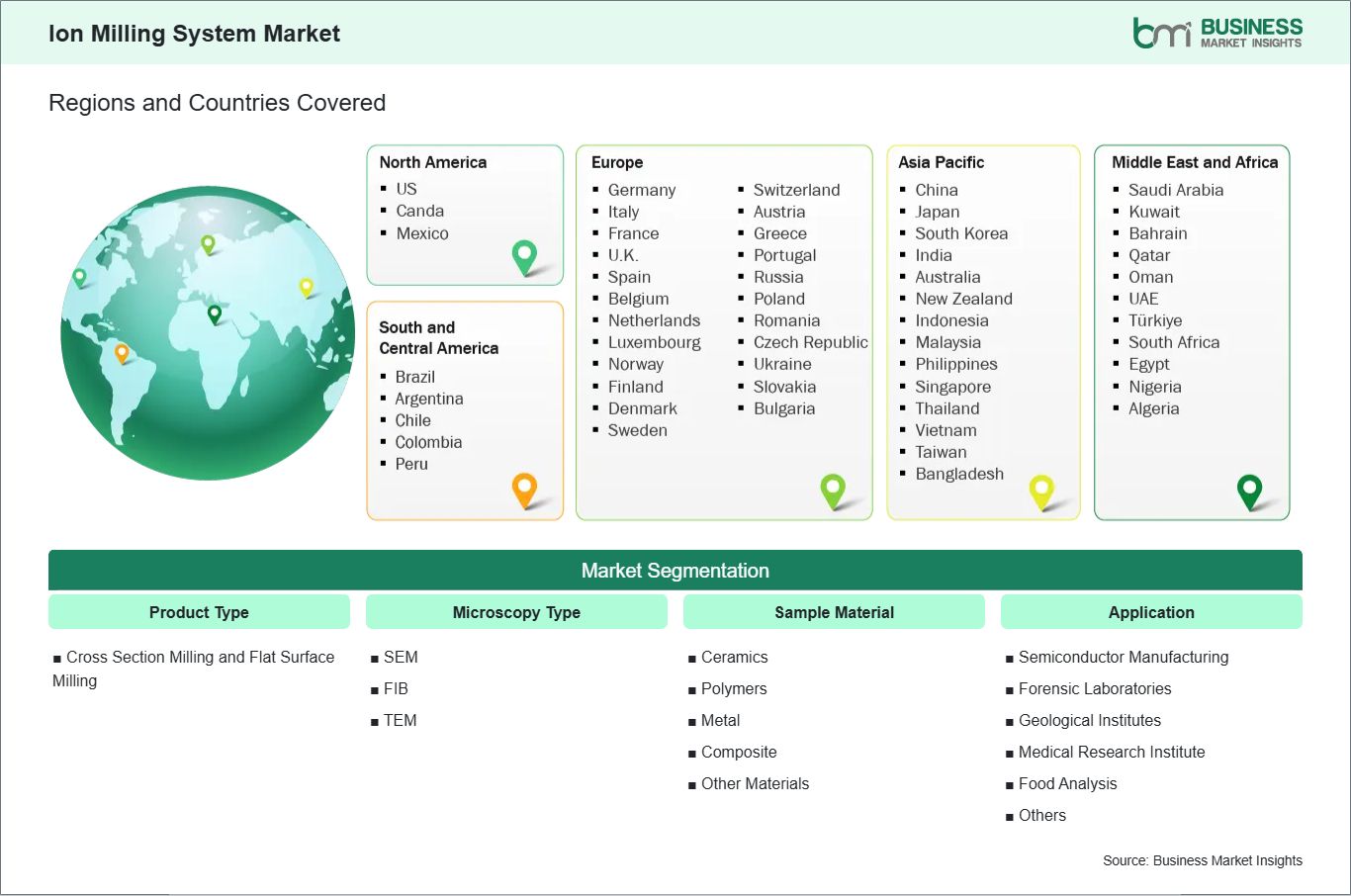
The market is segmented by product type, microscopy type, sample material, and application, reflecting distinct preparation requirements across analytical environments.
By Product Type
- Cross Section Milling: Preferred for exposing buried interfaces and multilayer structures with low distortion.
- Flat Surface Milling: Used for uniform finishing before high-resolution surface observation and analysis.
By Microscopy Type
- SEM: Accounts for broad routine use in surface and cross-sectional imaging workflows.
- FIB: Supports targeted preparation where site specificity and layered analysis are required.
- TEM: Demands highly controlled thinning for defect-sensitive structural characterization.
By Sample Material
- Ceramics: Requires controlled milling to preserve brittle microstructural features.
- Polymers: Benefits from temperature-managed preparation to limit heat-related deformation.
- Metal: Relies on smooth finishing for grain, coating, and defect interpretation.
- Composite: Needs balanced removal across dissimilar phases and embedded interfaces.
- Other Materials: Includes specialized specimens requiring tailored beam conditions and holders.
By Application
- Semiconductor Manufacturing: Uses ion milling for failure analysis and interface verification.
- Forensic Laboratories: Applies precise sectioning for trace evidence and material examination.
- Geological Institutes: Employs milling for mineral boundary assessment and compositional studies.
- Medical Research Institute: Supports specimen preparation for structural and biomaterial analysis.
- Food Analysis: Assists microstructural examination of processed and packaged materials.
- Other Application: Covers academic and industrial laboratories with specialized preparation demands.
Market Forces
Ion Milling System Market Drivers and Opportunities
Higher Precision Requirements in Microscopy Sample Preparation
Analytical workflows increasingly depend on specimen surfaces that remain free from mechanical damage, pullout, and preparation-induced distortion. As microscopy systems reveal finer structural details, laboratories need preparation methods that preserve interfaces and phase boundaries with greater consistency. This requirement is encouraging wider deployment of ion milling systems across facilities handling sensitive materials, layered structures, and failure analysis tasks where surface quality directly shapes interpretation.
The effect of this shift is evident in research, industrial quality control, and laboratory modernization programs that prioritize reproducibility. Better-prepared surfaces improve analytical confidence, reduce rework, and support more dependable imaging across complex specimen types. That makes ion milling relevant in environments where conventional polishing methods cannot provide the level of finish required for advanced materials evaluation and defect-focused investigations.
Automation and Multi-Workflow Integration in Laboratory Preparation
An important opportunity is emerging around instruments that combine automated preparation control with compatibility across SEM, FIB, and TEM workflows. Laboratories increasingly value systems that simplify setup, support remote monitoring, and handle a wider range of materials without extensive manual tuning. This trend creates room for innovation in interface design, cooling functions, and process standardization for laboratories managing multiple analytical requirements.
Future scope is linked to broader deployment in applied research centers, production-support labs, and institutions expanding high-resolution imaging capacity. Systems that shorten preparation time while maintaining surface quality can extend use beyond expert operators into routine workflows. That expansion may widen the market across semiconductor, materials, forensic, and life science settings where throughput and preparation consistency are becoming equally important.
Size and Share Analysis
Ion Milling System Market Size and Share Analysis
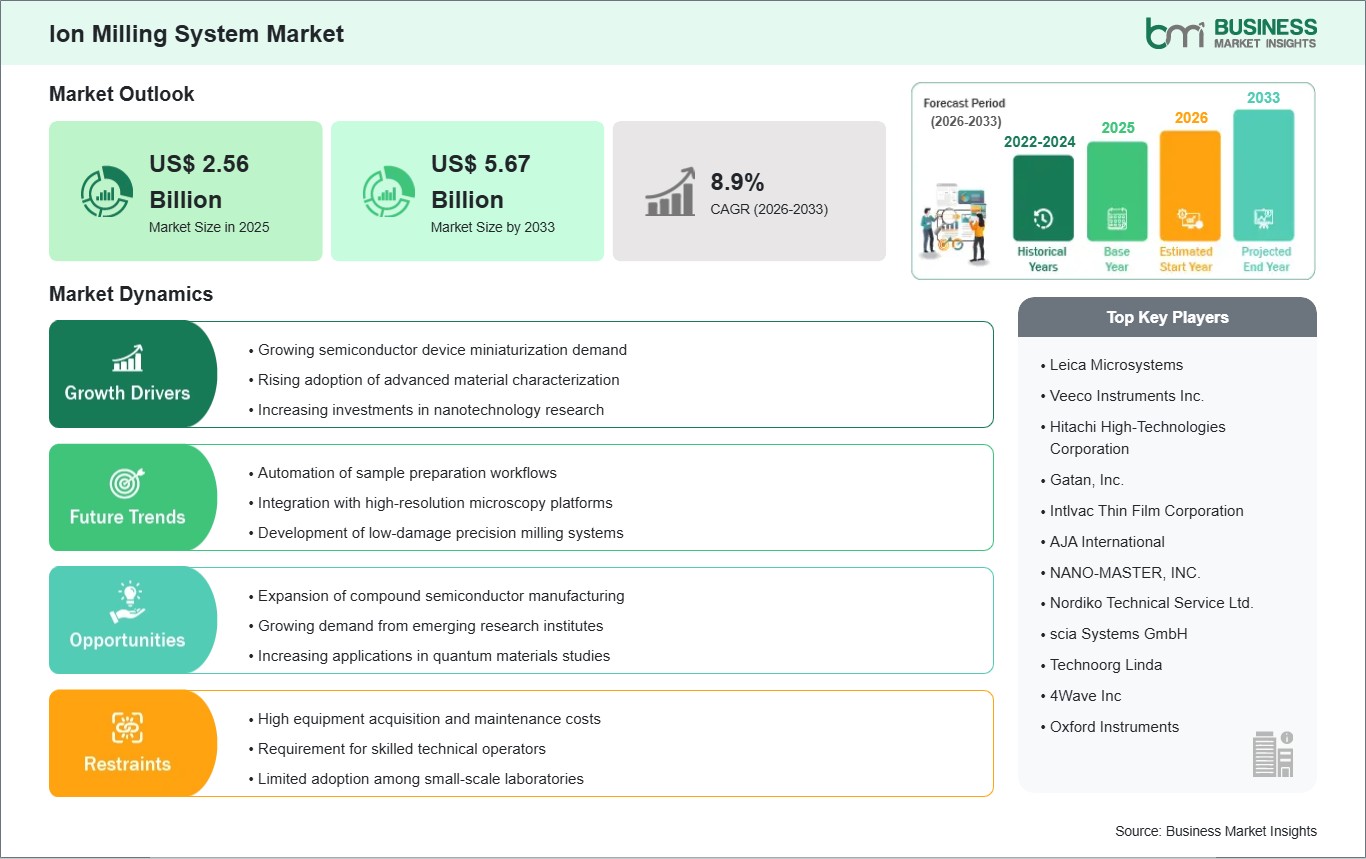
The Ion Milling System market size is projected to grow from US$ 2.56 Billion in 2025 to US$ 5.67 Billion by 2033, registering a CAGR of 8.9% during 2026 - 2033. This trajectory indicates a market shaped by the need for higher specimen quality, broader laboratory automation, and stronger alignment between preparation tools and advanced microscopy workflows.
Among product categories, cross section milling holds a prominent position because it addresses layered structures, coated materials, and buried defects that require clean interface exposure. By microscopy type, SEM-oriented preparation maintains a broad footprint, while TEM and FIB workflows sustain specialized demand where preparation precision and localized structural interpretation are more critical.
By application, semiconductor manufacturing represents a leading area of use due to the need for interface inspection, failure analysis, and process verification at fine scales. Material-focused research settings also contribute strongly, particularly where ceramics, polymers, metals, and composites require artifact-controlled preparation before imaging, compositional analysis, or defect investigation.
Report Coverage
Ion Milling System Market Report Coverage and Deliverables
The "Ion Milling System Market Size and Forecast (2022–2033)" report provides a detailed analysis of the market covering below areas:
- Market size and forecast at global, regional, and country levels for all the key market segments covered under the scope
- Market trends, as well as market dynamics such as drivers, restraints, and key opportunities
- Market analysis covering key market trends, global and regional framework, major players, regulations, and recent market developments
- Industry landscape and competition analysis covering market concentration, heat map analysis, prominent players, and recent developments for the market
- Detailed company profiles, including SWOT analysis
Geographic Insights
Ion Milling System Market Geographic Insights
The Ion Milling System market shows diverse regional adoption patterns influenced by laboratory maturity, microscopy infrastructure, industrial specialization, and the complexity of specimen preparation requirements. Across the global landscape, procurement behavior is closely tied to investments in analytical precision and the shift toward preparation methods that reduce artifact formation. This broad trend supports demand in both research-intensive environments and industrial facilities requiring dependable cross-sectional or surface finishing workflows.
North America maintains a strong position through established microscopy networks, semiconductor analysis activity, and advanced materials research programs. Demand in the region is shaped by laboratories that require repeatable preparation for defect analysis, coating evaluation, and high-resolution imaging. Purchasing decisions often favor systems with workflow flexibility, cooling capability, and operating simplicity that can support both specialized and routine analytical use.
Asia Pacific continues to expand its presence as semiconductor manufacturing, electronics characterization, and academic materials research deepen across the region. Laboratories are steadily enhancing preparation standards to match increasingly sophisticated microscopy systems and tighter process control needs. This setting supports wider use of ion milling systems in industrial analysis as well as institutional research where throughput and specimen consistency are both important.
Europe remains important because of its strong base in precision instrumentation, materials science, and cross-disciplinary laboratory research. Emerging markets across the Middle East, Africa, and South and Central America are showing selective uptake, particularly where forensic capability, geological analysis, or industrial inspection is advancing. Adoption in these areas is typically more application-specific, creating opportunities for systems that balance preparation quality with operational accessibility.
Industry Activity
Recent Developments
The Ion Milling System market is evaluated by gathering qualitative and quantitative data post primary and secondary research, which includes important corporate publications, association data, and databases. A few of the key developments in the Ion Milling System marketare
- In January 2025, JEOL USA launched its new Cross Section Polisher™ (CP) and Cooling Cross Section Polisher (CCP) broad ion beam milling systems. The upgraded instruments feature a high-speed milling source with rates up to 1.2 mm/h, remote browser-based operation, enhanced workflow automation, air-isolated transfer capabilities, and wide-area milling for advanced specimen preparation in semiconductor, materials science, battery, polymer, and life science applications.
- In May 2026, Gatan launched the PECS III and Ilion III next-generation broad beam ion milling systems. The PECS III system provides high-quality, low-damage surface preparation for semiconductors, batteries, and advanced materials, while the Ilion III system delivers high-throughput cross-section milling with enhanced precision for industrial laboratory applications. The systems are designed to improve sample preparation consistency, throughput, and analytical accuracy across materials characterization workflows.
Trust & Transparency
Research Methodology
The market analysis combines proprietary research with secondary data from government agencies, company disclosures, regulatory filings, industry databases and expert interviews. Market estimates are validated through data triangulation, cross-market benchmarking and analyst
review.
View Full Research Methodology
Key Sources Referred:
World Bank – Global Trade IndicatorsWorld Trade Organization (WTO)(International Monetary Fund )IMFInternational Trade Administration (ITA)Company websiteCompany annual reportsCompany investor presentations