
Law Enforcement Software Market Outlook: Size, Share, Trends, Growth Analysis, Competitive Landscape & Forecast, 2026–2033

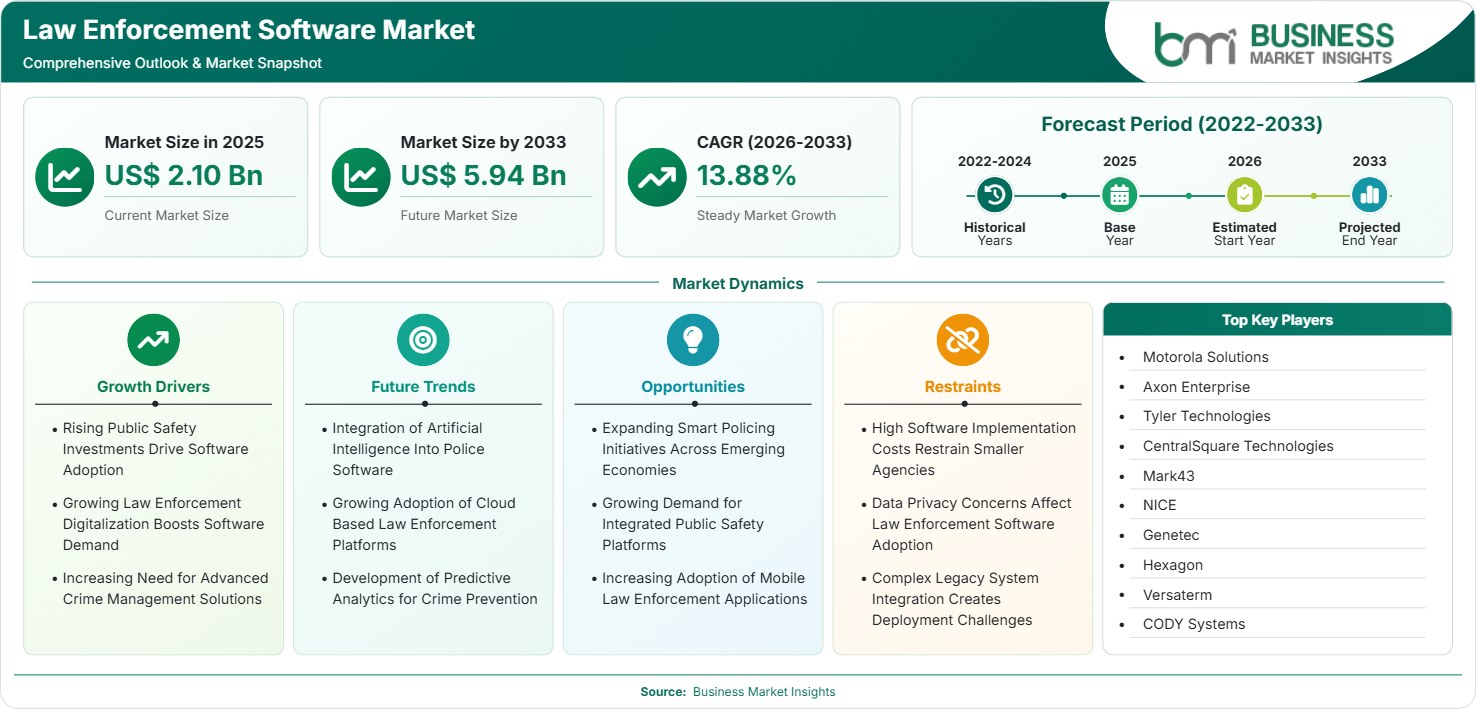
The Law Enforcement Software Market size was valued at US$ 2.10 billion in 2025 and is projected to reach US$ 5.94 billion by 2033, growing at a CAGR of 13.88% during 2026–2033, driven by digital policing, integrated public safety platforms, cloud modernization, mobile operations, and data-led investigations.

Report Coverage
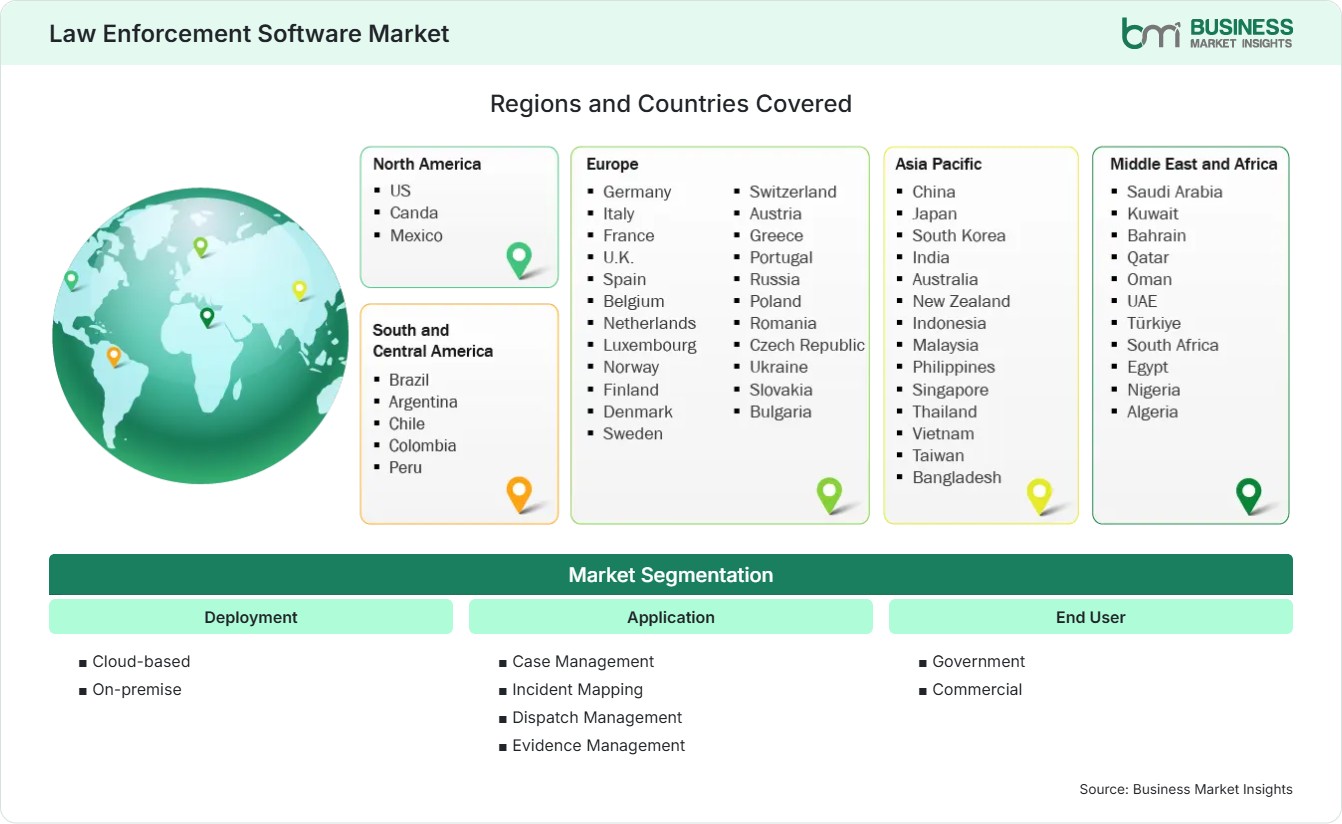
  • Deployment: Cloud-based, On-premise
  • Application: Case Management, Incident Mapping, Dispatch Management, Evidence Management
  • End User: Government, Commercial
US$ 2.10 Bn Market size in 2025
US$ 5.94 Bn Market Size by 2033
13.88% CAGR, 2026 - 2033
2026-2033 Forecast Period

AI Overview

Law Enforcement Software Market Summary

  • North America Region: North America holds a 28%–31% share in 2025 and is projected to expand at a 12.5%–13.3% CAGR through 2033, supported by public safety modernization, cloud migration, interoperable records, digital evidence, analytics, mobile policing, and established technology procurement ecosystems. The US represents the principal regional demand center, supported by mature public safety infrastructure, agency modernization, integrated records systems, cloud adoption, and continuing investment in technology-enabled policing.
  • Fastest Growing Region: Asia Pacific holds a 20%–24% Law Enforcement Software Market share in 2025 and is projected to expand at a 15.0%–16.2% CAGR through 2033, supported by smart-city programs, police digitization, expanding urban populations, mobile-first operations, integrated command centers, crime analytics, and modernization of government technology infrastructure.
  • Leading Segment: Cloud-based deployment holds a 60%–64% share in 2025 and is projected to expand at a 14.3%–15.1% CAGR through 2033, supported by scalable infrastructure, faster upgrades, centralized administration, interoperability, remote access, cybersecurity investment, and reduced dependence on agency-managed hardware.
  • High Growth Segment: Evidence Management holds a 34%–38% share in 2025 and is projected to expand at a 15.0%–16.0% CAGR through 2033, supported by increasing digital evidence volumes, body-worn cameras, mobile devices, chain-of-custody requirements, automated workflows, secure sharing, and integrated investigative platforms.
  • Key Market Opportunity: Integrated platforms connecting dispatch, records, evidence, mobile applications, analytics, mapping, and investigations can reduce operational fragmentation while creating opportunities for vendors to expand recurring software relationships across agencies.
  • Major Market Players: Motorola Solutions, Inc.; Axon Enterprise, Inc.; Tyler Technologies, Inc.; CentralSquare Technologies, LLC; Mark43, Inc.; NICE Ltd.; Genetec Inc.; Hexagon AB; Versaterm Inc.; CODY Systems, LLC.
Strategic Insights

Law Enforcement Software Market: Strategic Insights

Law Enforcement Software Market Strategic Framework
FREE PDF
Request your free sample
Request free sample
Stakeholder View

Key Takeaways

  • The value chain is moving from standalone records, dispatch, and evidence applications toward interoperable platforms that connect operational data across the complete incident lifecycle, increasing the strategic value of integration capabilities.
  • Cloud deployment offers the clearest structural opportunity because agencies can reduce infrastructure management, accelerate upgrades, simplify remote access, and connect geographically distributed personnel through centralized software environments.
  • Product innovation in this area is becoming more about AI-driven reporting, automation, mobility, analytics, evidence management, smart searching, and configurable user interfaces, all while avoiding administration overhead and retaining human oversight.
  • Asia Pacific provides the strongest expansion case as governments modernize policing infrastructure alongside broader smart-city programs, digital-government initiatives, urban safety projects, and connected emergency-response capabilities.
  • Investment is increasingly directed toward platform consolidation, cloud-native public safety technology, AI-enabled workflows, mobile applications, analytics, and interoperability, creating opportunities for both established vendors and specialized technology providers.
  • Vendors that combine cybersecurity, compliance, interoperability, configurable workflows, and strong implementation support can differentiate more effectively because public agencies evaluate software through operational resilience rather than functionality alone.
Geographic Outlook

Law Enforcement Software Market Regional Highlights

North America Law Enforcement Software Market

North America holds a 28%–31% share in 2025 and is projected to expand at a 12.5%–13.3% CAGR through 2033. The region benefits from mature public safety procurement, established software vendors, cloud infrastructure, digital evidence adoption, and integrated emergency-response ecosystems. US agencies account for most regional demand, while Canada provides additional opportunities through public safety modernization, digital records, emergency communications, and analytics. Federal and local technology programs continue supporting modernization of law enforcement capabilities.

  • Cloud migration is gaining traction as agencies seek scalable infrastructure, centralized administration, automated upgrades, stronger resilience, and easier integration across dispatch, records, mobile, and evidence workflows.
  • Integrated evidence platforms are becoming strategically important as body-worn cameras, smartphones, digital documents, and other electronic sources increase the volume and complexity of investigative information.
  • Public-sector procurement increasingly emphasizes interoperability, cybersecurity, audit trails, role-based access, and compliance alongside core functionality, favoring established providers with mature implementation capabilities.
  • Analytics and artificial intelligence are being integrated into operational workflows, but agencies increasingly require governance mechanisms covering accuracy, accountability, transparency, and appropriate use.

US Law Enforcement Software Market

The US represents approximately 80%–84% of North American demand in 2025 and is projected to expand at a 12.6%–13.4% CAGR through 2033. Federal, state, county, municipal, and tribal agencies create a broad customer base with differing procurement cycles and technology requirements. The Law Enforcement Software Market in US benefits from established CAD and RMS ecosystems, widespread digital evidence adoption, cloud infrastructure, mobile applications, and government technology funding.

  • Federal and local technology programs support investment in equipment, interoperable communications, and digital public safety infrastructure, strengthening the addressable software environment.
  • Agencies increasingly seek integrated records, dispatch, mobile, analytics, and evidence capabilities rather than maintaining multiple disconnected applications.
  • Privacy and civil-rights requirements are influencing procurement of analytics, biometrics, and AI-enabled applications, increasing demand for traceability, governance, training, and risk controls.

Europe Law Enforcement Software Market

Europe holds a 21%–24% share in 2025 and is projected to expand at a 12.7%–13.7% CAGR through 2033. Germany, the UK, France, Italy, and the Netherlands represent leading technology markets, while Poland and Spain provide additional modernization opportunities. European demand is shaped by data protection, cybersecurity, cross-border information exchange, digital evidence, emergency response, and increasingly sophisticated public-sector technology programs.

  • Germany combines strong industrial technology capabilities with demand for secure public-sector platforms, analytics, digital records, and coordinated emergency-response workflows.
  • The UK and France provide substantial opportunities through established digital-government programs, policing modernization, intelligence sharing, and technology-enabled investigations.
  • Data protection requirements encourage vendors to build privacy controls, granular permissions, retention policies, audit capabilities, and secure information-sharing mechanisms into core platforms.
  • Cross-border crime and investigative cooperation increase the importance of interoperable records, standardized data exchange, identity management, and secure collaboration between agencies.

Asia Pacific Law Enforcement Software Market

Asia Pacific holds a 20%–24% share in 2025 and is projected to expand at a 15.0%–16.2% CAGR through 2033, making it the fastest-growing regional market. China, Japan, South Korea, Australia, India, and Singapore provide major opportunity centers. Smart-city development, digital government, urban security requirements, mobile policing, centralized command centers, and growing technology investment are accelerating modernization across the region.

  • India provides strong potential as police modernization increasingly intersects with digital government, command-center development, mobile field operations, analytics, and integrated public safety infrastructure.
  • China supports demand through extensive smart-city investment, connected surveillance environments, emergency-response systems, and technology-oriented public administration.
  • Japan and South Korea offer technically mature environments where cybersecurity, interoperability, intelligent analytics, and sophisticated public safety workflows are increasingly important.
  • Southeast Asian governments provide emerging opportunities as urbanization and digital transformation encourage modernization of emergency communications, police records, and command infrastructure.

Rest of World Law Enforcement Software Market

Rest of World holds a 25%–29% share in 2025 and is projected to expand at an 11.5%–12.5% CAGR through 2033. Latin America, the Middle East, and Africa remain diverse markets with varying procurement capabilities, but digital government programs and public safety modernization are creating opportunities. Brazil, Mexico, the UAE, Saudi Arabia, Israel, and South Africa provide comparatively attractive adoption environments.

Latin American agencies are increasingly evaluating cloud-based systems, mobile applications, digital records, and analytics to address fragmented workflows and resource constraints. Middle Eastern governments are emphasizing connected command centers, smart-city infrastructure, integrated emergency response, and centralized information systems.

  • Mexico and Brazil offer opportunities through modernization of police information systems, emergency response infrastructure, digital records, and cross-agency data exchange.
  • Gulf markets favor advanced command-center platforms, analytics, mobile operations, and integrated systems aligned with smart-city and digital-government strategies.
  • Israel provides a specialized technology ecosystem combining cybersecurity, analytics, intelligence, and advanced public safety applications.
  • South Africa provides demand potential through digital policing, records modernization, mobile applications, and information-sharing initiatives.
Global Market Geography
FREE PDF
Request your free sample
Request free sample
Segment Analysis

Law Enforcement Software Market Segmentation

Deployment

Cloud-based deployment holds a 60%–64% share in 2025 and is projected to grow at a 14.3%–15.1% CAGR through 2033. The segment benefits from scalable infrastructure, centralized administration, rapid updates, remote access, and lower dependence on agency-managed hardware. The Law Enforcement Software Market scope increasingly includes cloud architectures capable of connecting distributed public safety teams securely.

  • Cloud-based: Agencies favor cloud platforms for scalable infrastructure, automated updates, remote access, centralized security controls, disaster recovery, and integration across dispatch, records, mobile, analytics, and evidence.
  • On-premise: Established agencies retain on-premise environments where legacy integrations, local control, procurement policies, data residency, or specialized security requirements influence deployment decisions.

Application

Evidence Management leads application demand with a 34%–38% share in 2025 and is projected to grow at a 15.0%–16.0% CAGR through 2033. Digital evidence expansion, body-worn cameras, mobile recordings, cloud storage, investigative collaboration, and chain-of-custody requirements support adoption. Other applications remain essential because agencies increasingly prefer integrated operational workflows.

  • Case Management: Digital case management centralizes investigative information, assignments, documents, workflows, and related evidence while improving collaboration among officers, detectives, supervisors, and prosecutors.
  • Incident Mapping: Mapping tools connect incidents with geographic information, helping agencies visualize activity, identify patterns, coordinate resources, and improve situational awareness during investigations and response.
  • Dispatch Management: Dispatch platforms coordinate calls, units, locations, priorities, and communications, creating a continuous information flow between communications centers and field personnel.
  • Evidence Management: Evidence systems organize digital files, metadata, access permissions, audit trails, and sharing workflows, supporting secure custody and efficient investigative review across connected teams.

End User

Government agencies represent the dominant end-user category, holding an estimated 86%–90% share in 2025 and projected to grow at a 13.4%–14.1% CAGR through 2033. Public-sector requirements for accountability, secure information exchange, emergency response, records management, and operational efficiency underpin adoption. Commercial demand remains narrower but includes specialized security and investigative applications.

  • Government: Police departments, sheriff offices, federal agencies, municipal authorities, and other public organizations require secure systems for records, dispatch, investigations, evidence, analytics, and coordinated response.
  • Commercial: Private security organizations, transportation operators, critical infrastructure companies, and specialized investigative providers use selected capabilities where public safety workflows overlap with operational security requirements.
Market Forces

Law Enforcement Software Market Dynamics

Key Market Drivers

Rising Public Safety Investments Drive Software Adoption

Public safety departments have placed their focus on technologies that would help enhance coordination, accessibility of information, continuity of operations, and administration efficiencies. In the contemporary age, procurement processes are increasingly seeing software not as an auxiliary tool but as a critical part of infrastructure. Budgets, digital government projects, upgrading of aged platforms, and the need for enhanced service delivery processes create an enabling environment for transformation. The Law Enforcement Software Market growth is thus linked to wider transformation of technology in the public sector as opposed to software procurement processes alone.

Growing Law Enforcement Digitalization Boosts Software Demand

This transformation is affecting the way information is collected, processed, exchanged, and stored by agencies regarding public safety information. There is an increase in the use of electronic report-making by officers, electronic exchange of information between dispatch centers, and investigations being done using evidence that is coming from cameras, mobile phones, databases, and other outside sources. Hence, the Law Enforcement Software Market trend is shifting towards connected solutions where information moves across operations without needing to be reentered manually each time. This will require more application programming interfaces, data models, identities, secure cloud, and workflows.

Increasing Need for Advanced Crime Management Solutions

Inquiries are increasingly becoming dependent on the information that can be collected from various digital sources, hence the need for software that can organize evidence, tie up related files, automate process workflows, and facilitate collaboration. For the investigators to analyze videos, documents, communications, images, places, and structured databases under one single environment, it is insufficient to simply use traditional files. Crime management applications target such areas as searching, correlation, automation, workflow customization, organization of evidence, and collaboration. AI can assist in performing some of these tasks, such as transcription, summarization, classification, and information searches, depending on governance.

Key Market Opportunities

Expanding Smart Policing Initiatives Across Emerging Economies

Smart policing initiatives present opportunities for vendors with modular solutions, which can be used to integrate dispatch, mobile, records, analysis, mapping, and command capabilities. Many emerging economies run hybrid technology systems where an upgrade cannot necessarily be achieved at once through the replacement of all systems. The Law Enforcement Software Market forecast, hence, becomes increasingly dependent on products that allow phased implementation, flexible integration, localization of interface, and scalable infrastructure. Cloud computing can minimize the extent of technological management within the organization, and mobile applications will enhance functionality for field officers.

Growing Demand for Integrated Public Safety Platforms

The integrated solution tackles one of the basic operating challenges in that information about public safety tends to be scattered between solutions bought at different times for other purposes. Integration of dispatch, records, evidence, mobile field operations, analytics, and investigation could help avoid redundancy and ensure continuity of information. This does not only apply to upgrading the old solution, because an agency can gradually introduce new modules, integration capabilities, analytics, and automation on top of the platform foundation already in place. Interfaces and standards for data exchange become increasingly relevant differentiators due to the mixed technology environment faced by agencies.

Increasing Adoption of Mobile Law Enforcement Applications

Mobile applications have become indispensable since the field workers require immediate access to the dispatch information, records, mapping information, reporting capabilities, alerts, and investigative information in the absence of their fixed stations. Mobile applications should ideally have features such as authentication, access control based on role, mobile device management, offline capability, location-based services, and fast synchronization with core systems. The use of mobile applications will help decrease delays in administration by enabling the officers to make their reports, get information, communicate with the dispatch, and get necessary information from the field itself.

Market Restraints and Challenges

High Software Implementation Costs Restrain Smaller Agencies

Factor: Several smaller organizations may be working with tight budget constraints for information technology, minimal internal IT staffing, aging infrastructure, and a lack of capacity for substantial migration projects. Implementation would involve system configuration, data conversion, integrations, security measures, user training, process optimization, and technical support. Impact: This factor might result in a longer procurement process and might make agencies reluctant to proceed with modernization or settle for less, even though more robust platforms would bring more benefits. The vendor can overcome this limitation through modular systems, cloud management services, packaged implementations, subscription pricing, and implementation tailored for small agencies.

Data Privacy Concerns Affect Law Enforcement Software Adoption

Factor: The software used by public agencies for safety is handling more and more personally sensitive information, investigative documentation, geographical information, electronic evidence, biometric information, and other information that is produced by means of surveillance technologies. This implies that privacy, civil rights, cybersecurity, and AI governance are material factors during procurement. Impact: The agencies might need to conduct further evaluations, control access to information, develop retention plans, have mechanisms in place for auditing, conduct risk assessment, and train users prior to deploying new technologies.

Company Analysis

Competitive Landscape

Law Enforcement Software Market analysis indicates that competition is shifting toward integrated platforms combining records, dispatch, evidence, mobile operations, analytics, mapping, and intelligent workflows. Vendors increasingly differentiate through cloud architecture, interoperability, cybersecurity, configurable deployment, implementation support, and specialized public safety expertise.

Company Name

Overview

Products and Services relevant to this market

Motorola Solutions, Inc.

Global public safety technology provider with a broad software ecosystem serving emergency communications and law enforcement agencies.

CommandCentral, CAD, records, evidence, analytics, video, dispatch, command-center software, and connected public safety workflows.

Axon Enterprise, Inc.

Public safety technology company combining digital evidence, records, mobile workflows, and connected officer technologies.

Axon Records, Axon Evidence, digital evidence management, case workflows, reporting, analytics, and mobile applications.

Tyler Technologies, Inc.

Public-sector software provider with integrated solutions spanning courts, public safety, records, dispatch, and mobile operations.

CAD, law enforcement records, mobile applications, analytics, reporting, evidence workflows, and integrated public safety platforms.

CentralSquare Technologies, LLC

Public safety software provider focused on connected government and mission-critical operational workflows.

CAD, RMS, NG911, analytics, mobile, records, crime mapping, intelligence, and integrated public safety suites.

Mark43, Inc.

Cloud-native public safety software provider focused on connected operations across dispatch, records, mobile, and analytics.

CAD, RMS, mobile operations, case management, analytics, evidence, data integration, and cloud-native public safety platforms.

NICE Ltd.

Technology provider serving public safety communications, contact centers, analytics, and operational intelligence requirements.

Emergency communications, interaction analytics, workforce tools, command-center capabilities, and public safety software.

Genetec Inc.

Security technology company providing integrated systems for public safety, video, access, and operational intelligence.

Video management, evidence-related workflows, analytics, access control, investigation support, and unified security platforms.

Hexagon AB

Global technology group providing geospatial, public safety, command, and operational intelligence solutions.

Computer-aided dispatch, records, mapping, analytics, command-center software, and geospatial public safety technologies.

Versaterm Inc.

Public safety software provider focused on law enforcement operations, records, dispatch, and connected workflows.

CAD, RMS, public portals, mobile operations, evidence, community engagement, and investigative workflows.

CODY Systems, LLC

Public safety technology specialist focused on information sharing and law enforcement intelligence workflows.

Law enforcement information systems, records integration, intelligence sharing, analytics, and investigative support applications.

Trust & Transparency

Research Methodology

The market analysis combines proprietary research with secondary data from government agencies, company disclosures, regulatory filings, industry databases and expert interviews. Market estimates are validated through data triangulation, cross-market benchmarking and analyst review.

View Full Research Methodology

Questions Answered

Frequently Asked Questions

What does the Law Enforcement Software Market report indicate about future competition?

Competition will increasingly center on integrated platforms, cloud-native architecture, interoperability, cybersecurity, artificial intelligence-assisted workflows, mobile capabilities, evidence management, and configurable public safety applications. Vendors that can demonstrate reliable implementation, strong governance, secure information sharing, and lifecycle support should strengthen their positions with government customers.

Why are mobile applications creating new opportunities for law enforcement agencies?

Mobile applications provide field personnel with access to dispatch information, records, maps, reporting tools, warrants, and evidence workflows without requiring officers to return to fixed workstations. This improves information continuity and can reduce administrative delays while supporting more connected field operations.

How are cloud technologies influencing law enforcement software adoption?

Cloud technologies provide scalable infrastructure, centralized updates, remote accessibility, disaster recovery, and simplified maintenance. They also support integration between geographically distributed agencies and field personnel. Cloud-native architectures can reduce dependence on locally managed infrastructure while enabling vendors to deliver continuous functionality improvements.

Which applications present the strongest opportunity in the market?

Evidence management, case management, dispatch management, mobile operations, analytics, and incident mapping present strong opportunities. Digital evidence growth and the need to connect investigative information with operational systems are encouraging agencies to adopt platforms that provide centralized access and controlled information sharing.

What factors are improving Law Enforcement Software Market return on investment?

Public safety modernization, cloud migration, integrated records, mobile workflows, digital evidence, analytics, and automated reporting can improve operational efficiency while reducing fragmented technology processes. Integrated platforms can also lower duplication and improve information availability across dispatchers, officers, investigators, and administrators.

Access the Full Law Enforcement Software Market Report

Get segment-level forecasts, regional estimates, competitive benchmarking, company profiles and downloadable Excel datasets.

Access the full Law Enforcement Software Market Report
350 pages PDF & Excel | 2026-08-20
Similar Research

Related Market Reports