
Laser Micromachining Tools Market Outlook: Size, Share, Trends, Growth Analysis, Competitive Landscape & Forecast, 2022-2033

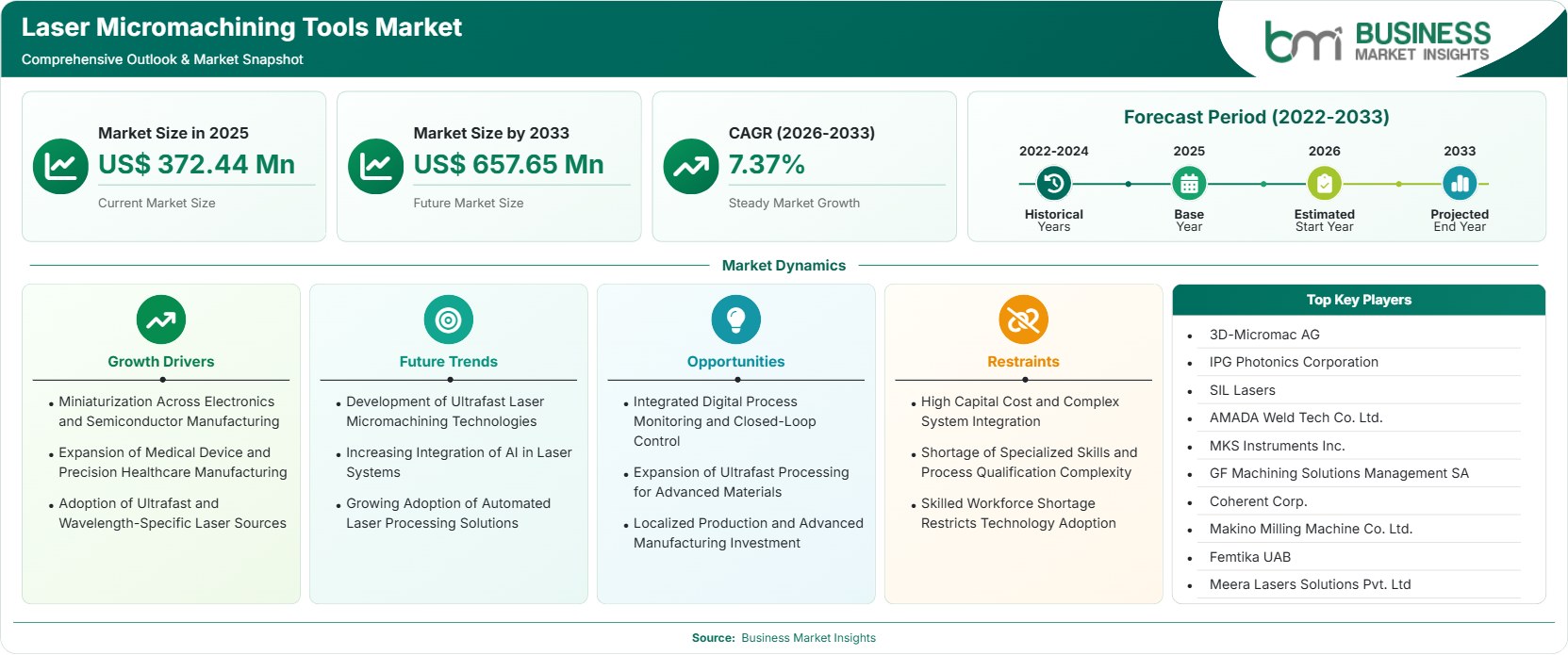
The Laser Micromachining Tools Market size was valued at US$ 372.44 Million in 2025 and is projected to reach US$ 657.65 Million by 2033, growing at a CAGR of 7.37% during 2026–2033, driven by miniaturization, ultrafast lasers, semiconductor fabrication, medical devices, and automated precision manufacturing.

Report Coverage
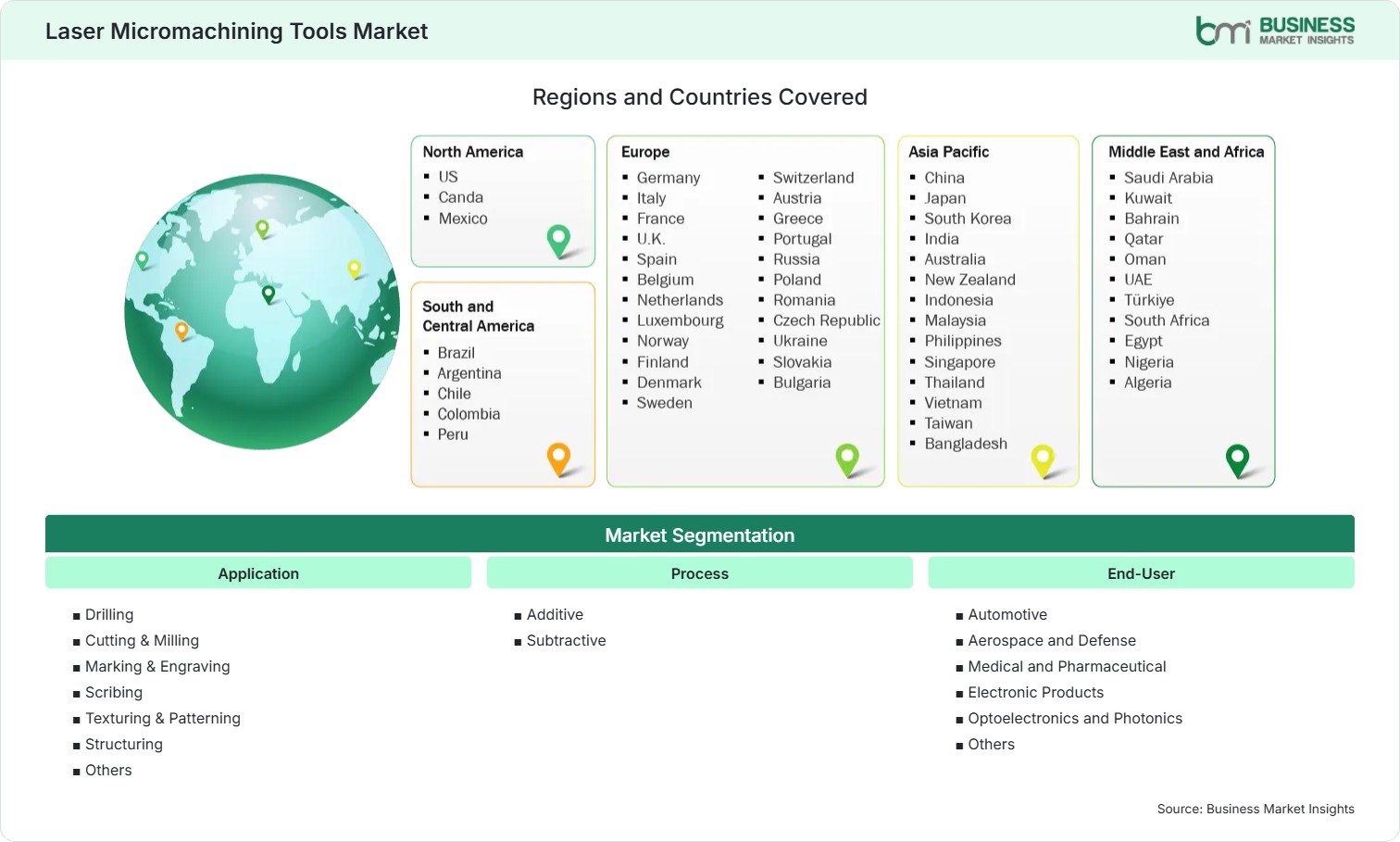
  • Application: Drilling, Cutting & Milling, Marking & Engraving, Scribing, Texturing & Patterning, Structuring, Others
  • Process: Additive, Subtractive
  • End-User: Automotive, Aerospace and Defense, Medical and Pharmaceutical, Electronic Products, Optoelectronics and Photonics, Others
US$ 372.44 Mn Market size in 2025
US$ 657.65 Mn Market Size by 2033
7.37% CAGR, 2026 - 2033
2026-2033 Forecast Period

AI Overview

Laser Micromachining Tools Market Summary

  • North America Region: North America holds market share of 34%–38% in 2025, with CAGR of 6.8%–7.6% through 2033, supported by aerospace, medical devices, semiconductor reshoring, automation, and precision manufacturing. The U.S. market advances at 6.9%–7.7% CAGR, driven by defense modernization, semiconductor investment, medical manufacturing, and ultrafast laser adoption.
  • Fastest Growing Region: Asia Pacific holds market share of 29%–33% in 2025, with CAGR of 8.2%–9.1% through 2033, supported by electronics production, semiconductor capacity, electric vehicles, medical devices, and industrial automation.
  • Leading Segment: Cutting & Milling holds market share of 35%–39% in 2025, with CAGR of 7.0%–7.8% through 2033, benefiting from component miniaturization, precision requirements, flexible material processing, and expanding electronics, automotive, aerospace, and medical applications.
  • High Growth Segment: Optoelectronics and Photonics holds market share of 14%–18% in 2025, with CAGR of 8.7%–9.6% through 2033, driven by optical components, photonic integration, microstructures, fiber devices, advanced packaging, and high-precision manufacturing.
  • Key Market Opportunity: Investment is shifting toward ultrafast, wavelength-flexible, digitally controlled platforms that combine micromachining, inspection, automation, and data analytics, enabling higher throughput and repeatable production.
  • Major Market Players: 3D-Micromac AG, IPG Photonics Corporation, SIL Lasers, AMADA Weld Tech Co., Ltd., MKS Instruments, Inc., GF Machining Solutions Management SA, Coherent Corp., Makino Milling Machine Co., Ltd., Femtika UAB, Meera Lasers Solutions Pvt. Ltd.
Strategic Insights

Laser Micromachining Tools Market: Strategic Insights

Laser Micromachining Tools Market Strategic Framework
FREE PDF
Request your free sample
Request free sample
Stakeholder View

Key Takeaways

  • The value chain is moving from standalone laser sources toward integrated platforms combining beam delivery, motion stages, control software, vision, metrology, and process monitoring.
  • Cutting and milling remains the largest application opportunity, while optoelectronics and photonics offer stronger incremental upside as optical interconnects, photonic devices, sensors, and precision components require increasingly intricate microfeatures.
  • Ultrafast pulse durations, deep-ultraviolet wavelengths, green lasers, beam shaping, and closed-loop monitoring are becoming central to processing strategies where thermal damage, dimensional accuracy, and repeatability determine production economics.
  • Asia Pacific provides the strongest capacity-expansion case because electronics, semiconductor, automotive, and battery manufacturing are concentrated across China, Japan, South Korea, Taiwan, India, and Southeast Asia.
  • Capital is increasingly directed toward complementary laser capabilities and application-specific technologies.
  • Competitive differentiation increasingly depends on application engineering. Customers prioritize validated process recipes, uptime, integration support, and measurable cost-per-part improvements alongside source specifications.
Geographic Outlook

Laser Micromachining Tools Market Regional Highlights

North America Laser Micromachining Tools Market

North America holds Laser Micromachining Tools Market share of 34%–38% in 2025 and is projected to expand at a CAGR of 6.8%–7.6% through 2033. The region benefits from aerospace engineering, medical-device manufacturing, defense procurement, semiconductor localization, and advanced automation. The United States leads regional demand, while Canada contributes specialized photonics and aerospace applications.

  • Aerospace and defense manufacturers increasingly require repeatable microdrilling, cutting, and structuring for lightweight components, propulsion systems, and advanced materials, supporting investment in high-precision laser platforms and process monitoring.
  • Medical-device producers prioritize clean, non-contact processing for stents, implants, catheters, and surgical components, increasing adoption of laser systems capable of maintaining tight tolerances while minimizing thermal effects.
  • The United States remains the regional leader, supported by defense, medical technology, and semiconductor investments, with national demand expanding at 6.9%–7.7% CAGR through 2033.
  • Canada and Mexico provide complementary opportunities through aerospace, automotive, and electronics supply chains, although adoption remains more concentrated in specialized production environments.

US Laser Micromachining Tools Market

The U.S. holds Laser Micromachining Tools Market share of 28%–32% in 2025 within North America and is projected to grow at a CAGR of 6.9%–7.7% through 2033. Demand is supported by aerospace, defense, medical devices, semiconductor manufacturing, and reshoring initiatives.

  • Semiconductor investment is strengthening demand for precision laser processing, particularly where compact feature sizes, sensitive materials, and low thermal impact require advanced pulse control and short wavelengths.
  • Medical manufacturing creates sustained opportunities for microdrilling, cutting, marking, and surface modification, particularly for minimally invasive devices requiring traceability, repeatability, and controlled material interaction.
  • Defense and aerospace programs support specialized applications involving lightweight structures, advanced alloys, and high-value components where non-contact machining can reduce mechanical stress and tool wear.

Europe Laser Micromachining Tools Market

Europe holds Laser Micromachining Tools Market share of 21%–25% in 2025 and is projected to expand at a CAGR of 6.4%–7.2% through 2033. Germany leads regional adoption through precision engineering and industrial automation, while France and the United Kingdom support aerospace and photonics.

  • Germany remains the leading European manufacturing base, with strong capabilities in machine tools, automotive production, industrial automation, and photonics that support demand for integrated micromachining equipment.
  • France benefits from aerospace and defense manufacturing, where precise drilling, cutting, and structuring of advanced materials creates opportunities for high-performance laser platforms and application-specific systems.
  • The United Kingdom offers high-growth potential through photonics, medical technology, semiconductor research, and specialized engineering, supporting demand for ultrafast and precision laser processing.
  • European sustainability priorities encourage non-contact processes that reduce consumables, chemical usage, and mechanical tooling, improving the investment case for laser-based production in selected applications.

Asia Pacific Laser Micromachining Tools Market

Asia Pacific holds Laser Micromachining Tools Market share of 29%–33% in 2025 and is projected to grow at a CAGR of 8.2%–9.1% through 2033. China leads regional consumption, while Japan and South Korea provide advanced manufacturing capabilities.

  • China leads regional demand through electronics, semiconductor, automotive, battery, and industrial production, creating broad requirements for cutting, drilling, scribing, marking, and surface structuring.
  • Japan remains a technology-intensive market where automotive, electronics, medical, and precision machinery manufacturers prioritize highly repeatable processing and advanced laser integration.
  • South Korea benefits from semiconductor, display, battery, and electronics manufacturing, supporting demand for precise processing of thin materials and intricate microstructures.
  • India represents a high-growth opportunity as electronics manufacturing, aerospace production, medical-device localization, and industrial modernization increase demand for advanced production equipment.

Rest of World Laser Micromachining Tools Market

South and Central America account for an estimated 4%–6% of 2025 demand, with CAGR of 6.1%–7.0% through 2033, led by Brazil and Mexico's automotive, electronics, and industrial ecosystems. Brazil grows at 6.4%–7.3% CAGR. Middle East and Africa represent 3%–5%, with CAGR of 6.7%–7.8%, led by UAE and Saudi Arabia through industrial diversification and advanced manufacturing initiatives. South Africa provides specialized aerospace and engineering opportunities.

  • Brazil's automotive and industrial base supports selective adoption of cutting, marking, and drilling systems, while localized technical support remains important for purchasing decisions.
  • Mexico benefits from automotive and electronics supply-chain integration, creating opportunities for precision laser equipment serving export-oriented manufacturing and component production.
  • The UAE is investing in advanced manufacturing capabilities, creating niche demand for high-precision systems in aerospace, defense, medical, and industrial applications.
  • Saudi Arabia's industrial diversification programs may increase demand for automated production technologies as local manufacturing capacity and engineering ecosystems develop.
  • South Africa offers specialized opportunities in aerospace, medical technology, mining equipment, and industrial engineering, although overall adoption remains constrained by smaller advanced-manufacturing volumes.
Global Market Geography
FREE PDF
Request your free sample
Request free sample
Segment Analysis

Laser Micromachining Tools Market Segmentation

Application

The Application segment accounts for a broad share of demand, with Laser Micromachining Tools Market share concentrated in cutting and milling, while complex structuring and texturing gain traction. The segment expands at 7.1%–8.0% CAGR through 2033 as manufacturers pursue miniaturization, precision, automation, and flexible processing across electronics, medical, aerospace, automotive, and photonics applications.

  • Drilling: Microdrilling supports cooling channels, fuel components, medical devices, and aerospace parts, with demand driven by high aspect ratios, repeatability, and non-contact processing.
  • Cutting & Milling: Cutting and milling address miniature components and intricate profiles, benefiting from tight tolerances, flexible material compatibility, automation, and reduced mechanical tool wear.
  • Marking & Engraving: Marking and engraving enable permanent identification, traceability, branding, and functional coding, with adoption supported by regulatory requirements and automated production lines.
  • Scribing: Scribing supports photovoltaic, semiconductor, display, and electronic manufacturing, where controlled material removal improves device fabrication accuracy and process repeatability.
  • Texturing & Patterning: Texturing and patterning create functional surfaces for bonding, friction control, wettability, and optical performance, supporting adoption across batteries, medical devices, and advanced materials.
  • Structuring: Structuring enables precise microfeatures for photonics, sensors, electronics, and biomedical components, with growth linked to increasingly complex product architectures and miniaturized functional surfaces.

Process

The Process segment is shaped by established subtractive processing and emerging additive capabilities, with Laser Micromachining Tools Market share supported by subtractive applications. The segment grows at 7.0%–7.8% CAGR through 2033 as manufacturers seek controlled material removal, advanced deposition, and digitally integrated production workflows.

  • Additive: Additive processing enables localized material deposition and microfabrication, supporting complex geometries, repair, prototyping, and specialized production where conventional machining creates excessive material waste.
  • Subtractive: Subtractive processing remains foundational for precision cutting, drilling, ablation, and structuring, benefiting from mature workflows, micron-scale accuracy, broad material compatibility, and industrial automation.

End-User

The End-User segment benefits from diversified demand across high-precision manufacturing industries, with Laser Micromachining Tools Market trends increasingly influenced by electronics and photonics miniaturization. The segment expands at 7.2%–8.1% CAGR through 2033 as production complexity, traceability, and automation requirements intensify across industrial applications.

  • Automotive: Automotive manufacturers use laser micromachining for lightweight materials, battery components, sensors, and precision parts, with electric vehicle production expanding demand for controlled microprocessing.
  • Aerospace and Defense: Aerospace and defense applications require precision drilling, cutting, and structuring of advanced alloys and composites, emphasizing repeatability, low distortion, and process qualification.
  • Medical and Pharmaceutical: Medical and pharmaceutical manufacturing uses laser processing for implants, stents, surgical devices, and specialized components, where cleanliness, dimensional accuracy, and traceability are critical.
  • Electronic Products: Electronics manufacturing drives demand for microdrilling, scribing, cutting, and marking as components become smaller, thinner, denser, and increasingly integrated.
  • Optoelectronics and Photonics: Optoelectronics and photonics applications require precise processing of optical materials and intricate structures, supporting high-value demand for ultrafast, short-wavelength, and low-damage systems.
Market Forces

Laser Micromachining Tools Market Dynamics

Key Market Drivers

Miniaturization Across Electronics and Semiconductor Manufacturing

As electronics get smaller, there will be an increased need for processing systems capable of producing smaller geometries without damaging surrounding structures. For semicoadvanced packaging, advanced processes for controlled ablation, scribing, drilling, and patterning on thin substrates, glass, ceramics, polymers, and compound semiconductors will become increasingly crucial. The density of packed electronic components will increase the need for beam quality and pulse stability. The Laser Micromachining Tools Market growth can therefore be fueled by the replacement of mechanical systems in applications where tool wear or contact force would result in lower yields.

Expansion of Medical Device and Precision Healthcare Manufacturing

Medical device manufacturing is a robust structural driver, as devices today feature increasingly small channels, complex shapes, small holes, and surfaces that traditional machining techniques cannot economically produce. Stents, catheters, implants, surgical instruments, diagnostic elements, etc., need heat control, cleanliness, and accuracy. Laser micromachining enables contactless processing and supports a wide range of materials, including metals, polymers, and ceramics, thereby meeting diverse medical manufacturing needs. Laser Micromachining Tools Market growth is further driven by healthcare manufacturers focusing on product quality and process validation rather than merely machine productivity.

Adoption of Ultrafast and Wavelength-Specific Laser Sources

Technological innovations in laser sources are revolutionizing the economics of precision processing through increased control over thermal management,feature quality, and material suitability. The emergence of picosecond and femtosecond lasers allows one to achieve precision machining processes with low heat diffusion. In addition, green and deep-ultraviolet lasers have made interactions with suitable materials more effective. This technological development explains the Laser Micromachining Tools Market trend towards product specialization to meet specific demands, rather than general-purpose laser sources. Increasingly,, manufacturers choose pulse duration, wavelength, repetition rate, beam shape, and scanning technique based on specific material features and throughput.

Key Market Opportunities

Integrated Digital Process Monitoring and Closed-Loop Control

Combining machine vision, optical sensors, metrology, and software analysis opens a promising path towards the creation of higher-value systems. More and more manufacturers want equipment that can detect abnormalities during processing rather than relying solely on post-processing inspection. Closed-loop control may help increase yields by adjusting laser power, scanning speed, focusing, or the laser itself in response to changes in material properties or the environment. Such an approach is particularly valuable for aerospace, medical, semiconductor, and photonics manufacturing processes, where scrap losses are significant and validation procedures are strict. Laser suppliers combining sources with inspection and analysis capabilities may enhance their service revenue streams.

Expansion of Ultrafast Processing for Advanced Materials

Ultrafast laser systems provide an investment case as suppliers use difficult-to-machine materials such as ceramics, glass, composites, sapphire, and compound semiconductors. Short pulse lengths can minimize thermal effects and produce high-quality microstructures. This is an appealing technology for future applications in electronics, photonics, medicine, and the aerospace industry. An investment case includes not only systems but also application development, process qualification, beam delivery, and special optics. The Laser Micromachining Tools Markets forecasts reveal a need for differentiation, with optimized combinations of precision and productivity prioritized over high-power sources.

Localized Production and Advanced Manufacturing Investment

Manufacturing localization is creating openings for laser systems companies in countries thathat are t are expanding their manufacturing capabilities in semiconductors, electronics, automotive, aerospace, and medical devices. With the building of new factories, there will be a need for machinery that can support several types of products and have quick changeover of processes, hence more need for machines with a modular platform and programmable processes. Asia Pacific seems to offer strong prospects, while North America and Europe have reshoring and industrial upgrading as advantages. Investing in regional demonstration centers and collaborations with contract manufacturers is key.

Market Restraints and Challenges

High Capital Cost and Complex System Integration

Factor: The need for high-cost sources, precision stages, optics, beam delivery, cooling, control systems, safety features, and integration associated with sophisticated laser platforms makes large capital expenditures a necessity for small companies. Impact: High initial costs may prevent purchase, especially when production does not provide sufficient payoff within a short period. This constraint is particularly significant for ultra-fast laser systems that require specialized maintenance and process development. Purchasers have been moving towards evaluating the cost of ownership, efficiency improvements, and manpower savings rather than equipment cost alone. Providers can work around this barrier through modularity, financing, service contracts, and application demonstrations.

Shortage of Specialized Skills and Process Qualification Complexity

Factor: Micromachining using lasers demands know-how in laser physics, materials interactions, optics, motion control, software, measurement technology, and manufacturing engineering, and many of the more advanced applications require significant process qualification time. Impact: Skill constraints can mean increased installation time, greater operating hazards, and reduced capacity to fully exploit advanced machinery. This factor is particularly relevant for smaller manufacturers looking to venture into ultrashort-pulse or specific-wavelength processing applications. The customers will need to spend a lot of time experimenting in order to find stable production settings, thereby increasing their costs well above the machinery costs.

Company Analysis

Competitive Landscape

Competitive positioning in Laser Micromachining Tools Market analysis increasingly depends on the ability to combine laser sources, precision motion, application software, optics, automation, and process monitoring. The competitive field includes diversified photonics companies, specialized micromachining providers, machine-tool manufacturers, and regional laser technology specialists.

Company Name

Overview

Products and Services relevant to this market

3D-Micromac AG

German specialist focused on laser micromachining and advanced production technologies, serving demanding industrial applications requiring precision, automation, and high process quality.

Laser micromachining systems, microprocessing platforms, laser-based manufacturing solutions, process development, and application-specific production equipment.

IPG Photonics Corporation

U.S.-based photonics company with broad fiber and pulsed laser capabilities supporting precision materials processing across industrial and advanced manufacturing applications.

Nanosecond, picosecond, and femtosecond laser sources, micro-machining solutions, beam delivery, surface processing, cleaning, and integrated laser technologies.

SIL Lasers

India-based laser technology specialist serving industrial customers with laser solutions for precision processing and specialized manufacturing requirements.

Industrial laser systems, laser sources, precision processing technologies, customized solutions, and application support for micro-scale manufacturing processes.

AMADA Weld Tech Co., Ltd.

Japanese precision technology provider combining laser processing expertise with manufacturing systems for demanding industrial and electronic applications.

Laser welding, cutting, marking, microprocessing, precision joining systems, process monitoring, and integrated manufacturing solutions.

MKS Instruments, Inc.

U.S. technology provider offering equipment and components across advanced manufacturing, photonics, and precision process environments.

Laser sources, photonics components, process-control technologies, vacuum and analytical systems, and solutions supporting precision manufacturing.

GF Machining Solutions Management SA

Swiss machine-tool specialist integrating laser technologies with advanced manufacturing platforms for high-precision industrial production.

Laser texturing, laser micromachining, precision machine tools, automation, software, and integrated production solutions.

Coherent Corp.

U.S. photonics company supplying laser technologies and components used in materials processing, semiconductor, electronics, and precision manufacturing applications.

Industrial and ultrafast lasers, laser diodes, optics, beam delivery technologies, and solutions supporting micromachining and advanced manufacturing.

Makino Milling Machine Co., Ltd.

Japanese advanced machine-tool manufacturer with expertise in precision machining and integrated manufacturing technologies for high-value industrial applications.

Precision machining centers, laser-assisted technologies, automation, advanced manufacturing systems, and production engineering solutions.

Femtika UAB

Lithuanian photonics specialist focused on ultrafast laser technologies and precision microfabrication for industrial and research applications.

Femtosecond laser systems, microfabrication platforms, 3D micromachining, direct laser writing, and precision processing solutions.

Meera Lasers Solutions Pvt. Ltd.

India-based laser technology company providing industrial laser systems and application-focused solutions for precision manufacturing requirements.

Laser marking, cutting, engraving, micromachining equipment, customized laser systems, integration, and technical application support.

Trust & Transparency

Research Methodology

The market analysis combines proprietary research with secondary data from government agencies, company disclosures, regulatory filings, industry databases and expert interviews. Market estimates are validated through data triangulation, cross-market benchmarking and analyst review.

View Full Research Methodology

Questions Answered

Frequently Asked Questions

How should manufacturers evaluate a micromachining platform?

Manufacturers should assess total cost of ownership, validated process capability, uptime, service coverage, integration flexibility, software, automation, and application expertise. The most appropriate system is determined by material, feature geometry, tolerance, production volume, and quality requirements rather than laser power alone.

What determines laser micromachining system productivity?

According to Laser Micromachining Tools Market report, productivity depends on pulse energy, repetition rate, beam quality, scanning speed, wavelength, spot size, material properties, automation, and process stability. A higher-power source does not automatically deliver better economics because throughput must be balanced against thermal effects, quality requirements, yield, and downstream inspection.

Why are ultrafast lasers important for microfabrication?

Ultrafast lasers deliver extremely short pulses that can remove material with limited heat diffusion into surrounding regions. This improves feature quality for sensitive substrates and complex geometries. Their advantages are particularly relevant to semiconductor, medical, photonics, glass, and advanced-material applications requiring precise microstructures.

How does laser micromachining support sustainable manufacturing?

The technology is non-contact, which eliminates mechanical cutting-tool wear and can reduce consumable usage. Selective material removal also limits waste, while laser cleaning and surface modification can replace some abrasive or chemical processes. Sustainability benefits depend on system efficiency and application-specific energy consumption.

What materials can laser micromachining process effectively?

Laser micromachining can process metals, ceramics, polymers, glass, composites, semiconductors, and other advanced materials. The appropriate wavelength and pulse duration depend on absorption characteristics, required feature size, heat sensitivity, and throughput. Ultrafast systems are particularly useful when minimizing thermal damage is critical.

Access the Full Laser Micromachining Tools Market Report

Get segment-level forecasts, regional estimates, competitive benchmarking, company profiles and downloadable Excel datasets.

Access the full Laser Micromachining Tools Market Report
350 pages PDF & Excel | 2026-08-17
Similar Research

Related Market Reports