
Laser Marking Machine Market Outlook: Size, Share, Trends, Growth Analysis, Competitive Landscape & Forecast, 2026-2033

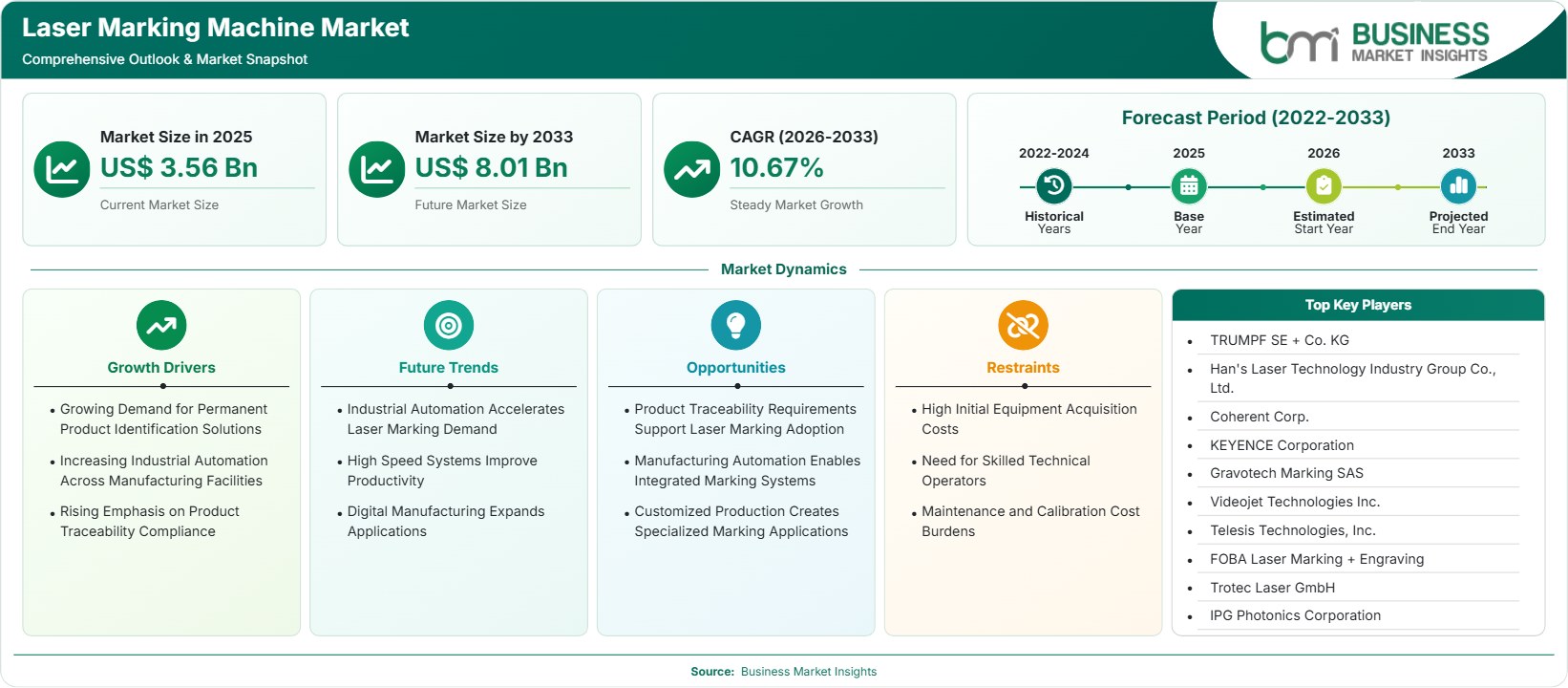
The Laser Marking Machine Market size was valued at US$ 3.56 Billion in 2025 and is projected to reach US$ 8.01 Billion by 2033, growing at a CAGR of 10.67% during 2026–2033. Demand is supported by industrial automation, traceability regulations, electronics miniaturization, and high-precision manufacturing, while opportunities emerge from electric vehicles, medical devices, smart factories, and advanced semiconductor production.

Report Coverage
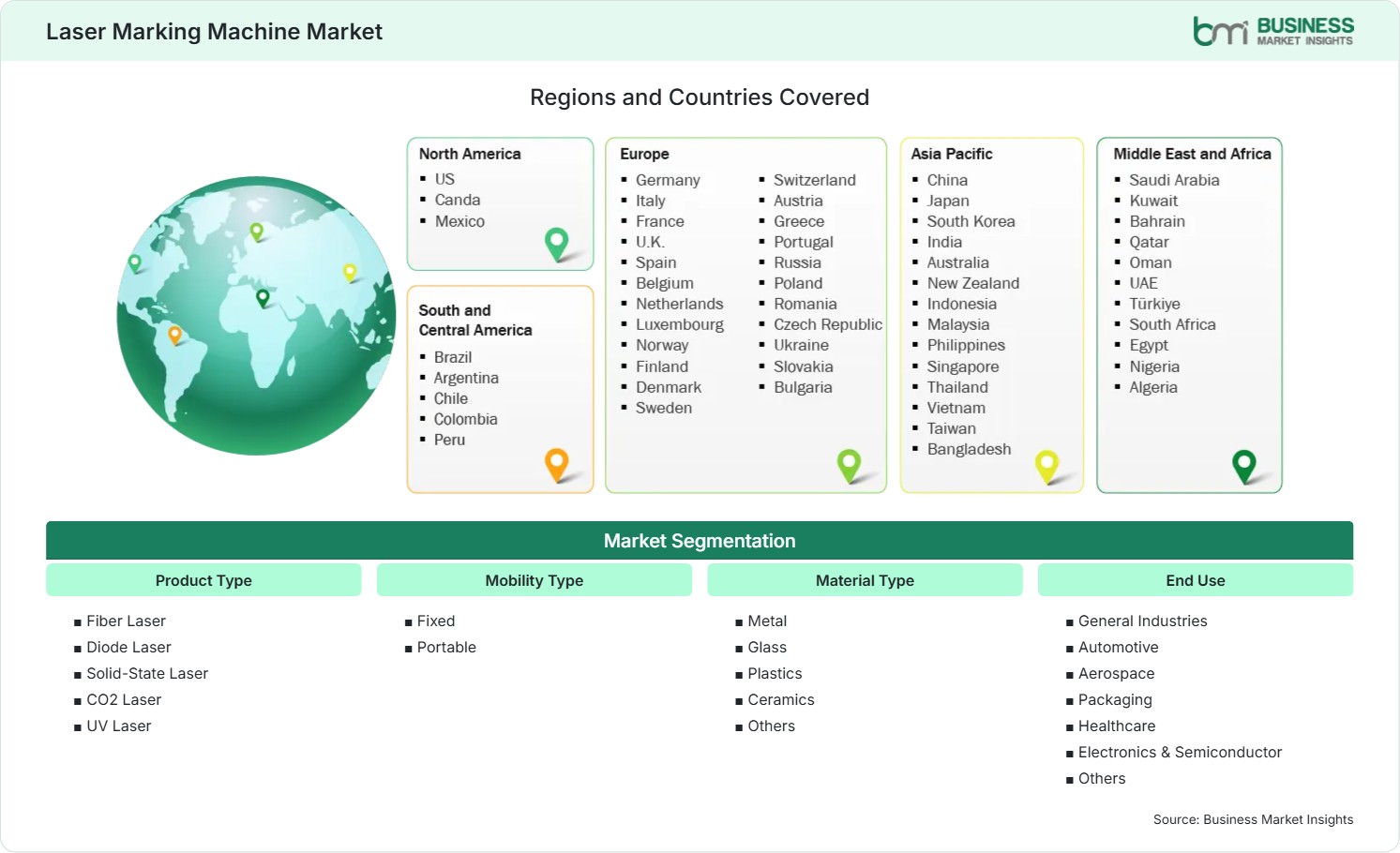
  • Product Type: Fiber Laser, Diode Laser, Solid-State Laser, CO2 Laser, UV Laser
  • Mobility Type: Fixed, Portable
  • Material Type: Metal, Glass, Plastics, Ceramics, Others
  • End Use: General Industries, Automotive, Aerospace, Packaging, Healthcare, Electronics & Semiconductor, Others
US$ 3.56 Bn Market size in 2025
US$ 8.01 Bn Market Size by 2033
10.67% CAGR, 2026 - 2033
2026-2033 Forecast Period

AI Overview

Laser Marking Machine Market Summary

  • North America Region: North America holds a market share of 34%–37% in 2025, growing with a CAGR of 9.4%–10.0% during 2026–2033. Growth is driven by aerospace traceability mandates, EV manufacturing expansion, semiconductor investments, industrial automation adoption, digital production monitoring, medical device serialization requirements, and increasing deployment across precision-engineered components. Brief U.S. market analysis: Strong aerospace, medical-device, and semiconductor investments support adoption, advancing at a CAGR of 9.6%–10.2%.
  • Fastest Growing Region: Asia Pacific holds a market share of 29%–32% in 2025 and is projected to expand at a CAGR of 12.2%–12.9% through 2033. Rising electronics output, battery manufacturing, domestic industrial automation programs, export-oriented production, semiconductor investments, traceability requirements, and expanding manufacturing ecosystems accelerate regional demand.
  • Leading Segment: Fiber Laser accounts for 41%–44% share in 2025 and advances at a CAGR of 11.3%–12.0%. Superior marking speed, low maintenance, excellent metal-processing performance, integration with robotics, energy efficiency, production-line compatibility, and high reliability support widespread industrial deployment globally.
  • High Growth Segment: Electronics & Semiconductor represents 17%–20% share in 2025 while progressing at a CAGR of 13.0%–13.8%. Increasing chip fabrication, component traceability, miniature product identification, cleanroom manufacturing requirements, precision marking needs, and smart electronics production strengthen investment momentum.
  • Key Market Opportunity: Integration of machine vision, AI-driven inspection, digital traceability, and Industry 4.0 connectivity creates opportunities for intelligent marking platforms across automotive, healthcare, aerospace, electronics, and packaging manufacturing environments globally.
  • Major Market Players: TRUMPF SE + Co. KG, Han's Laser Technology Industry Group Co., Ltd., Coherent Corp., KEYENCE Corporation, Gravotech Marking SAS, Videojet Technologies Inc., Telesis Technologies, Inc., FOBA Laser Marking + Engraving, Trotec Laser GmbH, and IPG Photonics Corporation.
Strategic Insights

Laser Marking Machine Market: Strategic Insights

Laser Marking Machine Market Strategic Framework
FREE PDF
Request your free sample
Request free sample
Stakeholder View

Key Takeaways

  • The value chain increasingly integrates laser-source manufacturers, automation suppliers, software developers, machine-vision providers, and industrial OEMs, creating opportunities for vertically integrated solutions.
  • Semiconductor packaging, EV battery manufacturing, and medical-device production offer the most attractive growth pockets because of strict traceability and precision-marking requirements.
  • Product innovation is shifting toward AI-enabled inspection systems, automated parameter optimization, remote diagnostics, and connected manufacturing platforms that support predictive maintenance.
  • Asia Pacific presents the strongest long-term investment proposition due to expanding electronics output, government-supported industrial upgrading programs, and accelerating factory automation initiatives.
  • Strategic acquisitions increasingly target software integration, laser-source technologies, and automation capabilities as manufacturers seek broader industrial solution portfolios.
  • Demand for compact portable systems is rising among maintenance operations, aerospace servicing facilities, and distributed manufacturing environments requiring flexible marking capabilities.
Geographic Outlook

Laser Marking Machine Market Regional Highlights

North America Laser Marking Machine Market

North America represents a 34%-37% share of the global revenue in 2025 and is set to grow at a CAGR of 9.4%-10.0% till 2033. North America enjoys state-of-the-art aerospace manufacturing operations, robust medical device manufacturing, high penetration of industrial automation solutions, and significant investments in semiconductor manufacturing. High traceability requirements within the defense, healthcare, and automotive industries will aid in equipment purchases. North America has a solid installed base of smart factories using vision-based identification systems. Laser Marking Machine Market share remains highest globally due to technological maturity and premium industrial equipment spending.

  • Aerospace suppliers increasingly implement permanent part identification systems to satisfy stringent compliance and lifecycle traceability requirements across commercial aviation and defense manufacturing programs.
  • Semiconductor investment programs create demand for precision component identification, wafer handling traceability, and contamination-sensitive marking technologies integrated within advanced production facilities.
  • Automotive manufacturers deploy automated identification solutions for batteries, power electronics, and drivetrain components to support quality assurance and product authentication goals.
  • Strong adoption of Industry 4.0 practices encourages integration between production analytics, machine vision inspection, and connected identification platforms across manufacturing ecosystems.

US Laser Marking Machine Market

The United States represents 78%–82% of North American revenues and advances at a CAGR of 9.6%–10.2% through 2033. Demand is reinforced by domestic semiconductor investments, defense modernization programs, healthcare device manufacturing, and EV supply chain expansion. Production facilities increasingly require durable identification technologies capable of supporting serialization and product authentication. The country benefits from significant R&D activity and strong adoption of advanced factory automation systems.

  • Semiconductor fabrication investments increase precision-marking requirements for wafers, components, packaging systems, and production traceability workflows throughout manufacturing environments.
  • Medical-device manufacturers prioritize permanent identification technologies that support regulatory compliance, sterilization resistance, and product lifecycle tracking requirements.
  • Aerospace and defense suppliers invest in high-precision systems capable of marking mission-critical components exposed to demanding operational conditions.

Europe Laser Marking Machine Market

Europe holds 24%–27% of global revenue in 2025 and is estimated to be between 24% and 27%, with an anticipated CAGR of 9.8%–10.5% till 2033. Germany continues to lead as the largest country; meanwhile, there is a more rapid growth of manufacturing zones in Eastern Europe. Strategies for industrial digitization, car manufacturing, sophisticated machinery manufacturing, and sustainability initiatives contribute to increased demand. In the region, manufacturers turn more to efficient identification solutions instead of consumable ones.

  • Germany leads regional demand supported by advanced automotive manufacturing, industrial machinery production, and extensive deployment of smart factory technologies.
  • Poland and Czechia emerge as high-growth locations with CAGR ranges approaching 11.0%–11.8% due to expanding export-oriented manufacturing activities.
  • Sustainability objectives encourage broader replacement of traditional coding technologies with low-maintenance, consumable-free laser alternatives across production facilities.
  • Medical technology manufacturing clusters increasingly deploy high-precision identification systems supporting strict compliance and product-tracking requirements.

Asia Pacific Laser Marking Machine Market

Asia Pacific accounts for 29%–32% of global revenue in 2025 and records the fastest CAGR of 12.2%–12.9% through 2033. China remains the largest market, while India and Southeast Asia demonstrate the strongest expansion prospects. Electronics manufacturing, semiconductor investment, EV battery production, and government-supported industrial modernization initiatives support sustained demand. The region benefits from large-scale manufacturing ecosystems and increasing automation penetration. Laser Marking Machine Market growth remains strongest among industrial regions due to expanding production capacity.

  • China dominates regional revenues through extensive electronics production, industrial equipment manufacturing, and robust domestic laser technology ecosystems.
  • India records high growth with estimated CAGR of 13.0%–13.8%, supported by manufacturing localization and electronics production expansion programs.
  • Southeast Asian economies attract foreign direct investment into electronics, automotive components, and industrial automation facilities requiring advanced identification solutions.
  • Battery manufacturing growth drives adoption of permanent traceability technologies throughout EV component and energy-storage value chains.

Rest of World Laser Marking Machine Market

Rest of World contributes 8%–11% of global revenue in 2025 and expands at a CAGR of 10.5%–11.2% through 2033. South and Central America benefit from automotive production, food processing, and industrial modernization activity.

The Middle East and Africa experience growing adoption across aerospace maintenance, packaging operations, and manufacturing diversification initiatives. Investments in industrial infrastructure support gradual acceleration of technology deployment across emerging economies.

  • Brazil leads regional demand, supported by automotive manufacturing, industrial processing, and wider adoption of digital production technologies.
  • Saudi Arabia demonstrates stronger growth, estimated at 11.5%–12.3%, benefiting from industrial diversification and advanced manufacturing investments.
  • Packaging and consumer-goods industries increasingly adopt permanent coding systems to improve product traceability and counterfeiting protection.
  • Aerospace maintenance and industrial servicing facilities create opportunities for portable solutions supporting on-site identification requirements.
Global Market Geography
FREE PDF
Request your free sample
Request free sample
Segment Analysis

Laser Marking Machine Market Segmentation

Product Type

This segment represented approximately 41%–44% share through Fiber Laser systems in 2025 and continues expanding with a CAGR of 11.3%–12.0%. Adoption is driven by speed, precision, and compatibility with automated production lines. Laser Marking Machine Market scope continues broadening as manufacturers seek durable, maintenance-efficient identification technologies supporting industrial digitalization initiatives.

  • Fiber Laser: Preferred for metal marking applications, providing high reliability, superior speed, and strong compatibility with automotive, aerospace, semiconductor, and industrial manufacturing operations.
  • Diode Laser: Gains adoption in compact systems where efficiency, reduced power consumption, and integration flexibility are important for specialized industrial applications.
  • Solid-State Laser: Supports precision marking requirements involving sensitive materials, advanced manufacturing processes, and high-quality permanent identification outcomes.
  • CO2 Laser: Widely utilized for packaging, plastics, wood, glass, and non-metal materials requiring high-speed coding and marking capabilities.
  • UV Laser: Increasingly adopted for electronics and medical applications where minimal thermal impact and ultra-fine marking precision are critical.

Mobility Type

Fixed systems account for 67%–70% market share in 2025 and maintain a CAGR of 10.2%–10.9% through the forecast period. Automated production integration, high throughput requirements, and continuous manufacturing operations support segment leadership. Portable equipment adoption continues rising in maintenance-oriented and field-service applications.

  • Fixed: Dominates industrial manufacturing environments through seamless integration with conveyors, robotic cells, and automated production workflows.
  • Portable: Supports flexible deployment requirements, enabling maintenance teams and distributed operations to perform on-site identification and traceability tasks.

Material Type

Metal applications contribute 38%–41% share in 2025 while expanding at a CAGR of 11.0%–11.7%. Increasing demand from aerospace, automotive, and industrial machinery producers supports adoption. Laser Marking Machine Market trends increasingly favor material-specific optimization that enhances readability, permanence, and processing efficiency.

  • Metal: Largest material category driven by automotive parts, industrial equipment, aerospace components, and battery manufacturing requirements.
  • Glass: Utilized in medical, electronics, and packaging sectors where permanent identification improves traceability and product authentication.
  • Plastics: Experiences strong demand from consumer goods, healthcare, and electronics industries requiring non-contact marking capabilities.
  • Ceramics: Supports specialized manufacturing applications involving durability requirements and resistance to harsh environmental conditions.

End Use

General Industries represent 28%–31% share in 2025 with a CAGR of 9.8%–10.4%, while Electronics & Semiconductor emerges as the highest-growth category at 13.0%–13.8%. The Laser Marking Machine Market size opportunity expands across increasingly automated sectors emphasizing traceability and quality assurance.

  • General Industries: Broad application base spanning machinery, fabricated products, industrial equipment, and diversified manufacturing environments.
  • Automotive: Relies on permanent identification for components, batteries, drivetrain assemblies, compliance requirements, and quality assurance programs.
  • Aerospace: Requires durable marking technologies capable of maintaining readability across demanding operational and environmental conditions.
  • Packaging: Supports coding, authentication, serialization, and traceability requirements across consumer and industrial product categories.
  • Healthcare: Enables regulatory-compliant identification of instruments, implants, and medical devices requiring long-term permanence.
  • Electronics & Semiconductor: Fastest-growing application area due to miniaturization, cleanroom production, traceability demands, and semiconductor investment expansion.
Market Forces

Laser Marking Machine Market Dynamics

Key Market Drivers

Industrial Traceability and Serialization Requirements

Manufacturers increasingly require permanent identification technologies to support product authentication, recalls, quality monitoring, and lifecycle management. The aerospace, health care, automotive, and electronics sectors are characterized by strict traceability demands. The global aviation supply chains that meet the IATA standards in digitalization and health care products traceability demands will keep on increasing the need for robust marking solutions. As regulations become more and more strict, companies tend to invest in systems that can provide machine-readable markings. This factor plays an important role in the adoption of devices for a long period of time.

Expansion of Smart Manufacturing and Automation

Industrial automation spending continues rising as manufacturers pursue productivity improvements and quality consistency. The development of laser technology involves integration with robotics, machine vision systems, MES software, and digital production tracking systems. Intelligent factories need reliable solutions in terms of identification that will allow automated inspection and data analysis. The combination of production machines' connectivity and traceability process improves the acceptance. The development of industrial robotics installations and digital manufacturing projects in developed and developing countries results in continuous demand for integrated marketing solutions.

Growth of Electronics, Semiconductor, and EV Production

The expansion of semiconductor fabrication facilities, electronics manufacturing, and electric vehicle production significantly increases identification requirements. The components get smaller while the traceability requirements become stricter. Battery cells, microchips, sensors, and power electronics need precision and permanence of marking without affecting delicate materials. This is why manufacturers need to equip themselves with advanced laser technology that can deliver high-resolution marking. The increasing additions to semiconductor capacity in North America, Europe, and Asia, along with growing EV production, support this demand.

Key Market Opportunities

AI-Enabled Vision Inspection and Connected Platforms

Creating future value will require the use of intelligent systems for marking, verifying, and production analysis. Manufacturers are now deploying integrated solutions that automatically check the mark’s quality, detect flaws, and provide optimum process control parameters. Laser Marking Machine Market Forecasts now incorporate demands for platforms that enable predictive maintenance, remote diagnostics, and digital traceability. Software-based ecosystems offered by providers may result in recurring service revenue and increase customer loyalty. With increased penetration of smart factories, intelligent inspection capabilities enabled by AI technology emerge as an attractive growth area for several industries.

Emerging Manufacturing Ecosystems in Asia and Latin America

Rapid industrialization creates attractive deployment opportunities in India, Vietnam, Indonesia, Mexico, and Brazil. Multinational manufacturers continue diversifying supply chains and investing in regional production capacity. Automation and traceability systems are being introduced at the time of building these factories, rather than later. The government’s encouragement of industries like electronics, automobiles, and industrial manufacturing will help boost equipment purchases. Local service networks and distribution systems built by suppliers can capitalize on increasing capital spending in new manufacturing ecosystems.

Medical Devices and Advanced Healthcare Manufacturing

Healthcare production requires durable identification technologies resistant to sterilization processes and harsh operating environments. Increased demand for implantable items, surgical instruments, and other medical devices leads to the creation of new marking options. High spending on health care and increasing manufacturing of advanced medical devices drive the adoption rate. Companies are actively seeking marking technologies that would help them achieve compliance, ensure the authenticity of their products, and track the entire lifecycle.

Market Restraints and Challenges

High Capital Costs and Integration Complexity

Factor: Advanced systems incorporating automation, machine vision, and software connectivity require substantial upfront investment. Impact: Such smaller enterprises would prefer to either delay the purchase decision or go for cheaper options. The integration of the system with the existing production facility requires engineering changes and staff training, among other measures, making the implementation process time-consuming and expensive. Although the economic value offered by the lifecycle perspective is appealing, its high capital cost is an obstacle to adoption in many cases.

Technical Skill Gaps and Maintenance Requirements

Factor: Successful deployment requires trained personnel capable of programming systems, optimizing parameters, and maintaining laser sources. Impact: Companies without special expertise incur inefficiencies in terms of low productivity, poor mark quality, and other inefficiencies. Applications that are more complex and involve several materials or use production lines require technical expertise in software, optics, and process engineering. The constraints of the personnel could hinder the adoption and the efficiency of use of the technology. Availability of service and training is very important to potential buyers.

Company Analysis

Competitive Landscape

The Laser Marking Machine Market analysis indicates a moderately consolidated market characterized by global laser technology leaders, specialized marking providers, and automation-focused manufacturers competing through innovation, precision, software integration, and industry-specific solutions.

Company Name

Overview

Products and Services relevant to this market

TRUMPF SE + Co. KG

German industrial technology leader with strong expertise in laser systems, automation, and advanced manufacturing platforms.

Fiber laser markers, integrated production systems, industrial laser sources, automation solutions, and smart-factory connectivity tools.

Han's Laser Technology Industry Group Co., Ltd.

Major Chinese laser equipment manufacturer serving industrial production, electronics, and automotive sectors globally.

Fiber, UV, and CO2 marking equipment, automation platforms, industrial laser systems, and production solutions.

Coherent Corp.

Global photonics company providing advanced laser technologies for industrial and electronics applications.

Laser sources, precision-marking systems, semiconductor-focused solutions, and industrial processing technologies.

KEYENCE Corporation

Automation specialist recognized for sensors, machine vision, and industrial marking technologies.

Laser markers, vision inspection systems, factory automation tools, and traceability solutions.

Gravotech Marking SAS

Specialized provider focused on permanent identification and industrial traceability technologies.

Laser marking equipment, engraving systems, traceability software, and industrial identification solutions.

Videojet Technologies Inc.

Global coding and marking company serving packaging and manufacturing industries.

Laser coders, serialization systems, packaging identification technologies, and production-line integration services.

Telesis Technologies, Inc.

Industrial marking specialist delivering traceability and permanent identification solutions.

Laser markers, dot peen technologies, software platforms, and manufacturing identification systems.

FOBA Laser Marking + Engraving

Precision-marking specialist emphasizing healthcare, electronics, and industrial applications.

Laser Marking Machine Markets, vision verification systems, and integrated traceability technologies.

Trotec Laser GmbH

Austrian laser technology company serving industrial and professional processing markets.

Marking, cutting, engraving systems, laser software, and workflow optimization tools.

IPG Photonics Corporation

Leading fiber laser innovator with strong global industrial manufacturing presence.

Fiber laser sources, industrial marking technologies, automation-compatible laser platforms, and processing solutions.

Trust & Transparency

Research Methodology

The market analysis combines proprietary research with secondary data from government agencies, company disclosures, regulatory filings, industry databases and expert interviews. Market estimates are validated through data triangulation, cross-market benchmarking and analyst review.

View Full Research Methodology

Questions Answered

Frequently Asked Questions

Which end-use industry offers the strongest long-term opportunity?

Electronics and semiconductor manufacturing present the strongest growth outlook because of miniaturization, strict quality standards, expanding chip production, and rising traceability requirements.

What does the Laser Marking Machine Market Report indicate about future competition?

Competition is shifting beyond hardware performance toward software integration, AI-enabled inspection, digital traceability ecosystems, and lifecycle service capabilities.

How does Industry 4.0 influence equipment demand?

Connected factories increasingly require integrated marking, inspection, analytics, and traceability capabilities. This drives demand for systems supporting machine vision, cloud connectivity, and production monitoring.

Which technology category currently leads revenue generation?

Fiber laser systems lead due to superior efficiency, lower maintenance requirements, excellent performance on metals, and broad compatibility with automated manufacturing environments.

What factors are accelerating adoption across manufacturing industries?

Automation, product traceability requirements, anti-counterfeiting initiatives, and the need for permanent identification are driving deployment across automotive, healthcare, aerospace, electronics, and packaging sectors.

Access the Full Laser Marking Machine Market Report

Get segment-level forecasts, regional estimates, competitive benchmarking, company profiles and downloadable Excel datasets.

Access the full Laser Marking Machine Market Report
350 pages PDF & Excel | 2026-09-04