
Laser Plastic Welding Market Outlook: Size, Share, Trends, Growth Analysis, Competitive Landscape & Forecast, 2026-2033

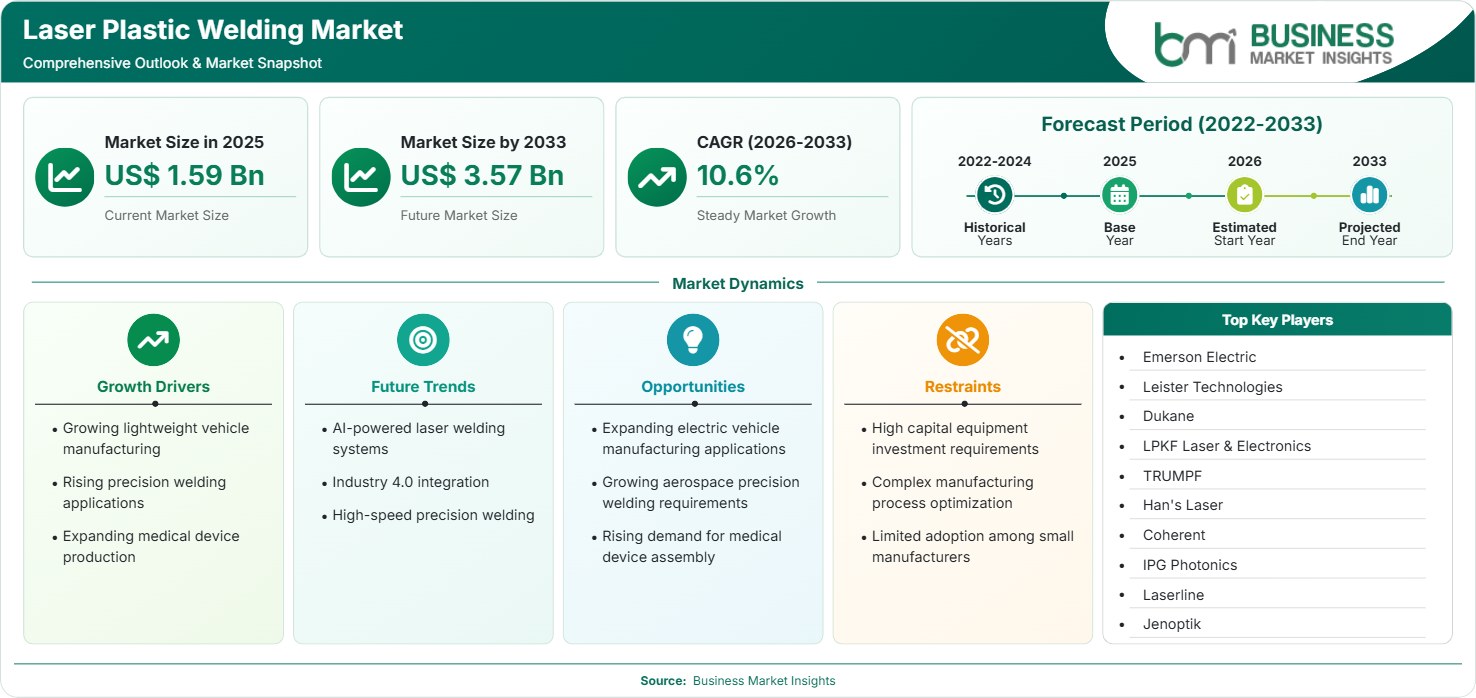
The Laser Plastic Welding Market size was valued at US$ 1.59 Billion in 2025 and is projected to reach US$ 3.57 Billion by 2033, growing at a CAGR of 10.6% from 2026 to 2033, driven by lightweight vehicle manufacturing, precision welding applications, medical device production, electric vehicle expansion, and advanced manufacturing automation.

Report Coverage
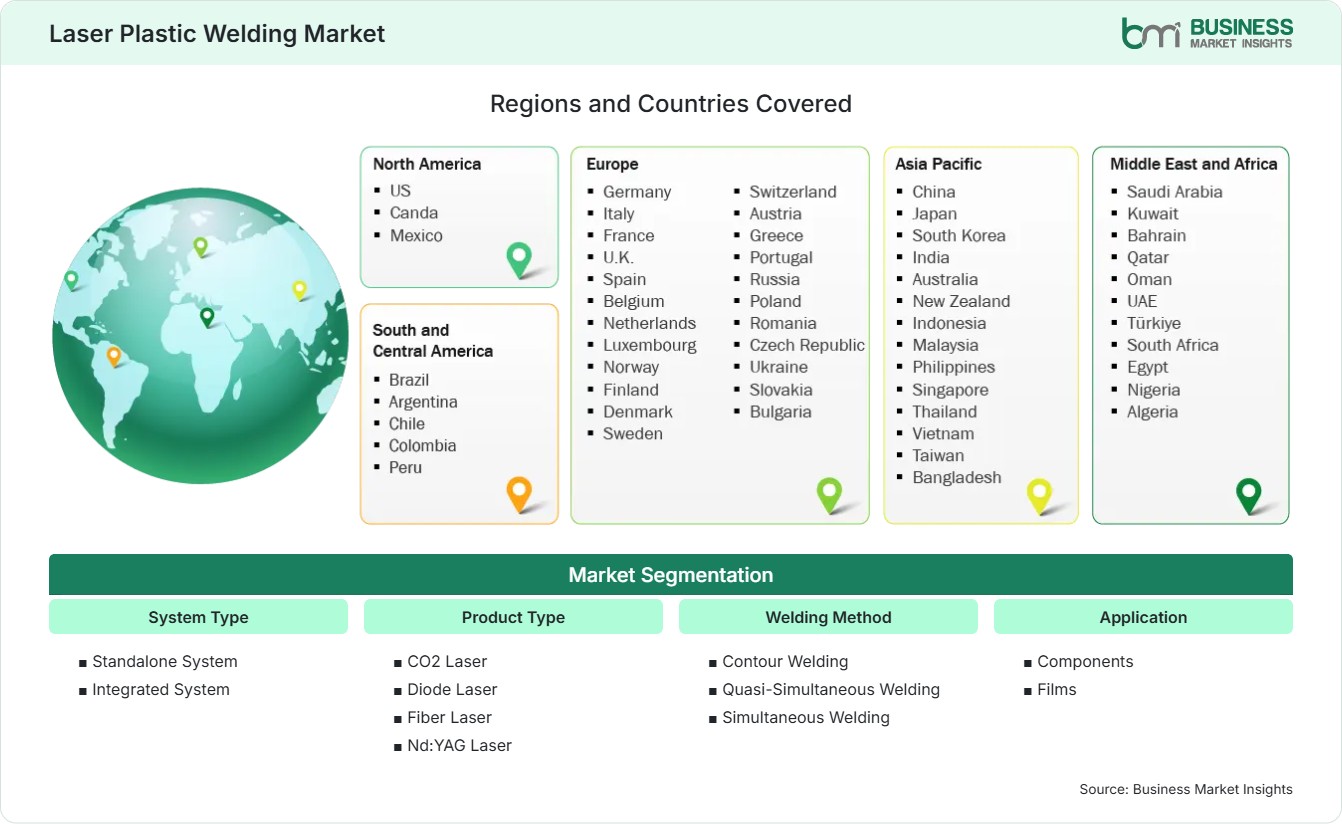
  • System Type: Standalone System, Integrated System
  • Product Type: CO2 Laser, Diode Laser, Fiber Laser, Nd:YAG Laser
  • Welding Method: Contour Welding, Quasi-Simultaneous Welding, Simultaneous Welding
  • Application: Components, Films
  • End-use Industry: Electrical & Electronics, Healthcare, Automotive, Others
US$ 1.59 Bn Market size in 2025
US$ 3.57 Bn Market Size by 2033
10.6% CAGR, 2026 - 2033
2026-2033 Forecast Period

01 AI Overview

Laser Plastic Welding Market Summary

  • North America Region: North America holds a market share of 34%–37% in 2025, growing with a CAGR of 9%–11% influenced by automotive innovation, medical device manufacturing, electronics production, and industrial automation. The US market expands with a CAGR of 9%–11% during 2026–2033, supported by electric vehicle manufacturing, advanced production systems, and precision assembly demand.
  • Fastest Growing Region: Asia Pacific represents a share range of 32%–35% in 2025, expanding with a CAGR of 12%–14% driven by automotive production, electronics manufacturing, healthcare device expansion, and increasing investments in industrial automation technologies.
  • Leading Segment: Integrated System represents the leading system type segment with a share range of 58%–61% in 2025, growing at a CAGR of 10%–12% due to automated production requirements, improved efficiency, and integration with manufacturing lines.
  • High Growth Segment: Fiber Laser demonstrates a share range of 24%–27% in 2025, expanding at a CAGR of 12%–14% due to energy efficiency, precision capabilities, and increasing adoption across advanced manufacturing applications.
  • Key Market Opportunity: Opportunities are concentrated in electric vehicle components, aerospace precision welding, medical device assembly, and advanced polymer manufacturing applications requiring reliable joining technologies.
  • Major Market Players: Emerson Electric, Leister Technologies, Dukane, LPKF Laser & Electronics, TRUMPF, Han's Laser, Coherent, IPG Photonics, Laserline, Jenoptik.
02 Strategic Insights

Laser Plastic Welding Market: Strategic Insights

Laser Plastic Welding Market Strategic Framework
FREE PDF
Request your free sample
Request free sample
03 Stakeholder View

Key Takeaways

  • The manufacturing value chain is shifting toward automated joining technologies that improve precision, reduce material waste, and support lightweight component production.
  • Electric vehicles, medical devices, and electronics represent high-potential application areas due to increasing requirements for reliable polymer assembly.
  • Innovation priorities include higher-power laser systems, improved process monitoring, artificial intelligence integration, and automated quality control.
  • Asia Pacific provides strong investment opportunities through expanding automotive production, electronics manufacturing, and industrial automation adoption.
  • Strategic partnerships between laser technology providers, automotive manufacturers, and industrial automation companies are shaping competitive positioning.
04 Geographic Outlook

Laser Plastic Welding Market Regional Highlights

North America Laser Plastic Welding Market

North America accounted for a share range of 34%–37% in 2025 and is projected to grow at a CAGR of 9%–11% during 2026–2033. The region maintains a strong position due to advanced automotive manufacturing, medical device production, electronics innovation, and automation adoption. The Laser Plastic Welding Market share in North America is supported by demand for high-quality manufacturing processes and precision joining technologies.

  • The United States remains the largest contributor due to automotive innovation, electric vehicle production, and advanced manufacturing investments.
  • Manufacturers are adopting laser welding systems to improve production accuracy and reduce assembly complexity.
  • Medical device companies are increasing adoption of clean joining technologies for specialized healthcare products.
  • Electronics manufacturers are utilizing precision welding solutions for miniaturized and complex components.

US Laser Plastic Welding Market

The US represented a share range of 30%–33% in 2025 and is expected to expand at a CAGR of 9%–11% between 2026–2033. The country remains a major laser plastic welding market due to strong industrial automation capabilities, automotive technology development, and healthcare manufacturing expertise. Demand is supported by electric mobility investments and increasing requirements for advanced polymer processing.

  • Automotive manufacturers are integrating laser welding systems for lightweight components and electric vehicle applications.
  • Healthcare companies are adopting precision joining technologies for medical equipment and disposable device production.
  • Industrial automation investments are supporting adoption of integrated laser welding systems.
  • Technology providers are developing advanced solutions for high-volume manufacturing environments.

Europe Laser Plastic Welding Market

Europe held a share range of 26%–29% in 2025, growing at a CAGR of 10%–12% during 2026–2033. The region benefits from advanced automotive engineering, industrial automation expertise, and strong manufacturing standards. Germany, France, and the United Kingdom represent leading markets, while Italy and other manufacturing economies provide additional opportunities through automotive and industrial applications.

  • Germany supports growth through automotive engineering expertise and advanced manufacturing technology adoption.
  • France is expanding adoption across aerospace, automotive, and healthcare manufacturing sectors.
  • The United Kingdom is investing in precision manufacturing and industrial automation technologies.
  • European manufacturers are prioritizing efficient production methods and lightweight component development.

Asia Pacific Laser Plastic Welding Market

Asia Pacific accounted for a share range of 32%–35% in 2025 and is expanding at a CAGR of 12%–14% during 2026–2033. The region represents the fastest-growing laser plastic welding market due to large-scale automotive production, electronics manufacturing expansion, healthcare device investments, and increasing industrial automation. China, Japan, South Korea, and India are major contributors through advanced manufacturing capabilities and growing adoption of precision welding technologies.

  • China is expanding adoption of laser welding through investments in electric vehicle production, electronics manufacturing, and industrial automation.
  • Japan continues developing precision manufacturing capabilities through automotive innovation and advanced industrial equipment adoption.
  • South Korea is increasing demand for laser welding systems through electronics, battery, and semiconductor-related manufacturing.
  • India is witnessing growing adoption due to automotive production expansion, healthcare manufacturing, and industrial modernization.

Rest of World Laser Plastic Welding Market

Rest of World represented a share range of 7%–10% in 2025, growing at a CAGR of 10%–12% during 2026–2033. Latin America, the Middle East, and Africa are gradually adopting laser plastic welding technologies through industrial development, automotive investments, and healthcare manufacturing expansion. Brazil, Mexico, Saudi Arabia, and the UAE are emerging markets supported by manufacturing diversification.

  • Brazil is adopting advanced welding technologies through automotive production, industrial modernization, and manufacturing efficiency initiatives.
  • Mexico is expanding laser welding applications through automotive supply chain development and electronics manufacturing growth.
  • Saudi Arabia and the UAE are investing in industrial diversification and advanced manufacturing capabilities.
  • African markets are gradually adopting automation technologies for industrial development and specialized manufacturing applications.
Global Market Geography
FREE PDF
Request your free sample
Request free sample
05 Segment Analysis

Laser Plastic Welding Market Segmentation

System Type

The system type segment is influenced by increasing automation adoption, production efficiency requirements, and demand for integrated manufacturing solutions. Integrated Systems represented the leading segment with a share range of 58%–61% in 2025 and a CAGR of 10%–12% between 2026–2034. The Laser Plastic Welding Market scope is expanding through automated production lines, smart manufacturing initiatives, and advanced process control requirements.

  • Standalone System: Standalone systems support flexible manufacturing operations by providing independent welding capabilities for specialized production environments and lower-volume applications.
  • Integrated System: Integrated systems are increasingly adopted due to automation compatibility, higher production efficiency, improved monitoring capabilities, and seamless manufacturing line integration.

Product Type

The product type segment reflects increasing demand for efficient laser sources capable of delivering precision, reliability, and optimized energy performance. Fiber lasers demonstrate strong adoption due to their flexibility, efficiency, and suitability for advanced manufacturing applications. The Laser Plastic Welding Market trends indicate rising preference for laser systems offering improved control, reduced maintenance, and enhanced process consistency.

  • CO2 Laser: CO2 lasers are used for specific plastic welding applications requiring effective material interaction and established industrial processing capabilities.
  • Diode Laser: Diode lasers support compact system designs, energy efficiency, and precise welding applications across various industrial sectors.
  • Fiber Laser: Fiber lasers are gaining adoption due to high efficiency, excellent beam quality, and suitability for automated precision manufacturing processes.
  • Nd:YAG Laser: Nd:YAG lasers provide reliable performance for specialized welding applications requiring controlled energy delivery and accurate processing.

Welding Method

The welding method segment is driven by manufacturing requirements for speed, precision, and material compatibility. Contour welding remains widely used due to flexibility across different component designs, while simultaneous and quasi-simultaneous methods support high-volume production. Increasing automation and quality requirements are encouraging manufacturers to select welding methods based on application complexity and production demands.

  • Contour Welding: Contour welding enables flexible processing by following component geometries and supporting customized plastic joining applications.
  • Quasi-Simultaneous Welding: Quasi-simultaneous welding improves process consistency by applying laser energy across multiple areas through rapid scanning techniques.
  • Simultaneous Welding: Simultaneous welding supports high-volume manufacturing by delivering uniform energy distribution and efficient production cycles.

Application

The applications segment is growing due to rising demand for lightweight components, precision assemblies, and high-end polymer-based products. Components are a key application sector, driven by manufacturing requirements in the automotive, electronics, and healthcare sectors. Film applications are growing in specialized industries owing to the need for precise assembly techniques.

  • Components: Component applications include automotive parts, electronic assemblies, medical devices, and industrial products requiring durable plastic joining solutions.
  • Films: Film applications utilize laser welding for specialized manufacturing processes requiring controlled bonding, reduced contamination, and high production accuracy.

End-use Industry

The end-use industry segment will be influenced by growing acceptance across the automotive, healthcare, electronics, and industrial manufacturing industries. The automobile and electronics industries will be key consumers due to the need for lightweight materials and miniaturized components. Applications within healthcare will increase owing to the demand for a contamination-free assembly process.

  • Electrical & Electronics: Electronics manufacturers use laser welding for precision assemblies, compact components, and reliable polymer joining applications.
  • Healthcare: Healthcare manufacturers adopt laser welding for medical device production requiring clean, accurate, and repeatable assembly processes.
  • Automotive: Automotive companies utilize laser welding for lightweight components, electric vehicle systems, and advanced polymer assemblies.
06 Market Forces

Laser Plastic Welding Market Dynamics

Key Market Drivers

Growing Lightweight Vehicle Manufacturing

The expansion of lightweight vehicle manufacturing is driving the adoption of advanced joining technologies as automotive companies seek to reduce weight and improve efficiency. The Laser Plastic Welding Market growth is supported by increasing use of polymer components, electric vehicle systems, and advanced automotive assemblies. Laser welding enables joints that use less material and require less mechanical joining. Automotive firms are implementing these systems in their production lines to enhance the precision of manufacturing. With the increase in electric vehicle production, there is a greater need for welding systems tailored to batteries, sensors, and lightweight structures.

Rising Precision Welding Applications

The growing need for precision manufacturing is driving the adoption of laser welding systems in sectors that require precise joining. The Laser Plastic Welding Market trends are driven by the miniaturization of electronic equipment, the complexity of medical equipment, and the demand for high-tech industrial parts. Laser welding techniques offer benefits including energy control, reduced distortion, and superior quality end products compared to traditional welding techniques. Laser welding, coupled with digital manufacturing and process monitoring techniques, will enhance the control system while retaining existing quality standards. Given the rising demand for high-end parts in various industries, there will be a rising need for precise plastic welding techniques.

Expanding Medical Device Production

The expansion in the manufacturing of medical devices has created a demand for the laser plastic welding process due to the need for clean, reliable, and contamination-free joining. Laser plastic welding is used by the manufacturers of medical devices in the making of disposable medical devices, diagnostic equipment, and other specific healthcare devices. The technology ensures a clean joining process without any adhesives or additional material that might harm the devices being made. Increased investments in the healthcare sector and increased demands for more advanced medical devices have opened up new markets for welding technology companies.

Key Market Opportunities

Expanding Electric Vehicle Manufacturing Applications

The manufacturing of electric vehicles is a major business opportunity because there is an increased need for lightweight components, battery-related assemblies, and more sophisticated polymer technology. Manufacturers are utilizing new technologies in production processes that will increase efficiency and improve the performance of the parts. Laser plastic welding is helpful in the manufacturing of electric vehicles since it helps in welding complicated plastic components that are used in electronics, sensors, and interior parts. The growth of electric mobility programs around the globe creates business opportunities for manufacturers of innovative technologies. It would be beneficial for companies supplying laser welding equipment to establish partnerships with automobile manufacturers.

Growing Aerospace Precision Welding Requirements

Aerospace manufacturing is creating opportunities for laser plastic welding due to the increasing demand for lightweight, durable, and precisely assembled components. Aircraft manufacturers require advanced production methods that support strict quality standards and complex material requirements. Laser welding technology offers capabilities that make it possible to carry out controlled processing operations for use in special applications within the aerospace sector. The increased spending in upgrading and manufacturing more sophisticated and lighter aircraft will contribute to the demand for high-precision manufacturing machines. Companies providing advanced laser welding technology with advanced monitoring capabilities can cater to the aerospace industry's needs.

Rising Demand for Medical Device Assembly

Medical device assembly is emerging as a growth opportunity due to increasing demand for accurate, hygienic, and repeatable manufacturing processes. Laser plastic welding enables the production of complex medical components while minimizing contamination risks and improving product consistency. Growing healthcare technology adoption and increasing production of diagnostic and therapeutic devices are encouraging manufacturers to invest in advanced assembly technologies, supporting a positive laser plastic welding market forecast. Companies offering systems suitable for regulated healthcare manufacturing environments can capture opportunities through partnerships with medical device producers. Rising demand for disposable healthcare products and precision medical equipment is expected to strengthen the adoption of laser welding solutions.

Market Restraints and Challenges

High Capital Equipment Investment Requirements

Factor: Laser plastic welding systems require substantial upfront investment due to advanced laser sources, automation components, precision control systems, and specialized installation requirements. Impact: High capital costs can restrict adoption among small and medium-sized manufacturers that may have limited budgets for advanced production equipment. Companies must also consider expenses related to operator training, maintenance, system calibration, and technology upgrades. Although laser welding improves productivity and product quality, the initial financial commitment can delay implementation decisions. Equipment manufacturers are addressing this challenge through modular solutions, improved service models, and scalable systems designed to support different production requirements. Broader adoption will depend on improved affordability and return-on-investment visibility.

Complex Manufacturing Process Optimization

Factor: Laser plastic welding requires precise control of material properties, laser parameters, component design, and production conditions to achieve consistent results. Impact: Process optimization complexity can increase implementation timelines and require specialized technical expertise during system deployment. Different polymers, component geometries, and application requirements demand customized welding parameters and extensive testing. Manufacturers may face challenges related to quality assurance, process validation, and integration with existing production environments. Companies are investing in simulation tools, automation software, and advanced monitoring technologies to simplify optimization. Successful implementation depends on technical expertise, reliable process control, and collaboration between equipment providers and manufacturing teams.

07 Company Analysis

Competitive Landscape

The Laser Plastic Welding Market analysis highlights a competitive environment driven by laser innovation, automation capabilities, manufacturing precision, and increasing demand across automotive, healthcare, electronics, and industrial applications. Leading companies are focusing on advanced laser sources, integrated welding systems, strategic partnerships, and application-specific solutions to strengthen their global market position.

Company Name

Overview

Products and Services relevant to this market

Emerson Electric

Industrial technology company providing automation and manufacturing solutions.

Laser welding systems, industrial automation, precision manufacturing solutions.

Leister Technologies

Technology company specializing in plastic processing solutions.

Laser plastic welding systems, industrial joining technologies, automation solutions.

Dukane

Industrial equipment manufacturer focused on advanced joining technologies.

Plastic welding systems, ultrasonic and laser joining solutions.

LPKF Laser & Electronics

Technology company specializing in laser-based manufacturing systems.

Laser welding systems, precision manufacturing equipment, polymer processing solutions.

TRUMPF

Industrial technology company providing laser and manufacturing solutions.

Laser systems, industrial processing technologies, automation solutions.

Han's Laser

Laser equipment manufacturer serving global industrial markets.

Laser processing systems, welding equipment, automation technologies.

Coherent

Photonics technology company developing laser-based solutions.

Laser sources, precision processing systems, industrial applications.

IPG Photonics

Laser technology company specializing in fiber laser systems.

Fiber lasers, laser processing solutions, industrial welding systems.

Laserline

Laser technology provider focused on industrial laser applications.

Diode laser systems, plastic welding solutions, industrial integration.

Jenoptik

Photonics and technology company offering precision solutions.

Laser technologies, optical systems, industrial manufacturing solutions.

08 Industry Activity

Recent Developments

April 2026

LPKF Laser & Electronics SE announced the successful market launch of its Absorbing-to-Absorbing (ATA) laser plastic welding technology, which enables welding of two absorbing plastic components without the traditional transparent-to-absorber material combination. The technology includes integrated thermography for process monitoring and is being used by Schaeffler for the development of e-mobility components.

April 2026

Evosys Laser GmbH expanded its North American presence through strategic partnerships to strengthen customer support and sales capabilities for laser plastic welding solutions, including automated manufacturing systems for medical technology applications.

March 2025

Hymson Laser Technology Group / Hymson Novolas AG acquired Leister Technologies AG’s laser plastic welding business, including existing product lines and expertise, and established a new Laser Technology Center in Switzerland to continue development and customer support for laser plastic welding systems.

January 2025

Laser Photonics Corporation (LPC) and its subsidiary Control Micro Systems (CMS) announced expansion of their Clear-on-Clear Plastic Welding technology development program, targeting advanced laser welding solutions for industries requiring transparent plastic joining applications.

10 Trust & Transparency

Research Methodology

The market analysis combines proprietary research with secondary data from government agencies, company disclosures, regulatory filings, industry databases and expert interviews. Market estimates are validated through data triangulation, cross-market benchmarking and analyst review.

View Full Research Methodology

11 Questions Answered

Frequently Asked Questions

How does the Laser Plastic Welding Market Report help stakeholders?

The market report provides insights into technology trends, competitive strategies, segment performance, regional opportunities, and investment areas.

What challenges affect laser plastic welding adoption?

High equipment costs, technical complexity, process optimization requirements, and the need for specialized expertise can limit adoption among some manufacturers.

How are electric vehicles influencing laser welding demand?

Electric vehicle production is increasing demand for lightweight plastic components, battery-related assemblies, and advanced manufacturing processes requiring precise joining technologies.

Why is laser plastic welding preferred over traditional joining methods?

Laser plastic welding provides clean, precise, and reliable joining without adhesives or mechanical fasteners, improving product quality and manufacturing efficiency.

What industries are driving demand for laser plastic welding systems?

Automotive, healthcare, electrical and electronics, aerospace, and industrial manufacturing sectors are driving adoption due to requirements for precision, reliability, and lightweight component production.

Access the Full Laser Plastic Welding Market Report

Get segment-level forecasts, regional estimates, competitive benchmarking, company profiles and downloadable Excel datasets.

Access the full Laser Plastic Welding Market Report
350 pages PDF & Excel | 2026-07-30