
Plastic Welding Equipment Market Outlook: Size, Share, Trends, Growth Analysis, Competitive Landscape & Forecast, 2026–2033

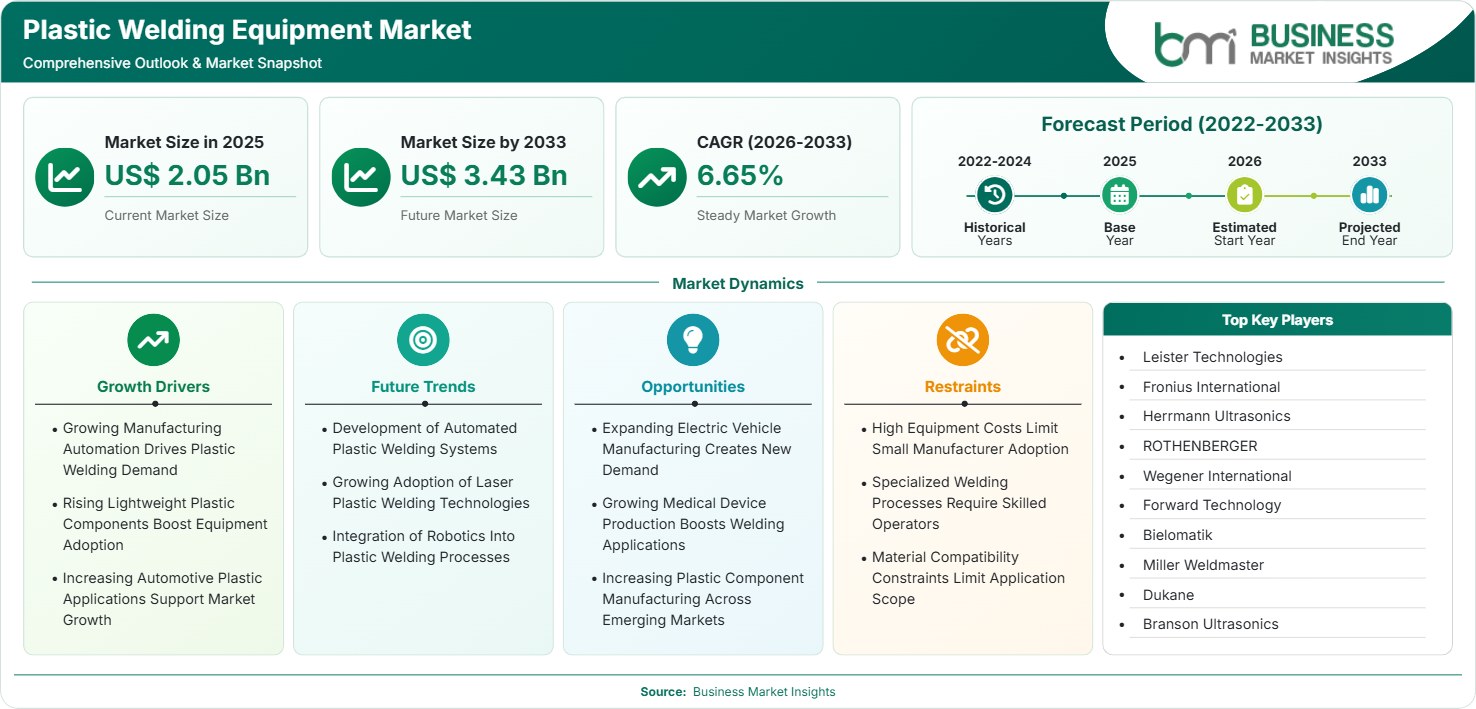
The Plastic Welding Equipment Market size was valued at US$ 2.05 billion in 2025 and is projected to reach US$ 3.43 billion by 2033, growing at a CAGR of 6.65% during 2026–2033, supported by manufacturing automation, lightweight components, electric vehicle production, medical devices, and advanced joining technologies.

Report Coverage
  • Type: Automatic, Semi-automatic, Manual
  • Technology: Ultrasonic Welding, Vibration Welding, Laser Welding, Infrared Welding, Spin Welding, Hot Plate Welding, Others
  • Application: Automotive, Electronics & Electrical, Packaging, Medical Devices, Consumer Goods, Others
US$ 2.05 Bn Market size in 2025
US$ 3.43 Bn Market Size by 2033
6.65% CAGR, 2026 - 2033
2026-2033 Forecast Period

01 AI Overview

Plastic Welding Equipment Market Summary

  • North America Region: North America holds a 25%–29% share in 2025 and is projected to grow at a 5.7%–6.4% CAGR through 2033, supported by manufacturing automation, advanced automotive production, medical-device manufacturing, electronics assembly, equipment modernization, and demand for repeatable joining quality.
  • Fastest Growing Region: Asia Pacific holds a 38%–42% share in 2025 and is projected to grow at a 7.4%–8.2% CAGR through 2033, supported by industrial expansion, automotive manufacturing, electronics production, EV investment, packaging demand, and increasing automation.
  • Leading Segment: Automatic equipment holds a 42%–46% share in 2025 and is projected to grow at a 6.4%–7.0% CAGR through 2033, supported by production consistency, labor optimization, repeatability, process monitoring, and high-volume manufacturing requirements.
  • High Growth Segment: Laser welding holds a 12%–16% Plastic Welding Equipment Market share in 2025 and is projected to grow at a 9.0%–10.2% CAGR through 2033, supported by precision joining, clean welds, complex geometries, automation compatibility, and advanced automotive and medical applications.
  • Key Market Opportunity: Increasing demand for automated plastic joining, EV components, medical devices, electronics, and lightweight assemblies creates opportunities for equipment suppliers offering precision, flexibility, process monitoring, and application-specific solutions.
  • Major Market Players: Leister Technologies AG, Fronius International GmbH, Herrmann Ultraschalltechnik GmbH & Co. KG, ROTHENBERGER Werkzeuge GmbH, Wegener International, Inc., Forward Technology, Bielomatik Leuze GmbH + Co. KG, Miller Weldmaster Corporation, Dukane IAS LLC, and Branson Ultrasonics Corporation.
02 Strategic Insights

Plastic Welding Equipment Market: Strategic Insights

Plastic Welding Equipment Market Strategic Framework
FREE PDF
Request your free sample
Request free sample
03 Stakeholder View

Key Takeaways

  • Equipment suppliers with scalable automation architectures can address both high-volume production and customized manufacturing requirements without relying exclusively on manual systems.
  • Laser and ultrasonic technologies provide attractive opportunities where manufacturers require clean joining, tighter process control, complex geometries, or reduced thermal impact on surrounding components.
  • Product development is moving toward connected equipment, recipe management, automated parameter control, inline quality monitoring, and data-enabled process validation.
  • Asia Pacific offers the strongest expansion opportunity as automotive, electronics, packaging, and industrial manufacturing ecosystems increasingly adopt automated plastic joining processes.
  • Suppliers can strengthen competitive positioning through application engineering, specialized tooling, local service networks, operator training, and lifecycle support rather than equipment sales alone.
  • Strategic partnerships with component manufacturers, automation integrators, and material suppliers can accelerate adoption by reducing process-development complexity for end users.
04 Geographic Outlook

Plastic Welding Equipment Market Regional Highlights

North America Plastic Welding Equipment Market

North America holds a 25%–29% share in 2025 and is projected to grow at a 5.7%–6.4% CAGR through 2033. Demand is supported by automated manufacturing, automotive component production, medical-device assembly, packaging applications, and replacement of aging joining systems across established industrial facilities.

  • Automated production is gaining preference where manufacturers require consistent weld quality, controlled cycle times, reduced manual intervention, and repeatable joining performance across large production volumes.
  • Automotive component manufacturers are expanding plastic joining capabilities for lightweight assemblies, fluid-management components, interior systems, battery-related structures, and under-hood applications requiring reliable thermoplastic connections.
  • Medical-device manufacturers favor controlled joining technologies capable of supporting clean production environments, repeatable sealing, and precise assembly of specialized polymer components.
  • Localized equipment servicing, tooling support, and process engineering remain important purchasing factors because production downtime can materially affect manufacturing economics.

US Plastic Welding Equipment Market

The U.S. represents approximately 80%–84% of North American demand in 2025 and is projected to grow at a 5.8%–6.5% CAGR through 2033. Demand is supported by industrial automation, automotive manufacturing, medical-device production, electronics, packaging, and modernization of established production facilities.

  • Automotive manufacturers and suppliers are adopting automated plastic joining systems for lightweight components, electrical assemblies, fluid systems, and increasingly complex vehicle architectures.
  • Medical-device production supports demand for controlled welding processes where repeatability, traceability, clean assembly, and precise energy delivery are important purchasing requirements.
  • Advanced equipment with programmable parameters and monitoring capabilities is gaining attention among manufacturers seeking lower scrap, improved process consistency, and greater production visibility.

Europe Plastic Welding Equipment Market

Europe holds a 23%–27% share in 2025 and is projected to grow at a 5.2%–6.0% CAGR through 2033. Germany, Italy, France, the United Kingdom, and Poland remain important manufacturing centers, while Eastern European production locations provide additional opportunities for automated joining equipment and localized industrial investment.

  • Germany maintains strong demand through automotive manufacturing, industrial machinery, electronics, medical technology, and sophisticated plastics-processing ecosystems requiring precise joining equipment.
  • France, Italy, and the United Kingdom provide established demand across packaging, automotive, medical, consumer products, and specialized industrial manufacturing applications.
  • Poland and Central European manufacturing locations offer stronger expansion opportunities as industrial investment, supplier localization, and automated production capacity continue developing.
  • Manufacturers increasingly prioritize equipment that improves energy management, process control, production efficiency, and repeatability across high-volume manufacturing operations.

Asia Pacific Plastic Welding Equipment Market

Asia Pacific holds a 38%–42% Plastic Welding Equipment Market share in 2025 and is projected to grow at a 7.4%–8.2% CAGR through 2033. China, Japan, South Korea, India, and Southeast Asian manufacturing centers support regional demand through automotive, electronics, packaging, consumer goods, and industrial production expansion.

  • China combines extensive manufacturing capacity with strong demand for automated plastic joining equipment across automotive, electronics, packaging, and industrial component production.
  • India offers expanding opportunities as automotive localization, electronics manufacturing, medical-device production, and industrial automation increase demand for specialized joining systems.
  • Japan and South Korea support premium technology adoption through sophisticated automotive and electronics manufacturing environments requiring precision, repeatability, and process control.
  • Southeast Asian economies are developing attractive opportunities as manufacturers diversify production footprints and increase investment in automated polymer component assembly.

Rest of World Plastic Welding Equipment Market

Rest of World represents approximately 7%–11% of global demand in 2025 and is projected to grow at a 5.8%–7.0% CAGR through 2033. Latin American markets benefit from automotive and packaging production, while Middle Eastern and African opportunities are linked to industrial diversification and manufacturing development.

Brazil and Mexico remain important demand centers because of automotive manufacturing, packaging production, consumer goods, and industrial supply chains. The Middle East is developing additional opportunities through manufacturing diversification, infrastructure-related plastics applications, and investments in localized production capabilities.

  • Mexico benefits from automotive manufacturing and cross-border industrial supply chains that require automated polymer component joining and production equipment.
  • Brazil provides opportunities across automotive, packaging, consumer products, and industrial plastics manufacturing as producers modernize production capabilities.
  • Gulf economies are developing manufacturing capacity and can support specialized equipment demand through industrial diversification initiatives and localized component production.
  • South Africa provides a regional entry point for suppliers serving automotive, packaging, medical, and industrial manufacturing applications across Southern Africa.
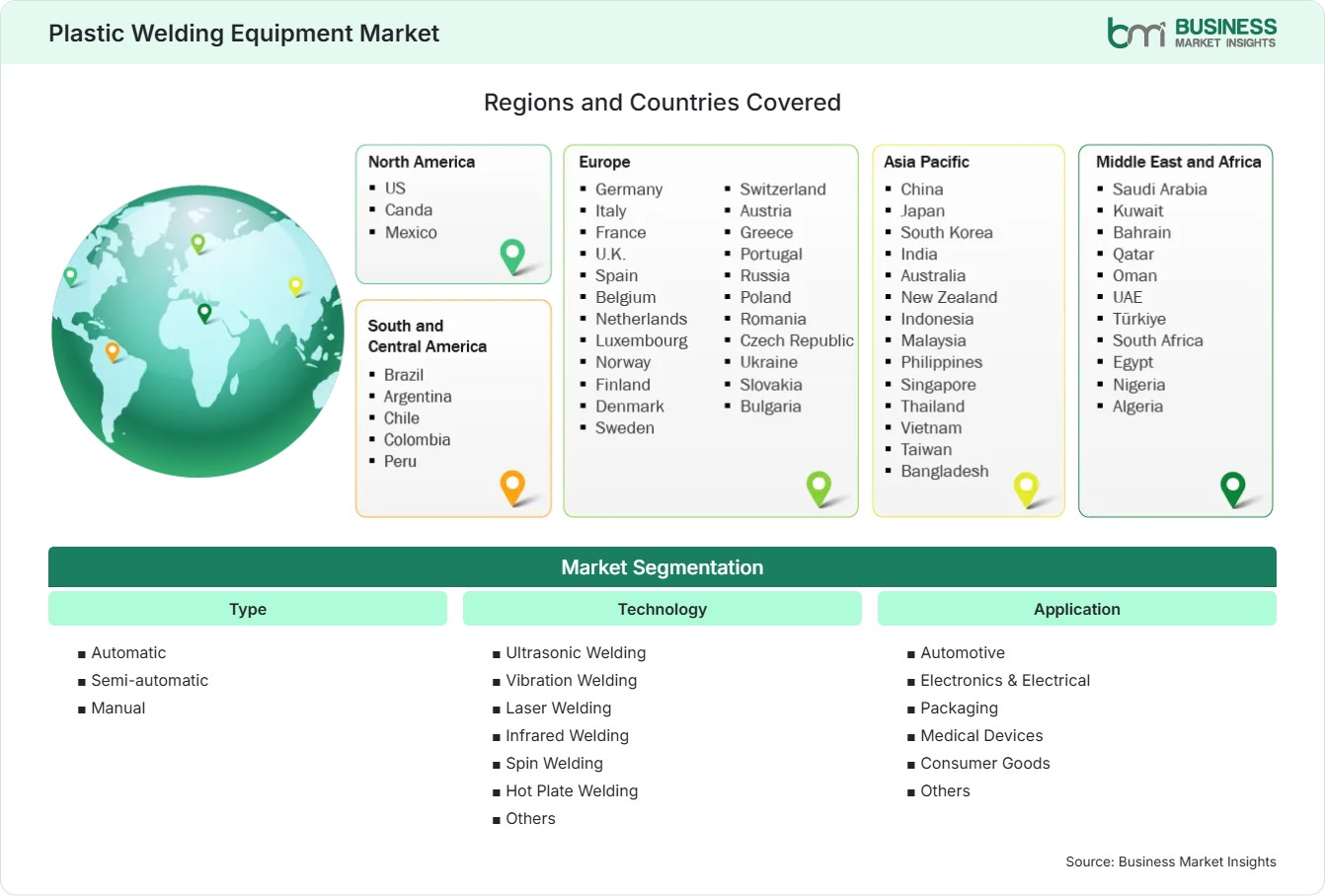
Global Market Geography
FREE PDF
Request your free sample
Request free sample
05 Segment Analysis

Plastic Welding Equipment Market Segmentation

Type

Automatic equipment holds a 42%–46% share in 2025 and is projected to grow at a 6.4%–7.0% CAGR through 2033. Automation improves repeatability, cycle control, productivity, and integration with high-volume production lines, supporting adoption among manufacturers seeking consistent joining quality.

  • Automatic: Automatic systems support high-volume production through programmed welding cycles, controlled parameters, automated handling, and repeatable joining performance, making them suitable for demanding industrial manufacturing environments.
  • Semi-automatic: Semi-automatic systems balance operator involvement with controlled welding processes, supporting manufacturers requiring flexibility, moderate production volumes, and improved consistency without fully automated production lines.
  • Manual: Manual equipment provides flexibility for repair, installation, prototyping, low-volume fabrication, and irregular components where automated systems may not provide sufficient economic justification.

Technology

Ultrasonic welding remains a leading technology within the Plastic Welding Equipment Market because it enables rapid joining of compatible thermoplastics with localized energy delivery and strong automation compatibility. Laser welding is the high-growth technology, supported by precision, clean joining, complex geometries, and increasing requirements in advanced manufacturing applications.

  • Ultrasonic Welding: Ultrasonic systems provide rapid thermoplastic joining through localized vibration and are widely applicable to electronics, automotive, medical, packaging, and consumer product assemblies.
  • Vibration Welding: Vibration welding supports larger polymer components and demanding structural assemblies where frictional energy generates heat across joining interfaces and enables strong thermoplastic connections.
  • Laser Welding: Laser welding provides precise, controlled energy delivery with limited surrounding heat exposure, supporting complex polymer assemblies, transparent components, medical devices, electronics, and advanced automotive applications.
  • Infrared Welding: Infrared welding offers non-contact heating and controlled joining for thermoplastic components where clean interfaces, repeatable heating, and reduced mechanical contact are desirable.
  • Spin Welding: Spin welding uses rotational friction to generate localized heat and is particularly suitable for cylindrical thermoplastic components requiring fast and repeatable joining.
  • Hot Plate Welding: Hot plate welding joins thermoplastic parts through heated interfaces and supports larger components, complex geometries, automotive assemblies, and industrial applications requiring strong welded joints.

Application

Automotive applications hold a 30%–34% share in 2025 and are projected to grow at a 6.8%–7.5% CAGR through 2033. Lightweight polymer components, electrification-related assemblies, fluid systems, interiors, and under-hood applications are increasing the requirement for reliable joining equipment across vehicle manufacturing.

  • Automotive: Automotive applications use plastic welding for fluid systems, interiors, battery-related structures, lighting components, reservoirs, and lightweight assemblies requiring reliable thermoplastic joining.
  • Electronics & Electrical: Electronics and electrical applications require precise joining for housings, connectors, sensors, and enclosures where controlled energy delivery protects sensitive components and supports production consistency.
  • Packaging: Packaging applications use welding to seal polymer films, containers, and flexible structures, with demand influenced by high-volume production, seal integrity, throughput, and material compatibility.
  • Medical Devices: Medical-device production requires repeatable, controlled joining for specialized polymer assemblies, fluid-management components, housings, and disposable products where process consistency and clean manufacturing are critical.
  • Consumer Goods: Consumer goods manufacturers use plastic welding for appliances, household products, sporting equipment, and molded assemblies where appearance, durability, productivity, and cost efficiency influence process selection.
06 Market Forces

Plastic Welding Equipment Market Dynamics

Key Market Drivers

Growing Manufacturing Automation Drives Plastic Welding Demand

Joining processes in manufacturing companies are being increasingly automated using machines capable of giving a constant energy supply, pressure control, cycle time, and welding performance. Automation will help eliminate the effects of variability of the operators, at the same time enhancing productivity and repeatability. Equipment manufacturers are including features like programmable controls, recipes, process monitoring, and automation in order to meet the demands of current manufacturing lines. Therefore, the Plastic Welding Equipment Market trend is shifting towards joining equipment that will be incorporated into the overall automation of manufacturing processes. This is especially true in cases where labor shortages are common and there is a need for quality and efficient production.

Rising Lightweight Plastic Components Boost Equipment Adoption

The growing demand for lighter, more compact components in automotive and industrial production is driving the adoption of thermoplastics for these applications. This results in an increased requirement for joining techniques that can accommodate the wide range of polymers, part geometries, wall thicknesses, and reinforcement arrangements. Welding can help achieve clean, consistent joints that do not require mechanical fixings, thereby enabling lightweight component configurations. The development of equipment is therefore moving toward accurate energy delivery, flexible tooling, and process control, which would accommodate the increasing complexity of injection-molded parts. Companies able to show the welding capability for engineered thermoplastics can take advantage of this trend.

Increasing Automotive Plastic Applications Support Market Growth

The automotive manufacturers are increasingly using plastics for the interiors, fluids, lights, electricals, reservoirs, and semi-structural structures. With the growing shift towards advanced designs in vehicle architecture, there is a growing need for joining technologies that facilitate complex geometries, while also providing dimensional and sealing integrity. Plastic welding systems would help in the integration and automation of the parts and assemblies, especially in cases where fasteners would add to the weight of the components and increase the production process. The demands are further being fueled due to the advent of electric vehicles, which have additional polymer parts around the battery, thermal, and electrical management.

Key Market Opportunities

Expanding Electric Vehicle Manufacturing Creates New Demand

The manufacture of electric vehicles provides opportunities for plastic welding equipment in relation to battery enclosures, thermal management, electrical protection elements, charging equipment, connector parts, and lightweight interior parts. Such processes need to be carefully conducted as polymer parts may require sealing, insulating, stability, and protection from environmental factors. The Plastic Welding Equipment Market forecast receives support through providing specialized equipment for innovative EV components rather than just conventional vehicle components. Manufacturers of such equipment might generate added value by implementing innovations in the manufacturing process, designing the tools, QA systems, and assembly lines.

Growing Medical Device Production Boosts Welding Applications

There are many opportunities for plastic welders in medical device manufacturing, since polymers are used extensively in the manufacture of fluid management devices, diagnostic devices, housing, disposables, and other medical devices. Medical device manufacturers seek joining machines that offer repeatable, controlled, and sealed joints as part of their validated manufacturing process. Machines utilizing ultrasonic technology, lasers, and others can be suitable for applications where the use of adhesives or mechanical fasteners would cause potential contamination issues or material compatibility problems. Differentiation can come from clean manufacturing process capabilities, application testing services, documentation support, precise tooling, and process parameter control. Increasing medical device manufacturing capacity worldwide provides more customers.

Increasing Plastic Component Manufacturing Across Emerging Markets

Manufacturing countries in the developing world present potential because of growth in automotive, electronics, packaging, consumer products, and plastics processing industries. Plants setting up shop can incorporate advanced joining technology right away, as opposed to continuing with traditional manual methods. This offers a chance to supply companies selling modular solutions, scalable equipment, localized service, and training based on specific applications. Collaboration in the regions with system integrators and plastics processors will help overcome implementation challenges while maximizing the use of equipment. Manufacturers can also cater to smaller plants through semi-automatic equipment, which ensures process uniformity without having to invest in fully automatic lines.

Market Restraints and Challenges

High Equipment Costs Limit Small Manufacturer Adoption

Factor: Plastic welding systems that are advanced need money to be spent on machines, tools, controls, integration, installation, and qualification of the process. Impact: The fact that there are high initial costs means that small and medium-sized businesses could be delayed from implementing such technology due to a lack of sufficient production volume to provide a quick payback on the machine. The buyer may still use traditional methods of welding or other technologies that are not advanced, even if they have lower automation and consistency. Suppliers can overcome this factor through modularity and scalability of machines, financing, leasing, and upgradeable systems. But capital sensitivity is still a limitation in fragmented manufacturing environments.

Specialized Welding Processes Require Skilled Operators

Factor: The welding of plastic involves material compatibility, joint configuration, tooling, energy input, temperature, pressure, and timing, and needs specific technical expertise for the same. Impact: A shortage of operators and application engineers will lead to longer periods for set-up and tuning. More advanced machinery can alleviate the need for hands-on expertise to some extent via process recipes and process monitoring. However, machinery manufacturers will require experts who can tune parameters according to material and tooling changes. Solution: Application labs, operator training, remote diagnostics, pre-configured process recipes, and technical support from the supplier could help in overcoming the issue.

07 Company Analysis

Competitive Landscape

The competitive environment combines specialized plastic joining manufacturers, welding technology providers, automation-focused suppliers, and diversified industrial equipment companies. Plastic Welding Equipment Market analysis indicates that competition centers on joining precision, technology breadth, automation integration, tooling capabilities, application engineering, service coverage, and lifecycle support.

Company Name

Overview

Products and Services relevant to this market

Leister Technologies AG

Specialist provider of plastic welding and process-heat technologies serving industrial and infrastructure applications globally.

Plastic welding machines, hot-air systems, extrusion welders, infrared systems, accessories, and application support.

Fronius International GmbH

Diversified welding technology company with expertise in automated joining systems and industrial production technologies.

Welding systems, automation technologies, process-control solutions, industrial joining equipment, and production support.

Herrmann Ultraschalltechnik GmbH & Co. KG

Specialist ultrasonic technology provider serving automotive, packaging, medical, electronics, and consumer-product manufacturers.

Ultrasonic welding machines, tooling, generators, automation systems, process monitoring, and application engineering.

ROTHENBERGER Werkzeuge GmbH

Industrial tool and equipment manufacturer serving professional installation, fabrication, and joining applications.

Plastic welding tools, heating equipment, pipe-processing systems, accessories, and professional joining solutions.

Wegener International, Inc.

Equipment provider focused on plastic fabrication and thermoplastic welding solutions for industrial applications.

Plastic welding equipment, extrusion systems, hot-air tools, fabrication machinery, and related accessories.

Forward Technology

Industrial welding equipment specialist supporting thermoplastic joining and automated production applications.

Ultrasonic, spin, vibration, and other plastic welding systems, tooling, automation, and engineering services.

Bielomatik Leuze GmbH + Co. KG

Engineering company providing automated production systems and specialized plastic joining technologies.

Ultrasonic, vibration, hot plate, infrared, and laser welding systems with automation and process engineering.

Miller Weldmaster Corporation

Manufacturer specializing in automated and semi-automated thermoplastic welding equipment for industrial fabrication.

Hot-air and wedge welding systems, automated machines, thermoplastic fabrication equipment, and production solutions.

Dukane IAS LLC

Industrial joining technology provider with a strong focus on ultrasonic plastic welding and automation.

Ultrasonic welders, actuators, generators, tooling, automation systems, and process-control technologies.

Branson Ultrasonics Corporation

Established ultrasonic joining technology provider serving high-volume manufacturing and engineered plastic applications.

Ultrasonic welding systems, actuators, power supplies, tooling, automation platforms, and process-development support.

10 Trust & Transparency

Research Methodology

The market analysis combines proprietary research with secondary data from government agencies, company disclosures, regulatory filings, industry databases and expert interviews. Market estimates are validated through data triangulation, cross-market benchmarking and analyst review.

View Full Research Methodology

11 Questions Answered

Frequently Asked Questions

What does the Plastic Welding Equipment Market report indicate about future competition?

The report indicates that competition will increasingly focus on automation readiness, process monitoring, technology versatility, tooling expertise, application engineering, and service capabilities. Suppliers that support customers from process development through production integration can strengthen long-term relationships and differentiate beyond equipment pricing.

Why are electric vehicles creating new opportunities for plastic welding equipment?

EV production increases the use of polymer components in battery systems, thermal-management assemblies, electrical protection structures, connectors, charging systems, and lightweight interiors. These applications require precise joining and sealing, creating opportunities for specialized equipment, tooling, process monitoring, and automated production systems.

How are advanced welding technologies influencing equipment adoption?

Ultrasonic, laser, infrared, vibration, and automated hot plate technologies are expanding process options for manufacturers. These technologies allow joining systems to be matched more closely with polymer type, component geometry, production volume, weld-quality requirements, and automation objectives.

Which applications present the strongest opportunity in the market?

Automotive, electronics, medical devices, packaging, and EV-related component manufacturing present strong opportunities. Applications requiring lightweight polymer structures, reliable sealing, clean joining, high production volumes, and repeatable assembly are particularly suitable for advanced plastic welding technologies.

What factors are improving Plastic Welding Equipment Market return on investment?

Automation, lower manual intervention, improved weld consistency, reduced scrap, faster cycle management, and production-line integration can improve equipment economics. Manufacturers can also increase returns by selecting modular systems that support multiple components and applications rather than dedicated equipment with limited utilization.

Access the Full Plastic Welding Equipment Market Report

Get segment-level forecasts, regional estimates, competitive benchmarking, company profiles and downloadable Excel datasets.

Access the full Plastic Welding Equipment Market Report
350 pages PDF & Excel | 2026-08-19