Arc Welding Market Regional Highlights
North America Arc Welding Market
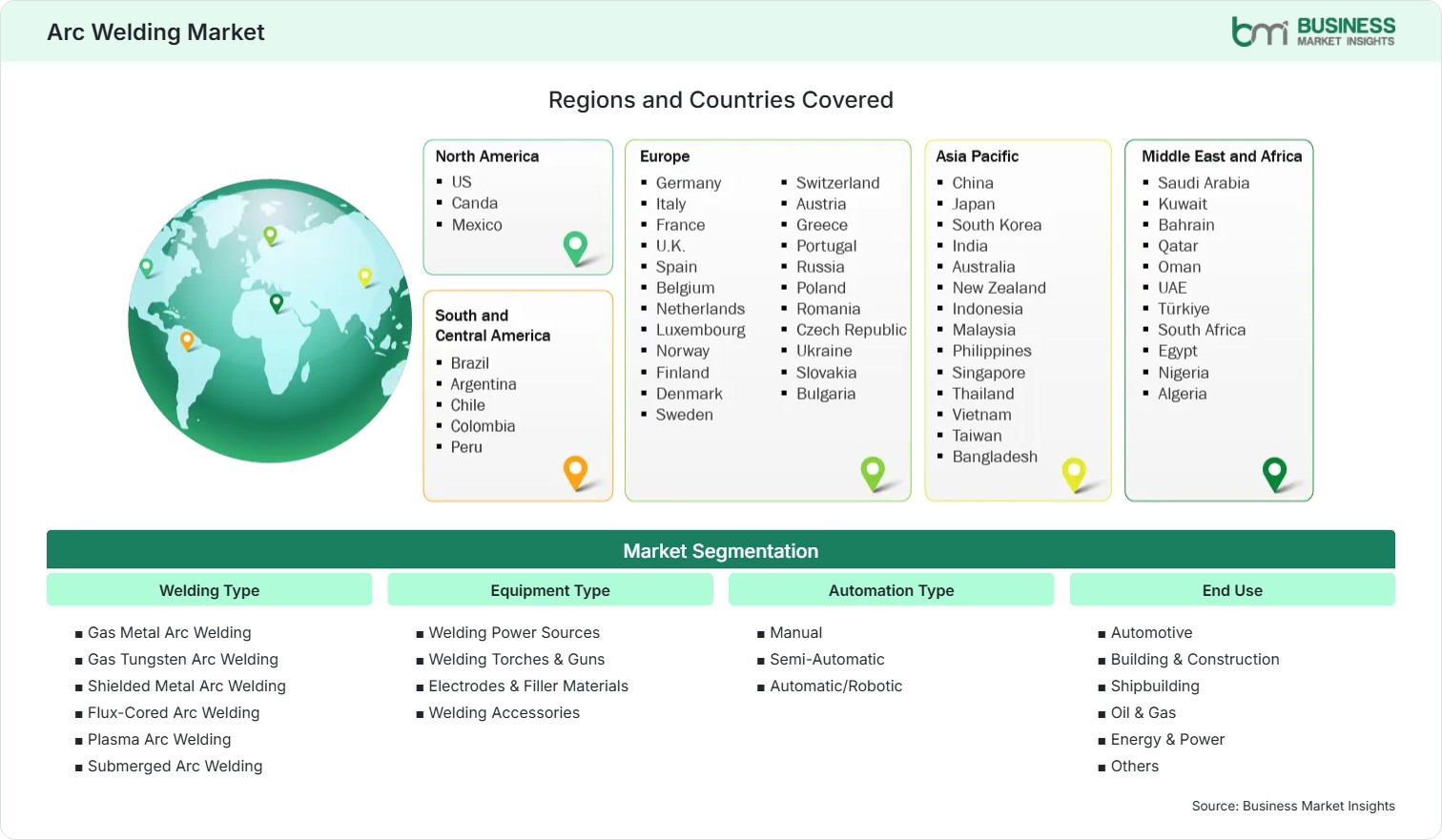
North America holds 25%–28% share in 2025 and North America Arc Welding Market forecast to grow at 4.8%–5.3% CAGR through 2033. The region benefits from manufacturing investment, infrastructure renewal, automotive production, energy projects, and construction activity. The US dominates regional demand, while Canada contributes through energy, construction, transportation, and industrial fabrication.
- Investments in manufacturing are contributing to the demand for more productive welding machines due to increased investments in fabrication capacity and automation of process with less manual intervention at various stages.
- Infrastructural development is fueling the demand for the use of welding equipment in areas that require the use of robust welding machines.
- Adoption of automation technology is increasing among manufacturers seeking consistent weld results with less dependence on available skilled labor.
- Energy projects provide additional demand for welding equipment and consumables as fabrication requirements increase across infrastructure, equipment manufacturing, and maintenance activities.
US Arc Welding Market
The US Arc Welding Market represents 82%–86% of North American demand in 2025 and is projected to expand at 4.9%–5.4% CAGR through 2033. Investment in industrial equipment, construction, transport equipment manufacturing, infrastructure and equipment upgrading facilitate the demand. Fabricators are now considering automation along with regular machinery to cope with issues of productivity and availability of labor. Energy conservation and process control have become more important in terms of operating cost considerations.
- Manufacturing modernization is supporting investment in welding equipment capable of higher duty cycles, improved process control, digital monitoring, and integration with automated production systems.
- Construction and infrastructure activity supports demand for portable and heavy-duty equipment suited to structural fabrication, field operations, maintenance, and large-scale industrial projects.
- Labor constraints are encouraging fabricators to automate repetitive welding operations where consistent cycle times, quality control, and production continuity justify capital investment.
Europe Arc Welding Market
Europe Arc Welding Market holds 22%–25% share in 2025 and is forecast to grow at 4.4%–5.0% CAGR through 2033. The growth of Germany, Italy, France, and the UK is sustained due to the presence of established automotive industry, machinery industry, construction industry, and fabrication industries. However, Poland and Spain represent potential markets as the manufacturing base grows through industrialization. Germany is estimated to grow between 4.8% and 5.4% annually, whereas Poland is estimated to grow between 5.7% and 6.3%.
- Germany benefits from advanced manufacturing, automotive production, machinery fabrication, and established automation capabilities that support demand for digitally integrated welding systems.
- Poland provides stronger growth potential as industrial capacity expands and manufacturing investment increases demand for welding equipment, consumables, and automated production technologies.
- European manufacturers increasingly prioritize energy efficiency and process optimization as industrial operating costs influence investment in newer welding power sources and automated systems.
Asia Pacific Arc Welding Market
Asia Pacific Arc Welding Market holds 39%–42% share in 2025 and is projected to grow at 6.2%–6.8% CAGR through 2033. China, Japan, South Korea, and India represent leading demand centers, while India and Southeast Asian economies provide stronger expansion opportunities. China is projected to grow at 6.1%–6.7% CAGR, while India is expected to expand at 7.0%–7.7% CAGR. Manufacturing capacity additions, construction, automotive production, shipbuilding, energy infrastructure, and industrial automation collectively support equipment demand across the region.
- China benefits from extensive manufacturing capacity, and industrial infrastructure requiring high volumes of welding equipment.
- India provides strong growth potential through manufacturing expansion, and increasing industrial automation.
- Japan and South Korea support advanced welding demand through automotive, shipbuilding, machinery, electronics, and industrial automation industries requiring controlled and repeatable processes.
- Southeast Asia is developing as an additional fabrication center as manufacturing investment, infrastructure construction, transportation equipment production, and industrial capacity expand.
Rest of World Arc Welding Market
Rest of World holds 8%–11% share in 2025 and is projected to grow at 4.0%–4.7% CAGR through 2033 as industrial capacity and infrastructure spending expand. The South and Central American regions have consistent demand because of construction, mining, energy infrastructure, automotive manufacture, and manufacturing. Brazil and Mexico are still key markets due to industrial operations and manufacturing. Mexico has a competitive advantage because of manufacturing operations and transport equipment manufacture, whereas Brazil has an extensive industrial and infrastructure base. The Middle East and African regions present growth potential for energy infrastructure, construction, industrialization, transport infrastructure, and equipment maintenance.
- Brazil remains an important regional demand center because industrial fabrication, construction, mining, energy, and transportation applications require diverse welding equipment and consumables.
- Mexico benefits from manufacturing expansion and industrial supply-chain integration, supporting demand for production welding systems, equipment modernization, and fabrication automation.
- Gulf economies provide opportunities through infrastructure and energy investment, increasing requirements for heavy fabrication, equipment maintenance, and industrial construction capabilities.
- South Africa contributes to regional demand through mining, infrastructure, energy, construction, and industrial maintenance applications requiring durable welding systems.