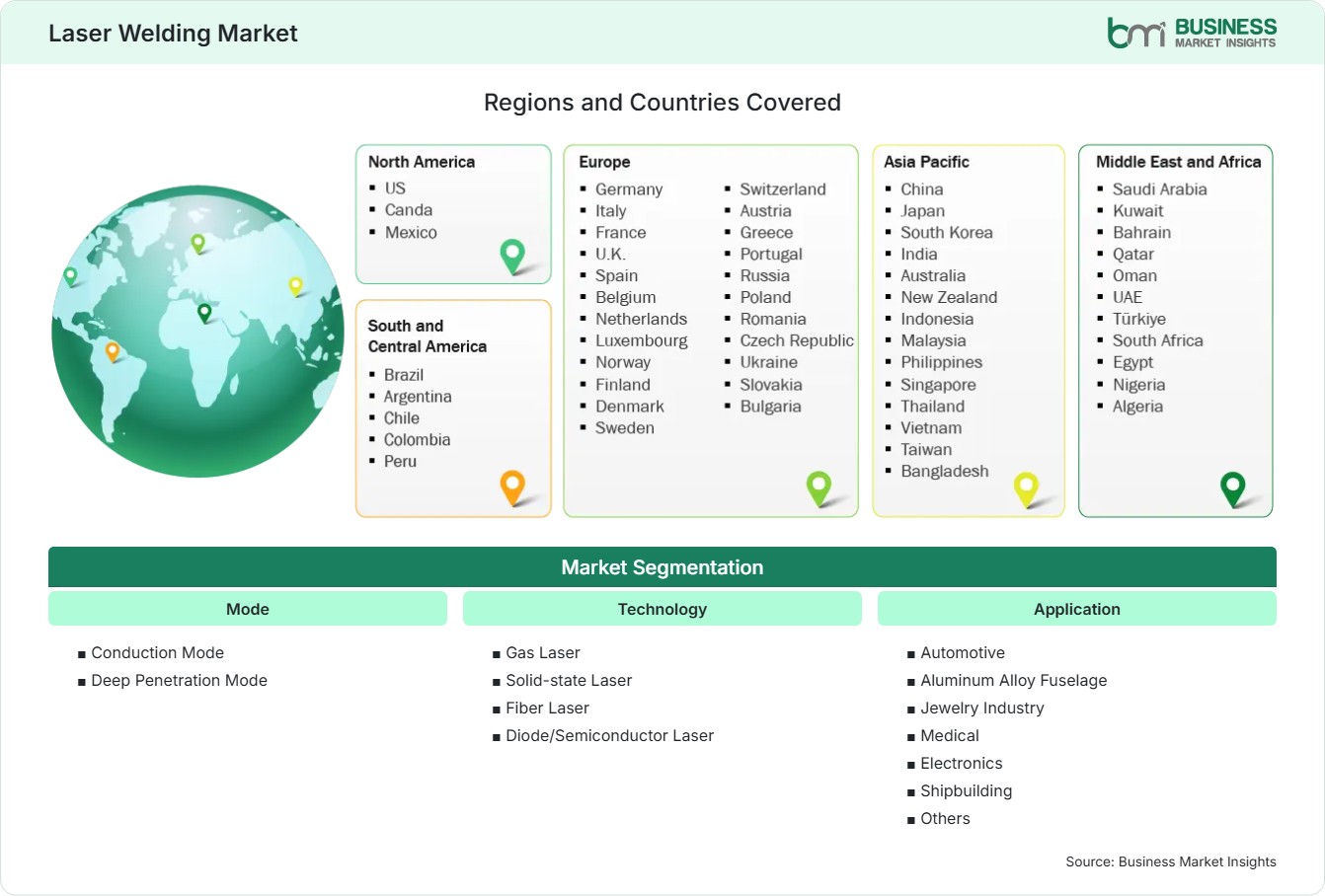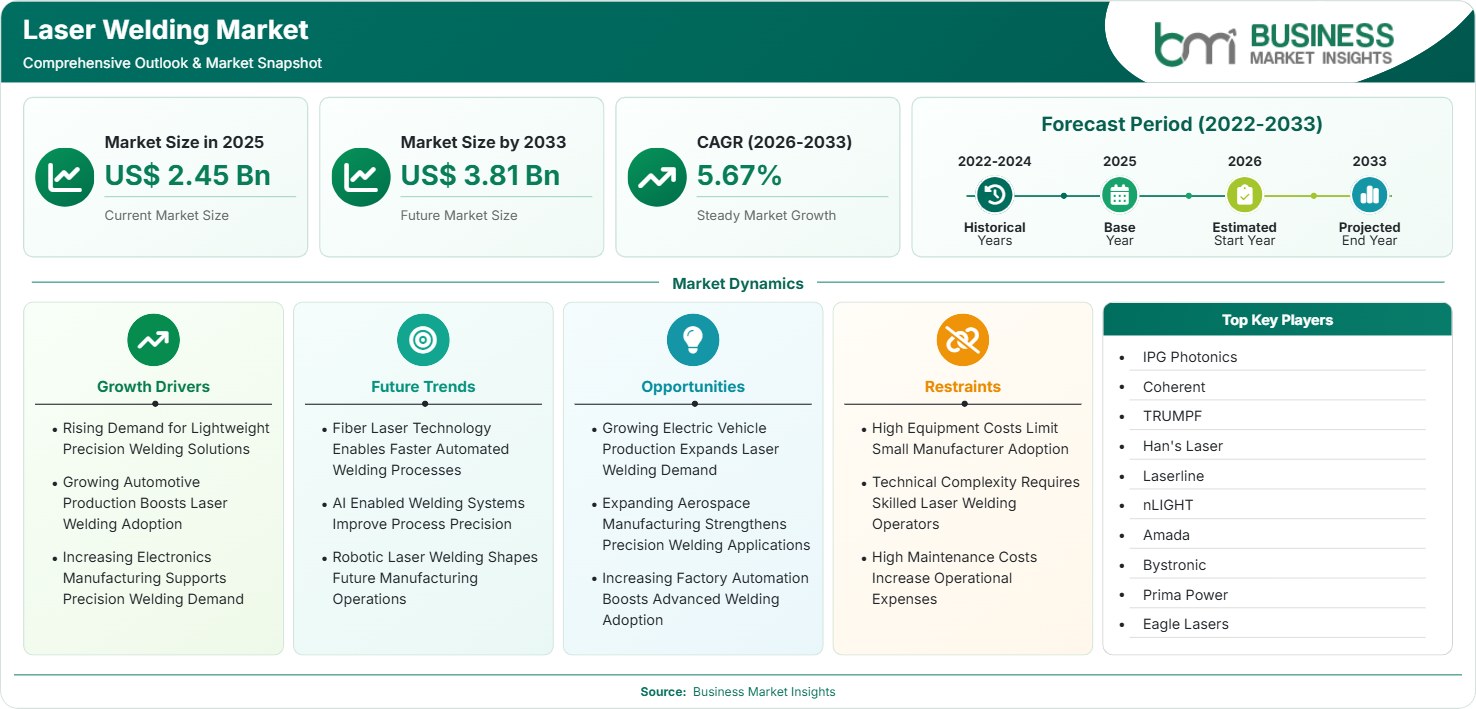
Laser Welding Market Regional Highlights
North America Laser Welding Market
North America held 28%–32% Laser Welding Market share in 2025 and is projected to expand at 5.1%–5.8% CAGR through 2033. Demand reflects automotive electrification, aerospace production, medical devices, electronics reshoring, and industrial automation. The US remains the principal regional contributor, supported by advanced manufacturing investment and high adoption of robotic production. Mexico strengthens the regional supply chain through vehicle and electronics manufacturing.
- Automotive and battery manufacturing are increasing requirements for controlled, repeatable welding of lightweight structures and conductive components across North American production facilities.
- Aerospace programs favor low-distortion joining and traceable process control, supporting laser adoption for structural assemblies and complex components requiring consistent quality.
- Industrial automation investments encourage integration of robotic welding cells with sensors, scanners, and software, improving productivity while reducing dependence on manual intervention.
- Medical-device manufacturers require precise joining of small components, creating demand for compact laser systems capable of controlled heat input and repeatable processing.
US Laser Welding Market
The US represented 20%–23% of global demand and 70%–75% of North American demand in 2025, expanding at 5.0%–5.7% CAGR through 2033. Domestic automotive, aerospace, medical-device, semiconductor, and electronics manufacturing provide diversified demand. Industrial reshoring and factory modernization support investments in automated welding platforms.
- EV and battery investments are expanding demand for precise busbar, cell, module, and power-electronics joining, where thermal control and process monitoring influence production yields.
- Aerospace manufacturers increasingly value automated joining systems capable of producing consistent weld quality across lightweight alloys and complex assemblies with documented process parameters.
- Medical and electronics applications favor compact, programmable systems that deliver localized heat input while minimizing component deformation and maintaining tight dimensional tolerances.
Europe Laser Welding Market
Europe held 24%–28% share in 2025 and is projected to grow at 4.8%–5.6% CAGR through 2033. Germany leads regional demand, while Italy, France, and the United Kingdom maintain important automotive, industrial, aerospace, and engineering applications. Germany is estimated to grow at 5.0%–5.8% CAGR, while Poland is among the faster-growing manufacturing markets at 6.0%–6.8%. Energy efficiency, automation, premium vehicle manufacturing, and advanced machinery expertise support adoption despite industrial cost pressures.
- Germany remains the leading regional Laser Welding Market, supported by automotive engineering, industrial machinery, aerospace suppliers, and sophisticated automation infrastructure requiring precise joining technologies.
- Italy benefits from machinery, automotive, and luxury-goods manufacturing, creating applications for flexible laser systems across high-value components and specialized production.
- France and the United Kingdom benefit from aerospace and defense manufacturing requirements, where controlled heat input and repeatable welding support lightweight structural production.
- Poland offers high-growth potential as automotive and industrial supply chains expand, increasing demand for automated equipment and digitally connected manufacturing processes.
Asia Pacific Laser Welding Market
Asia Pacific held 34%–38% share in 2025 and is forecast to expand at 6.4%–7.2% CAGR through 2033. China leads regional demand, supported by automotive, EV, electronics, battery, and industrial production. Japan and South Korea remain technologically advanced Laser Welding Markets, while India and Southeast Asia provide high-growth opportunities. China is estimated to grow at 6.5%–7.3% CAGR, while India may achieve 7.2%–8.0% CAGR.
- China remains the largest regional Laser Welding Market, with electric vehicle sales exceeding 11 million in 2024 and strong battery manufacturing activity supporting precision welding demand.
- Japan maintains demand for advanced joining in automotive, electronics, robotics, and precision machinery, favoring highly reliable equipment with sophisticated process control.
- South Korea benefits from battery, electronics, automotive, and semiconductor manufacturing, supporting demand for high-speed welding systems with tight process repeatability.
- India offers high-growth potential as automotive, electronics, aerospace, and industrial manufacturing capacity expands, creating opportunities for localized equipment and automation providers.
- Southeast Asia is emerging as a manufacturing alternative for electronics and automotive supply chains, increasing demand for flexible, scalable welding technologies.
Rest of World Laser Welding Market
South and Central America represented 7%–10% of global demand in 2025, with Brazil and Mexico-linked supply chains supporting automotive and industrial applications. Brazil is estimated at 5.5%–6.3% CAGR, while Colombia offers 6.2%–7.0% potential. The region benefits from industrial modernization and vehicle manufacturing expansion.
- Brazil provides opportunities in automotive, heavy equipment, energy infrastructure, and industrial machinery, where localized production increasingly requires automated precision joining capabilities.
- Mexico-linked manufacturing ecosystems strengthen regional demand for automotive and electronics welding equipment, although the market remains sensitive to capital expenditure cycles.
- Saudi Arabia and the UAE are developing advanced manufacturing capabilities, creating opportunities for automated welding technologies within diversified industrial and infrastructure programs.
- South Africa benefits from automotive production and engineering expertise, supporting applications requiring reliable joining of metals across vehicle and industrial components.