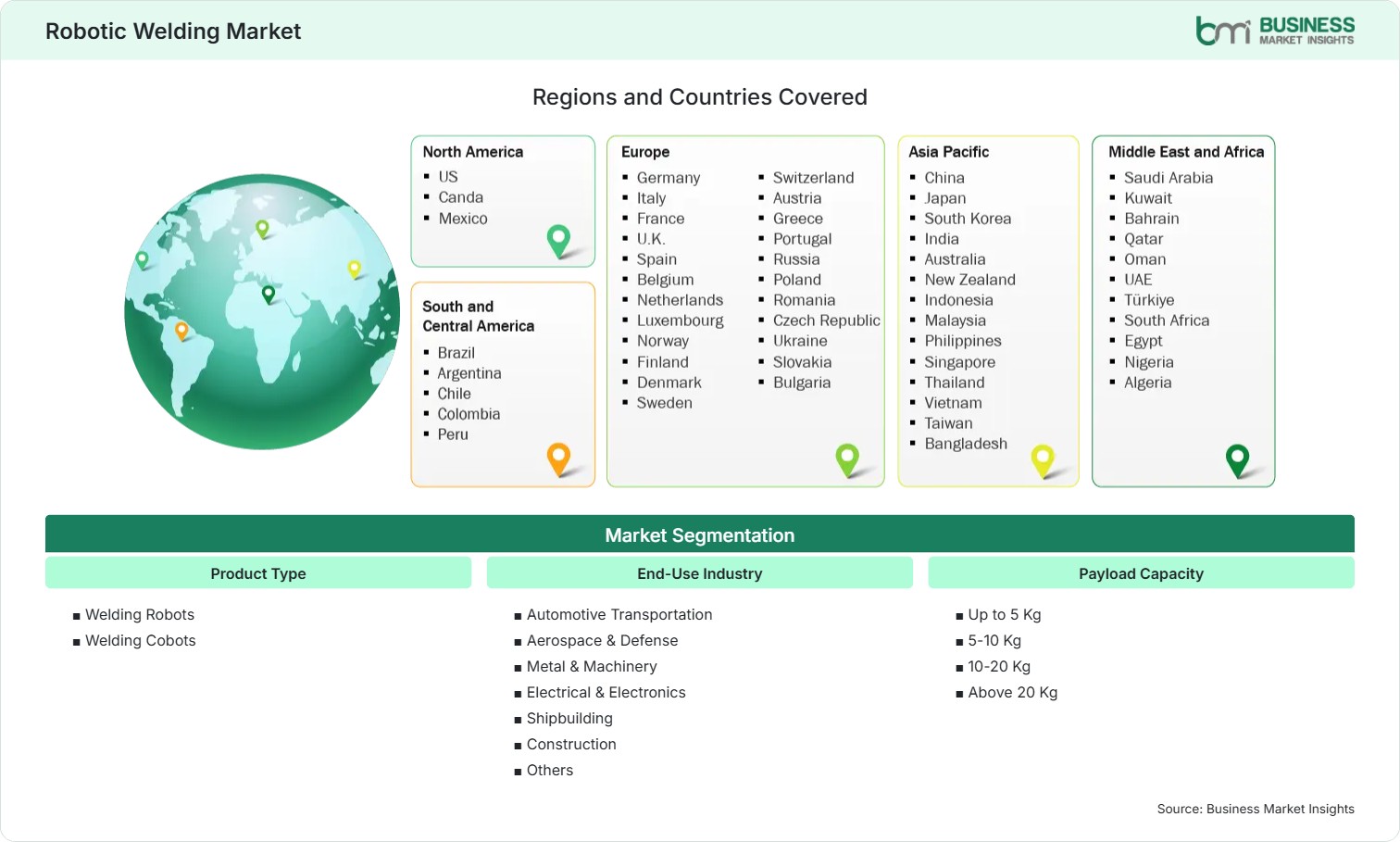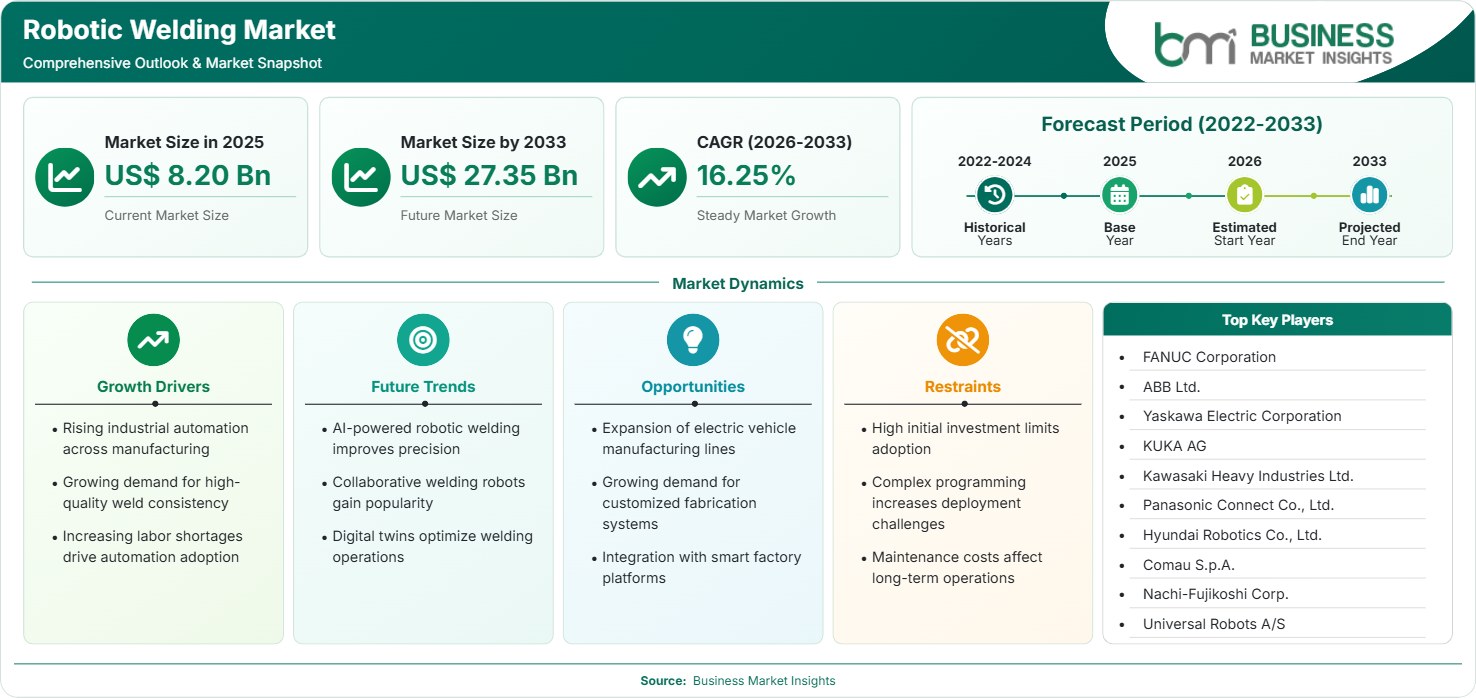
Robotic Welding Market Regional Highlights
North America Robotic Welding Market
North America accounted for 30%–33% of the Robotic Welding Market Share in 2025 and is projected to expand at a CAGR of 15.6%–16.0% during 2026–2033. Strong industrial automation, increasing investments in smart manufacturing, reshoring of production facilities, and growing adoption of intelligent robotics continue strengthening regional competitiveness. Automotive, aerospace, heavy equipment, and metal fabrication industries remain major adopters of advanced robotic welding technologies to improve production efficiency and product quality.
- Automotive manufacturers continue modernizing production facilities with intelligent robotic welding systems to improve throughput, weld consistency, production flexibility, and manufacturing precision while reducing operational costs.
- Aerospace manufacturers increasingly deploy robotic welding technologies for high-precision fabrication of structural components, supporting enhanced quality assurance and compliance with stringent manufacturing standards.
- Government initiatives promoting advanced manufacturing and industrial digitalization encourage greater investments in automation technologies across multiple industrial sectors.
- Growing labor shortages across skilled manufacturing occupations continue accelerating adoption of robotic welding systems capable of operating continuously with minimal human intervention.
- Increasing integration of artificial intelligence, machine vision, and predictive maintenance technologies further improves robotic system performance, equipment reliability, and manufacturing productivity.
US Robotic Welding Market
The United States represented 26%–29% of global revenue in 2025 and is forecast to register a CAGR of 15.8%–16.2% through 2026–2033. Strong investments in factory automation, advanced manufacturing technologies, and electric vehicle production continue supporting robust demand. Expanding adoption of collaborative robotics and smart factory platforms further strengthens industrial competitiveness.
- Manufacturing companies continue investing in robotics to improve production efficiency, reduce dependence on manual welding operations, and address skilled labor shortages.
- Electric vehicle manufacturers increasingly deploy intelligent robotic welding systems to support high-volume production while maintaining precision and consistent weld quality.
- Growing adoption of Industrial Internet of Things technologies enables real-time equipment monitoring, predictive maintenance, and production optimization across manufacturing facilities.
- Continuous investment in research and development accelerates commercialization of intelligent robotic welding technologies designed for flexible manufacturing environments.
Europe Robotic Welding Market
Europe held 25%–28% robotic welding market share during 2025 and is anticipated to grow at a CAGR of 15.1%–15.6% through 2026–2033. Strong industrial automation capabilities, advanced engineering expertise, expanding automotive manufacturing, and increasing adoption of Industry 4.0 technologies continue supporting regional development. Germany leads regional demand with a CAGR of 15.3%–15.8%, while Poland records the fastest growth at 16.4%–16.9% owing to expanding industrial investments.
- Germany maintains regional leadership through advanced automotive production, industrial robotics expertise, and continuous investment in intelligent manufacturing technologies.
- Poland experiences rapid industrial expansion supported by increasing foreign manufacturing investments, factory modernization, and automation across metal fabrication industries.
- Growing adoption of collaborative robots improves manufacturing flexibility while enabling safe human-robot interaction in complex welding operations.
- European manufacturers continue integrating artificial intelligence and digital simulation technologies into robotic welding systems to improve productivity and process optimization.
- Sustainability initiatives encourage deployment of energy-efficient robotic manufacturing solutions that minimize waste and improve resource utilization.
Asia Pacific Robotic Welding Market
Asia Pacific accounted for 38%–41% of industry revenue in 2025 and is projected to record the highest CAGR of 17.4%–17.9% during 2026–2033. Expanding manufacturing industries, increasing industrial robot installations, growing electric vehicle production, and supportive government automation initiatives continue driving regional expansion. China leads regional demand with a CAGR of 17.3%–17.8%, while India records the fastest growth at 18.2%–18.7%.
- China continues strengthening manufacturing leadership through significant investments in industrial robotics, intelligent production systems, and advanced manufacturing technologies.
- India benefits from expanding automotive production, industrial modernization initiatives, and increasing adoption of robotic automation across engineering and fabrication industries.
- Japan and South Korea continue driving robotics innovation through advanced manufacturing technologies, intelligent automation systems, and precision engineering expertise.
- Rapid industrialization across Southeast Asia encourages manufacturers to deploy robotic welding systems to improve production quality and international competitiveness.
- Government-supported smart manufacturing initiatives continue accelerating industrial automation investments across multiple production sectors.
Rest of World Robotic Welding Market
The Rest of World accounted for 6%–9% robotic welding market share in 2025 and is expected to register a CAGR of 15.8%–16.3% during 2026–2033. South & Central America continue expanding industrial automation through investments in automotive manufacturing and metal fabrication industries.
The Middle East & Africa are witnessing increasing demand driven by infrastructure development, industrial diversification, and manufacturing modernization initiatives. Brazil leads South & Central America with a CAGR of 16.0%–16.4%, while Saudi Arabia records the highest regional growth at 16.5%–17.0% through expanding industrial automation investments.
- Brazil continues strengthening manufacturing competitiveness through factory modernization, increasing industrial robot deployment, and expanding automotive production capacity.
- Saudi Arabia supports industrial diversification through strategic investments in advanced manufacturing technologies, automation infrastructure, and intelligent production facilities.
- Metal fabrication industries increasingly adopt robotic welding technologies to improve product quality, production efficiency, and operational safety.
- Expanding industrial automation partnerships improve technology transfer while encouraging adoption of advanced robotic manufacturing systems.
- Growing infrastructure and heavy engineering projects create long-term demand for high-capacity robotic welding solutions across developing economies.