
Robotic Gripper Market Outlook: Size, Share, Trends, Growth Analysis, Competitive Landscape & Forecast, 2026–2033

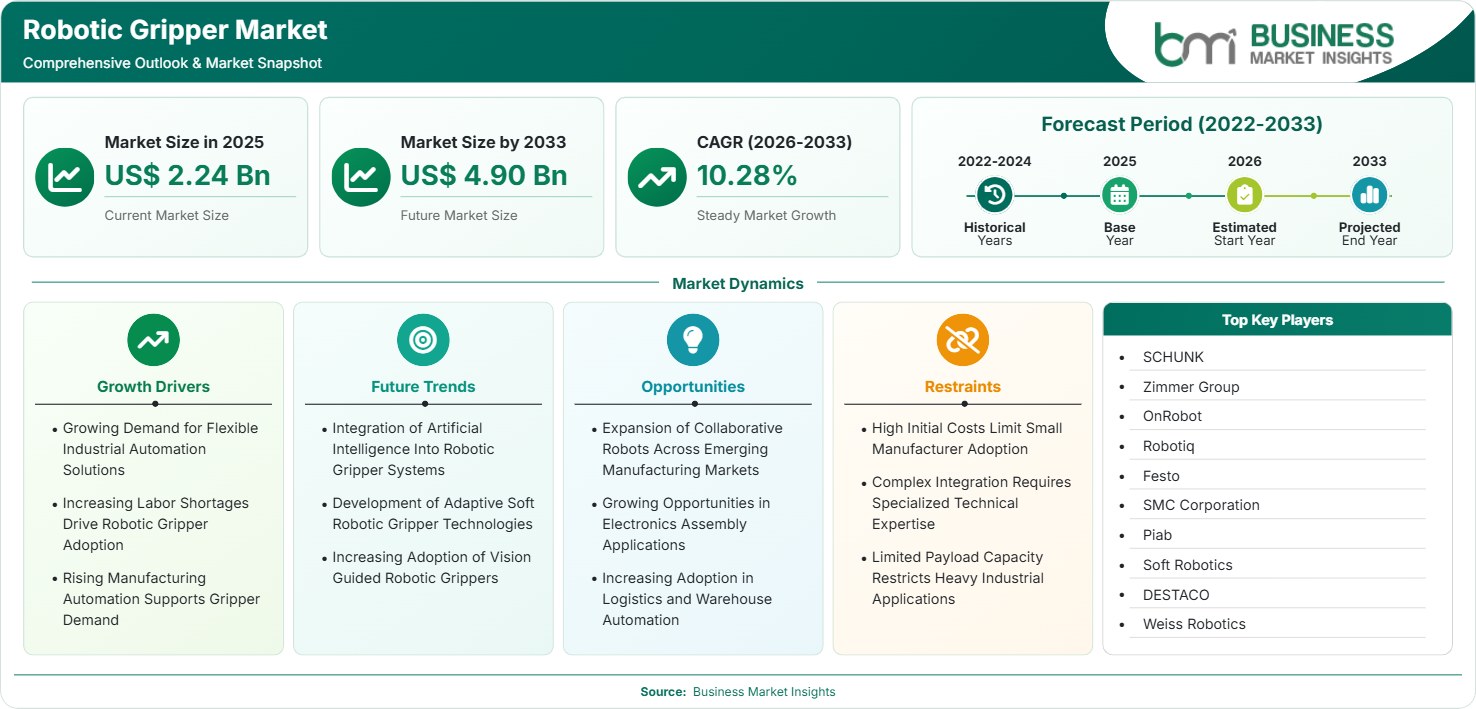
The Robotic Gripper Market size was valued at US$ 2.24 billion in 2025 and is projected to reach US$ 4.90 billion by 2033, growing at a CAGR of 10.28% during 2026–2033, driven by increasing industrial automation adoption, rising demand for flexible robotic systems, labor shortages, and growing deployment of collaborative robots across manufacturing sectors.

Report Coverage
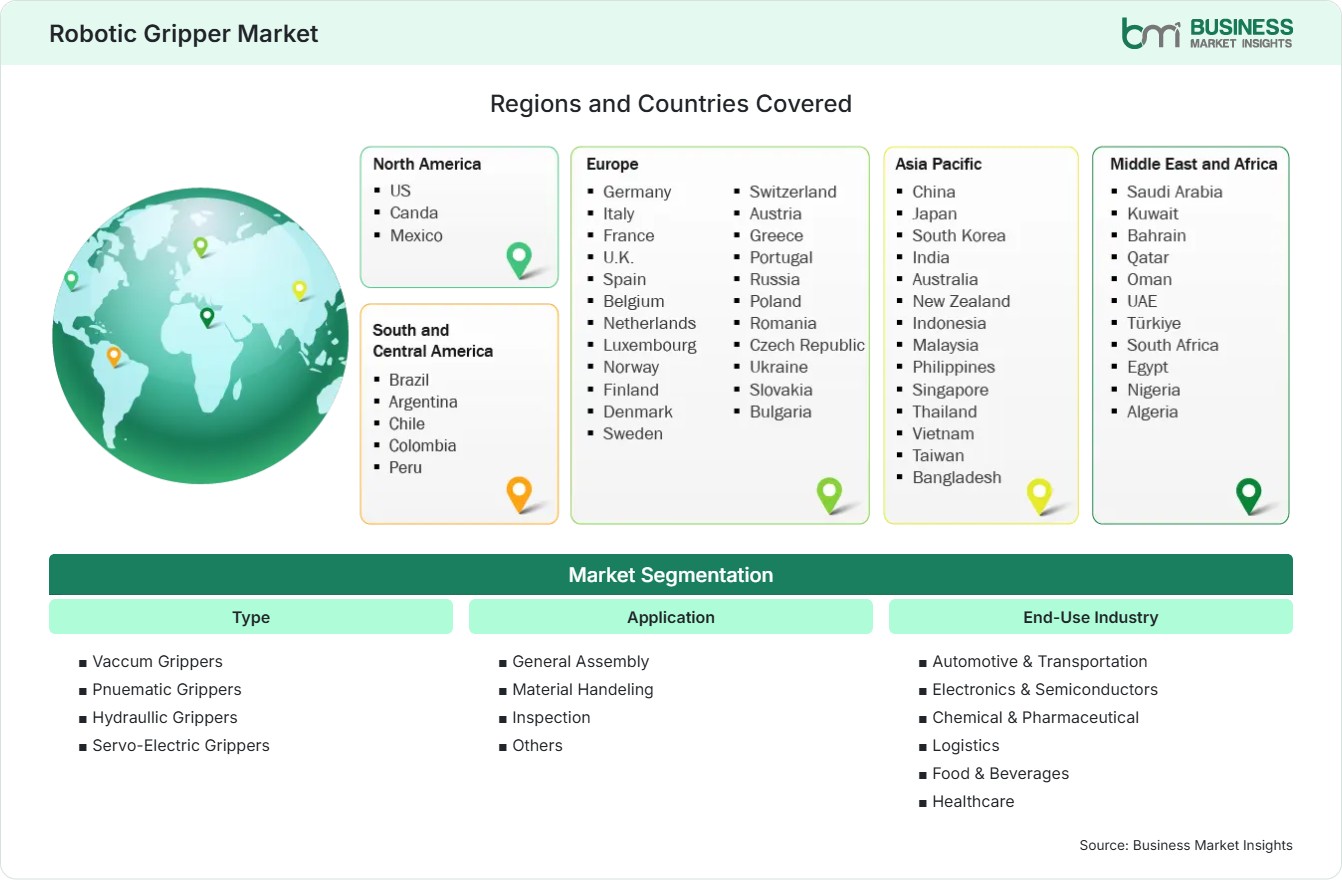
  • Type: Vaccum Grippers, Pnuematic Grippers, Hydraullic Grippers, Servo-Electric Grippers
  • Application: General Assembly, Material Handeling, Inspection, Others
  • End-Use Industry: Automotive & Transportation, Electronics & Semiconductors, Chemical & Pharmaceutical, Logistics, Food & Beverages, Healthcare
US$ 2.24 Bn Market size in 2025
US$ 4.90 Bn Market Size by 2033
10.28% CAGR, 2026 - 2033
2026-2033 Forecast Period

AI Overview

Robotic Gripper Market Summary

  • North America Region: North America holds 28%–32% market share in 2025 and is expected to grow at a 9%–11% CAGR during 2026–2033. Growth is supported by advanced manufacturing automation, increasing adoption of collaborative robots, industrial modernization initiatives, and rising demand for flexible robotic handling solutions.
  • Fastest Growing Region: Asia Pacific accounts for 38%–42% market share in 2025 and is projected to grow at a 11%–13% CAGR through 2033. Growth is driven by expanding manufacturing activities, increasing automation investments, rising electronics production, and growing adoption of robotic systems across industrial facilities.
  • Leading Segment: Pneumatic Grippers represent 40%–44% market share in 2025 due to widespread industrial adoption, cost effectiveness, high reliability, and suitability for assembly, handling, and manufacturing automation applications.
  • High Growth Segment: Servo-Electric Grippers are expected to grow at a 13%–15% CAGR during 2026–2033 due to increasing demand for precision handling, flexible automation, smart manufacturing, and collaborative robotic applications.
  • Key Market Opportunity: Expansion of collaborative robots, increasing automation across emerging manufacturing economies, and growing demand for intelligent material handling solutions are creating significant opportunities for robotic gripper manufacturers.
  • Major Market Players: SCHUNK GmbH & Co. KG, Zimmer Group, OnRobot A/S, Robotiq Inc., Festo SE & Co. KG, SMC Corporation, Piab AB, Soft Robotics Inc., DESTACO, and Weiss Robotics GmbH & Co. KG.
Strategic Insights

Robotic Gripper Market: Strategic Insights

Robotic Gripper Market Strategic Framework
FREE PDF
Request your free sample
Request free sample
Stakeholder View

Key Takeaways

  • The Robotic Gripper Market ecosystem includes robotic manufacturers, automation solution providers, component suppliers, and end-use industries collaborating to improve robotic handling capabilities across manufacturing environments.
  • Electronics assembly, automotive production, and logistics automation represent major growth opportunities due to increasing requirements for precision handling and flexible production systems.
  • Innovation is focused on intelligent gripping technologies, sensor-enabled systems, adaptive designs, and improved integration with collaborative robotic platforms.
  • Asia Pacific provides strong investment opportunities due to expanding manufacturing facilities, automation adoption, and increasing demand for advanced industrial robotics.
  • Strategic partnerships between robotics companies and automation providers are shaping competition as businesses seek customized solutions for different industrial applications.
  • The transition toward smart manufacturing is creating demand for robotic grippers capable of supporting connected production environments and dynamic handling requirements.
Geographic Outlook

Robotic Gripper Market Regional Highlights

North America Robotic Gripper Market

North America maintains a strong position due to advanced industrial automation infrastructure, increasing adoption of collaborative robots, and growing investments in smart manufacturing technologies. The region holds 28%–32% Robotic Gripper Market share in 2025 and is projected to grow at a 9%–11% CAGR during 2026–2033. The United States represents the major contributor, supported by manufacturing modernization, labor challenges, and increasing demand for automated handling solutions across industries.

  • The US manufacturing sector is expanding robotic automation adoption to improve productivity and operational efficiency.
  • Automotive and electronics industries are increasing investments in advanced robotic handling systems.
  • Collaborative robot deployment is creating demand for flexible and easy-to-integrate gripper solutions.
  • Manufacturers are focusing on automation technologies to address workforce availability challenges.
  • Robotics suppliers are developing application-specific grippers for diverse industrial requirements.

US Robotic Gripper Market

The US market is supported by increasing industrial automation investments, rising adoption of collaborative robots, and demand for advanced manufacturing technologies. The country represents 24%–28% share within North America in 2025 and is expected to grow at a 9%–11% CAGR during 2026–2033. The Robotic Gripper Market growth is influenced by manufacturing digitization, flexible automation requirements, and increasing deployment of robotic systems across industrial facilities.

  • Automotive manufacturers are adopting robotic grippers for precision assembly and material handling operations.
  • Electronics producers are integrating automated gripping systems for delicate component handling.
  • Logistics companies are increasing automation investments to improve warehouse productivity.
  • Technology providers are developing smarter gripper systems with enhanced sensing capabilities.

Europe Robotic Gripper Market

Europe demonstrates steady growth due to strong industrial automation capabilities, advanced manufacturing ecosystems, and increasing adoption of Industry 4.0 solutions. The region accounts for 25%–29% market share in 2025 and is projected to grow at a 9%–11% CAGR during 2026–2033. Germany, France, Italy, and the UK are key contributors due to automotive manufacturing strength and increasing demand for automated production systems.

  • Germany is supporting adoption through advanced robotics manufacturing and industrial automation expertise.
  • France is increasing investments in smart manufacturing and flexible production technologies.
  • Italy is adopting robotic handling systems across manufacturing and industrial applications.
  • The UK is expanding automation adoption to improve manufacturing competitiveness.
  • European companies are focusing on collaborative robotics and intelligent automation solutions.

Asia Pacific Robotic Gripper Market

Asia Pacific represents the largest regional market due to extensive manufacturing activities, expanding automation investments, and increasing adoption of robotics across industrial sectors. The region holds 38%–42% market share in 2025 and is expected to grow at a 11%–13% CAGR during 2026–2033. China, Japan, South Korea, and India are major contributors due to electronics manufacturing, automotive production, and industrial automation expansion.

  • China is increasing robotic adoption across manufacturing industries to improve production efficiency.
  • Japan is integrating advanced robotic systems into precision manufacturing operations.
  • South Korea is expanding automation in electronics and semiconductor production facilities.
  • India is developing manufacturing capabilities with increasing industrial robotics adoption.
  • Regional suppliers are expanding production capacity to support automation demand.

Rest of World Robotic Gripper Market

Latin America, the Middle East, and Africa represent emerging opportunities due to gradual industrial automation adoption and increasing manufacturing investments. The region accounts for 6%–10% market share in 2025 and is projected to grow at a 8%–10% CAGR during 2026–2033. Growing industrial modernization efforts and increasing awareness of automation benefits are supporting future demand.

  • Latin American industries are adopting robotic solutions to improve manufacturing productivity.
  • Middle Eastern markets are investing in automation technologies across industrial sectors.
  • African manufacturing facilities are exploring robotics for operational improvement.
  • International robotics providers are expanding partnerships in developing economies.
  • Increasing industrial digitization is supporting future robotic gripper adoption.
Global Market Geography
FREE PDF
Request your free sample
Request free sample
Segment Analysis

Robotic Gripper Market Segmentation

Type

The type segment includes Vacuum Grippers, Pneumatic Grippers, Hydraulic Grippers, and Servo-Electric Grippers. Pneumatic Grippers represent the leading segment due to broad industrial usage, reliability, and suitability for manufacturing applications. The segment accounts for 40%–44% market share in 2025 and is expected to grow at a 9%–11% CAGR during 2026–2033. Increasing automation across industries supports continued demand.

  • Vacuum Grippers: Vacuum grippers are widely used for handling smooth, lightweight, and fragile materials in electronics, packaging, and manufacturing applications.
  • Pneumatic Grippers: Pneumatic grippers provide reliable gripping performance, cost efficiency, and widespread adoption across industrial automation processes.
  • Hydraulic Grippers: Hydraulic grippers support heavy-duty applications requiring high gripping force and are used in demanding industrial environments.
  • Servo-Electric Grippers: Servo-electric grippers enable precise and flexible handling through advanced control capabilities and integration with smart robotic systems.

Application

The application segment includes General Assembly, Material Handling, Inspection, and Others. Material Handling represents significant adoption due to increasing automation requirements in manufacturing, logistics, and warehouse operations. Robotic grippers are being deployed to improve efficiency, accuracy, and production consistency across multiple applications.

  • General Assembly: Robotic grippers support automated assembly operations by enabling precise component positioning and repeatable manufacturing processes.
  • Material Handling: Material handling applications are expanding due to increasing demand for automated movement, sorting, and packaging operations.
  • Inspection: Inspection applications use robotic grippers for accurate positioning and handling during quality control processes.
  • Others: Other applications include specialized automation tasks requiring adaptable gripping solutions across industrial environments.

End-Use Industry

The end-use industry segment includes Automotive & Transportation, Electronics & Semiconductors, Chemical & Pharmaceutical, Logistics, Food & Beverages, and Healthcare. Automotive and electronics industries represent major adoption areas due to high automation requirements and demand for precision handling systems.

  • Automotive & Transportation: Automotive industries use robotic grippers for assembly, component handling, and production line automation.
  • Electronics & Semiconductors: Electronics manufacturers adopt precision grippers for handling sensitive components and improving production accuracy.
  • Chemical & Pharmaceutical: These industries utilize robotic grippers for controlled handling and automated processing applications.
  • Logistics: Logistics facilities are integrating robotic grippers for warehouse automation and efficient material movement.
  • Food & Beverages: Food processing companies use robotic grippers for packaging, sorting, and handling operations.
  • Healthcare: Healthcare applications involve robotic gripping solutions for medical manufacturing and specialized automation tasks.
Market Forces

Robotic Gripper Market Dynamics

Key Market Drivers

Growing Demand for Flexible Industrial Automation Solutions

The growing need for flexible automation systems is driving the adoption of robotic grippers in manufacturing companies. Firms are turning to robotic systems capable of performing a range of production functions efficiently. Robotic grippers allow firms to automate intricate handling tasks while minimizing dependence on manual efforts. The Robotic Gripper Market trend is driven by rising demand for intelligent gripper technology as production requirements evolve. Manufacturers are designing intelligent gripper technology with enhanced sensing, flexibility, and integration. Smart factory initiatives are contributing to the trend toward robotic automation systems.

Increasing Labor Shortages Drive Robotic Gripper Adoption

The labor shortage in manufacturing sectors is prompting organizations to adopt robotic grippers to handle repetitive and precision-related tasks. Organizations have been forced to embrace automation solutions to keep up with their production processes and cope with the labor shortage. Robotic grippers help enhance process reliability through accurate handling. Manufacturers are now turning to robotic technology for assembling, packaging, and material-handling processes. The increasing demand to enhance production processes has led to the growing requirement for gripping technologies. Organizations are turning towards collaborative robots and easy-to-use automation solutions that can serve small production settings.

Rising Manufacturing Automation Supports Gripper Demand

A rise in the adoption of robotic automation is driving the growth of the market, as the industry focuses on implementing the latest technologies in its manufacturing processes. Sectors like automotive, electronics, logistics, and healthcare have started incorporating robotics in order to increase efficiency and minimize inefficiencies. Robotic grippers play an important role in the process, as they help robots interact with various materials. The Robotic Gripper Market growth is fueled by the rising adoption of automated assembly lines and digital manufacturing processes. Technology firms are developing specialized grippers for various industrial applications.

Key Market Opportunities

Expansion of Collaborative Robots Across Emerging Manufacturing Markets

The use of collaborative robots in manufacturing is creating new opportunities for grippers. Collaborative robots need gripping solutions that can be flexibly adapted to the task and the human labor involved. The adoption of collaborative robots by companies is driven by the need for efficiency while retaining operational flexibility. The affordability of robots is making collaborative automation possible for smaller companies. The Robotic Gripper Market forecast indicates that there will be more opportunities due to collaborative automation and flexible manufacturing systems. Companies that manufacture lightweight, intelligent, and easy-to-integrate grippers will benefit from this trend.

Growing Opportunities in Electronics Assembly Applications

With the growth of the electronics manufacturing industry, there will be greater opportunities for robotic grippers, driven by the need for accurate component handling. Electronics manufacturing usually involves accurate handling of the parts. To ensure accuracy, the use of robotic grippers is essential. Companies in the electronics manufacturing industry have been adopting robotic grippers to ensure accuracy, speed up production, and improve quality control. There has been an increase in the demand for miniaturized components and complex electronic devices. This has led to the increased use of specialized grippers. Such trends have contributed to the widespread adoption of robot grippers in precision manufacturing processes.

Increasing Adoption in Logistics and Warehouse Automation

The growing trend of using automation in logistics and warehouses is opening up new avenues for robotic gripper providers. The increasing popularity of e-commerce and the need to make their supply chain more efficient are driving companies to adopt robots for handling purposes. Robotic grippers allow companies to automatically pick, sort, package, and transport goods through warehouse premises. Companies are investing in gripper technology capable of grasping various types of products. Newer robotic grippers with enhanced sensor capabilities are aiding the advanced warehouse automation requirements. The emphasis on efficiency will drive demand for robotics in logistics.

Market Restraints and Challenges

High Initial Costs Limit Small Manufacturer Adoption

Factor: A large amount of money is required at the beginning stage of installing robots and automation equipment, creating financial problems for small companies. Impact: High costs increase implementation delays for small and mid-size companies with limited budgets for automation. Implementing robotic grippers requires funding for installation, software integration, worker training, etc. The company needs to consider the benefits and costs of implementing the automation solution before proceeding. The manufacturers are working to create cheaper, modular robotic systems. Cost factor still remains an important problem.

Complex Integration Requires Specialized Technical Expertise

Factor: The technical integration of robotic grippers with robotic systems and industrial software is highly complex and involves specific knowledge. Impact: It is difficult to find knowledgeable specialists, which makes integration more complicated and time-consuming. To successfully install robotic grippers, one needs knowledge of programming, configuration, and optimization of the technology. Businesses might need external assistance to implement the latest technologies in their environment. Technology vendors are trying to simplify integration by providing standardized solutions. It will be crucial for users to obtain specific knowledge about technologies.

Company Analysis

Competitive Landscape

The Robotic Gripper Market analysis highlights competition among robotics companies, automation solution providers, and industrial component manufacturers focused on improving robotic handling performance. Companies are developing advanced gripping technologies, including intelligent, adaptive, and collaborative robot-compatible solutions, to support growing automation requirements across manufacturing, logistics, healthcare, and other industries.

Company Name

Overview

Products and Services relevant to this market

SCHUNK GmbH & Co. KG

Global automation technology company specializing in gripping systems and robotic components.

Robotic grippers, adaptive gripping solutions, automation modules, and precision handling systems for industrial applications.

Zimmer Group

German automation technology provider offering advanced components for industrial and collaborative robotics.

Robotic grippers, handling systems, pneumatic and electric gripping technologies, and automation solutions.

OnRobot A/S

Robotics company focused on collaborative robot applications and flexible automation solutions.

Collaborative robot grippers, end-of-arm tools, automation accessories, and plug-and-play robotic solutions.

Robotiq Inc.

Robotics company specializing in adaptive grippers and collaborative automation technologies.

Adaptive robotic grippers, end-of-arm tooling, sensors, and automation solutions for flexible manufacturing.

Festo SE & Co. KG

Industrial automation company providing pneumatic and electric automation technologies.

Pneumatic grippers, electric gripping systems, automation components, and robotic handling technologies.

SMC Corporation

Global manufacturer of pneumatic automation equipment and industrial components.

Pneumatic grippers, automation systems, air preparation technologies, and industrial handling solutions.

Piab AB

Automation company specializing in vacuum-based handling and gripping technologies.

Vacuum grippers, suction systems, robotic handling solutions, and automated material handling technologies.

Soft Robotics Inc.

Robotics technology company developing adaptable gripping solutions inspired by soft robotics.

Soft robotic grippers, flexible automation systems, and handling solutions for complex products.

DESTACO

Industrial automation company providing clamping, gripping, and robotic tooling solutions.

Robotic grippers, end-effectors, automation tooling, and precision handling components.

Weiss Robotics GmbH & Co. KG

Robotics company developing intelligent gripping systems for industrial automation.

Servo-electric grippers, robotic end-effectors, intelligent gripping solutions, and automation technologies.

Trust & Transparency

Research Methodology

The market analysis combines proprietary research with secondary data from government agencies, company disclosures, regulatory filings, industry databases and expert interviews. Market estimates are validated through data triangulation, cross-market benchmarking and analyst review.

View Full Research Methodology

Questions Answered

Frequently Asked Questions

What does the Robotic Gripper Market report indicate about future competition?

The report indicates that competition will focus on intelligent gripping technologies, collaborative robot compatibility, customized automation solutions, and expansion across emerging manufacturing markets. Companies developing flexible, sensor-enabled, and cost-effective robotic gripper systems are expected to strengthen their positions as industrial automation adoption continues increasing.

Why are collaborative robots increasing demand for robotic gripper solutions?

Collaborative robots are increasing demand because they require flexible, lightweight, and easy-to-integrate gripping solutions for safe interaction with human operators. These systems enable manufacturers to automate smaller production tasks, improve workflow efficiency, and expand automation adoption across diverse industrial applications.

How are advanced robotic technologies influencing gripper adoption?

Advanced robotic technologies are increasing adoption by improving gripping precision, adaptability, sensing capabilities, and integration with automated systems. Manufacturers are incorporating intelligent grippers with enhanced control features to support complex handling tasks and improve performance across smart manufacturing environments.

Which applications present the strongest opportunity in the market?

Material handling, electronics assembly, automotive manufacturing, warehouse automation, and collaborative robotic applications represent strong opportunities. These applications require precise, adaptable, and efficient gripping technologies to improve production speed, enhance operational flexibility, and support automation across different industrial environments.

What factors are improving Robotic Gripper Market return on investment?

Increasing industrial automation adoption, rising labor shortages, growing demand for flexible manufacturing systems, and expansion of collaborative robots are improving return on investment. Robotic grippers help manufacturers enhance productivity, improve handling accuracy, reduce operational dependency on manual labor, and support efficient production processes across automotive, electronics, logistics, healthcare, and other industries.

Access the Full Robotic Gripper Market Report

Get segment-level forecasts, regional estimates, competitive benchmarking, company profiles and downloadable Excel datasets.

Access the full Robotic Gripper Market Report
350 pages PDF & Excel | 2026-09-06