
Service Robotics Market Outlook: Size, Share, Trends, Growth Analysis, Competitive Landscape & Forecast, 2026-2033

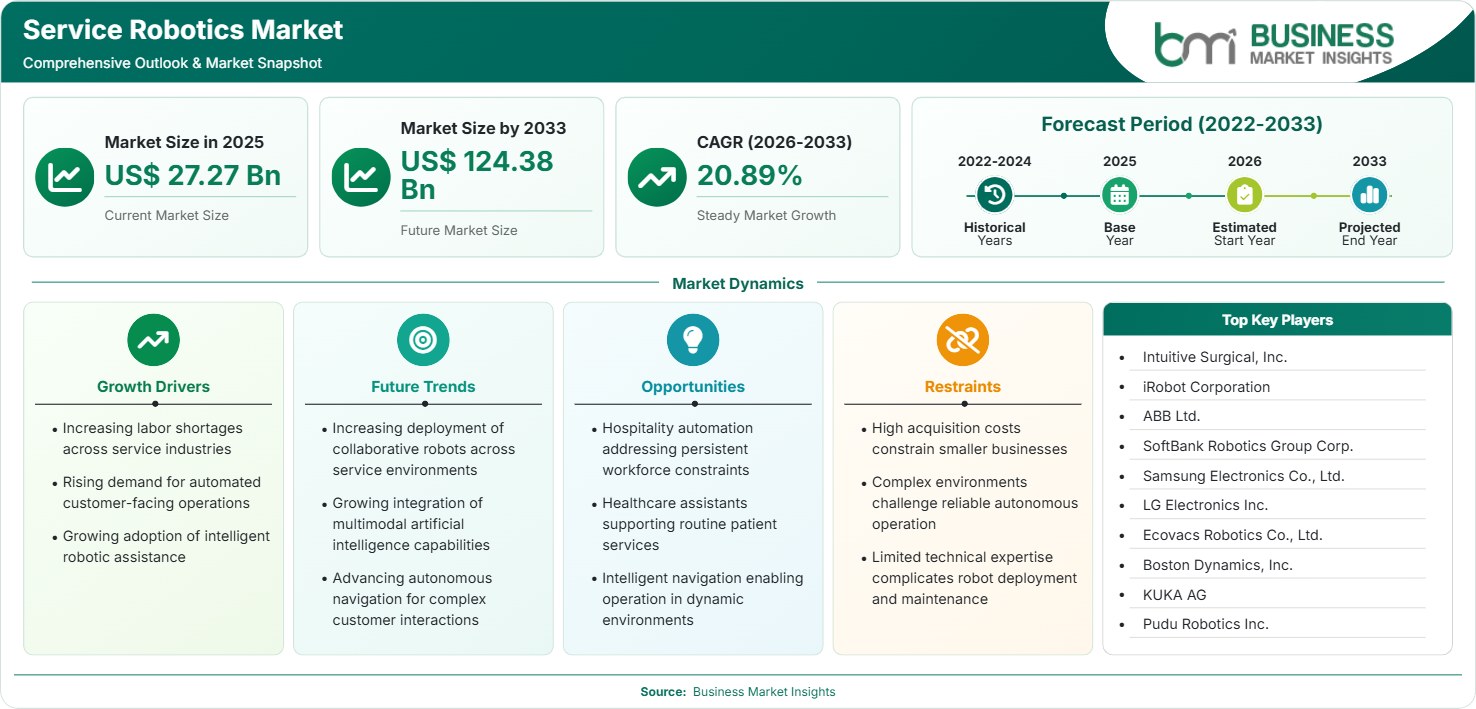
The Service Robotics Market size was valued at US$ 27.27 Billion in 2025 and is projected to reach US$ 124.38 Billion by 2033, growing at a CAGR of 20.89% during 2026–2033, driven by AI-enabled autonomy, healthcare automation, logistics digitization, labor shortages, and expanding opportunities across commercial delivery, domestic assistance, and intelligent service ecosystems.

Report Coverage
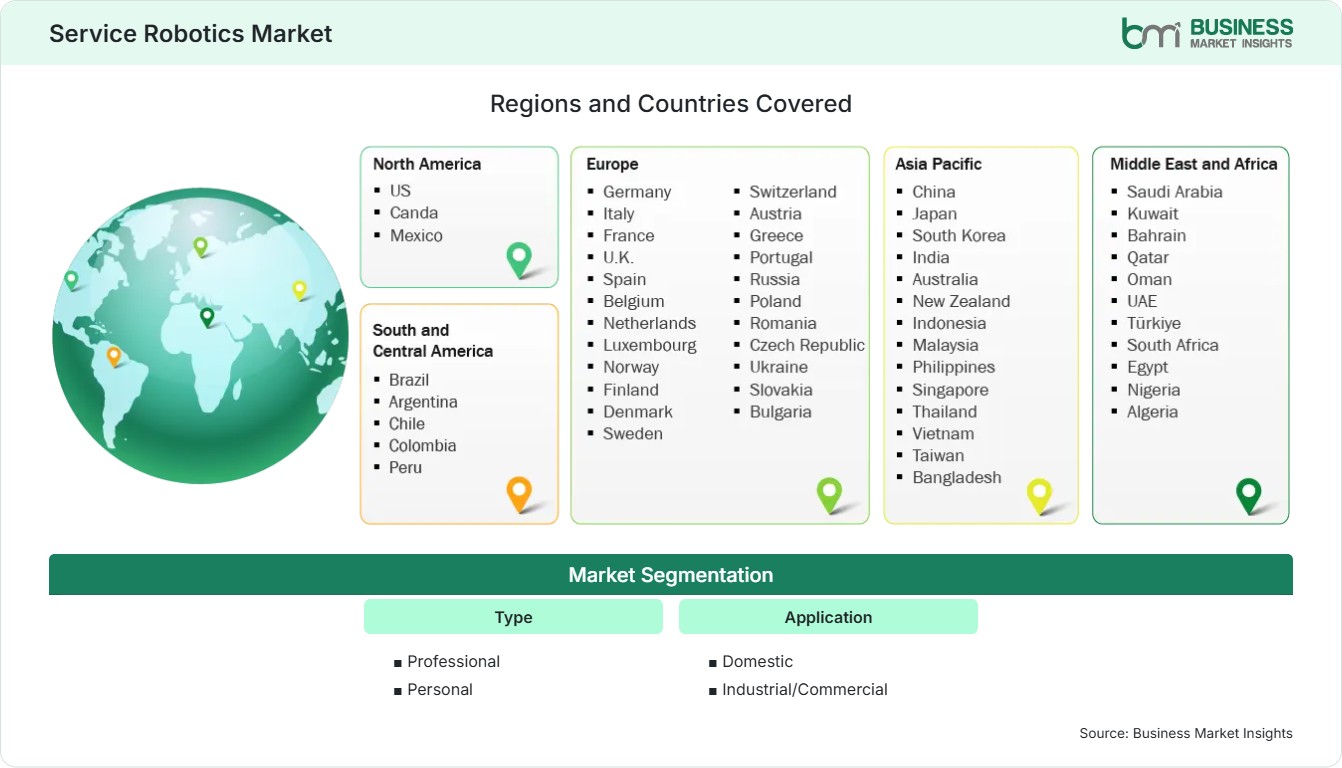
  • Type: Professional, Personal
  • Application: Domestic, Industrial/Commercial
US$ 27.27 Bn Market size in 2025
US$ 124.38 Bn Market Size by 2033
20.89% CAGR, 2026 - 2033
2026-2033 Forecast Period

AI Overview

Service Robotics Market Summary

  • North America Region: North America holds a market share of 34%–37% in 2025, growing at a CAGR of 18.5%–20.5% during 2026–2033. Growth is supported by healthcare robotics adoption, warehouse automation, labor scarcity, AI innovation, autonomous mobility deployment, rising investment activity, enterprise digitization, regulatory support, service transformation, productivity improvement, and expanding commercial implementations. The U.S. market benefits from strong healthcare robotics deployment and logistics automation, advancing at 18.8%–20.8%.
  • Fastest Growing Region: Asia Pacific holds a market share of 28%–31% in 2025, growing at a CAGR of 23.5%–25.5% during 2026–2033. Growth is supported by manufacturing scale, smart city investments, aging populations, automation programs, domestic robot demand, technology localization, government incentives, e-commerce expansion, startup funding, and digital transformation initiatives.
  • Leading Segment: Professional holds a market share of 63%–66% in 2025, growing at a CAGR of 19.5%–21.5% during 2026–2033. Adoption is driven by healthcare systems, logistics automation, field operations, hospitality modernization, labor optimization, safety requirements, enterprise investment, AI integration, remote monitoring capabilities, and productivity-focused deployment strategies.
  • High Growth Segment: Industrial/Commercial holds a market share of 58%–61% in 2025, growing at a CAGR of 21.5%–23.5% during 2026–2033. Expansion is supported by warehouse automation, autonomous delivery, healthcare operations, retail transformation, staffing constraints, service efficiency objectives, digital infrastructure development, robotics-as-a-service models, and intelligent workflow optimization.
  • Key Market Opportunity: Expanding robotics-as-a-service business models enable lower upfront costs, broader SME adoption, scalable deployments, recurring revenues, improved fleet utilization, rapid software upgrades, and stronger penetration across emerging economies.
  • Major Market Players: Intuitive Surgical, Inc.; iRobot Corporation; ABB Ltd.; SoftBank Robotics Group Corp.; Samsung Electronics Co., Ltd.; LG Electronics Inc.; Ecovacs Robotics Co., Ltd.; Boston Dynamics, Inc.; KUKA AG; Pudu Robotics Inc.
Strategic Insights

Service Robotics Market: Strategic Insights

Service Robotics Market Strategic Framework
FREE PDF
Request your free sample
Request free sample
Stakeholder View

Key Takeaways

  • The value chain is increasingly integrating AI software vendors, sensor manufacturers, cloud providers, platform developers, and robotics integrators, creating a highly interconnected ecosystem.
  • Industrial and commercial applications present the strongest upside due to persistent labor shortages in logistics, healthcare support, hospitality operations, and retail fulfillment.
  • Innovation is shifting toward multimodal AI, collaborative autonomy, machine vision, human-robot interaction, and robotics-as-a-service deployment frameworks.
  • Asia Pacific offers a compelling investment case through government automation programs, manufacturing capacity expansion, e-commerce growth, and domestic technology development.
  • Strategic acquisitions increasingly focus on AI software, autonomous navigation, medical robotics, warehouse automation, and service platform expansion.
  • Long-term differentiation will rely on software intelligence, fleet management, cybersecurity, interoperability, and recurring service revenues rather than hardware performance alone.
Geographic Outlook

Service Robotics Market Regional Highlights

North America Service Robotics Market

North America accounted for approximately 34%–37% of global demand in 2025 and is projected to expand at a CAGR of 18.5%–20.5% through 2033. The Service Robotics Market share remains strong due to mature healthcare infrastructure, logistics automation investment, advanced AI capabilities, and widespread enterprise digitization. Adoption across hospitals, fulfillment centers, hospitality operations, and public services continues accelerating. Major technology providers, venture capital activity, and favorable automation economics support regional leadership while enhancing deployment density across commercial and institutional environments.

  • Healthcare providers increasingly deploy surgical assistance, rehabilitation, and hospital logistics robots to improve resource allocation and operational efficiency.
  • E-commerce expansion sustains investment in mobile robots, autonomous delivery systems, and warehouse service automation.
  • Robotics-as-a-service models reduce adoption barriers for mid-sized enterprises pursuing automation initiatives.
  • AI-enabled fleet management platforms enhance operational scalability and asset utilization across multi-site deployments.

US Service Robotics Market

The United States represents approximately 78%–82% of regional revenue and is expected to grow at a CAGR of 18.8%–20.8%. Strong R&D activity, healthcare automation investment, and commercial logistics deployment maintain leadership. Large technology ecosystems accelerate AI integration into autonomous systems. Demand is supported by workforce shortages, aging demographics, and productivity-focused capital expenditure strategies. The country remains a major innovation hub for medical, logistics, hospitality, and domestic robotic solutions.

  • Surgical robotics deployment continues expanding across hospitals pursuing minimally invasive procedures and efficiency improvements.
  • Advanced warehouse automation supports omnichannel fulfillment and same-day delivery objectives.
  • Venture capital investment encourages commercialization of service-based autonomous platforms.
  • Smart facility management applications are expanding across commercial real estate environments.

Europe Service Robotics Market

The Europe region accounted for 24%–27% of total global revenues in 2025 and is expected to grow at a CAGR of 19.0%–21.0%. Robust regulatory policies, an aging population, and industrial digitalization are driving the growth. Germany is the leader in the region's implementation, and the United Kingdom shows one of the fastest growth rates, reaching 21%–23%. Upgradation of healthcare systems, focus on sustainability, and labor shortages drive investment in automation solutions. Regional players are adopting AI-enabled services for greater efficiency.

  • Germany maintains leadership through automation expertise, advanced engineering ecosystems, and healthcare robotics implementation.
  • The United Kingdom benefits from digital healthcare investments and commercial automation adoption.
  • Service robot deployment in hospitality and retail environments continues accelerating.
  • Collaborative public-private innovation programs support robotics commercialization and pilot projects.

Asia Pacific Service Robotics Market

The Asia Pacific region produced 28% - 31% of total revenues in 2025, and its forecast CAGR is 23.5% - 25.5%, making it the fastest-growing market. China has retained its position as the leading country, while India and Southeast Asian countries have become promising markets, with growth rates of 25%-27%. The Service Robotics Market growth is driven by production capabilities, government automation policies, technological development, and consumer demand.

  • China dominates through scale manufacturing, domestic innovation, and robotics policy support.
  • Japan benefits from aging demographics and sustained demand for assistive technologies.
  • India experiences strong adoption across healthcare support and commercial service applications.
  • E-commerce growth increases demand for autonomous logistics and delivery platforms.
  • Localized production reduces costs and improves market accessibility across developing economies.

Rest of World Service Robotics Market

The Rest of World accounted for around 9%–11% of the income in 2025 and is forecasted to grow at a CAGR of 20.0%–22.0%. The countries of South and Central America gain from logistics transformation and e-retail trends. On the other hand, the Middle East and Africa are gaining traction owing to investments in smart cities, healthcare infrastructure, and tourism automation programs. Brazil is an early adopter in Latin America, while the UAE demonstrates one of the strongest growth trajectories in the broader region.

  • Brazil advances deployment across healthcare facilities and logistics operations.
  • UAE investments in smart cities create opportunities for autonomous public-service applications.
  • Hospitality-focused robotics adoption is increasing across tourism-dependent economies.
  • Infrastructure modernization supports broader implementation of autonomous service platforms.
  • Rising awareness of workforce productivity benefits strengthens long-term demand potential.
Global Market Geography
FREE PDF
Request your free sample
Request free sample
Segment Analysis

Service Robotics Market Segmentation

Type

Professionals accounted for around 63% to 66% of the total revenue in 2025 and are projected to register a CAGR of 19.5% to 21.5% till 2033. The scope of the Service Robotics Market continues to grow across the healthcare, logistics, field operations, and hospitality sectors. Organizations need to automate processes to make them more productive, reliable, and efficient.

  • Professional: Driven by healthcare, logistics, hospitality, field service, and public-sector applications, professional robots deliver operational efficiency, higher accuracy, and automation-enabled productivity improvements across complex commercial environments.
  • Personal: Domestic cleaning, companionship, education, and home assistance applications are strengthening consumer adoption through affordability improvements, AI-enabled functionality, and smart-home ecosystem integration.

Application

Industrial/Commercial represented roughly 58%–61% of market revenue in 2025 and is expected to register a CAGR of 21.5%–23.5%. Trends in the Service Robotics Market include an increasing deployment trend in distribution centers, hospitals, hospitality venues, airports, and retail outlets. Businesses are increasingly focusing on autonomy to overcome labor shortages and streamline operations.

  • Domestic: Household cleaning, lawn maintenance, security monitoring, and lifestyle support applications continue attracting consumers seeking convenience, efficiency, and connected-home functionality.
  • Industrial/Commercial: Commercial users deploy autonomous systems for logistics, customer interaction, healthcare support, inspection, and delivery operations, benefiting from enhanced scalability, productivity, and service consistency.
Market Forces

Service Robotics Market Dynamics

Key Market Drivers

Rising Labor Shortages Across Service Industries

Workforce shortages in the healthcare, logistics, hospitality, and retail industries continue to push companies towards automation. According to the International Labor Organization and demographic trends in developed countries, there is an increasing labor shortage, particularly in older countries. Firms have been investing in robots to ensure high-quality services and operational continuity. The reason behind the Service Robotics Market growth is that autonomous systems can perform mundane, laborious, and time-consuming tasks. In hospitals, robots are used to transport goods, and logistics firms are investing in autonomous mobile robots.

Advancement of Artificial Intelligence and Machine Vision

Recent advancements in AI, computer vision, natural language processing, and edge computing have greatly boosted the capabilities of robots. Improved situational awareness helps robots to perform safely and efficiently in unstructured environments. Increased processing efficiency enables real-time decision-making and adaptability. The Service Robotics Market growth now depends largely on intelligence and autonomy rather than on mechanical abilities. Improved sensor technology helps robots to interact with humans, navigate, gather context-based information, and perform tasks optimally. This makes it possible to use robots in healthcare services, the hospitality industry, customer interaction, and commercial facilities management, supporting broader commercialization opportunities across multiple sectors.

Expansion of E-Commerce and Logistics Automation

The expansion of global e-commerce continues to put pressure on the supply chain, warehousing, and last-mile delivery. Logistics companies continue to use robots to enhance inventory flow, sorting capabilities, and delivery times. High volumes of packages call for efficient, continuous solutions that deliver at a consistent rate. Service Robotics Market trends indicate increased adoption of autonomous mobile robots, delivery robots, and inventory management systems. Integrating with cloud and warehousing systems provides logistics companies with visibility into their facilities and helps prevent fulfillment delays. Continuous investments in the digital supply chain and service delivery are driving growing demand for robotics solutions in logistics.

Key Market Opportunities

Robotics-as-a-Service Business Model Expansion

Robotics-as-a-service offers great potential by eliminating clients' initial capital expenditures. The subscription-based delivery models allow clients to have robotic technologies available to them at operating costs. Small and medium businesses begin to use automation once financial constraints are lifted. According to the Service Robotics Market Forecasts, there is a growing demand for scalable solutions that incorporate hardware, software, support, and analytics under service contracts. Suppliers can reap the benefits of customer loyalty, constant improvements, and recurring payments. This type of business model enables faster dissemination of robotic technologies in developing countries, where capital outlays have historically been a limitation. As digital infrastructure matures, service-based robotics platforms are expected to gain substantial commercial traction.

Growing Demand for Healthcare and Eldercare Automation

In North America, Europe, Japan, and other advanced countries, aging demographics are driving demand for care technologies. Providers are under pressure from rising demands while facing shortages of professionals and rising costs. Robotic devices can assist with patient mobility, rehabilitation, drug delivery, surveillance, and hospital administration. These applications improve the level of care while increasing process efficiency. Governments and health institutions are increasingly investing in technologies that enable care models. The development of human-robot interaction, certification, and diagnostics through AI will contribute to the future growth of companies producing health and elderly-care robotics.

Smart Cities and Autonomous Public Services

Urban modernization initiatives are creating new demand for autonomous public-service technologies. Municipal governments are integrating robotic systems into surveillance, sanitation, mobility assistance, information services, and infrastructure inspection. The smart-city investment programs in Asia Pacific, Middle East, and Europe will encourage trial implementations and commercialization opportunities. The advanced communication infrastructure, such as 5G networks and IoT platforms, will facilitate efficient fleet operation and monitoring. Robotic solution providers capable of offering interoperable, scalable solutions will have an opportunity to capitalize on this growth potential.

Market Restraints and Challenges

High Deployment Costs and Integration Complexity

Factor: The high costs of hardware, software customization needs, and infrastructure upgrades continue to pose obstacles for most organizations. Impact: Implementation is often hampered, especially for small businesses with limited budgets for automation. Implementation typically involves process redesign, training, cybersecurity considerations, and interoperability validation. Calculations of return on investment depend on the environment in which applications are used, leading to uncertainty in purchasing decisions. Maintenance issues and fears of obsolescence play a part in procurement. Even with cost reductions, the full implementation costs remain very high for sophisticated systems. Vendors must improve implementation efficiency and offer flexible financing structures to overcome economic adoption challenges and support wider commercialization.

Regulatory, Safety, and Data Security Concerns

Factor: Uncertainty in regulatory oversight of autonomy, artificial intelligence, safety compliance, and data privacy leads to deployment challenges. Impact: The companies could face lengthy approval periods, associated compliance expenses, and certain operational limitations. Service robots tend to collect large amounts of data about the environment and users, necessitating stronger cybersecurity and privacy measures. There is also additional complexity due to cross-jurisdictional regulations when expanding the global market presence. Reliability and safety records will also influence public adoption. These requirements can lengthen commercialization cycles and increase operating expenditures for market participants.

Company Analysis

Competitive Landscape

Service Robotics Market analysis indicates competition is driven by AI capabilities, autonomous navigation performance, application specialization, software ecosystems, and recurring service models.

Company Name

Overview

Products and Services relevant to this market

Intuitive Surgical, Inc.

Global leader in robotic-assisted healthcare solutions with strong clinical ecosystem and installed base.

da Vinci surgical systems, Ion robotic platforms, healthcare automation technologies, training and support services.

iRobot Corporation

Consumer robotics pioneer focused on intelligent home automation and floor-care robotics.

Roomba robotic vacuums, mopping robots, home cleaning automation platforms, connected services.

ABB Ltd.

Industrial technology company expanding autonomous and service robotics capabilities.

Mobile robots, autonomous navigation systems, AI-enabled automation software and lifecycle services.

SoftBank Robotics Group Corp.

Developer of human-interactive service robots used across hospitality, retail, and education.

Humanoid robots, customer engagement platforms, reception and service automation solutions.

Samsung Electronics Co., Ltd.

Electronics leader investing in consumer and assistive robotics technologies.

Home robotics, AI-powered assistants, smart-home robotics integration platforms and services.

LG Electronics Inc.

Developer of commercial and consumer automation products with robotics initiatives.

Service robots, hospitality robots, cleaning robots, smart building automation applications.

Ecovacs Robotics Co., Ltd.

Major consumer robotics manufacturer with strong presence in home automation.

Robotic vacuum cleaners, window-cleaning robots, intelligent household robotics solutions.

Boston Dynamics, Inc.

Advanced robotics company specializing in highly mobile autonomous platforms.

Inspection robots, mobile autonomous systems, AI-enabled robotic mobility solutions.

KUKA AG

Automation specialist expanding service and mobile robotics offerings globally.

Autonomous mobile robots, logistics automation systems, software and integration services.

Pudu Robotics Inc.

Service robotics specialist focused on hospitality and commercial environments.

Delivery robots, restaurant service robots, commercial autonomous mobility solutions.

Trust & Transparency

Research Methodology

The market analysis combines proprietary research with secondary data from government agencies, company disclosures, regulatory filings, industry databases and expert interviews. Market estimates are validated through data triangulation, cross-market benchmarking and analyst review.

View Full Research Methodology

Questions Answered

Frequently Asked Questions

What insights are included in a Service Robotics Market Report?

A Market Report typically covers market sizing, growth outlook, regional performance, competitive dynamics, technology trends, investment patterns, segmentation, and regulatory developments.

Why is Asia Pacific growing faster than other regions?

Manufacturing capacity, government support, smart-city investment, rising labor costs, expanding e-commerce, and increasing domestic technology development support faster regional expansion.

How does artificial intelligence improve robotic performance?

AI enables navigation, perception, predictive analytics, language understanding, adaptive behavior, and real-time decision-making, making robots more effective in dynamic service environments.

What makes professional robots the dominant category?

Professional robots deliver measurable operational benefits in hospitals, warehouses, airports, and commercial facilities, offering strong productivity, safety, and service-quality improvements.

Which industries generate the highest demand for service robots?

Healthcare, logistics, hospitality, retail, and domestic applications generate the highest demand due to workforce shortages, productivity requirements, and increasing automation investments.

Access the Full Service Robotics Market Report

Get segment-level forecasts, regional estimates, competitive benchmarking, company profiles and downloadable Excel datasets.

Access the full Service Robotics Market Report
350 pages PDF & Excel | 2026-09-10
Similar Research

Related Market Reports