
Drippers Market Outlook: Size, Share, Trends, Growth Analysis, Competitive Landscape & Forecast, 2026-2033

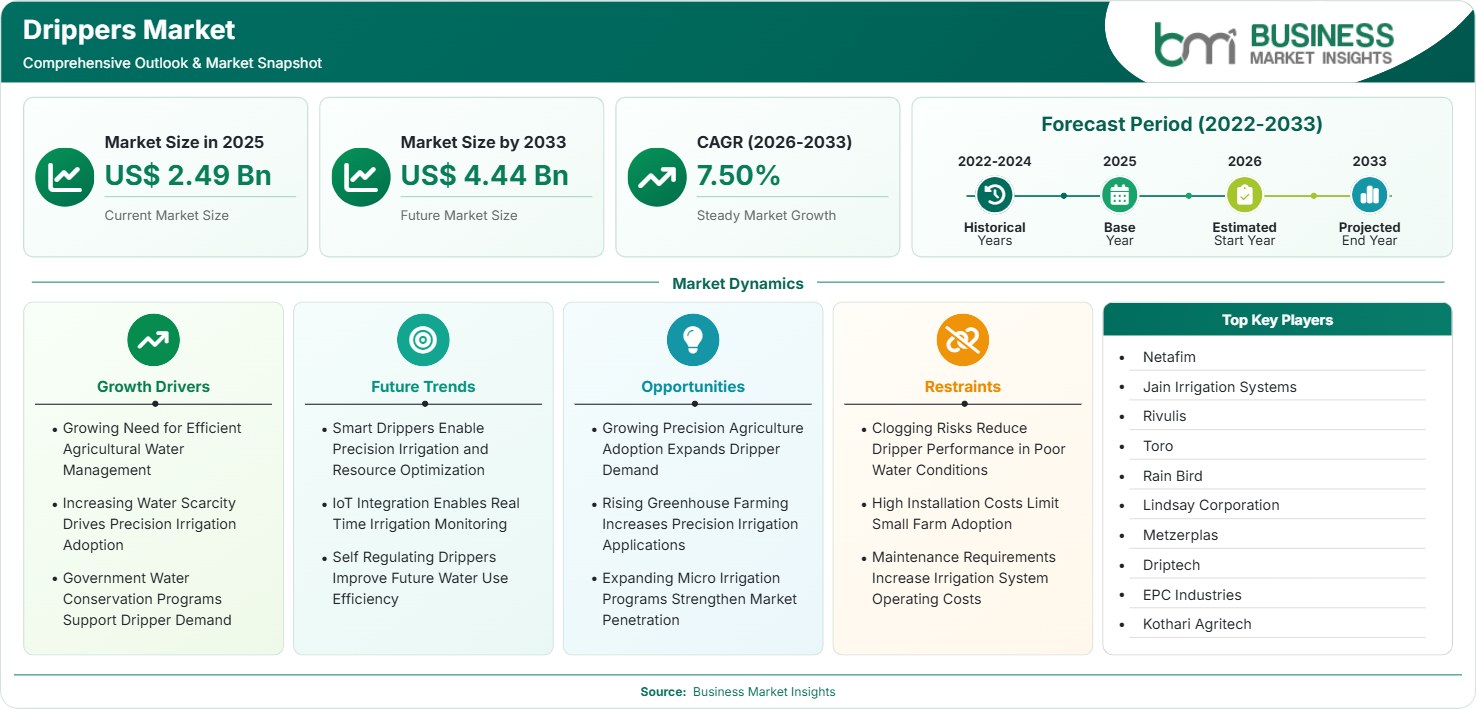
The Drippers Market size was valued at US$ 2.49 billion in 2025 and is projected to reach US$ 4.44 billion by 2033, growing at a CAGR of 7.50% during 2026–2033, driven by water conservation, precision agriculture, greenhouse cultivation, irrigation modernization, and efficient farm resource management.

Report Coverage
  • Dripper Type: Inline NPC, Inline PC, Online NPC, Online PC
  • Crop Type: Field Crops, Orchards & vineyards, Greenhouses & nurseries, Residential & landscaping
  • End User: Commercial Farms, Small & Marginal Farmers, Greenhouse Operators, Nurseries, Others
  • Material Type: PE/HDPE, Silicone/Elastomer, PVC, Biodegradable/Other
US$ 2.49 Bn Market size in 2025
US$ 4.44 Bn Market Size by 2033
7.50% CAGR, 2026 - 2033
2026-2033 Forecast Period

01 AI Overview

Drippers Market Summary

  • North America Region: North America holds a 20%–25% share in 2025, growing at a 6.2%–7.2% CAGR during 2026–2033, supported by specialty crops, drought management, precision irrigation, greenhouse farming, and water conservation. The US Drippers Market is expanding at a 6.3%–7.3% CAGR, supported by specialty crops, irrigation modernization, agricultural automation, and efficient water application.
  • Fastest Growing Region: Asia Pacific accounts for a 35%–40% share in 2025 and is projected to expand at an 8.3%–9.3% CAGR, supported by agricultural modernization, water scarcity, micro-irrigation programs, food production requirements, protected cultivation, and investment in efficient irrigation infrastructure.
  • Leading Segment: Inline PC represents a 30%–35% share in 2025 and is projected to grow at a 7.7%–8.7% CAGR, supported by uniform discharge, pressure compensation, commercial farming, orchards, vineyards, and irrigation across uneven agricultural terrain.
  • High Growth Segment: Greenhouses & nurseries represent a 14%–18% share in 2025 and are expected to grow at an 8.5%–9.5% CAGR, supported by controlled cultivation, fertigation, crop intensification, automation, and water-efficient production.
  • Key Market Opportunity: Precision agriculture, protected cultivation, and micro-irrigation programs create opportunities for manufacturers offering durable, affordable, automated, filtration-compatible, and fertigation-ready dripper systems.
  • Major Market Players: Netafim, Jain Irrigation Systems Limited, Rivulis, The Toro Company, Rain Bird Corporation, Lindsay Corporation, Metzerplas Cooperative Agricultural Organization Ltd., Driptech, EPC Industries Limited, Kothari Agritech
02 Strategic Insights

Drippers Market: Strategic Insights

Drippers Market Strategic Framework
FREE PDF
Request your free sample
Request free sample
03 Stakeholder View

Key Takeaways

  • The changing value chain now focuses on integrated irrigation systems that consist of drippers, coupled with filtration, fertigation, valves, sensors, controllers, and digital monitoring technology, which allows companies to add value beyond selling simple emitters.
  • The opportunities arise from commercial farms, orchards, vineyards, greenhouses, nurseries, and specialist crop growers because irrigation has the ability to add value through increased efficiency and water productivity.
  • Pressure-compensating products are gaining relevance as growers manage larger fields and variable terrain. Product innovation increasingly emphasizes uniform discharge, clog resistance, durability, automation compatibility, and longer service life.
  • Asia Pacific provides a compelling expansion opportunity as agricultural modernization and water conservation programs encourage micro-irrigation adoption. India and China remain important markets because of extensive farming activity and resource pressures.
  • Investment opportunities are emerging around irrigation automation, protected cultivation, precision farming, and integrated water management. Partnerships among manufacturers, distributors, technology providers, and public agencies can improve market penetration.
04 Geographic Outlook

Drippers Market Regional Highlights

North America Drippers Market

North America holds a 20%–25% share in 2025 and is projected to expand at a 6.2%–7.2% CAGR during 2026–2033. The region benefits from commercial agriculture, specialty crops, greenhouse expansion, and water conservation requirements. The United States represents the leading market, while Canada provides opportunities in horticulture and controlled agriculture. Drippers Market share is supported by established irrigation infrastructure and technology adoption.

  • Specialty crop producers increasingly use drip systems for fruits, vegetables, berries, vineyards, and other crops requiring precise irrigation and controlled fertigation.
  • Water-stressed agricultural regions are modernizing irrigation networks as producers seek to maintain productivity while responding to drought and groundwater management concerns.
  • Greenhouse and nursery operators are adopting automated drippers connected with fertigation and controllers, improving water delivery while reducing manual intervention.

US Drippers Market

The US represents a 16%–20% share of North America's 2025 market and is projected to grow at a 6.3%–7.3% CAGR through 2033. California, Florida, Arizona, and other irrigation-intensive states provide significant opportunities. Specialty crops, orchards, vineyards, and greenhouse production support demand for precise water delivery. The Drippers Market also benefits from farm automation and water conservation investments. Producers increasingly prioritize water productivity, fertigation efficiency, and crop-specific irrigation scheduling.

  • Specialty crop production remains important because fruits, vegetables, nuts, and vineyards benefit from targeted irrigation and controlled fertigation.
  • Drought and groundwater management concerns encourage growers to replace less efficient irrigation methods, particularly in regions where water availability affects agricultural output.
  • Greenhouse operators are integrating drippers with automated fertigation systems to improve crop consistency, reduce labor requirements, and manage water application precisely.

Europe Drippers Market

Europe accounts for a 22%–27% share in 2025 and is forecast to expand at a 5.8%–6.8% CAGR during 2026–2033. Spain, Italy, France, and the Netherlands represent leading markets, while Portugal provides high-growth potential. Spain is projected to grow at a 6.2%–7.2% CAGR, while Portugal could reach 7.0%–8.0%. Sustainable agriculture priorities, horticulture, water stress, and greenhouse production support regional adoption. Precision irrigation is increasingly important for resource-efficient crop production.

  • Spain provides strong demand across orchards, vineyards, vegetables, and other crops as producers address water constraints and modernize irrigation infrastructure.
  • Italy benefits from extensive horticulture and orchard cultivation, where drip irrigation supports controlled water application and efficient agricultural input management.
  • The Netherlands represents a technologically advanced greenhouse market where precise irrigation, fertigation, and automation support intensive controlled-environment crop production.

Asia Pacific Drippers Market

Asia Pacific represents a 35%–40% share in 2025 and is projected to register an 8.3%–9.3% CAGR during 2026–2033, making it the fastest-growing region. India and China lead demand, while Australia and Southeast Asia offer additional opportunities. India is estimated to grow at an 8.8%–9.8% CAGR, while China could reach an 8.0%–9.0% CAGR. Water scarcity, agricultural modernization, government programs, and protected cultivation are strengthening adoption.

  • India offers substantial potential as micro-irrigation programs, groundwater stress, and agricultural productivity requirements encourage efficient water delivery.
  • China is expanding precision irrigation as agricultural modernization and water conservation initiatives encourage producers to improve resource utilization.
  • Australia has established demand across horticulture and vineyards, with water management remaining important under variable rainfall conditions.

Rest of World Drippers Market

South and Central America account for a 10%–14% share in 2025 and are projected to grow at a 7.0%–8.0% CAGR, supported by commercial agriculture and horticulture. Brazil leads regional opportunities. The Middle East and Africa represent a 6%–10% Drippers Market share and are expected to expand at a 7.2%–8.2% CAGR, supported by water scarcity, irrigation modernization, and controlled agriculture.

Brazil, Mexico, and Chile provide opportunities in fruit, vegetable, and export-oriented production. Saudi Arabia, the UAE, and South Africa are investing in efficient irrigation as water availability influences agricultural development. Adoption depends on affordability, financing, water quality, technical expertise, and infrastructure.

  • Brazil provides significant opportunity because commercial agriculture and export-oriented horticulture require efficient irrigation across large cultivated areas.
  • Mexico and Chile offer applications in fruit, vegetable, and specialty crop production, where targeted irrigation improves resource utilization and crop consistency.
  • Saudi Arabia and the UAE are investing in water-efficient agricultural technologies as governments seek to strengthen food production despite severe resource constraints.
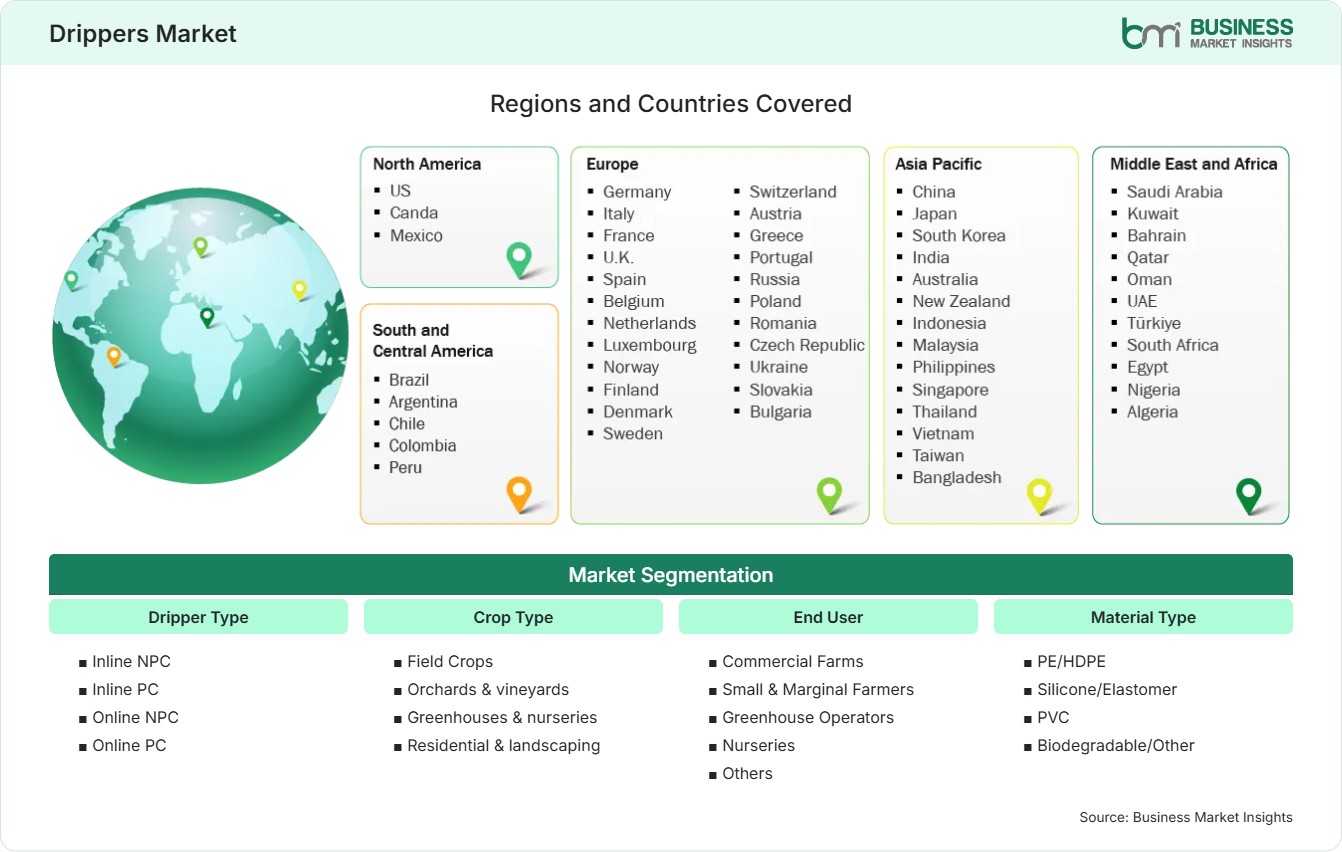
Global Market Geography
FREE PDF
Request your free sample
Request free sample
05 Segment Analysis

Drippers Market Segmentation

Dripper Type

Inline PC represents the leading dripper type, accounting for a 30%–35% share in 2025 and a 7.7%–8.7% CAGR during 2026–2034. Pressure compensation supports uniform discharge across variable field conditions, making the segment suitable for commercial farms, orchards, vineyards, and uneven terrain. The Drippers Market scope extends across irrigation systems requiring precise water delivery, flexible installation, and compatibility with fertigation and automation. Inline systems also enable efficient installation across closely spaced crops and intensive agricultural applications.

  • Inline NPC: Inline non-pressure-compensating drippers provide economical water delivery for uniform fields and closely spaced crops where pressure differences remain relatively limited.
  • Inline PC: Inline pressure-compensating drippers provide consistent discharge across pressure variations, making them suitable for commercial farms, orchards, vineyards, and extended irrigation lines.
  • Online NPC: Online non-pressure-compensating drippers allow flexible emitter placement and replacement, supporting irrigation layouts requiring adjustable positioning for varied crop spacing.
  • Online PC: Online pressure-compensating drippers combine flexible placement with improved flow consistency, supporting specialty crops, landscaping, and agricultural applications exposed to variable pressure.

Crop Type

Field Crops represent a 35%–40% share in 2025 and are projected to grow at a 6.8%–7.8% CAGR during 2026–2034. Adoption is expanding beyond high-value horticulture as producers seek better water efficiency and crop productivity. Greenhouses & nurseries provide high-growth potential at an 8.5%–9.5% CAGR due to controlled cultivation, fertigation, and intensive resource management.

  • Field Crops: Field crop applications are expanding as producers adopt efficient irrigation for corn, cotton, vegetables, and other crops where water management influences productivity.
  • Orchards & vineyards: Orchards and vineyards require precise root-zone irrigation, with drippers supporting citrus fruit, apples, pears, stone fruits, almonds, and pistachios.
  • Greenhouses & nurseries: Greenhouse and nursery operators use drippers for precise irrigation and fertigation, supporting intensive cultivation, consistent moisture, and efficient resource utilization.
  • Residential & landscaping: Residential and landscaping applications use drippers to provide controlled water directly to plants, supporting conservation across gardens, public areas, and landscaped spaces.

End User

Commercial Farms represent a 42%–47% share in 2025 and are projected to grow at a 7.0%–8.0% CAGR during 2026–2034. Large agricultural operations have strong incentives to invest in irrigation because water efficiency, labor productivity, and crop consistency influence operating economics. Greenhouse Operators and Nurseries provide additional opportunities as protected cultivation expands and precision irrigation becomes integrated with automated production systems.

  • Commercial Farms: Commercial farms adopt drippers to improve irrigation efficiency, support fertigation, reduce labor requirements, and maintain consistent water delivery across extensive cultivated areas.
  • Small & Marginal Farmers: Small and marginal farmers represent an important opportunity as affordable systems, subsidies, financing programs, and simplified installation models improve micro-irrigation access.
  • Greenhouse Operators: Greenhouse operators require precise water delivery and fertigation, making drippers important for controlled cultivation where crop uniformity and resource efficiency matter.
  • Nurseries: Nurseries use drippers to provide targeted irrigation for plants grown in containers, beds, and specialized environments requiring consistent moisture management.

Material Type

PE/HDPE represents a 65%–70% share in 2025 and is projected to grow at a 7.0%–8.0% CAGR during 2026–2034. Polyethylene-based materials offer flexibility, durability, chemical resistance, and suitability for agricultural irrigation networks. Material innovation is increasingly focused on service life, recyclability, UV resistance, and environmental performance. Biodegradable alternatives remain an emerging area for product development.

  • PE/HDPE: PE and HDPE materials provide flexibility, durability, and resistance to agricultural conditions, making them suitable for irrigation lines and emitter manufacturing.
  • Silicone/Elastomer: Silicone and elastomer materials support specialized dripper components requiring flexibility and resilient performance, particularly where sealing and pressure management are important.
  • PVC: PVC provides rigid, durable characteristics and is used within irrigation infrastructure where structural stability and compatibility with water distribution systems are required.
  • Biodegradable/Other: Biodegradable and alternative materials are emerging as manufacturers explore lower-impact products, improved end-of-life characteristics, and sustainability-oriented irrigation solutions.
06 Market Forces

Drippers Market Dynamics

Key Market Drivers

Growing Need for Efficient Agricultural Water Management

The agricultural sector needs to enhance its water productivity due to competition from household, industrial, and other uses of water as a natural resource. The drippers deliver water directly to the root zone of plants, thereby enabling precise application and even fertigation. The commercial sector is increasingly interested in adopting technologies that reduce unnecessary water distribution while sustaining crop productivity. Integrating dripper irrigation with filters, pumps, valves, sensors, and controllers enhances its functional capabilities. The Drippers Market trends are connected to the overall modernization of agricultural water rather than simply to emitter replacement.

Increasing Water Scarcity Drives Precision Irrigation Adoption

Increasing water scarcity has increased pressure on agricultural producers to improve water productivity, especially in drought-prone areas suffering from groundwater over-exploitation. Precision irrigation technology enables controlled water delivery based on crop needs, soil characteristics, and the irrigation schedule. Drip irrigation can include features such as pressure compensation, filters, fertigation, and automation of controls to achieve consistent application. Producers are looking for technology solutions to address low water availability without sacrificing yield. This factor applies to North America, Europe, Asia-Pacific, the Middle East, and Africa.

Government Water Conservation Programs Support Dripper Demand

The government is using its resources to develop water-saving projects, farm modernization schemes, and micro-irrigation projects. Through subsidies, financial support, technical expertise, and infrastructure development schemes, such policies can make it easier to adopt drip irrigation systems by reducing the barriers to entry. These policies are more effective for small and marginal farmers, who might find it difficult to raise funds to purchase irrigation equipment on their own. The government can also help to build up the capacity of the local distribution system. Policy measures raise awareness of water-efficient farming techniques and agricultural modernization. With governments' attention to agriculture, demand for drippers can benefit from these measures.

Key Market Opportunities

Growing Precision Agriculture Adoption Expands Dripper Demand

Precision farming will bring new opportunities for connecting drippers with sensors, weather information, soil moisture measurements, variable irrigation schedules, and automated control. With these tools, users can switch from a traditional irrigation schedule to data-driven watering. There are many business opportunities associated with such a solution for commercial farming enterprises with large cultivated plots, where manual irrigation may be inefficient. Manufacturers will be able to create systems that integrate with precision farming systems and provide real-time data on irrigation. The Drippers Market Forecasts rely on growing investment in connected farming as farmers seek to reduce their input costs.

Rising Greenhouse Farming Increases Precision Irrigation Applications

Controlled environment agriculture is on the rise as farmers seek more ways to control the conditions under which their crops grow. In greenhouses and nurseries, water needs to be applied accurately because too much water will negatively affect the crop, while insufficient water will reduce produce quality. Drippers would be ideal in these settings because they provide water and fertilizers directly to the plant or growth medium. There are opportunities for manufacturers to provide drippers that enable automation and precision in water delivery, as well as climatic control. The spread of greenhouse farming across Asia-Pacific, Europe, North America, and the Middle East is opening new markets.

Expanding Micro Irrigation Programs Strengthen Market Penetration

Micro-irrigation projects offer companies a chance to reach farmers who might not have easy access to efficient irrigation systems. Governments can help finance, install, train, and provide technical support so that these systems are easier to use. This kind of opportunity will be most relevant in cases where small and marginal farmers account for a significant share of agricultural output. Companies can design modular systems that will be easier to install and maintain. This will help effectively reach farmers by collaborating with governments, agricultural cooperatives, distributors, and financing organizations.

Market Restraints and Challenges

Clogging Risks Reduce Dripper Performance in Poor Water Conditions

Factor: Particles, algae, minerals, and biological organisms may clog emitters if the irrigation water is not adequately filtered or cleaned. Impact: Clogging may lead to nonuniform flow, increased maintenance needs, reduced crop performance, and decreased farmers' trust in drip irrigation systems. This factor is especially important if water quality is unstable or there is no adequate filtration equipment. Proper management will require filters, flushing, chemicals, and maintenance, which make drip irrigation more complicated. Manufacturers are working to increase the flow path, introduce self-flushing capability, and improve the emitters.

High Installation Costs Limit Small Farm Adoption

Factor: Drip irrigation involves spending on emitters, pipes, filters, pumps, fertigation devices, valves, installation labor, and maintenance structures. Impact: Initial expenditure can deter small-scale and marginal farmers, especially when finance is not readily accessible or when crop profits are unpredictable. Installation challenges can pose additional hurdles in the absence of professional installers. Subsidies from the government or group procurement can help reduce costs, although farmers would need technical support for proper system planning and maintenance. This particular constraint can be overcome by manufacturers through the use of modular products and less costly components.

07 Company Analysis

Competitive Landscape

The Drippers Market analysis reflects competition among global irrigation technology companies, agricultural equipment providers, and specialized micro-irrigation manufacturers. Competitive positioning increasingly depends on emitter performance, pressure compensation, clog resistance, material durability, automation compatibility, filtration integration, and distribution reach. Companies are also expanding toward complete irrigation solutions combining drippers with fertigation, sensors, controllers, and digital farm management capabilities.

Company Name

Overview

Products and Services relevant to this market

Netafim

Global irrigation technology company specializing in precision agriculture and micro-irrigation solutions.

Drippers, pressure-compensating emitters, filtration, fertigation, irrigation automation, and digital solutions.

Jain Irrigation Systems Limited

Integrated irrigation and agricultural technology company serving farmers across multiple geographies.

Drip irrigation systems, emitters, polyethylene pipes, filtration, fertigation, automation, and micro-irrigation solutions.

Rivulis

Global irrigation company providing precision irrigation and agricultural water management solutions.

Drippers, drip lines, filtration, fertigation, irrigation automation, and digital water management solutions.

The Toro Company

Diversified manufacturer offering irrigation and water management technologies for agriculture and landscaping.

Agricultural drip systems, emitters, irrigation controls, filtration, valves, and water management products.

Rain Bird Corporation

Irrigation technology company providing water-efficient solutions for agricultural and landscape applications.

Drip irrigation products, emitters, tubing, filtration, valves, controllers, and water management systems.

Lindsay Corporation

Infrastructure and irrigation technology provider serving agricultural producers with water management solutions.

Precision irrigation equipment, agricultural water management technologies, automation, and controls.

Metzerplas Cooperative Agricultural Organization Ltd.

Irrigation manufacturer specializing in drip irrigation technologies for agriculture and horticulture.

Drip lines, pressure-compensating drippers, irrigation components, filtration systems, and micro-irrigation products.

Driptech

Irrigation technology provider focused on affordable drip irrigation solutions for agricultural producers.

Drip irrigation systems, low-cost emitters, irrigation components, and agricultural water delivery solutions.

EPC Industries Limited

Indian irrigation technology company providing micro-irrigation and agricultural water management products.

Drip irrigation systems, emitters, filtration, fertigation solutions, pipes, and irrigation accessories.

Kothari Agritech

Agricultural technology company providing irrigation products for farmers and horticultural applications.

Drip irrigation systems, emitters, pipes, filtration, fertigation, and agricultural water management products.

10 Trust & Transparency

Research Methodology

The market analysis combines proprietary research with secondary data from government agencies, company disclosures, regulatory filings, industry databases and expert interviews. Market estimates are validated through data triangulation, cross-market benchmarking and analyst review.

View Full Research Methodology

11 Questions Answered

Frequently Asked Questions

What information is included in a Drippers Market Report?

The report includes market size, growth projections, segmentation analysis, regional insights, competitive landscape, technology trends, growth drivers, opportunities, restraints, company profiles, agricultural applications, and strategic industry factors.

What challenges affect dripper adoption?

Clogging caused by poor water quality, filtration requirements, maintenance needs, installation complexity, and high upfront costs can limit adoption, particularly among small farms and agricultural producers with constrained financing or technical support.

How is precision agriculture influencing dripper demand?

Precision agriculture is encouraging integration of drippers with soil moisture sensors, weather data, automated controllers, fertigation systems, and digital farm platforms, enabling growers to optimize irrigation schedules and improve water productivity.

Which dripper type leads the market?

Inline PC represents the leading dripper type because pressure compensation provides consistent water discharge across variable field conditions, supporting commercial farms, orchards, vineyards, and applications requiring uniform irrigation.

What factors are driving Drippers Market growth?

Increasing water scarcity, demand for efficient agricultural water management, precision agriculture adoption, greenhouse farming, government micro-irrigation programs, and growing emphasis on sustainable water use are supporting market development.

Access the Full Drippers Market Report

Get segment-level forecasts, regional estimates, competitive benchmarking, company profiles and downloadable Excel datasets.

Access the full Drippers Market Report
350 pages PDF & Excel | 2026-08-06