
Hydroponics Market Outlook: Size, Share, Trends, Growth Analysis, Competitive Landscape & Forecast, 2026-2033

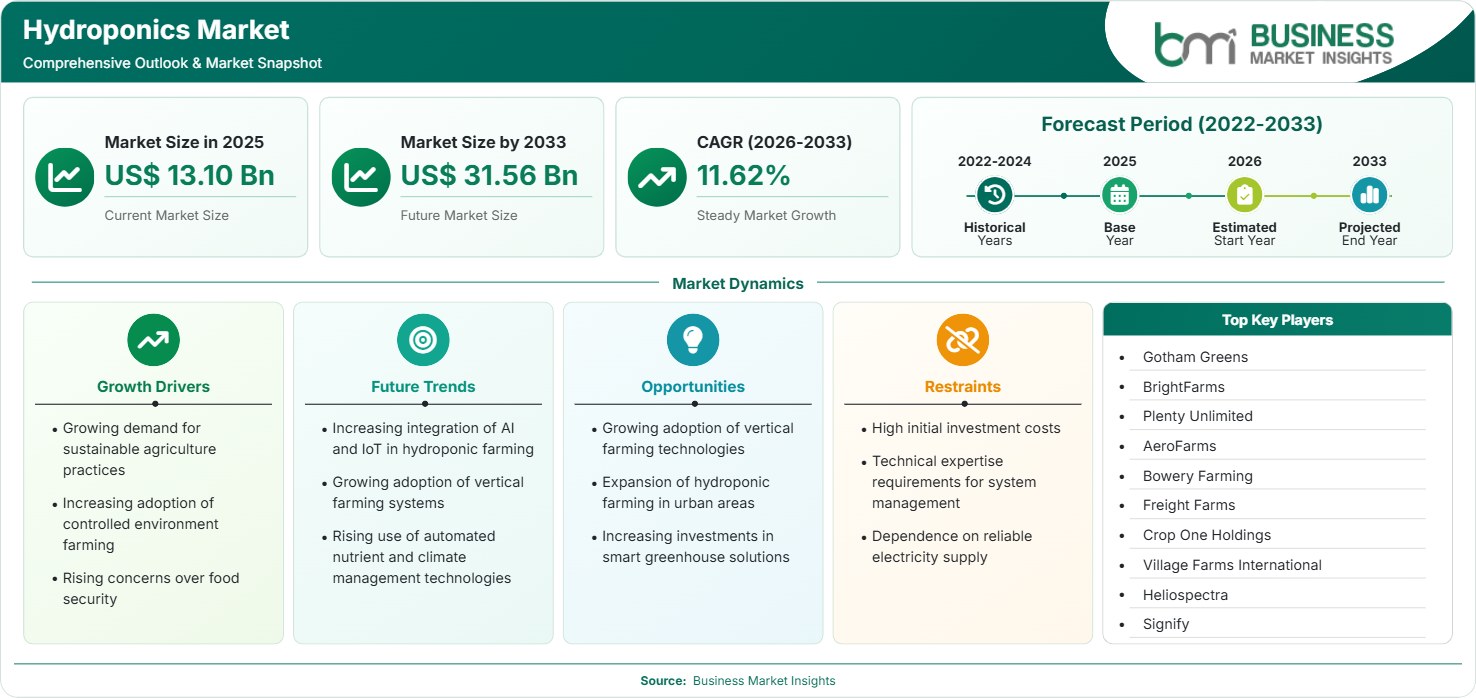
The Hydroponics Market size was valued at US$ 13.10 Billion in 2025 and is projected to reach US$ 31.56 Billion by 2033, growing at a CAGR of 11.62% during 2026–2033. Growth is driven by sustainable agriculture adoption, controlled environment farming expansion, rising food security concerns, and increasing investments in vertical farming and smart greenhouse technologies.

Report Coverage
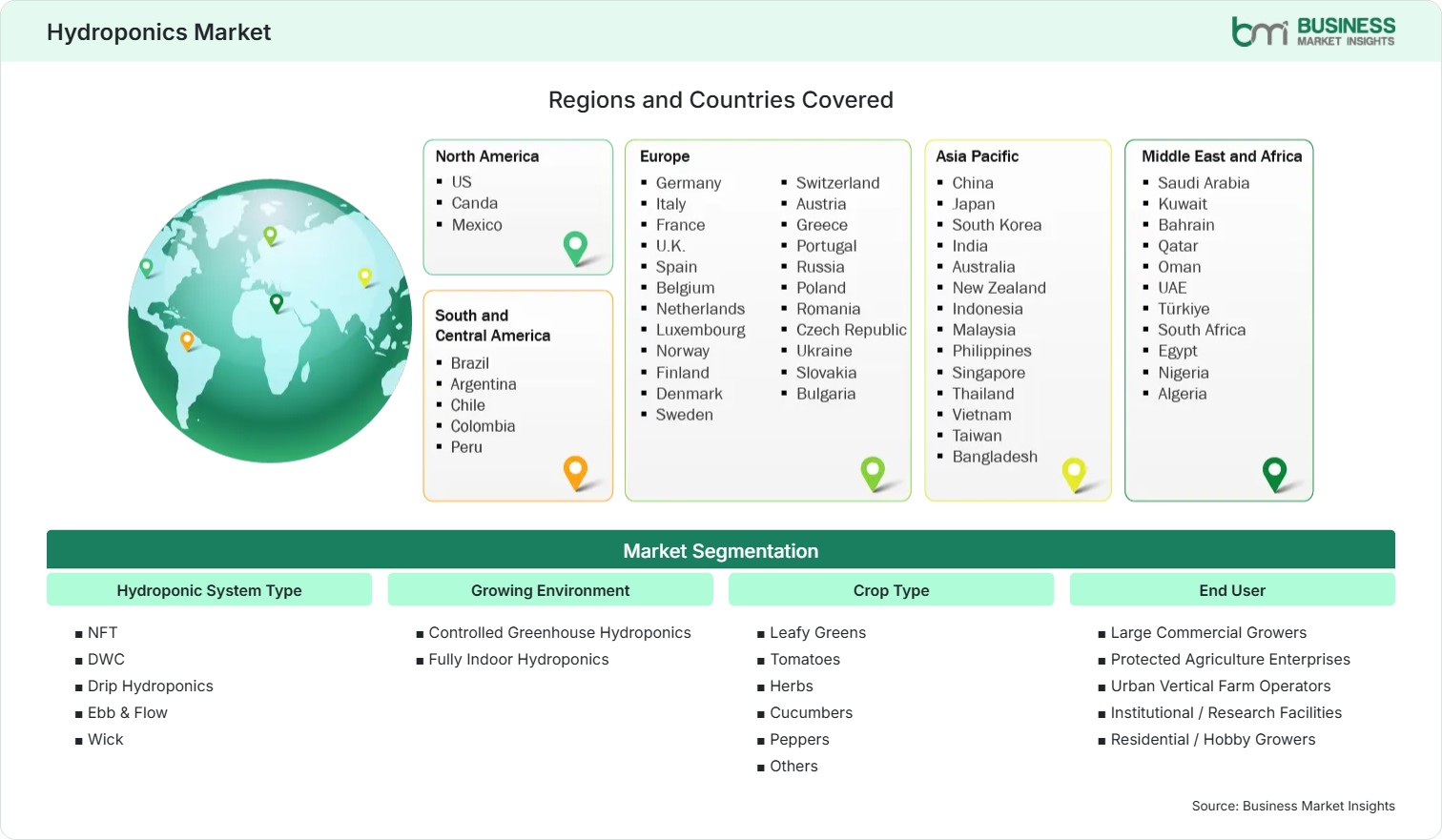
  • Hydroponic System Type: NFT, DWC, Drip Hydroponics, Ebb & Flow, Wick
  • Growing Environment: Controlled Greenhouse Hydroponics, Fully Indoor Hydroponics
  • Crop Type: Leafy Greens, Tomatoes, Herbs, Cucumbers, Peppers, Others
  • End User: Large Commercial Growers, Protected Agriculture Enterprises, Urban Vertical Farm Operators, Institutional / Research Facilities, Residential / Hobby Growers
US$ 13.10 Bn Market size in 2025
US$ 31.56 Bn Market Size by 2033
11.62% CAGR, 2026 - 2033
2026-2033 Forecast Period

AI Overview

Hydroponics Market Summary

  • North America Region: North America holds 36%–39% share in 2025, growing with a 10.8%–11.4% CAGR during 2026–2033, supported by commercial hydroponic farms, advanced automation systems, urban agriculture initiatives, and demand for locally produced crops. The U.S. market is expanding through vertical farming investments, smart cultivation technologies, and greenhouse innovation, registering a 11.0%–11.5% CAGR.
  • Fastest Growing Region: Asia Pacific holds 29%–32% share in 2025, growing at a 12.4%–13.0% CAGR through 2033, driven by food security requirements, urbanization, limited farmland availability, government support for modern agriculture, and increasing adoption of controlled farming solutions.
  • Leading Segment: Controlled Greenhouse Hydroponics holds 58%–61% share in 2025, growing at a 11.3%–11.8% CAGR, supported by commercial-scale cultivation, improved crop yields, climate control capabilities, and adoption among agricultural enterprises seeking efficient production systems.
  • High Growth Segment: Fully Indoor Hydroponics is expanding at a 13.0%–13.6% CAGR, supported by vertical farming adoption, advanced LED lighting, automated monitoring systems, and demand for year-round crop production in urban environments.
  • Key Market Opportunity: Opportunities are emerging through vertical farming expansion, urban food production, smart greenhouse development, and integration of automation technologies that improve productivity, resource efficiency, and crop quality.
  • Major Market Players: Gotham Greens, BrightFarms, Plenty Unlimited, AeroFarms, Bowery Farming, Freight Farms, Crop One Holdings, Village Farms International, Heliospectra, and Signify.
Strategic Insights

Hydroponics Market: Strategic Insights

Hydroponics Market Strategic Framework
FREE PDF
Request your free sample
Request free sample
Stakeholder View

Key Takeaways

  • The hydroponic value chain is evolving through integration of cultivation systems, automation technologies, environmental monitoring tools, and digital farm management platforms that improve operational efficiency.
  • Commercial growers and urban vertical farm operators represent major growth opportunities as demand increases for reliable crop production with reduced land and water requirements.
  • Technology innovation is shifting toward automated nutrient delivery, artificial intelligence-based monitoring, advanced LED solutions, and data-driven cultivation methods.
  • Asia Pacific offers strong investment potential due to rising food security concerns, urban population growth, limited agricultural land, and increasing adoption of modern farming technologies.
  • Companies are strengthening competitive positions through facility expansion, strategic partnerships, technology integration, and investments in scalable hydroponic farming solutions.
  • Smart greenhouse adoption is becoming a key differentiator as growers seek higher productivity, improved resource management, and consistent crop quality.
Geographic Outlook

Hydroponics Market Regional Highlights

North America Hydroponics Market

North America held a 36%–39% market share in 2025 and is expected to grow at a 10.8%–11.4% CAGR from 2026–2033. Growth is driven by advanced agricultural technologies, vertical farming expansion, and demand for locally produced crops. The United States leads the region through investments in controlled environment agriculture, automation, and urban farming initiatives in hydroponics market.

  • Growing investments in commercial hydroponic farms are improving production capacity through advanced cultivation systems, automated monitoring, and efficient resource management technologies.
  • Expansion of urban agriculture initiatives is increasing adoption of hydroponic solutions among city-based growers seeking reliable fresh produce supply chains.
  • Advanced LED lighting, climate control, and sensor technologies are enhancing crop productivity and operational efficiency across controlled farming facilities.
  • Increasing consumer preference for locally sourced food products is encouraging retailers and growers to adopt sustainable cultivation methods.

US Hydroponics Market

The United States accounted for 82%–85% of North America’s market share in 2025 and is projected to grow at an 11.0%–11.5% CAGR from 2026–2033. Growth is driven by advanced agricultural infrastructure, vertical farming investments, and smart greenhouse adoption. Commercial growers and urban farming companies are expanding hydroponic operations to meet demand for fresh, locally grown produce and improve resource efficiency in hydroponics market.

  • Commercial hydroponic operators are increasing production capacity through automated systems, advanced nutrient management, and scalable indoor farming facilities.
  • Technology companies are developing integrated solutions combining sensors, analytics, lighting, and climate controls to improve cultivation performance.
  • Retail partnerships with local growers are supporting adoption by improving distribution opportunities for hydroponically cultivated crops.
  • Growing focus on sustainable agriculture is encouraging investment in water-efficient and land-saving cultivation methods.

Europe Hydroponics Market

Europe held a 23%–26% market share in 2025 and is expected to grow at a 10.5%–11.1% CAGR from 2026–2033. Growth is driven by sustainability initiatives, greenhouse farming expertise, and resource-efficient agricultural technologies. The Netherlands leads adoption, while Germany and the U.K. are expanding through urban farming, food security programs, and controlled environment agriculture investments in region in hydroponics market.

  • The Netherlands maintains leadership through advanced greenhouse technologies, precision farming expertise, and strong commercial hydroponic cultivation capabilities.
  • Germany is expanding adoption through sustainable agriculture programs, technology investments, and increasing demand for efficient food production systems.
  • The United Kingdom is witnessing growth through urban farming initiatives, smart greenhouse investments, and demand for locally grown produce.
  • European growers are adopting automation and digital monitoring solutions to improve productivity and reduce resource consumption.
  • Government sustainability targets are encouraging investments in modern agricultural technologies and climate-resilient farming approaches.

Asia Pacific Hydroponics Market

Asia Pacific held a 29%–32% market share in 2025 and is projected to grow at a 12.4%–13.0% CAGR from 2026–2033, making it the fastest-growing region in hydroponics market. Growth is driven by food security concerns, urbanization, limited farmland, and adoption of modern farming technologies. China leads regional demand, while Japan, Singapore, and India are expanding through urban farming and smart agriculture initiatives.

  • China is expanding hydroponic adoption through agricultural technology investments, government support, and demand for efficient food production systems.
  • Singapore is developing advanced urban farming projects due to limited land availability and strong focus on domestic food production.
  • India is witnessing increasing adoption through startup investments, urban farming initiatives, and growing awareness of sustainable cultivation methods.
  • Japan continues advancing controlled environment agriculture through automation, precision technologies, and innovative cultivation systems.
  • Regional investments in smart greenhouses are creating opportunities for technology providers and commercial growers.

Rest of World Hydroponics Market

The Rest of World region accounted for 8%–11% share in 2025 and is projected to grow at a 10.2%–10.8% CAGR during 2026–2033. South and Central America are adopting hydroponic farming to improve agricultural efficiency and overcome climate-related challenges, with Brazil showing strong potential due to agricultural capabilities. The Middle East and Africa are investing in controlled environment farming to address water scarcity and food security concerns, particularly in countries with limited arable land in hydroponics market.

Latin American markets are benefiting from increasing interest in sustainable cultivation, while Middle Eastern countries are developing advanced farming systems supported by technology investments and food resilience strategies.

  • Brazil is adopting hydroponic systems through commercial farming expansion and increasing demand for efficient crop production methods.
  • Mexico is witnessing growth through urban agriculture projects and rising adoption of controlled cultivation technologies.
  • Gulf countries are investing in indoor farming solutions to reduce dependence on food imports and improve local production.
  • South Africa is developing hydroponic farming through agricultural innovation programs and increasing interest in sustainable food production.
  • Regional growers are adopting smart farming technologies to improve resource utilization and crop consistency.
Global Market Geography
FREE PDF
Request your free sample
Request free sample
Segment Analysis

Hydroponics Market Segmentation

Hydroponic System Type

The hydroponic system type segment is expanding due to increasing adoption of efficient cultivation technologies, water-saving practices, and automated farming solutions among commercial growers. NFT (Nutrient Film Technique) represents the leading category, accounting for 31%–34% share in 2025 and growing at a 11.1%–11.7% CAGR during 2026–2033. Strong suitability for leafy greens, efficient nutrient circulation, and scalability are supporting segment growth.

  • NFT: NFT systems are widely adopted for leafy greens and herbs due to efficient nutrient circulation, low water consumption, and suitability for commercial controlled farming environments.
  • DWC (Raft): Deep Water Culture systems support large-scale crop production through direct root oxygenation, making them suitable for commercial growers seeking consistent yields.
  • Drip Hydroponics: Drip systems provide precise nutrient delivery and are increasingly used for tomatoes, cucumbers, and other crops requiring controlled irrigation management.
  • Ebb & Flow: Ebb and Flow systems offer flexibility for different crop varieties through automated watering cycles and efficient nutrient management approaches.
  • Wick: Wick systems remain popular among residential and hobby growers due to simple operation, low maintenance requirements, and affordable setup costs.

Growing Environment

The growing environment segment is driven by increasing adoption of controlled agriculture solutions that improve productivity, crop quality, and resource efficiency. Controlled Greenhouse Hydroponics dominates with 58%–61% Hydroponics Market share in 2025 and grows at a 11.3%–11.8% CAGR during 2026–2033. Commercial growers prefer greenhouse-based systems due to scalability, climate management capabilities, and suitability for large-volume crop production.

  • Controlled Greenhouse Hydroponics: These systems enable year-round cultivation through climate regulation, automated monitoring, and efficient resource utilization for commercial agriculture operations.
  • Fully Indoor Hydroponics: Indoor systems are gaining adoption through vertical farming expansion, artificial lighting improvements, and demand for urban food production solutions.

Crop Type

The crop type segment is expanding due to rising demand for fresh produce, efficient cultivation methods, and year-round hydroponic farming. Leafy Greens represent the leading category, accounting for 35%–38% share in 2025 and growing at a 11.2%–11.8% CAGR during 2026–2033. Adoption of hydroponics for premium crops is encouraging growers to diversify production portfolios and improve cultivation efficiency.

  • Leafy Greens: Leafy greens are widely cultivated using hydroponics due to fast growth cycles, high demand, and suitability for vertical farming systems.
  • Tomatoes: Tomatoes represent a major hydroponic crop due to commercial value, controlled growing requirements, and improved yield potential under greenhouse conditions.
  • Herbs: Herbs are increasingly produced through hydroponics because of consumer demand for fresh products and suitability for compact urban farming systems.
  • Cucumbers: Cucumbers benefit from hydroponic cultivation through improved water management, controlled environments, and consistent production quality.
  • Peppers: Peppers are gaining adoption among commercial growers due to demand for premium produce and controlled cultivation advantages.

End User

The end user segment is expanding as commercial growers, urban farming operators, research institutions, and residential users increasingly adopt hydroponic systems for efficient crop production. Large Commercial Growers represent the leading category, accounting for 34%–37% share in 2025 and growing at a 11.0%–11.6% CAGR during 2026–2033. Rising demand for scalable cultivation, resource optimization, and consistent crop supply is encouraging adoption across diverse end-user groups.

  • Large Commercial Growers: Large growers adopt hydroponics to increase production efficiency, optimize resources, and supply consistent crop volumes to commercial markets.
  • Protected Agriculture Enterprises: These enterprises integrate hydroponic systems with greenhouse technologies to improve crop productivity and reduce environmental production challenges.
  • Urban Vertical Farm Operators: Urban operators use hydroponics to maximize limited space, support local food supply, and enable year-round crop cultivation.
  • Institutional / Research Facilities: Research facilities utilize hydroponics for crop studies, technology development, and innovation in controlled agricultural practices.
  • Residential / Hobby Growers: Residential users adopt hydroponic systems due to easy installation, compact designs, and growing interest in home-based food cultivation.
Market Forces

Hydroponics Market Dynamics

Key Market Drivers

Growing Demand for Sustainable Agriculture Practices

Growing demand for sustainable agriculture practices is accelerating hydroponics adoption as growers seek solutions that reduce water consumption, optimize land utilization, and improve crop productivity. Hydroponic systems enable controlled nutrient delivery and efficient resource management compared with conventional farming methods. Increasing environmental concerns, climate variability, and pressure on agricultural resources are encouraging commercial growers and urban farming operators to adopt alternative cultivation methods. Governments and agricultural organizations are supporting resource-efficient farming initiatives, creating favorable conditions for hydroponic technology expansion. The hydroponics market growth is supported by increasing investment in sustainable food production models, while market trends indicate stronger adoption of automated systems, smart monitoring technologies, and environmentally efficient cultivation approaches.

Increasing Adoption of Controlled Environment Farming

Increasing adoption of controlled environment farming is transforming crop production by enabling growers to maintain optimized conditions for temperature, humidity, lighting, and nutrient management. The hydroponics market trends Controlled environments help reduce production risks associated with weather fluctuations and seasonal limitations while improving crop consistency. Commercial growers are increasingly integrating hydroponics with greenhouses, indoor farms, and automation platforms to achieve higher efficiency. Rising demand for year-round fresh produce is encouraging investments in climate-controlled cultivation facilities across urban and commercial agricultural settings. Advances in sensors, artificial intelligence, and farm management software are further improving operational control. This adoption trend is strengthening hydroponic deployment among enterprises seeking predictable yields and improved resource utilization.

Rising Concerns Over Food Security

The growing apprehension about food security is fostering the adoption of hydroponics as countries try to find ways to reliably produce food due to population increase, urbanization, and agricultural difficulties. Hydroponics allows the growth of crops in places where arable land is not plentiful and facilitates local food production close to the consumers. Countries, technology firms, and investors in agriculture are looking at controlled agriculture methods more often as ways of improving resilience of the supply chain. Urban agriculture ventures are being developed in areas facing land shortages and production challenges due to weather conditions.

Key Market Opportunities

Growing Adoption of Vertical Farming Technologies

The increase in the use of technologies used in vertical farming has created a number of opportunities for hydroponic systems due to the increased density of crops that can be produced using the technology in urban areas. Vertical farms use hydroponic systems along with automated lighting, climate control, and other technologies to ensure optimal production in limited space. With increasing urbanization and demand for local food production, investment in vertical farms has grown in both developed and developing economies. Technology vendors have come up with scalable technologies for improving energy efficiency, crop monitoring, and performance.

Expansion of Hydroponic Farming in Urban Areas

The growth of hydroponics in urban settings is providing new avenues as urban centers look for sustainable ways to grow their own fresh produce. Urban hydroponic farms offer solutions to the issue of lack of space, making it possible to plant crops in warehouse settings, on rooftops, and in other small-scale agricultural zones. The rise in consumer demand for locally produced produce has made retailers and food producers look for ways to work with urban farms. There is an increase in investments in community farming schemes and indoor urban agriculture facilities that have increased the availability of the market.

Increasing Investments in Smart Greenhouse Solutions

The increased investment in smart greenhouse technologies is presenting more opportunities for integration of automation, sensor, AI, and digital technologies into hydroponic growing systems. The smart greenhouse technologies allow farmers to manage their environment better to increase crop quality and efficiencies. Agricultural firms are investing more into technologies that help with predictive analysis, automated irrigation, and crop monitoring in real time. This kind of technology has become an essential element for commercial farmers who strive to become more productive. Technology firms and agricultural firms are collaborating to innovate in greenhouse-based hydroponics. The increased demand for precision agriculture solutions is likely to lead to more investments in intelligent farming technologies.

Market Restraints and Challenges

High Initial Investment Costs

Factor: high initial investment costs create barriers due to expensive infrastructure requirements, including controlled environments, lighting systems, automation equipment, and specialized hydroponic installations. Impact: significant upfront capital requirements can restrict adoption among small-scale growers and residential users, particularly in developing markets with limited access to agricultural financing. High-end hydroponics systems entail high costs in terms of technology, energy, and setup. While improved efficiency in the long run is expected to make the business more profitable, the high upfront cost continues to be a barrier to entry. The industry is working around this constraint by developing modular solutions, leasing schemes, and accessible technologies.

Technical Expertise Requirements for System Management

Factor: technical expertise requirements for system management create operational challenges due to the need for knowledge in nutrient management, environmental control, equipment maintenance, and crop monitoring. Impact: limited availability of skilled operators can affect system performance, reduce productivity, and increase operational risks for growers adopting hydroponic technologies. Hydroponic growing is dependent on knowledge of plant biology, automation, and controlled environment technologies. There are efforts in place through training programs, digital monitoring devices, and improved system design to lessen technical challenges. Nonetheless, the need for technical expertise is one of the major obstacles in hydroponic farming.

Company Analysis

Competitive Landscape

The Hydroponics Market analysis indicates a competitive landscape shaped by agricultural technology companies, commercial farming operators, greenhouse solution providers, and smart farming innovators. Market participants are focusing on expanding cultivation capacity, improving automation capabilities, developing energy-efficient solutions, and integrating digital technologies to enhance productivity and scalability across commercial and urban farming applications.

Company Name

Overview

Products and Services relevant to this market

Gotham Greens

Gotham Greens operates large-scale urban hydroponic farms focused on sustainable food production and local supply chains.

Provides greenhouse hydroponic farming solutions, fresh produce cultivation, and controlled environment agriculture operations.

BrightFarms

BrightFarms specializes in indoor hydroponic farming with a focus on locally grown leafy greens and vegetables.

Operates hydroponic greenhouse farms producing fresh vegetables through controlled environment cultivation technologies.

Plenty Unlimited

Plenty Unlimited develops vertical farming technologies using advanced indoor cultivation systems and automation.

Provides vertical hydroponic farming platforms, automated growing systems, and technology-driven food production solutions.

AeroFarms

AeroFarms is a vertical farming company specializing in controlled environment agriculture and sustainable crop production.

Offers indoor hydroponic farming technologies, aeroponic systems, crop science solutions, and fresh produce cultivation.

Bowery Farming

Bowery Farming developed technology-enabled indoor farms using automation and data-driven cultivation approaches.

Provides indoor farming systems, software platforms, and hydroponic crop production technologies.

Freight Farms

Freight Farms develops modular container-based farming systems for distributed food production.

Offers containerized hydroponic farming units, farm management technology, and urban agriculture solutions.

Crop One Holdings

Crop One Holdings focuses on commercial-scale indoor farming through technology-enabled cultivation methods.

Provides large-scale hydroponic farming operations, controlled environment agriculture, and fresh produce production solutions.

Village Farms International

Village Farms International operates controlled environment agriculture facilities producing vegetables and specialty crops.

Provides greenhouse cultivation expertise, hydroponic growing systems, and commercial agricultural production services.

Heliospectra

Heliospectra develops advanced LED lighting solutions for controlled environment agriculture applications.

Offers smart LED grow lighting systems, environmental control technologies, and crop optimization solutions.

Signify

Signify provides lighting technologies supporting commercial horticulture and controlled agriculture applications.

Supplies horticultural LED lighting systems, smart lighting controls, and digital solutions for hydroponic farming environments.

Trust & Transparency

Research Methodology

The market analysis combines proprietary research with secondary data from government agencies, company disclosures, regulatory filings, industry databases and expert interviews. Market estimates are validated through data triangulation, cross-market benchmarking and analyst review.

View Full Research Methodology

Questions Answered

Frequently Asked Questions

What does the Hydroponics Market Report highlight about future opportunities?

The report highlights opportunities from vertical farming expansion, smart greenhouse adoption, automation integration, and increasing investments in sustainable food production technologies.

Why are indoor hydroponic farms gaining attention?

Indoor hydroponic farms are gaining attention due to their ability to produce crops year-round, operate in urban areas, and reduce dependence on external climate conditions.

How does hydroponics support sustainable agriculture?

Hydroponics supports sustainability by optimizing water usage, reducing land dependency, enabling controlled cultivation, and improving crop productivity through precise nutrient and environmental management.

Which hydroponic system type is widely used commercially?

NFT systems are widely adopted for commercial applications because they provide efficient nutrient delivery, lower water consumption, and suitability for high-value crops such as leafy greens.

What is driving the adoption of Hydroponics Market forecasts?

Adoption is driven by sustainable agriculture requirements, limited farmland availability, rising food security concerns, urban farming expansion, and demand for efficient crop production methods.

Access the Full Hydroponics Market Report

Get segment-level forecasts, regional estimates, competitive benchmarking, company profiles and downloadable Excel datasets.

Access the full Hydroponics Market Report
350 pages PDF & Excel | 2026-08-06
Similar Research

Related Market Reports