
Filters Market Outlook: Size, Share, Trends, Growth Analysis, Competitive Landscape & Forecast, 2026-2033

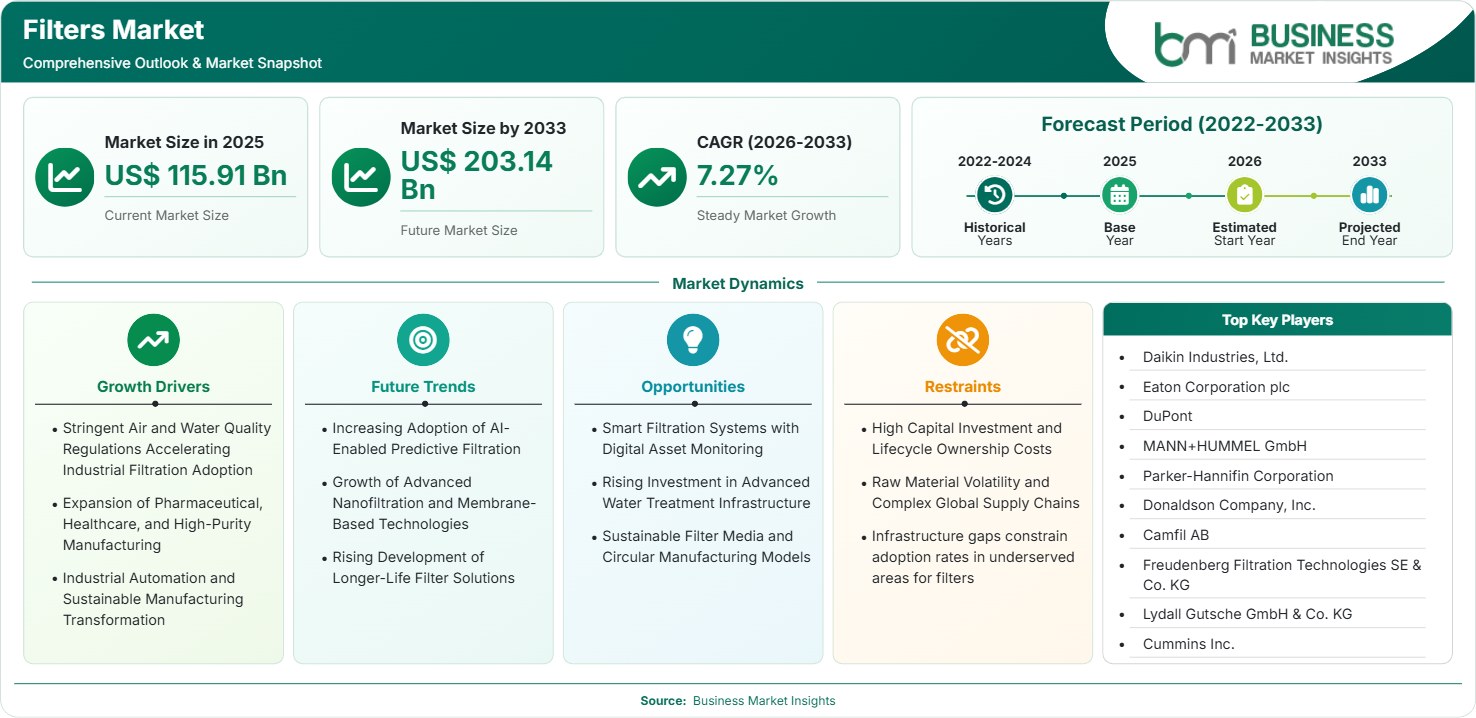
The Filters Market size was valued at US$ 115.91 Billion in 2025 and is projected to reach US$ 203.14 Billion by 2033, growing at a CAGR of 7.27% during 2026–2033, driven by stringent environmental regulations, expanding industrial production, advanced filtration technologies, increasing healthcare demand, and growing investments in sustainable air and water purification infrastructure worldwide.

Report Coverage
  • Product Type: Air, Water, Gas
  • Application: Food & Beverage, Chemicals & Materials, Oil & Gas and Power, Pharmaceuticals/Medical, Metal & Mining, Automotive, Others
US$ 115.91 Bn Market size in 2025
US$ 203.14 Bn Market Size by 2033
7.27% CAGR, 2026 - 2033
2026-2033 Forecast Period

AI Overview

Filters Market Summary

  • North America Region: North America holds a 34%–37% market share in 2025, growing with a 6.4%–6.9% CAGR during 2026–2033, supported by industrial automation, EPA emission regulations, replacement demand, and clean manufacturing investments. The United States remains the regional innovation hub through strong industrial production, healthcare expansion, and advanced filtration manufacturing, recording a CAGR of 6.5%–7.0%.
  • Fastest Growing Region: Asia Pacific accounts for 29%–32% market share in 2025 and is projected to expand at a 8.8%–9.4% CAGR during 2026–2033, supported by industrialization, urban infrastructure, environmental compliance, water treatment investment, and manufacturing capacity expansion.
  • Leading Segment: Air filtration represents 44%–47% of the market in 2025 and is expected to grow at a 7.0%–7.5% CAGR through 2033, driven by industrial air quality regulations, HVAC modernization, healthcare requirements, semiconductor production, and energy-efficient filtration technologies.
  • High Growth Segment: Pharmaceuticals/Medical applications account for 15%–18% market share in 2025 while advancing at a 9.2%–9.8% CAGR during 2026–2033, supported by sterile manufacturing, biologics production, regulatory compliance, cleanroom investments, and increasing healthcare infrastructure worldwide.
  • Key Market Opportunity: Rising investments in membrane filtration, smart monitoring technologies, sustainable filter materials, and circular manufacturing practices are creating new revenue opportunities while improving energy efficiency, operational reliability, and environmental compliance across industries.
  • Major Market Players: Daikin Industries, Ltd.; Eaton Corporation plc; DuPont; MANN+HUMMEL GmbH; Parker-Hannifin Corporation; Donaldson Company, Inc.; Camfil AB; Freudenberg Filtration Technologies SE & Co. KG; Lydall Gutsche GmbH & Co. KG; Cummins Inc.
Strategic Insights

Filters Market: Strategic Insights

Filters Market Strategic Framework
FREE PDF
Request your free sample
Request free sample
Stakeholder View

Key Takeaways

  • The filtration value chain is becoming increasingly integrated as material suppliers, membrane developers, equipment manufacturers, automation providers, and aftermarket service companies collaborate to deliver higher-performance, lower-maintenance filtration systems across industrial applications.
  • The strongest commercial opportunities are emerging in pharmaceutical manufacturing, semiconductor fabrication, municipal water treatment, and advanced food processing, where regulatory compliance and contamination control require increasingly sophisticated filtration technologies.
  • Product innovation is shifting toward nanofiber media, intelligent filter monitoring, recyclable filtration materials, antimicrobial coatings, and energy-efficient airflow optimization, enabling manufacturers to improve operational efficiency while lowering environmental impact.
  • Asia Pacific presents the most attractive long-term investment destination because rapid industrial expansion, urban infrastructure development, environmental regulation enforcement, and increasing clean manufacturing capacity continue driving sustained demand across multiple end-use industries.
  • Strategic acquisitions, technology partnerships, and manufacturing capacity expansions remain central competitive strategies as companies strengthen regional distribution networks, enhance specialized filtration portfolios, and improve access to rapidly growing industrial and healthcare markets.
  • Digitalization is transforming maintenance practices through sensor-enabled predictive diagnostics, remote asset monitoring, and data-driven lifecycle management, enabling end users to reduce operational downtime while optimizing filter replacement schedules and maintenance expenditure.
Geographic Outlook

Filters Market Regional Highlights

North America Filters Market

North America accounted for approximately 34%–37% of the Filters Market share in 2025 and is projected to register a 6.4%–6.9% CAGR during 2026–2033. Environmental regulation, modernization of industrial plants, rising pharmaceutical production, and continued investment in wastewater management are key factors contributing to regional demand. The USA is the biggest contributor to the region, while Canada has benefitted from mining, food processing, and energy. Adoption of smart filters by industries is another important factor to consider.

  • The United States leads regional demand due to stringent EPA regulations, advanced healthcare infrastructure, industrial automation, and investments in semiconductor, biotechnology, and food manufacturing requiring high-performance filtration.
  • HVAC modernization in commercial buildings, data centers, hospitals, and schools is driving demand for energy-efficient filtration that reduces contaminants, energy use, and maintenance costs.
  • Water infrastructure upgrades in the United States and Canada are supporting membrane, activated carbon, and ultrafiltration systems to meet stricter drinking water standards.
  • Industrial manufacturers are adopting IoT-enabled filtration monitoring for predictive maintenance, reduced downtime, and improved equipment performance.
  • Growing EV and battery production is creating opportunities for cleanroom air filtration, chemical filtration, and contamination control technologies.

US Filters Market

The United States accounted for 74%–77% of North American revenue in 2025 and is expected to grow at a 6.5%–7.0% CAGR through 2033. Industrial automation increased pharmaceutical manufacturing, aircraft production, and strict workplace air quality standards are expected to continue driving demand. Higher government infrastructure spending on water treatment and sewage systems is also boosting the deployment of domestic filtration equipment in the Filters Market.

  • Pharmaceutical manufacturing growth is driving demand for sterile air, liquid, and gas filtration systems for biologics, vaccines, and advanced drugs while meeting FDA requirements.
  • Expanding semiconductor manufacturing is increasing demand for ultra-high-purity filtration technologies for contamination-free production and advanced chip fabrication.
  • Aging municipal water infrastructure is driving replacement demand for membrane filtration, activated carbon systems, and digital monitoring solutions.
  • Sustainability initiatives are encouraging manufacturers to adopt reusable filter media, energy-efficient HVAC filtration, and eco-friendly technologies to reduce carbon emissions.

Europe Filters Market

Europe held approximately 26%–29% market share during 2025 and is anticipated to grow at a 6.8%–7.3% CAGR through 2033. The Filters Market trends supported by Strict environmental legislation, circular economy initiatives, advanced manufacturing capabilities, and robust healthcare infrastructure continue driving technology adoption. Germany leads regional demand through automotive, industrial machinery, and pharmaceutical production, while Poland demonstrates the fastest expansion with an estimated 8.0%–8.5% CAGR, supported by manufacturing investments and industrial modernization.

  • Germany leads through advanced automotive, automation, chemical, and engineering industries, supporting filtration innovation and exports.
  • EU sustainability regulations are driving investments in recyclable filter materials, energy-efficient air systems, and advanced wastewater treatment.
  • Pharmaceutical growth in Germany, Switzerland, Ireland, and Belgium is increasing demand for high-efficiency cleanroom and sterile filtration systems.
  • Poland's expanding industrial base and FDI are accelerating advanced filtration adoption in automotive, food processing, and electronics.
  • Growth in renewable energy and hydrogen projects is creating demand for specialized filtration systems for clean energy infrastructure.

Asia Pacific Filters Market

Asia Pacific represented approximately 29%–32% of market revenue in 2025 and is forecast to record the fastest 8.8%–9.4% CAGR between 2026 and 2033. Rapid industrialization, urbanization, stricter environmental regulations, and expanding manufacturing investments continue accelerating adoption. China remains the leading regional market, while India records the highest regional growth at approximately 9.5%–10.1% CAGR, supported by industrial expansion, water infrastructure projects, and healthcare investment in Filters Market.

  • China leads regional demand through large-scale manufacturing, electronics, water infrastructure, and stricter industrial emission standards.
  • India is seeing rapid adoption across pharmaceuticals, food processing, automotive, and wastewater treatment, supported by infrastructure and industrial investments.
  • Japan and South Korea are investing in semiconductor, precision manufacturing, and healthcare sectors requiring advanced contamination control and filtration.
  • Growth in commercial buildings, metro systems, airports, and healthcare facilities is increasing demand for HVAC filtration to improve indoor air quality.
  • Rising foreign investment in Southeast Asian manufacturing is expanding demand for filtration equipment, industrial components, and membrane technologies.

Rest of World Filters Market

South & Central America together with the Middle East & Africa accounted for approximately 8%–11% of global revenue in 2025 and are expected to expand at a 7.4%–7.9% CAGR during 2026–2033. Investments in water desalination, mining, oil and gas operations, food processing, and industrial diversification continue supporting market expansion.

Brazil remains the leading South & Central American market, while Saudi Arabia leads Middle Eastern demand through desalination and industrial investments. The United Arab Emirates demonstrates the fastest regional growth in Filters Market supported by infrastructure modernization, advanced manufacturing, and sustainable water management initiatives.

  • Brazil's investments in wastewater treatment, mining, food processing, and manufacturing are driving demand for advanced filtration technologies.
  • Saudi Arabia's Vision 2030 is supporting growth in industrial air filtration, desalination, and advanced water treatment.
  • Mining expansion in South Africa and Chile is increasing demand for process filtration, dust collection, and liquid filtration systems.
  • GCC desalination investments are creating opportunities for membrane filtration, reverse osmosis, and pretreatment systems.
  • Healthcare infrastructure growth across emerging economies is increasing demand for cleanroom filtration, medical water purification, and contamination control.
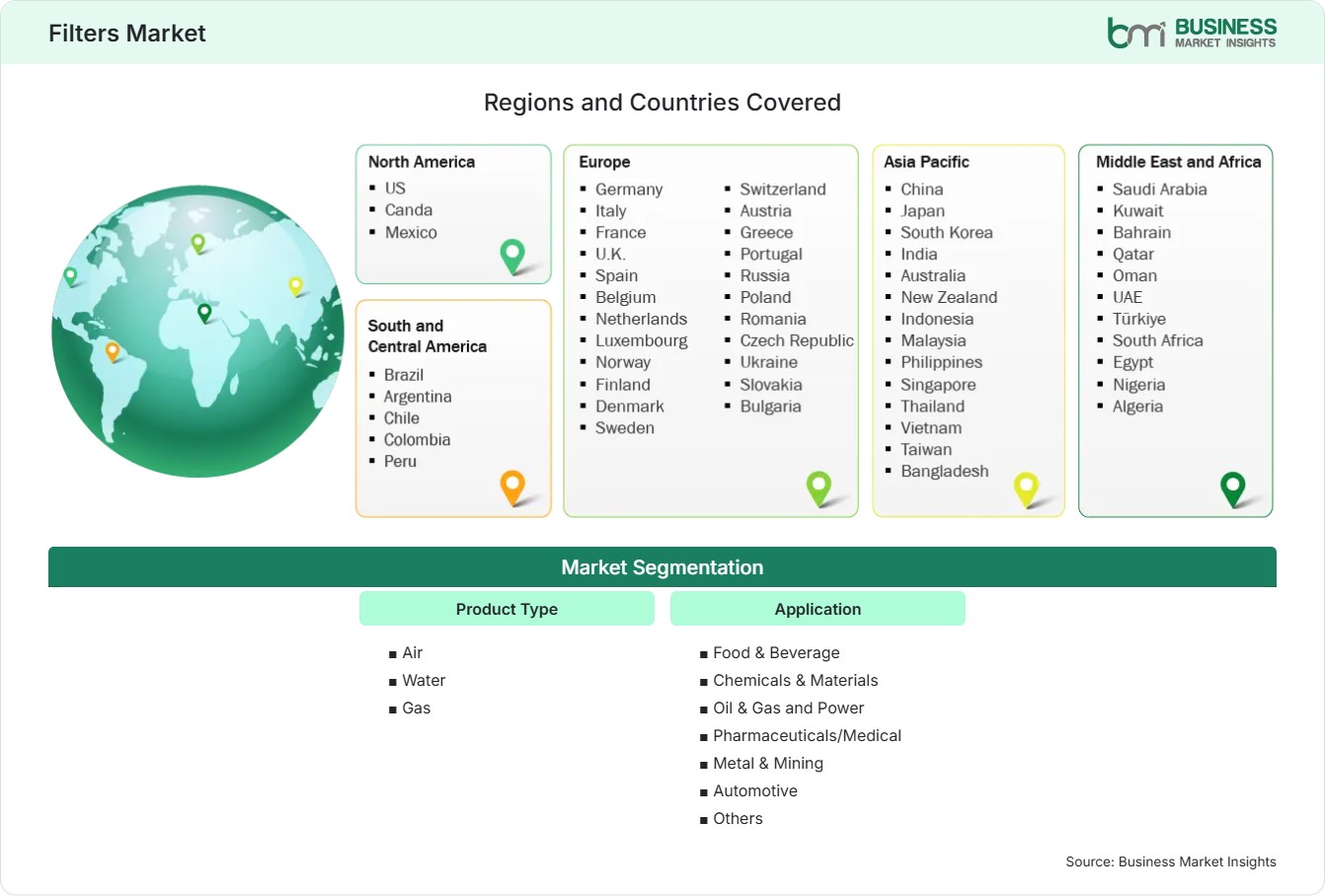
Global Market Geography
FREE PDF
Request your free sample
Request free sample
Segment Analysis

Filters Market Segmentation

Product Type

The product type segment accounted for the complete market, with Air filters representing the largest share at approximately 44%–47% in 2025 while advancing at a 7.0%–7.5% CAGR through 2033. Rising industrial emission regulations, indoor air quality standards, healthcare expansion, and manufacturing modernization continue driving adoption. The Filters Market scope continues expanding through innovations in filtration media, intelligent monitoring systems, and sustainable product development.

  • Air: Leads demand across HVAC, cleanrooms, manufacturing, automotive, healthcare, and commercial buildings, driven by contamination control and energy efficiency.
  • Water: Growing investments in drinking water, wastewater reuse, desalination, and industrial treatment are increasing demand for membrane and activated carbon filtration.
  • Gas: Adoption is rising in semiconductor, chemical, oil and gas, healthcare, and specialty industries requiring high-purity gas filtration.

Application

The application segment is led by Food & Beverage, accounting for approximately 25%–28% of market revenue in 2025 while recording a 6.9%–7.4% CAGR through 2033 in Filters Market. Food safety regulations, process hygiene requirements, beverage manufacturing expansion, and contamination prevention continue supporting demand. Meanwhile, Pharmaceuticals/Medical represents the fastest-growing application with an estimated 9.2%–9.8% CAGR, driven by biologics production, cleanroom expansion, and sterile manufacturing requirements.

  • Food & Beverage: Growing packaged food production and hygiene standards are driving demand for liquid, air, and process filtration.
  • Chemicals & Materials: Advanced filtration supports contamination control, process efficiency, catalyst protection, and product quality.
  • Oil & Gas and Power: Filtration technologies improve equipment reliability, process efficiency, emissions control, and safety.
  • Pharmaceuticals/Medical: Growth in biologics, vaccines, sterile processing, and cleanrooms is increasing demand for precision filtration.
  • Metal & Mining: Filtration systems support dust control, slurry processing, wastewater treatment, equipment protection, and environmental compliance.
  • Automotive: Vehicle, EV, battery, paint, and component manufacturing are driving demand for industrial air and liquid filtration.
Market Forces

Filters Market Dynamics

Key Market Drivers

Stringent Air and Water Quality Regulations Accelerating Industrial Filtration Adoption

Environmental and health regulations by governments around the world have continued to tighten, thereby forcing industries to adopt the latest filtration technology. This is evident in the regulations by the U.S. Environmental Protection Agency, the European Union Industrial Emissions Directive, and China's Blue Sky programs where they have lowered acceptable emission standards in all the industries. At the same time, the World Health Organization has estimated that 99% of the people globally breathe air that exceeds acceptable pollution levels. This situation has created a need to replace filter units in HVAC systems, pharmaceutical, chemical, and food industries, and municipal water filtration plants. Consequently, Filters Market growth remains supported by regulatory compliance requirements, sustainability commitments, and expanding investments in advanced air, liquid, and gas purification technologies.

Expansion of Pharmaceutical, Healthcare, and High-Purity Manufacturing

The growing trend within the pharmaceutical industry towards the production of biologicals, cell therapy, vaccine development, and sterility manufacturing is driving demand for precision filtration equipment. The manufacturing facilities need contamination-free environments that meet good manufacturing practice (GMP) guidelines hence the investment in HEPA, ULPA, membrane, and sterility filtration technologies. Similar needs are seen in semiconductor manufacturing, biotechnology research labs, and the medical device manufacturing industry. Continued growth in healthcare facilities in developing countries is contributing to the rising demand for specialty filtration products. Manufacturers have responded by offering filtration media that provide greater filtration capacity and extended product life, and that also allow digital monitoring.

Industrial Automation and Sustainable Manufacturing Transformation

ndustries have started implementing intelligent filtration systems on their automated production lines to increase efficiency, reduce maintenance costs, and meet sustainability goals. Using digital sensors, predictive analytics, and IIoT, it is possible to continuously monitor the efficiency of filtration and machinery operation. Increasing focus on carbon emission reduction and sustainable resource management drives more companies to implement energy-efficient filtration solutions that use reusable filtration media and feature low pressure drop systems. The International Energy Agency continues emphasizing the importance of industrial energy efficiency in the decarbonization strategy. These developments continue strengthening long-term demand across multiple industrial applications.

Key Market Opportunities

Smart Filtration Systems with Digital Asset Monitoring

The digital transformation offers great potential for growth, as more companies are adopting advanced filtration systems capable of predictive maintenance and diagnostics. The filtration system uses sensors that monitor airflow, contaminants, pressure differential, and filter life expectancy, enabling the operator to plan effectively for filter changes. Advanced filtration systems increase productivity levels in the plant without increasing operating costs. With the advancement of Industry 4.0 technology, there are favorable conditions for software-based filtration systems that provide operational intelligence. Long-term Filters Market Forecasts indicate growing investment in smart industrial infrastructure, encouraging manufacturers to develop connected filtration ecosystems supported by cloud-based analytics and artificial intelligence.

Rising Investment in Advanced Water Treatment Infrastructure

The growing issue of water scarcity, industrial wastewater reclamation, and stringent effluent discharge norms are fueling the need for advanced filtration solutions globally. While governments are working to upgrade potable water infrastructure, industrial players are increasingly reusing process water to ensure sustainable processes and reduce operational costs. Reverse osmosis, ultrafiltration, nanofiltration, and activated carbon filters have become a necessity for municipalities, food & beverages industries, pharma, mining, and electronics manufacturers. The rapid pace of urbanization witnessed in Asia Pacific, the Middle East, and Africa is opening new avenues for membrane producers and comprehensive filtration solutions vendors.

Sustainable Filter Media and Circular Manufacturing Models

As environmental consciousness rises, it is pushing manufacturers to create filtration media that can be recycled, use materials from natural resources, and are reusable to minimize their environmental footprint over the life cycle. The growing focus by industrial buyers on filtration systems not only on their effectiveness but also on their green credentials and carbon emissions savings provides an opening for innovative filtration companies that are investing in circular business models, emission-reducing manufacturing methods, and sustainable raw material sourcing to build their competitive advantage while fulfilling procurement needs. The growing emphasis on waste reduction and extending the product life cycle by regulations is providing more scope for innovative filtration companies.

Market Restraints and Challenges

High Capital Investment and Lifecycle Ownership Costs

Advanced filtration systems often require significant upfront investment, specialized installation, and continuous maintenance, particularly across pharmaceutical manufacturing, semiconductor fabrication, municipal water treatment, and industrial processing facilities. Factor: High-performance filtration technologies incorporate premium membrane materials, specialized filter media, automated monitoring systems, and customized engineering solutions that increase procurement and installation costs. Impact: Small and medium-sized enterprises frequently postpone equipment modernization due to budget limitations, extending replacement cycles and slowing adoption of advanced filtration technologies despite growing regulatory requirements and operational efficiency benefits.

Raw Material Volatility and Complex Global Supply Chains

The filtration industry depends on stable supplies of synthetic fibers, specialty polymers, activated carbon, stainless steel, glass microfiber materials, and electronic monitoring components sourced through globally interconnected supply networks. Factor: Geopolitical uncertainty, transportation disruptions, inflationary pressures, and fluctuations in petrochemical feedstock prices increase manufacturing costs while creating procurement uncertainty for filtration equipment producers. Impact: Manufacturers face margin pressure, extended production lead times, inventory management challenges, and pricing volatility, making long-term procurement planning increasingly complex while reducing short-term profitability across competitive industrial markets.

Company Analysis

Competitive Landscape

The competitive environment remains highly diversified as multinational manufacturers compete through technology innovation, regional expansion, sustainability initiatives, and strategic acquisitions. Continuous investment in digital filtration platforms, membrane technologies, and energy-efficient products is reshaping Filters Market analysis, while aftermarket services and customized industrial solutions continue strengthening customer retention and long-term competitive positioning.

Company Name

Overview

Products and Services Relevant to this Market

Daikin Industries, Ltd.

Global HVAC and air quality technology leader serving commercial, industrial, and residential markets.

Air filters, HVAC filtration, cleanroom systems, indoor air quality solutions, environmental control equipment.

Eaton Corporation plc

Diversified industrial technology company serving power management, manufacturing, aerospace, and automation sectors.

Hydraulic, industrial, fuel, lubrication, and power generation filtration systems.

DuPont

Materials science company developing advanced filtration membranes and engineered materials for industrial applications.

Reverse osmosis membranes, ultrafiltration membranes, water purification technologies, specialty filtration materials.

MANN+HUMMEL GmbH

International filtration specialist serving automotive, industrial, water treatment, and life sciences markets.

Automotive and industrial filters, water filtration, membranes, clean air solutions.

Parker-Hannifin Corporation

Global motion and control technology provider with broad industrial filtration capabilities.

Hydraulic, compressed air, process, fuel, and gas filtration systems.

Donaldson Company, Inc.

Manufacturer of industrial air, engine filtration, and dust collection systems.

Dust collectors, industrial air and engine filters, compressed air, and process filtration products.

Camfil AB

Global manufacturer focused on premium clean air solutions for commercial, healthcare, and industrial environments.

HEPA filters, cleanroom filtration, HVAC filtration, molecular filtration, air pollution control systems.

Freudenberg Filtration Technologies SE & Co. KG

International filtration technology provider delivering innovative air and liquid filtration products across diverse industrial sectors.

Industrial air filters, automotive filtration, HVAC solutions, process filtration media, specialty filter materials.

Lydall Gutsche GmbH & Co. KG

Specialist manufacturer of advanced filtration media and engineered nonwoven materials for industrial applications.

Fine filtration media, liquid filtration materials, industrial filtration fabrics, engineered nonwoven solutions.

Cummins Inc.

Global power solutions company with extensive engine and industrial filtration product portfolio supporting heavy-duty equipment.

Fuel filters, oil filters, coolant filtration, air filtration, industrial engine filtration technologies.

Trust & Transparency

Research Methodology

The market analysis combines proprietary research with secondary data from government agencies, company disclosures, regulatory filings, industry databases and expert interviews. Market estimates are validated through data triangulation, cross-market benchmarking and analyst review.

View Full Research Methodology

Questions Answered

Frequently Asked Questions

What does the Filters Market Report evaluate for business decision-makers?

The report evaluates market size, competitive landscape, regional performance, technology developments, application trends, investment opportunities, strategic challenges, and long-term growth prospects, enabling manufacturers, investors, distributors, and industrial users to make informed business decisions.

Which technologies are expected to shape future industry innovation?

Nanofiber media, membrane filtration, reusable filter materials, antimicrobial coatings, smart monitoring systems, low-pressure-drop designs, and sustainable manufacturing technologies are expected to drive product innovation while improving energy efficiency and environmental performance.

How is digitalization influencing the filtration industry?

IoT-enabled sensors, predictive maintenance platforms, artificial intelligence, and cloud-based monitoring are improving equipment reliability, extending filter life, reducing maintenance costs, and enabling real-time optimization of industrial filtration performance across multiple end-use sectors.

Which region is expected to witness the strongest future expansion in Filters Market?

Asia Pacific is projected to record the highest growth through 2033 due to accelerating industrialization, urban infrastructure development, expanding healthcare investments, stricter environmental regulations, and increasing manufacturing capacity across China, India, and Southeast Asia.

What are the primary applications driving demand for filtration systems?

Demand is primarily generated from food and beverage processing, pharmaceuticals, healthcare, municipal water treatment, automotive manufacturing, chemicals, oil and gas, mining, power generation, and commercial HVAC systems where contamination control and regulatory compliance are essential.

Access the Full Filters Market Report

Get segment-level forecasts, regional estimates, competitive benchmarking, company profiles and downloadable Excel datasets.

Access the full Filters Market Report
350 pages PDF & Excel | 2026-08-26