
Coalescing Filter Market Outlook: Size, Share, Trends, Growth Analysis, Competitive Landscape & Forecast, 2026-2033

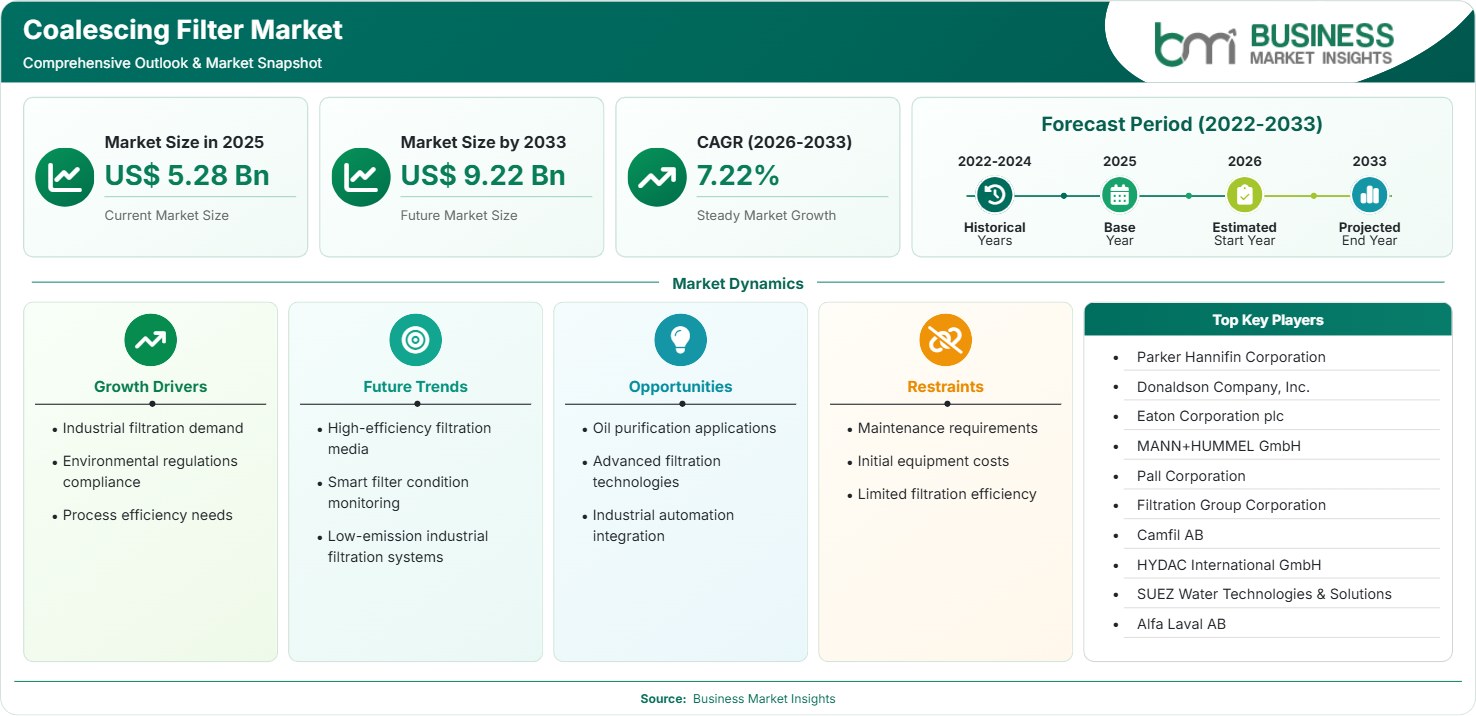
The Coalescing Filter Market size was valued at US$ 5.28 billion in 2025 and is projected to reach US$ 9.22 billion by 2033, growing at a CAGR of 7.22% during 2026–2033. The growth is mainly attributed to rising need for industrial filtration processes, strict environmental standards, increasing process fluids demand, and increased efficiency in operation.

Report Coverage
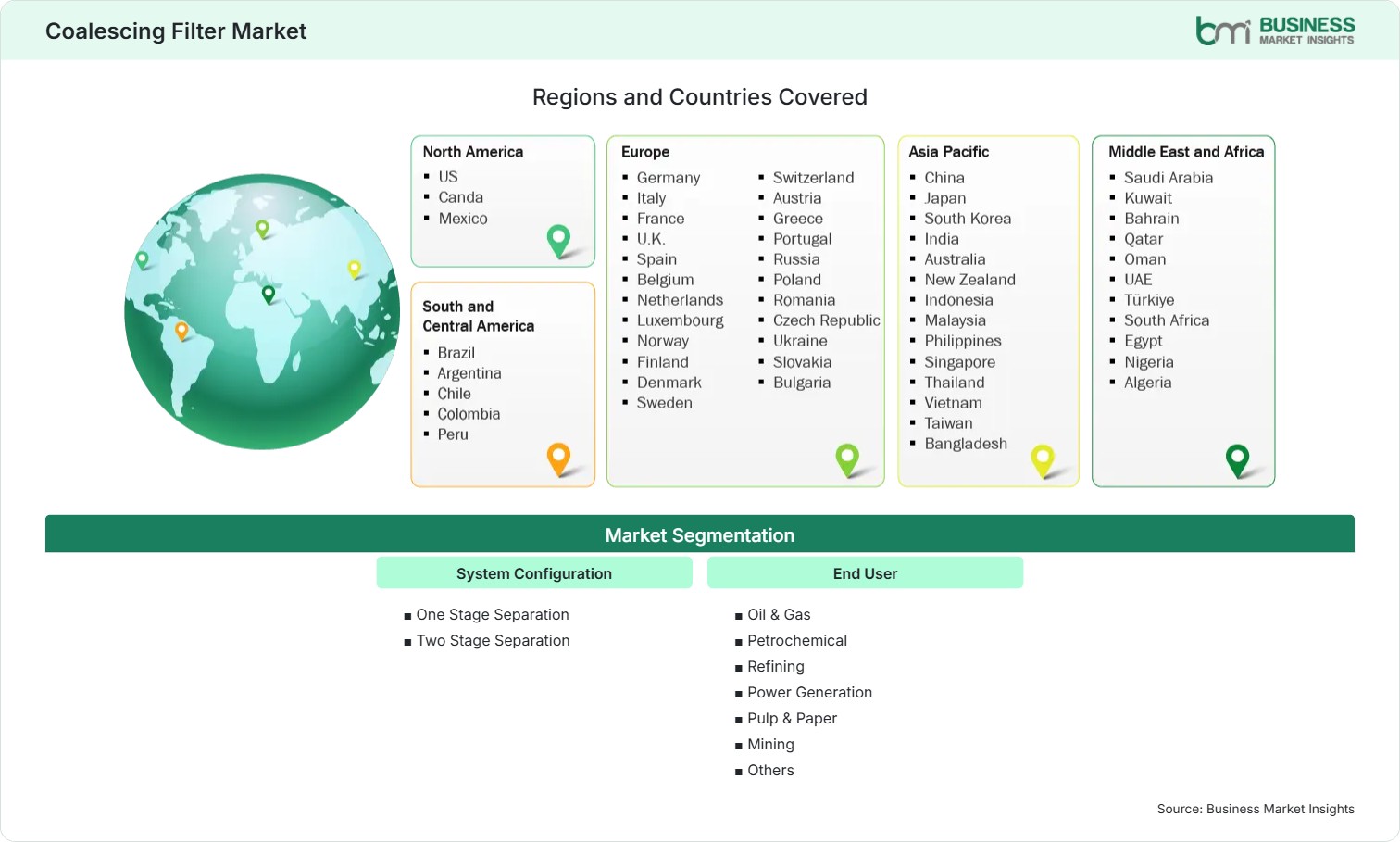
  • System Configuration: One Stage Separation, Two Stage Separation
  • End User: Oil & Gas, Petrochemical, Refining, Power Generation, Pulp & Paper, Mining, Others
US$ 5.28 Bn Market size in 2025
US$ 9.22 Bn Market Size by 2033
7.22% CAGR, 2026 - 2033
2026-2033 Forecast Period

01 AI Overview

Coalescing Filter Market Summary

  • North America Region: North America accounts for approximately 31%–34% market share in 2025 and is projected to grow at a CAGR of 6.8%–7.3% during 2026–2033. This region is endowed with well-established oil and gas infrastructure, sophisticated processing facilities, robust environmental legislation, and investment in effective filtering processes. In terms of contribution to the industry, the United States ranks first due to its refinery renovations, industrial automation, and energy sector upgrades, with an expected 6.9%–7.4% CAGR through 2033.
  • Fastest Growing Region: The Asia Pacific region is estimated to contribute about 34%-37% of market share in 2025, and is projected to grow at a CAGR of 7.8%-8.3% during 2026-2033. The growth will be fueled by increased industrialization, refinery and petrochemical capacity expansion, infrastructure development, regulatory initiatives on environment protection, and capital expenditure in manufacturing and power plants.
  • Leading Segment: Oil & Gas holds around 28% to 31% market share in 2025 and is expected to register a CAGR of 7.1% to 7.6% between 2026 and 2033. Growing requirement for fuel refinement, protection of compressors, and hydraulic fluids along with improving reliability of machinery will drive the adoption of coalescing filters.
  • High Growth Segment: The Power Generation segment holds a share of around 14% - 17% in 2025 and is estimated to witness a CAGR of 7.8% - 8.4%. The growing focus towards equipment safety, turbine performance, reliability, and purity of process fluids is propelling the growth of filtration technologies in power plants.
  • Key Market Opportunity: The integration of smart monitoring devices, filtration media, automatic maintenance systems, and oil purification systems is opening up new avenues for the manufacturing of filters in various industries that require efficient operation with minimal down time.
  • Major Market Players: Parker Hannifin Corporation, Donaldson Company, Inc., Eaton Corporation plc, MANN+HUMMEL GmbH, Pall Corporation, Filtration Group Corporation, Camfil AB, HYDAC International GmbH, SUEZ Water Technologies & Solutions, and Alfa Laval AB.
02 Strategic Insights

Coalescing Filter Market: Strategic Insights

Coalescing Filter Market Strategic Framework
FREE PDF
Request your free sample
Request free sample
03 Stakeholder View

Key Takeaways

  • The market ecosystem is expanding through collaboration between filtration manufacturers, industrial equipment suppliers, process operators, and maintenance service providers focused on improving contamination control and operational efficiency.
  • Oil and gas, petrochemical, and power generation industries remain major opportunity areas due to continuous demand for fluid purification, equipment protection, and process reliability improvements across critical infrastructure.
  • Technology development is shifting toward advanced filtration media, high-efficiency separation systems, smart monitoring capabilities, and automated maintenance solutions that reduce downtime and improve lifecycle performance.
  • Asia Pacific presents strong investment potential due to rapid industrial expansion, increasing refinery capacity, manufacturing growth, and implementation of stricter environmental compliance frameworks.
  • Strategic acquisitions, product portfolio expansion, and partnerships between filtration specialists and industrial technology companies are strengthening competitive positioning in global markets.
  • Increasing adoption of Industry 4.0 solutions is creating opportunities for connected filtration systems capable of providing real-time performance monitoring, predictive maintenance insights, and improved resource utilization.
04 Geographic Outlook

Coalescing Filter Market Regional Highlights

North America Coalescing Filter Market

North America accounted for approximately 31%–34% of the global market in 2025 and is projected to expand at a CAGR of 6.8%–7.3% through 2033. The Coalescing Filter Market share in the region is supported by established oil and gas operations, refinery modernization, industrial process optimization, and stringent environmental regulations. The United States remains the dominant contributor due to its large energy infrastructure, advanced manufacturing base, and increasing demand for efficient contamination control systems.

  • Expansion of refinery and petrochemical facilities is increasing adoption of coalescing filters for fuel purification, compressed air treatment, and protection of critical processing equipment.
  • Environmental compliance requirements are encouraging industries to deploy advanced separation technologies that improve emissions control, reduce waste generation, and enhance operational sustainability.
  • Industrial automation adoption is driving demand for intelligent filtration systems equipped with monitoring capabilities that improve maintenance planning and reduce unexpected equipment failures.
  • Mature manufacturing infrastructure supports continued replacement of traditional filtration systems with higher-efficiency solutions designed for improved process performance.
  • Growth in natural gas processing and power generation applications continues creating demand for reliable filtration technologies capable of handling complex industrial operating conditions.

US Coalescing Filter Market

The United States represented approximately 26%–29% of global revenue in 2025 and is expected to register a CAGR of 6.9%–7.4% during 2026–2033. The country maintains a strong position due to extensive energy infrastructure, advanced industrial processing capabilities, and regulatory emphasis on environmental protection. Increasing investments in refinery upgrades, gas processing facilities, and manufacturing automation continue supporting demand for advanced filtration systems.

  • Oil and gas operators are adopting advanced coalescing technologies to improve fuel quality, protect compressors, and extend equipment service life across production facilities.
  • Industrial manufacturers are upgrading filtration infrastructure to improve operational efficiency, minimize contamination-related failures, and comply with increasingly strict environmental standards.
  • Power generation facilities are investing in efficient filtration solutions to maintain turbine performance, improve reliability, and reduce maintenance requirements.
  • Domestic filtration manufacturers continue developing high-performance products designed for demanding industrial applications requiring precise separation efficiency.

Europe Coalescing Filter Market

Europe accounted for approximately 25%–28% market share in 2025 and is forecast to grow at a CAGR of 6.7%–7.2% through 2033. Regional demand is supported by strict environmental regulations, industrial sustainability initiatives, and modernization of manufacturing and energy infrastructure. Germany leads regional adoption, while Norway and the Netherlands demonstrate strong growth due to energy processing activities and industrial technology investments.

  • European industries are increasing adoption of advanced filtration systems to comply with environmental policies focused on cleaner production and resource efficiency.
  • Oil and gas operations in Northern Europe continue requiring reliable separation technologies for offshore processing, fuel treatment, and equipment protection.
  • Chemical and pharmaceutical manufacturers are investing in precision filtration systems to maintain product quality and process reliability.
  • Industrial automation initiatives are supporting integration of smart filtration solutions with digital monitoring and predictive maintenance capabilities.
  • Sustainability-focused manufacturing programs are encouraging replacement of conventional filtration systems with energy-efficient and high-performance alternatives.

Asia Pacific Coalescing Filter Market

Asia Pacific represented approximately 34%–37% of the global market in 2025 and is projected to achieve the fastest growth with a CAGR of 7.8%–8.3% during 2026–2033. The region benefits from expanding industrial capacity, refinery investments, infrastructure development, and increasing environmental compliance requirements. China represents the largest market, while India demonstrates rapid growth due to manufacturing expansion, energy demand, and industrial modernization initiatives.

  • Refinery and petrochemical capacity expansion across Asia Pacific is increasing demand for filtration systems that improve process efficiency and equipment reliability.
  • Manufacturing growth in China, India, and Southeast Asia is accelerating adoption of industrial filtration technologies across automotive, chemicals, and heavy industries.
  • Government initiatives focused on pollution reduction and cleaner industrial operations are encouraging companies to upgrade filtration infrastructure.
  • Rising power generation investments are creating demand for coalescing filters used in turbine protection and fluid management applications.
  • Expansion of industrial automation technologies is increasing deployment of connected filtration systems with real-time monitoring capabilities.

Rest of World Coalescing Filter Market

The Rest of World region accounted for approximately 8%–11% of the Coalescing Filter market share in 2025 and is expected to grow at a CAGR of 6.9%–7.4% through 2033. South America, the Middle East, and Africa are experiencing increasing demand due to energy sector development, industrial expansion, and infrastructure modernization. Growing investments in oil production, refining capacity, and manufacturing facilities are creating additional opportunities for filtration solution providers.

South America is supported by oil production activities and industrial processing growth, particularly in Brazil. Middle Eastern countries are expanding energy infrastructure and petrochemical capacity, while African markets are developing industrial facilities and power generation projects.

  • Brazil remains a significant regional Coalescing Filter market due to its oil and gas industry, industrial manufacturing base, and increasing investment in processing infrastructure.
  • Middle Eastern energy producers are adopting advanced filtration systems to improve operational efficiency across refineries, gas processing plants, and petrochemical facilities.
  • African industrial development projects are increasing demand for reliable filtration technologies supporting mining, energy, and manufacturing applications.
  • Infrastructure investments across emerging economies are encouraging adoption of modern industrial equipment requiring efficient fluid separation systems.
  • Expansion of global filtration suppliers into developing markets is improving access to advanced coalescing technologies and maintenance services.
Global Market Geography
FREE PDF
Request your free sample
Request free sample
05 Segment Analysis

Coalescing Filter Market Segmentation

System Configuration

The System Configuration segment defines filtration architecture based on separation efficiency, operational flexibility, and application requirements across industrial facilities. The segment accounted for approximately 100% of market revenue in 2025 and is projected to expand at a CAGR of 7.0%–7.4% during 2026–2033. Increasing demand for reliable contamination control, process optimization, and equipment protection is encouraging industries to select filtration systems based on capacity requirements, maintenance preferences, and operating conditions.

  • One Stage Separation (Simplex Arrangement): Simplex systems are widely adopted for applications requiring straightforward filtration processes, lower installation complexity, and cost-effective contamination removal. They are commonly used in smaller industrial operations and applications with moderate filtration requirements.
  • Two Stage Separation (Duplex Arrangement): Duplex systems support continuous operation through advanced separation capabilities and reduced downtime during maintenance activities. They are preferred in critical industrial applications requiring uninterrupted filtration performance and enhanced equipment protection.

End-User

The End-User segment represents diverse industrial applications where contamination control, fluid quality management, and process reliability are essential for operational performance. The segment accounted for approximately 100% of the Coalescing Filter market revenue in 2025 and is anticipated to grow at a CAGR of 7.1%–7.5% through 2033. Increasing industrial production, environmental compliance requirements, and demand for efficient processing systems are driving adoption across energy, manufacturing, and resource-intensive industries.

  • Oil & Gas: The oil and gas industry represents the largest application area due to extensive use of coalescing filters in fuel treatment, gas processing, compressor protection, and lubrication systems requiring high contamination control standards.
  • Petrochemical: Petrochemical facilities utilize coalescing filtration systems to maintain process fluid purity, protect sensitive equipment, and improve operational reliability across chemical conversion and production processes.
  • Refining: Refineries increasingly deploy advanced filtration solutions to remove contaminants from fuels, oils, and process streams while improving equipment efficiency, reducing maintenance requirements, and supporting compliance with environmental standards.
  • Power Generation: Power generation facilities adopt coalescing filters to protect turbines, lubrication systems, and auxiliary equipment from contaminants that can reduce efficiency, increase wear, and create operational disruptions.
  • Pulp & Paper: The pulp and paper sector uses filtration technologies to maintain process quality, protect machinery, and improve fluid management efficiency across manufacturing operations requiring consistent production performance.
  • Mining: Mining operations require robust filtration systems for hydraulic fluids, compressed air, and process equipment protection due to harsh operating environments, heavy machinery usage, and contamination risks.
  • Others: Other industrial applications include manufacturing, chemical processing, transportation, and specialized equipment operations where efficient separation technologies support improved reliability, cleaner processes, and reduced maintenance frequency.
06 Market Forces

Coalescing Filter Market Dynamics

Key Market Drivers

Increasing industrial filtration demand across process industries

Growing industrial activity across oil and gas, petrochemical, refining, power generation, mining, and manufacturing sectors is increasing the requirement for efficient contamination removal systems. Coalescing filters have begun to gain importance in removing liquid aerosols, oil mists, and minute particles from compressed air, gases, and fluids. The factors driving the Coalescing Filters Market growth include increasing industrial manufacturing operations, rising demand for protecting equipment from various problems, and growing concerns about minimizing operational failure rates. Industrial segments have chosen to go in for such filtering systems that help improve the durability and performance of their machinery without causing any disturbances in operations.

Growing environmental regulations and compliance requirements

Stringent environmental regulations on emissions, industrial waste management, and efficiency are driving industries to adopt filtration technology. The environmental agencies across the globe are concentrating more on green production, low levels of pollution, and efficient use of resources in their operations. The coalescing filter helps the industry to achieve the above objectives by ensuring high purity of fluids and process control. Companies operating in energy-intensive sectors are upgrading filtration infrastructure to meet environmental targets while maintaining operational performance. Increasing government intervention has especially affected oil and gas industries, petrochemical industries, and manufacturing plants that need efficient separation technology to sustain their operations.

Need for improved process efficiency and equipment reliability

There is a growing trend among industrial plant operators to favor technology solutions that boost productivity, minimize downtime, and reduce maintenance costs. Coalescing filter separators protect compressors, turbines, hydraulics, and process equipment from contamination damage before it can damage sensitive equipment parts. The efficiency of the filtration system impacts the longevity and performance of the equipment being used. The Coalescing Filter Market trends reveal the increased use of filters with high performance, specifically those suitable for industrial operations. There is advancement in technology used to make the filter media and designs, such that there are systems capable of optimization of maintenance through monitoring.

Key Market Opportunities

Rising adoption of oil purification applications

The rising demand for clean lubricants, hydraulic fluids, and fuel filtration systems provides great business opportunities for coalescing filters. Oil & Gas, Power Generation, Marine, and Heavy Equipment industries depend on effective filtration systems for proper oil purification. With the help of advanced filtration technology, it becomes possible to filter water particles, oil mists, and contamination from oil-based products. The growing importance of Predictive Maintenance and Asset Optimization is driving the adoption of cost-effective purification technologies among facility managers. Companies producing specialized filters for oil purification can benefit from such market conditions.

Development of advanced filtration technologies

Innovation in filtration media, nanofiber materials, smart sensors, and high-efficiency separation technologies is creating new growth opportunities. Manufacturers are currently concentrating on the enhancement of filtration precision, minimizing pressure losses, extending the lifespan of the system, and creating a smaller version of coalescing filters to be installed in confined industrial spaces. The use of innovative materials is helping to achieve high performance levels in highly demanding operating conditions in terms of temperature, pressure, and chemicals. Coalescing Filter Market Forecasts indicate that technology-driven product differentiation will become increasingly important as industries seek filtration solutions offering improved efficiency, reliability, and lower operating costs.

Integration of industrial automation and smart monitoring systems

The integration of filtration systems with industrial automation platforms is creating opportunities for connected and intelligent equipment solutions. Smart coalescing filters fitted with sensors and monitoring capabilities could provide real-time data on pressure variations, contamination, and filter performance. The monitoring capability would support implementing predictive maintenance techniques by detecting problems before equipment breakdowns occur. Factories implementing Industry 4.0 technologies are demanding digitally connected filtration systems. This has motivated manufacturers to develop smart filtration equipment that can help increase efficiency in manufacturing operations.

Market Restraints and Challenges

Maintenance requirements affecting operational efficiency

Factor: Coalescing filters require periodic inspection, cleaning, and replacement of filter elements to maintain separation efficiency and prevent performance degradation. Impact: Frequent maintenance requirements can increase operational expenses and create downtime challenges for industrial facilities operating continuous production processes. Improper maintenance practices may reduce filtration effectiveness, increase energy consumption, and negatively impact equipment reliability. Industries with remote installations or limited maintenance resources may experience additional challenges in managing replacement schedules and spare component availability. These factors can influence purchasing decisions, particularly among cost-sensitive operators evaluating filtration investments based on long-term operational benefits.

High initial equipment costs limiting adoption

Factor: Advanced coalescing filtration systems often require significant upfront investment due to specialized materials, precision engineering, and integration with industrial processing equipment. Impact: Higher installation costs can delay adoption among small and medium-sized industrial operators with limited capital budgets. Although advanced filtration systems provide long-term benefits through improved efficiency and reduced maintenance, initial expenditure remains a barrier in price-sensitive Coalescing Filter markets. Companies may postpone equipment upgrades or select lower-cost alternatives that provide limited performance advantages. This challenge encourages manufacturers to focus on developing cost-effective solutions, modular designs, and flexible financing approaches to improve accessibility across diverse industrial sectors.

07 Company Analysis

Competitive Landscape

The competitive environment is characterized by global filtration specialists, industrial technology providers, and process equipment manufacturers competing through advanced separation technologies, customized filtration solutions, digital monitoring capabilities, and expanded service networks. The Coalescing Filter Market analysis indicates that companies are focusing on improving filtration efficiency, developing durable filter media, integrating smart monitoring systems, and strengthening aftermarket support to address evolving requirements across energy, manufacturing, chemical processing, and industrial applications.

Company Name

Overview

Products and Services relevant to this market

Parker Hannifin Corporation

Global motion and control technology company offering advanced filtration solutions for industrial and energy applications.

Coalescing filters, compressed air filtration, hydraulic filtration systems, fluid purification technologies, and filtration services.

Donaldson Company, Inc.

Filtration technology provider serving industrial, automotive, aerospace, and energy sectors with specialized solutions.

Air and gas coalescing filters, industrial filtration systems, process filtration products, and maintenance solutions.

Eaton Corporation plc

Power management company providing filtration technologies for industrial and critical process applications.

Hydraulic filters, oil filtration systems, gas filtration solutions, contamination control products, and service support.

MANN+HUMMEL GmbH

Global filtration company specializing in air, water, and fluid filtration technologies across industries.

Industrial filtration systems, liquid filtration solutions, coalescing technologies, and customized filtration applications.

Pall Corporation

Filtration and separation technology provider serving energy, industrial, and life science markets worldwide.

Coalescing filters, process filtration systems, fluid management solutions, and contamination control technologies.

Filtration Group Corporation

Industrial filtration company focused on customized solutions for manufacturing, energy, and commercial applications.

Industrial filters, process filtration equipment, separation technologies, and engineered filtration solutions.

Camfil AB

Air filtration specialist providing high-efficiency filtration products for industrial and commercial environments.

Air filtration systems, clean process solutions, industrial filters, and energy-efficient filtration technologies.

HYDAC International GmbH

Engineering company specializing in hydraulic systems, filtration technology, and fluid management solutions.

Hydraulic filtration systems, oil purification equipment, contamination monitoring, and industrial filtration components.

SUEZ Water Technologies & Solutions

Water and industrial process technology provider delivering filtration and separation solutions.

Industrial water filtration, process separation systems, membrane technologies, and treatment solutions.

Alfa Laval AB

Industrial equipment manufacturer providing separation and fluid handling technologies across multiple sectors.

Separation systems, filtration equipment, process solutions, heat transfer technologies, and industrial services.

08 Industry Activity

Recent Developments

May, 2026

KELTEC Technolab announced the acquisition of Swift Filters, a North American manufacturer of custom filter elements. KELTEC's product portfolio includes coalescing filters, air/oil separators, oil filters, and refrigerated air dryers for compressed air systems.

April, 2026

Walker Filtration Ltd. granted U.S. Patent US12605663B2 for a multi-stage coalescing filter designed to separate coalesced liquid from aerosol-containing gas streams using a nested, multi-element configuration with a porous chamber to prevent gas bypass.

February, 2026

Pall Corporation launched the SepraSol Plus Horizontal Liquid/Gas (HLG) Coalescer and High Flow Gas (HFG) particle filtration solutions.

November, 2025

Parker Hannifin Corporation announced a definitive agreement to acquire Filtration Group for approximately US$9.25 billion, significantly expanding its industrial filtration portfolio and creating one of the world's largest filtration businesses serving industrial, automotive, HVAC, and process applications.

10 Trust & Transparency

Research Methodology

The market analysis combines proprietary research with secondary data from government agencies, company disclosures, regulatory filings, industry databases and expert interviews. Market estimates are validated through data triangulation, cross-market benchmarking and analyst review.

View Full Research Methodology

11 Questions Answered

Frequently Asked Questions

What factors challenge market expansion?

The Coalescing Filter Market report highlights challenges in the market including high initial equipment costs, maintenance requirements, replacement needs, and complex integration with existing industrial systems can limit adoption, particularly among smaller operators with constrained investment capabilities.

How are smart technologies influencing filtration systems?

Industrial automation and digital monitoring technologies are enabling connected filtration systems that provide real-time performance data, predictive maintenance capabilities, improved operational visibility, and reduced equipment downtime.

Which region is expected to experience the fastest growth?

Asia Pacific is projected to experience the fastest growth due to industrial expansion, refinery capacity additions, manufacturing development, infrastructure investments, and increasing adoption of advanced filtration technologies.

Which industry represents the largest application area?

Oil and gas represent the leading application segment because coalescing filters are widely used for fuel purification, gas processing, compressor protection, and contamination removal in upstream and downstream operations.

What is driving demand in the Coalescing Filter Market?

Demand is increasing due to industrial filtration requirements, stricter environmental regulations, equipment protection needs, and growing emphasis on improving process efficiency across oil and gas, petrochemical, power generation, and manufacturing industries.

Access the Full Coalescing Filter Market Report

Get segment-level forecasts, regional estimates, competitive benchmarking, company profiles and downloadable Excel datasets.

Access the full Coalescing Filter Market Report
350 pages PDF & Excel | 2026-07-28