
Cranes Market Outlook: Size, Share, Trends, Growth Analysis, Competitive Landscape & Forecast, 2026-2033

Cranes Market Size, Share, Trends & Forecast Report, 2026–2033

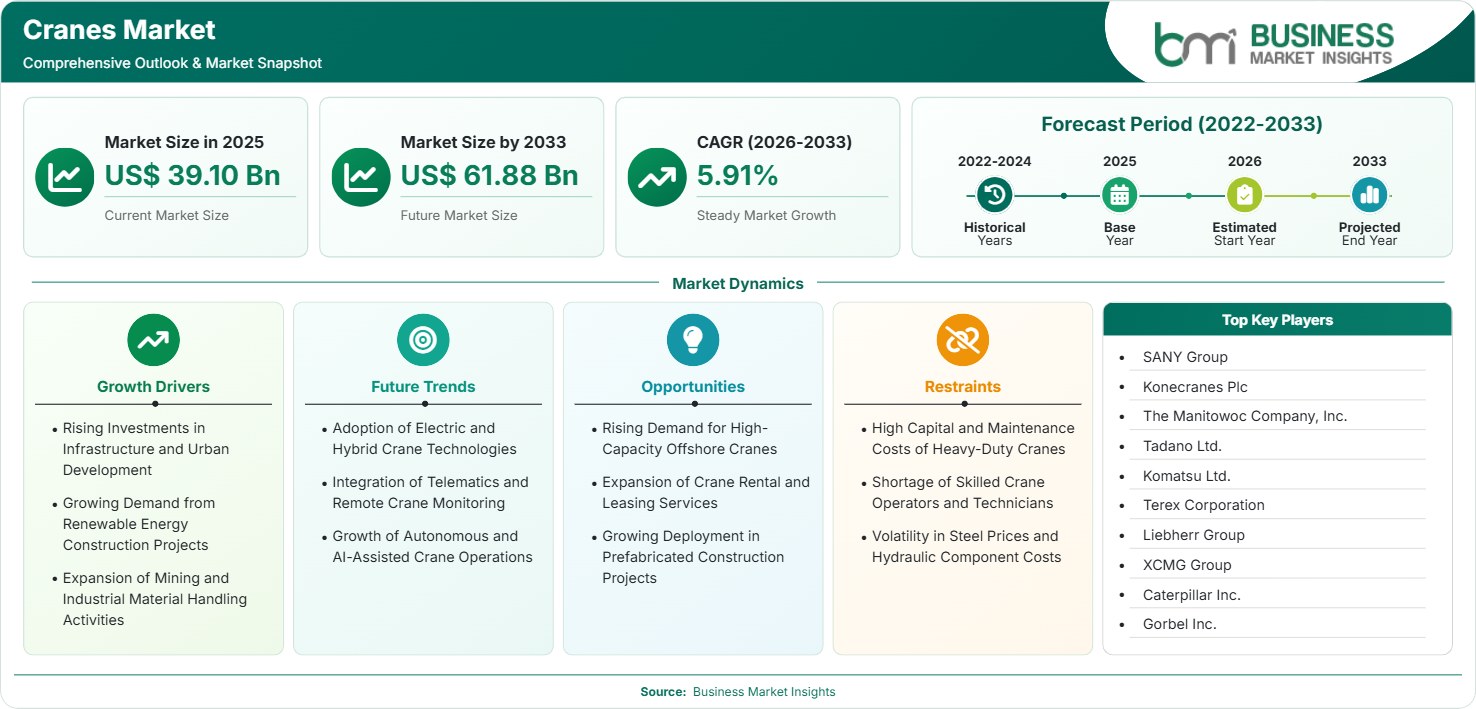
The Cranes Market size was valued at US$ 39.10 Billion in 2025 and is projected to reach US$ 61.88 Billion by 2033, growing at a CAGR of 5.91% during 2026–2033. Rising infrastructure investments, increasing mining activities, expanding industrial construction, and growing renewable energy projects continue driving demand while modernization of lifting equipment creates long-term market opportunities.

Report Coverage
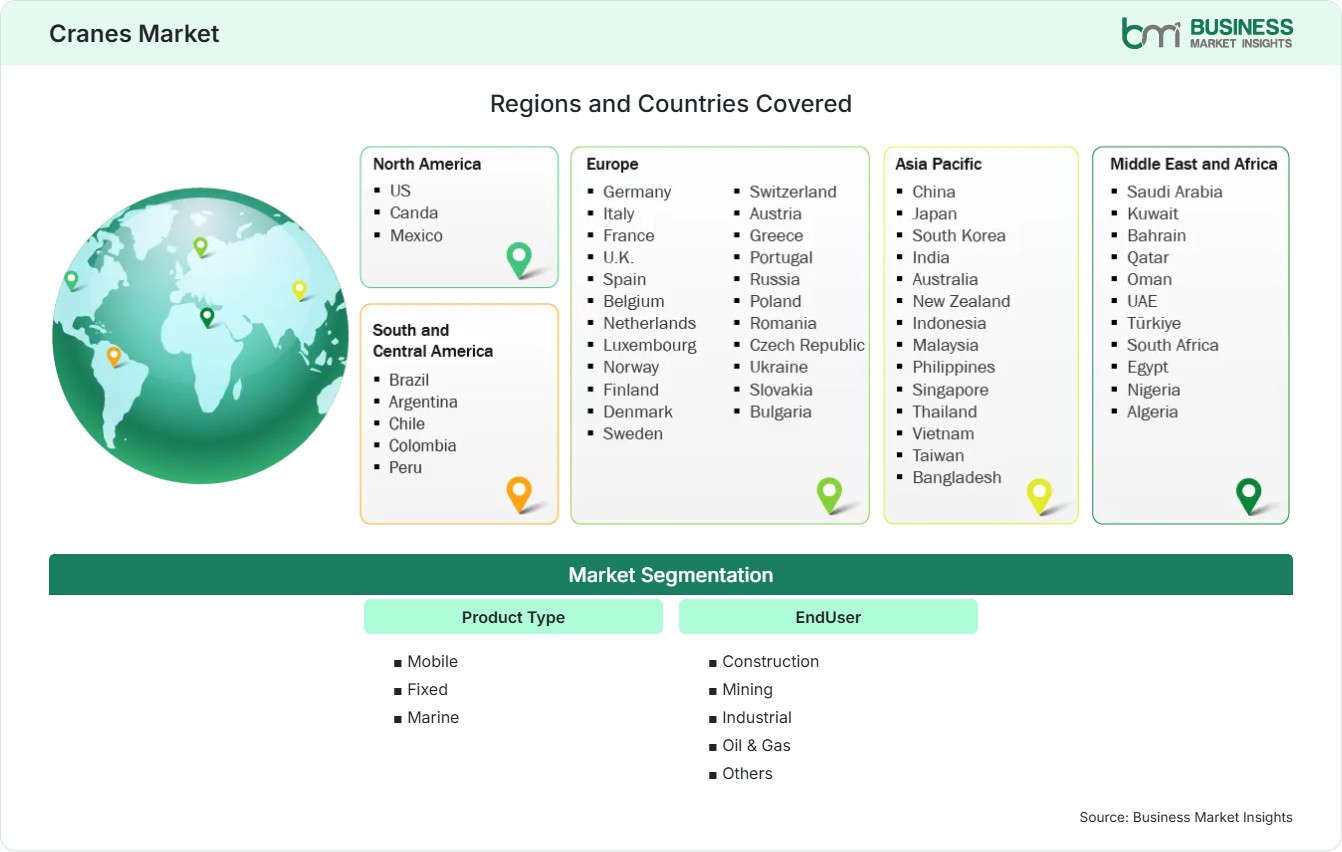
  • Product Type: Mobile, Fixed, Marine
  • EndUser: Construction, Mining, Industrial, Oil & Gas, Others
US$ 39.10 Bn Market size in 2025
US$ 61.88 Bn Market Size by 2033
5.91% CAGR, 2026 - 2033
2026-2033 Forecast Period

01 AI Overview

Cranes Market Summary

  • North America Region: North America holds 31%–34% cranes market share in 2025 and is projected to grow at a CAGR of 5.4%–5.8% during 2026–2033. Infrastructure modernization, industrial expansion, and renewable energy investments continue supporting demand for advanced lifting equipment.
  • Fastest Growing Region: Asia Pacific accounts for 36%–39% market share in 2025 and is expected to expand at a CAGR of 6.6%–7.0%. Large-scale urbanization, manufacturing growth, expanding logistics infrastructure, and increasing public infrastructure spending continue accelerating crane deployment.
  • Leading Segment: Mobile Cranes account for 47%–50% market share in 2025 while growing at a CAGR of 6.0%–6.4%. Operational flexibility, easy transportation, and suitability for infrastructure and construction projects continue supporting segment leadership.
  • High Growth Segment: Construction represents 38%–41% market share in 2025 and is projected to register a CAGR of 6.5%–6.9% owing to increasing investments in residential, commercial, transportation, and energy infrastructure worldwide.
  • Key Market Opportunity: Expansion of renewable energy installations, smart infrastructure development, port modernization, and automated construction equipment creates long-term opportunities for crane manufacturers and technology providers.
  • Major Market Players: SANY Group, Konecranes Plc, The Manitowoc Company, Inc., Tadano Ltd., Komatsu Ltd., Terex Corporation, Liebherr-International AG, XCMG Group, Caterpillar Inc., and Gorbel Inc.
02 Strategic Insights

Cranes Market: Strategic Insights

Cranes Market Strategic Framework
FREE PDF
Request your free sample
Request free sample
03 Stakeholder View

Key Takeaways

  • The crane makers are teaming up with suppliers, technology providers, leasing companies, and contractors to create integrated, safe, and effective lifting systems.
  • The construction and infrastructure are the two biggest sectors in terms of revenue generation due to investments in transport, urbanization, renewable energy, and industrial construction.
  • The main trends in innovation include the development of electrical drive systems, intelligent load monitoring systems, telematics, remote diagnostic tools, autonomy and predictive maintenance.
  • The cranes market forecasts suggest that the strongest growth potential is represented by the Asia Pacific because of rapid urbanization, industrialization, manufacturing and infrastructure development.
  • The leasing firms are expanding their fleets to provide more flexible and cost-effective equipment rental services to contractors.
  • The sustainability programs are fostering development of fuel-efficient, hybrid, and electrical cranes.
04 Geographic Outlook

Cranes Market Regional Highlights

North America Cranes Market

North America accounted for approximately 31%–34% of global revenue in 2025 and is projected to register a CAGR of 5.4%–5.8% through 2033. The Cranes Market share remains substantial due to continuous infrastructure modernization, expansion of logistics facilities, renewable energy investments, and strong industrial construction activities. Government funding for transportation networks, bridge rehabilitation, airports, and public utilities continues supporting equipment demand.

  • Large-scale transportation infrastructure modernization programs continue driving demand for mobile and fixed cranes across highway, bridge, railway, and airport construction projects.
  • Renewable energy investments, particularly wind energy installations, increase utilization of high-capacity cranes capable of supporting turbine assembly and maintenance operations.
  • Equipment rental companies continue expanding technologically advanced crane fleets to support contractors seeking flexible equipment access without significant capital investment.
  • Digital fleet management platforms and predictive maintenance technologies improve equipment utilization, operational safety, and lifecycle cost management across construction and industrial sectors.

US Cranes Market

The United States represents approximately 84%–87% of North American revenue and is projected to expand at a CAGR of 5.5%–5.9% throughout the forecast period. Federal infrastructure investment programs, expanding industrial manufacturing, renewable energy development, and commercial construction continue supporting sustained equipment demand.

  • Transportation infrastructure rehabilitation continues increasing demand for high-capacity lifting equipment.
  • Manufacturing expansion supports crane deployment across production facilities and industrial plants.
  • Renewable energy installations continue driving demand for heavy-duty mobile cranes.
  • Equipment digitalization enhances operational efficiency, fleet visibility, and predictive maintenance capabilities.

Europe Cranes Market

Europe accounted for approximately 23%–26% of global revenue in 2025 and is projected to grow at a CAGR of 5.2%–5.6% during the forecast period. Demand is supported by infrastructure modernization, renewable energy expansion, industrial automation, and commercial construction activities across major economies. Strict workplace safety regulations and increasing emphasis on low-emission construction equipment continue encouraging contractors to replace aging crane fleets with technologically advanced alternatives. Germany remains the largest regional cranes market owing to its strong manufacturing base and industrial equipment sector.

  • Germany dominates regional demand through extensive manufacturing activities, industrial expansion, logistics infrastructure, and continuous investments in automated material handling systems for production facilities and warehouses.
  • The United Kingdom continues strengthening market demand through railway upgrades, commercial redevelopment projects, offshore wind installations, and increasing investments in smart construction technologies.
  • France supports crane demand through urban infrastructure expansion, transportation modernization, and industrial construction projects, alongside continued investments in renewable energy facilities.
  • Nordic countries increasingly deploy heavy-duty cranes for offshore wind farms, marine construction, and port expansion projects requiring reliable high-capacity lifting solutions.

Asia Pacific Cranes Market

Asia Pacific represented approximately 36%–39% of global revenue in 2025 and is expected to register the fastest CAGR of 6.6%–7.0% through 2033. Rapid urbanization, industrialization, manufacturing growth, and significant public infrastructure spending continue supporting regional expansion. China remains the largest cranes market owing to extensive construction activities, industrial manufacturing, and large-scale infrastructure development, while India records the fastest growth driven by transportation projects, smart city programs, and industrial corridor development.

  • China maintains regional leadership through high investments in transportation infrastructure, manufacturing facilities, logistics hubs, renewable energy projects, and urban development programs requiring advanced lifting equipment.
  • India records the highest regional growth as government infrastructure initiatives, metro rail development, industrial parks, and commercial construction continue accelerating equipment demand.
  • Japan focuses on technologically advanced cranes featuring automation, energy efficiency, remote diagnostics, and intelligent safety systems for industrial and commercial applications.
  • South Korea supports market expansion through shipbuilding, heavy manufacturing, smart factories, and logistics infrastructure investments requiring precision lifting technologies.

Rest of World Cranes Market

The Rest of World accounted for approximately 9%–11% of global revenue in 2025 and is projected to expand at a CAGR of 5.7%–6.1% during 2026–2033. South and Central America continue benefiting from mining investments, commercial construction, and transportation infrastructure development. Meanwhile, the Middle East and Africa experience increasing crane demand through oil and gas projects, large-scale urban developments, industrial diversification, and renewable energy investments. Brazil leads cranes market revenue across Latin America, while Saudi Arabia records the fastest regional growth supported by major infrastructure projects, smart city developments, and economic diversification initiatives.

  • Brazil leads Latin American demand through mining operations, industrial construction, logistics expansion, and public infrastructure investments supporting long-term equipment utilization.
  • Mexico continues strengthening demand through manufacturing expansion, industrial facilities, automotive production, and warehouse construction linked to regional supply chain growth.
  • Saudi Arabia records the fastest growth due to mega infrastructure developments, tourism projects, industrial diversification, and renewable energy investments under Vision 2030.
  • The United Arab Emirates continues deploying advanced cranes across commercial construction, logistics facilities, ports, airports, and mixed-use urban development projects.
  • South Africa supports regional demand through mining activities, industrial modernization, renewable energy developments, and transportation infrastructure investments requiring reliable heavy lifting equipment.
Global Market Geography
FREE PDF
Request your free sample
Request free sample
05 Segment Analysis

Cranes Market Segmentation

Product Type

The Product Type segment accounted for approximately 58%–61% of the market in 2025 and is projected to grow at a CAGR of 6.0%–6.4% during 2026–2033. Product innovation is increasingly focused on improving lifting capacity, operational flexibility, fuel efficiency, automation, and digital monitoring capabilities. Manufacturers are integrating telematics, load management systems, remote diagnostics, and predictive maintenance solutions to enhance equipment productivity and safety. The Cranes Market scope continues expanding as infrastructure development, industrial projects, mining operations, and marine construction require application-specific lifting equipment across diverse operating environments.

  • Mobile: Mobile cranes remain the largest product category owing to their operational flexibility, rapid deployment, ease of transportation, and suitability for infrastructure construction, industrial maintenance, energy projects, and emergency lifting applications.
  • Fixed: Fixed cranes are widely utilized in manufacturing plants, ports, warehouses, commercial buildings, and industrial facilities where repetitive lifting operations, high stability, and continuous material handling are essential for productivity.
  • Marine: Marine cranes support offshore energy projects, ports, shipyards, naval operations, and cargo handling by providing reliable heavy lifting capabilities under demanding marine environments with advanced corrosion-resistant designs.

End-User

Growing investments across construction, mining, industrial manufacturing, and energy infrastructure continue driving crane adoption among diverse end users. The End-User segment represented approximately 38%–41% of market revenue in 2025 and is projected to register the fastest CAGR of 6.5%–6.9% throughout the forecast period. The Cranes Market trends indicate increasing preference for technologically advanced lifting equipment offering higher productivity, improved operator safety, reduced emissions, and lower maintenance requirements across large-scale infrastructure and industrial projects.

  • Construction: Construction remains the dominant end-user segment as residential, commercial, transportation, and public infrastructure projects increasingly require versatile lifting equipment capable of handling heavy structural materials efficiently.
  • Mining: Mining companies utilize heavy-duty cranes for equipment installation, maintenance, material handling, mineral processing facilities, and infrastructure development across surface and underground mining operations.
  • Industrial: Industrial facilities deploy cranes for production processes, machinery installation, warehouse operations, manufacturing automation, maintenance activities, and heavy equipment handling across multiple industrial sectors.
  • Oil & Gas: Oil and gas operators employ specialized cranes for refinery construction, offshore platforms, drilling operations, pipeline installation, equipment maintenance, and petrochemical facility expansion projects.
  • Others: Power generation, ports, shipbuilding, railways, logistics, aerospace, and defense sectors increasingly adopt advanced crane solutions to improve operational efficiency, safety compliance, and heavy material handling capabilities.
06 Market Forces

Cranes Market Dynamics

Key Market Drivers

Rising Investments in Infrastructure and Urban Development

Governments worldwide continue increasing investments in transportation infrastructure, smart cities, commercial buildings, residential housing, airports, ports, and public utilities to support economic growth and urbanization. According to the World Bank and OECD infrastructure outlook, global infrastructure investment requirements remain substantial over the coming decades, driving continuous demand for heavy lifting equipment. The Cranes Market growth is directly supported by expanding bridge construction, metro rail projects, highways, industrial corridors, and public infrastructure developments requiring high-capacity lifting solutions. Contractors increasingly prefer technologically advanced cranes equipped with telematics, automated safety features, and predictive maintenance capabilities that improve project efficiency, reduce downtime, and enhance workplace safety.

Growing Demand from Renewable Energy Construction Projects

There is still high demand for specialized cranes that are able to lift heavy parts when it comes to the erection of wind turbines, construction of solar power plants, hydroelectric facilities, and grid structures, because the development of renewable energy continues. Wind turbines of modern times need heavy machinery to transport and assemble towers, nacelles, and blades as installation heights increase. The growth of offshore wind farms contributes to high demand for marine and large capacity cranes that can operate under tough conditions. As renewable energy installations grow in order to reduce carbon emissions, crane companies produce even bigger cranes for next energy projects.

Expansion of Mining and Industrial Material Handling Activities

Mine works and manufacturing industries need sophisticated lifting machinery to boost their efficiency and maintain equipment. Crane machines are very important in mines, iron and steel plants, cement plants, automobile manufacturing industries, logistics and storage centers, and heavy engineering. Increasing spending on mineral production, industrial automation, warehouse construction, and manufacturing industry is expected to fuel the demand for equipment. Incorporation of smart monitoring, automation, and remote diagnostics helps enhance crane performance by reducing downtime and ensuring safety at all times.

Key Market Opportunities

Rising Demand for High-Capacity Offshore Cranes

Development of offshore wind energy farms, offshore exploration of oil and gas, subsea constructions, and marine construction activities creates immense opportunities for high-tonnage offshore cranes. Such systems are built for extreme environment conditions along with being capable of providing precise and safe lifting operations. Increasing investments into floating wind power platforms, offshore substations, and deep-sea energy sources keep motivating the development of highly automated and corrosion-resistant marine lifting technologies. Growth of offshore construction activity offers steady revenues to global crane manufacturers.

Expansion of Crane Rental and Leasing Services

More and more construction firms and industry players find it better to rent cranes as compared to buying them in order to save capital investment and enjoy better flexibility. Fleet management companies continue investing in new technological crane solutions that can cater to infrastructure, manufacturing, logistics, and energy industries. Fleet management systems, predictive maintenance solutions, and equipment utilization tools make the renting business even more efficient. The move to leasing solutions creates recurring income for equipment manufacturers, while customers get access to high-tech lifting equipment.

Growing Deployment in Prefabricated Construction Projects

Increasing use of prefabrication and modular construction is creating new avenues for the deployment of cranes around the world. Large prefabricated building sections need careful lifting, transport, and erection in the construction site, hence the increased use of mobile and tower cranes. The trend of using modular construction is increasing because of its ability to cut down the time taken to complete projects, ensure better quality, reduce labor dependency, and cut down wastage of materials.

Market Restraints and Challenges

High Capital and Maintenance Costs of Heavy-Duty Cranes

Factor: Heavy-duty cranes require substantial capital investment for acquisition, transportation, installation, operator training, periodic inspections, preventive maintenance, and replacement of critical hydraulic, mechanical, and electronic components.

Impact: High ownership costs can discourage equipment purchases by small and medium-sized contractors, particularly in developing markets with constrained project budgets. Rising financing expenses, maintenance requirements, and lifecycle operating costs further increase the total cost of ownership. Although rental services help reduce upfront investment, manufacturers continue facing challenges in expanding sales among price-sensitive customers where purchasing decisions remain strongly influenced by equipment affordability.

Shortage of Skilled Crane Operators and Technicians

Factor: Contemporary cranes have been incorporating sophisticated technologies such as automation, telematics, electronics, and predictive maintenance, which need skilled operators and skilled maintenance staff.

Impact: Labor shortage in the form of shortage of skilled operators and technicians for servicing will decrease the productivity of the crane and increase the risks of construction project delays. It will also increase the operating costs and workplace safety hazards. Construction companies are continuously training their staff on how to operate cranes through simulators and other technologies.

07 Company Analysis

Competitive Landscape

From the Cranes Market analysis, we see that the market is characterized by a partially concentrated competitive landscape, as global players try to compete in terms of product innovation, lifting capacity enhancement, digitalization of their fleets, energy-saving solutions, and geographical expansion. The top competitors keep developing telematics, predictive maintenance systems, hybrid/electric technology, and automation in order to increase efficiency and improve safety. Strategic acquisition, expansion of the network of dealers, localization of production facilities, and rental partnerships are among the main competitive moves for manufacturers.

Company Name

Overview

Products and Services Relevant to this Market

SANY Group

Global construction equipment manufacturer with extensive presence across Asia, Europe, and the Americas, offering advanced lifting equipment for infrastructure and industrial projects.

Mobile cranes, crawler cranes, all-terrain cranes, truck-mounted cranes, lifting solutions, telematics, equipment services, and aftermarket support.

Konecranes Plc

Leading provider of lifting equipment specializing in industrial material handling, intelligent crane technologies, and lifecycle maintenance solutions across multiple industries.

Overhead cranes, process cranes, port cranes, industrial lifting equipment, digital monitoring solutions, modernization services, and maintenance contracts.

The Manitowoc Company, Inc.

International crane manufacturer recognized for technologically advanced lifting equipment serving construction, infrastructure, industrial, and energy sectors worldwide.

Mobile cranes, crawler cranes, tower cranes, boom trucks, lifting solutions, fleet management technologies, and aftermarket services.

Tadano Ltd.

Japanese manufacturer focused on high-performance hydraulic lifting equipment with strong emphasis on operational safety, quality, and innovation.

All-terrain cranes, rough-terrain cranes, truck cranes, crawler cranes, aerial work platforms, maintenance services, and operator support.

Komatsu Ltd.

Global heavy equipment manufacturer supporting mining, construction, and industrial sectors through advanced machinery and integrated technology solutions.

Specialized lifting equipment, mining machinery, construction equipment, digital fleet management, maintenance solutions, and equipment support services.

Terex Corporation

Diversified industrial equipment company providing lifting and material handling solutions through globally recognized crane brands and service networks.

Tower cranes, rough-terrain cranes, crawler cranes, utilities equipment, lifting solutions, parts supply, and lifecycle maintenance services.

Liebherr-International AG

Major global manufacturer offering premium lifting equipment with advanced engineering capabilities serving construction, mining, marine, and industrial sectors.

Mobile cranes, crawler cranes, offshore cranes, tower cranes, maritime lifting systems, automation technologies, and maintenance services.

XCMG Group

One of the world's largest construction equipment manufacturers with extensive crane offerings for infrastructure, energy, and industrial applications.

Truck cranes, crawler cranes, all-terrain cranes, tower cranes, intelligent lifting systems, equipment financing, and aftermarket support.

Caterpillar Inc.

Global industrial equipment leader supporting mining, construction, and infrastructure sectors through integrated heavy equipment and digital technologies.

Material handling equipment, lifting solutions, heavy construction machinery, fleet monitoring technologies, equipment services, and maintenance support.

Gorbel Inc.

U.S.-based manufacturer specializing in ergonomic material handling and overhead lifting systems serving manufacturing and warehouse operations.

Workstation cranes, jib cranes, overhead crane systems, gantry cranes, lifting accessories, installation services, and maintenance solutions.

10 Trust & Transparency

Research Methodology

The market analysis combines proprietary research with secondary data from government agencies, company disclosures, regulatory filings, industry databases and expert interviews. Market estimates are validated through data triangulation, cross-market benchmarking and analyst review.

View Full Research Methodology

11 Questions Answered

Frequently Asked Questions

What does the cranes market report indicate about future opportunities?

The report highlights strong opportunities in offshore wind energy, modular construction, equipment rental services, smart lifting technologies, and infrastructure modernization. Manufacturers focusing on automation, electrification, sustainability, and digital fleet solutions are expected to strengthen their competitive position.

How are digital technologies transforming crane operations?

Manufacturers increasingly integrate telematics, predictive maintenance, remote diagnostics, load monitoring systems, automation, and fleet management software. These technologies improve equipment utilization, operator safety, maintenance planning, and overall project productivity while reducing operational downtime.

Which region is expected to experience the fastest growth?

Asia Pacific is projected to register the fastest growth during the forecast period, supported by rapid urbanization, industrialization, manufacturing expansion, transportation infrastructure development, and large-scale government investments in smart cities and renewable energy projects.

Which product segment dominates the market?

Mobile cranes hold the leading market position because of their operational flexibility, ease of transportation, faster deployment, and ability to perform lifting operations across construction, industrial, mining, and infrastructure projects with minimal site preparation.

What is driving demand in the market?

Demand is primarily driven by increasing investments in infrastructure development, urbanization, renewable energy projects, industrial expansion, mining activities, and modernization of logistics facilities. Growing adoption of technologically advanced lifting equipment with digital monitoring capabilities also supports long-term market growth.

Access the Full Cranes Market Report

Get segment-level forecasts, regional estimates, competitive benchmarking, company profiles and downloadable Excel datasets.

Access the full Cranes Market Report
350 pages PDF & Excel | 2026-08-07