Market Summary
Executive Summary and Global Market Analysis
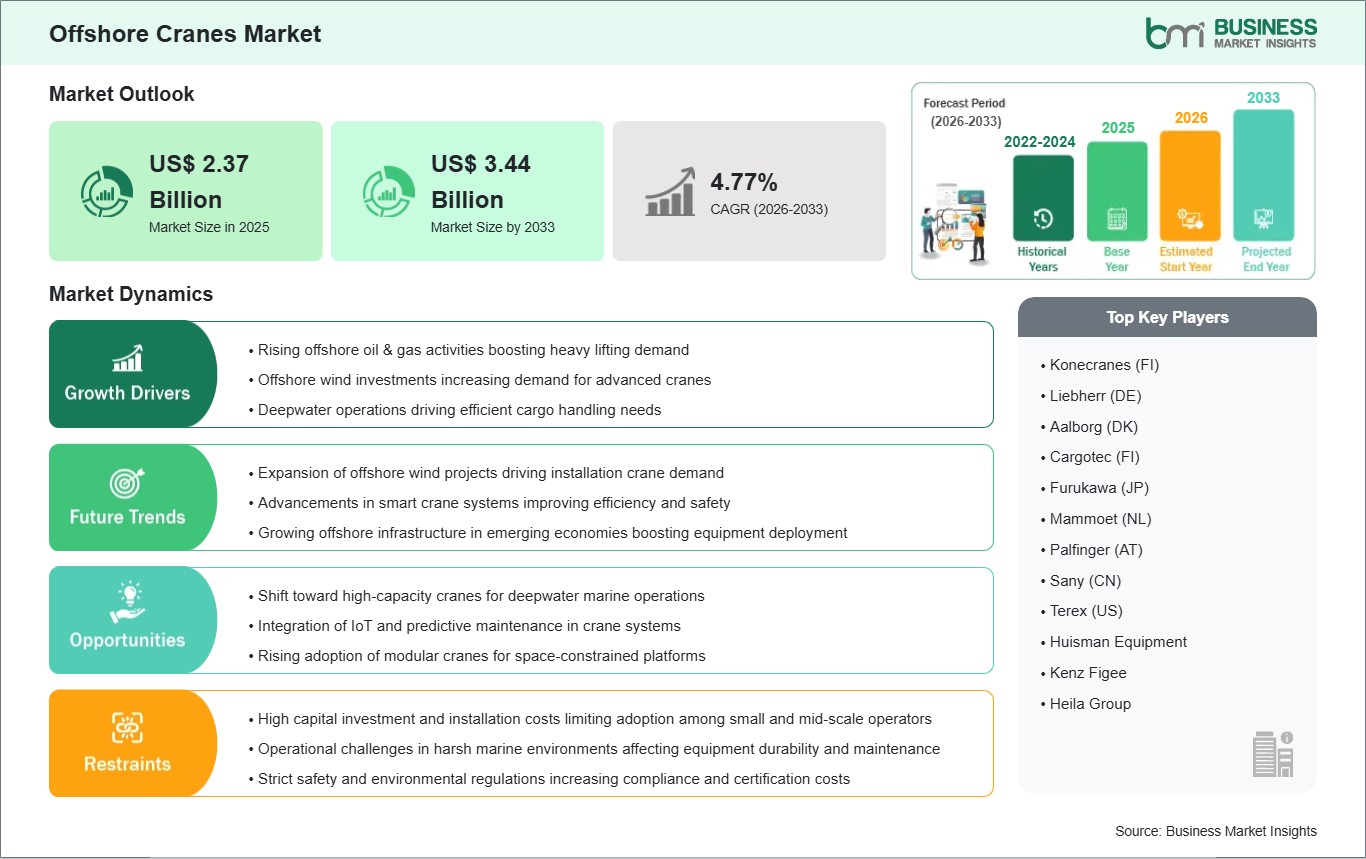
The Offshore Crane Market refers to advanced lifting and material handling systems designed for installation, maintenance, and operational support across offshore oil & gas platforms, floating production units, and offshore wind energy structures. These cranes include high-capacity lifting equipment engineered to operate in harsh marine environments characterized by strong winds, saltwater corrosion, and deepwater conditions. Offshore cranes utilize hydraulic, electric, and hybrid actuation systems combined with advanced control technologies, load monitoring sensors, and dynamic positioning integration to ensure safe and precise lifting operations. The market is increasingly evolving with the adoption of digital monitoring systems, IoT-enabled predictive maintenance, and automation technologies that enhance operational safety and efficiency. Growth is primarily driven by rising offshore oil & gas exploration activities, expanding offshore wind energy installations, and increasing investments in deepwater and ultra-deepwater infrastructure projects across global marine industries.
However, several factors may restrain market progression. The high capital cost associated with offshore crane manufacturing, installation, and maintenance remains a significant barrier, particularly for small and mid-sized operators. The industry also faces operational challenges due to extreme offshore environmental conditions such as high waves, corrosion, and unpredictable weather, which can impact equipment reliability and lifecycle performance. Strict safety regulations and certification requirements further increase compliance complexity and project costs. Additionally, logistical difficulties in transporting and installing heavy crane systems in remote offshore locations add to operational constraints. Integration challenges with existing offshore platform infrastructure and high downtime costs during maintenance activities also limit broader adoption.
Despite these challenges, the market outlook remains positive as the offshore energy sector continues to expand globally. Opportunities are emerging through the rapid growth of offshore wind energy projects, which require advanced installation and maintenance cranes for turbine deployment and servicing. Technological advancements in smart cranes, automation, and remote operation capabilities are improving efficiency and reducing operational risks in offshore environments. The development of high-capacity, deepwater-compatible cranes is enabling exploration in deeper and more challenging marine locations. Additionally, increasing investments in digital twin technology, predictive maintenance systems, and AI-based load management solutions are enhancing operational reliability. Collectively, these developments position the offshore crane market for steady long-term growth as a critical enabler of offshore energy and marine infrastructure development.
Segment Analysis
Offshore Cranes Market Segmentation
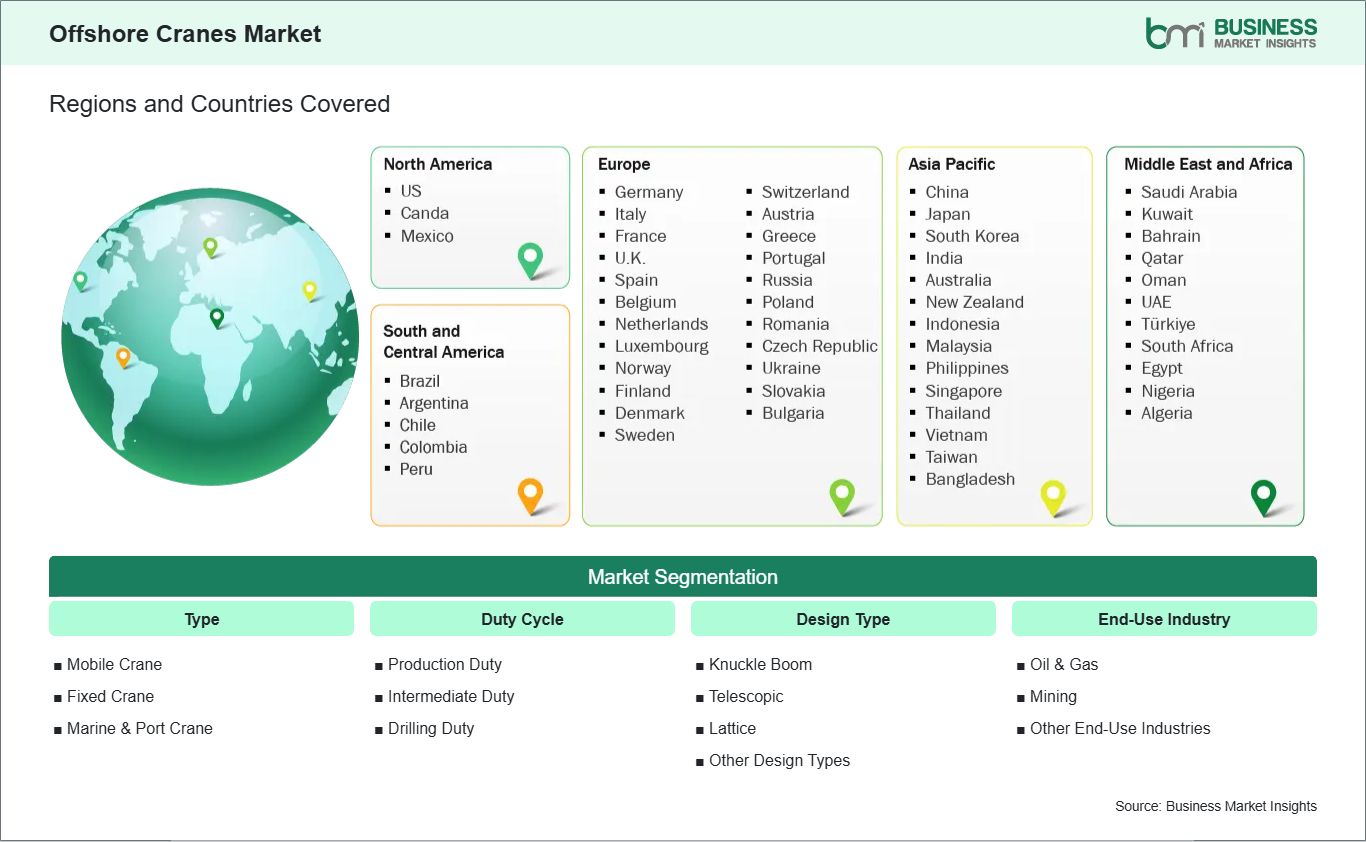
The offshore cranes market is segmented based on type, duty cycle, design type, end-use industry, and lifting capacity, reflecting its critical role in offshore oil & gas, wind energy, and marine infrastructure operations.
By Type
- Mobile Crane: Flexible cranes used for dynamic offshore operations and support vessels requiring mobility across platforms
- Fixed Crane: Permanently installed cranes on offshore platforms designed for continuous heavy-duty lifting operations
- Marine & Port Crane: Used for cargo handling, logistics support, and transfer operations between vessels and offshore structures
By Duty Cycle
- Production Duty: Cranes used in continuous offshore production environments such as oil & gas platforms and wind farms
- Intermediate Duty: Used for moderate-frequency lifting tasks including maintenance and supply operations
- Drilling Duty: Heavy-duty cranes designed for high-load drilling support operations in offshore exploration activities
By Design Type
- Knuckle Boom: Compact and flexible cranes ideal for space-constrained offshore environments with complex lifting angles
- Telescopic: Cranes with extendable boom structures offering versatility and improved reach for offshore operations
- Lattice: High-capacity cranes designed for heavy lifting in deepwater and ultra-deepwater offshore installations
- Others: Includes specialized crane configurations tailored for niche offshore applications
By End-Use Industry
- Oil & Gas: Dominant segment using offshore cranes for drilling, production, and platform maintenance activities
- Mining: Offshore and marine mining operations requiring heavy lifting and material handling equipment
- Others: Includes offshore wind energy, marine construction, and defense-related offshore applications
By Lifting Capacity
- Up to 500 mt: Light-duty offshore cranes used for maintenance and supply handling tasks
- 500–3000 mt: Medium to heavy-duty cranes used in production platforms and offshore installations
- Above 3000 mt: Ultra-heavy cranes designed for deepwater and large-scale offshore infrastructure projects
Market Forces
Offshore Cranes Market Drivers and Opportunities
Rising Demand for Offshore Energy Exploration, Marine Infrastructure Development, and Heavy Lifting Operations
The Offshore Crane market is being driven by the increasing demand for offshore oil & gas exploration, deepwater drilling activities, and large-scale marine infrastructure development. Offshore cranes play a critical role in lifting, installation, and maintenance operations across platforms, vessels, and offshore facilities operating in harsh marine environments. The growing shift toward deepwater and ultra-deepwater exploration is significantly increasing the need for high-capacity cranes capable of handling heavy loads under extreme weather and sea conditions. Additionally, the expansion of offshore wind energy projects is further accelerating demand for specialized installation and maintenance cranes. Rising investments in offshore production platforms, floating structures, and subsea infrastructure are strengthening market growth. Moreover, stringent safety regulations and operational efficiency requirements are pushing operators to adopt advanced crane systems with improved load handling, stability, and precision control capabilities.
Rising Integration of Smart Technologies, Automation, and Offshore Renewable Energy Expansion
Opportunities in the Offshore Crane market are expanding through the integration of automation, digital monitoring systems, and advanced control technologies that enhance operational safety and efficiency. The adoption of smart cranes equipped with IoT sensors, predictive maintenance systems, and real-time load monitoring is improving operational reliability and reducing downtime in offshore environments. The rapid growth of offshore wind energy installations is creating significant demand for high-performance cranes used in turbine installation, assembly, and maintenance activities. Additionally, increasing investments in deepwater oil & gas exploration are driving demand for ultra-heavy lifting cranes with enhanced capacity and dynamic positioning capabilities. The development of remotely operated and semi-automated crane systems is further improving safety by minimizing human exposure to hazardous offshore conditions. Advancements in digital twin technology, AI-based load optimization, and modular crane designs are also creating new opportunities for efficiency improvements and operational flexibility. Collectively, these factors are positioning the offshore crane market for sustained long-term growth as a key enabler of offshore energy and marine infrastructure development.
Size and Share Analysis
Offshore Cranes Market Size and Share Analysis
The Offshore Cranes Market is projected to grow from US$ 2.37 Billion in 2025 to US$ 3.44 Billion by 2033 , registering a CAGR of 4.77% from 2026 to 2033.
By type, mobile cranes account for a significant share as they offer flexibility and rapid deployment across offshore support vessels and dynamically changing operational environments, making them highly suitable for maintenance and auxiliary lifting tasks on offshore platforms. Fixed cranes continue to dominate heavy-duty offshore operations due to their permanent installation on oil & gas platforms and production facilities, enabling continuous high-capacity lifting, material handling, and operational support under extreme marine conditions. Marine & port cranes are also witnessing strong demand as offshore logistics and supply chain activities expand, supporting cargo handling, vessel loading/unloading, and transfer operations between onshore bases and offshore structures.
By duty cycle, production duty cranes dominate adoption due to their continuous operation in offshore oil & gas platforms and wind farms, where consistent heavy lifting and operational reliability are critical for production efficiency. Intermediate duty cranes are experiencing steady growth as they are widely used for maintenance, repair, and supply handling operations across offshore installations, balancing performance and cost efficiency. Drilling duty cranes are gaining traction in offshore exploration activities, where high-load lifting capability and rugged performance are essential for supporting drilling rigs and deepwater exploration operations under harsh environmental conditions.
Report Coverage
Offshore Cranes Market Report Coverage and Deliverables
The "Offshore Cranes Market Size and Forecast (2022–2033)" report provides a detailed analysis of the market covering below areas:
- Offshore cranes market size and forecast at global, regional, and country levels for all market segments covered under the scope
- Offshore cranes market trends, as well as drivers, restraints, and opportunities
- Offshore cranes market analysis covering key trends, global and regional framework, major players, regulations, and recent developments
- Industry landscape and competition analysis covering market concentration, heat map analysis, prominent players, and recent developments for the offshore cranes market
- Detailed company profiles, including SWOT analysis
Geographic Insights
Offshore Cranes Market Geographic Insights
The Offshore Crane Market shows diverse regional adoption patterns influenced by rising offshore oil & gas exploration activities, increasing offshore wind energy installations, and growing demand for advanced marine lifting solutions across deepwater and ultra-deepwater operations.
North America, being a highly advanced offshore energy and industrial region, holds a strong position in the market due to the presence of established oil & gas production facilities, offshore engineering companies, and leading crane manufacturers. The United States and Canada are witnessing increasing deployment of offshore cranes across drilling platforms, production facilities, and marine construction projects. The region is heavily focused on enhancing offshore operational safety, improving lifting efficiency, and supporting complex deepwater exploration activities. Strong investments in offshore oil & gas projects, LNG infrastructure, and offshore wind energy development are further supporting market expansion. Additionally, well-established regulatory frameworks and rapid adoption of automated and digitally enabled crane systems are accelerating deployment across offshore installations and marine vessels.
Europe is experiencing significant growth, driven by strong offshore wind energy expansion, mature offshore engineering capabilities, and increasing investments in renewable energy infrastructure. Countries such as Norway, the United Kingdom, and Germany are actively deploying advanced offshore cranes for wind turbine installation, maintenance, and offshore platform operations. The region’s strong focus on energy transition and carbon neutrality targets is accelerating the shift from traditional offshore oil & gas operations toward renewable offshore energy systems. The presence of leading crane manufacturers and advanced maritime engineering expertise is enabling large-scale adoption of high-capacity, digitally integrated crane systems. Additionally, increasing investments in deepwater exploration and offshore infrastructure modernization are supporting continued market growth.
Both regions are contributing significantly to the growth of the Offshore Crane Market, driven by technological advancements, increasing offshore energy investments, and rising adoption of intelligent and high-capacity lifting systems across diverse offshore applications.
Industry Activity
Recent Developments
The offshore cranes market is evaluated by gathering qualitative and quantitative data post primary and secondary research, which includes important corporate publications, association data, and databases. A few of the key developments in the offshore cranes market are:
- In May 2026, Crane specialist Liebherr has completed an extensive inspection and refurbishment of a BOS 35000 offshore crane aboard ZITON’s jack-up vessel Wind Enterprise during a 10-day service campaign in Denmark. The board offshore crane was installed on a 16-meter pedestal and will support offshore wind operations across Northern Europe, according to Liebherr.
- In March 2026, Chinese state-owned port and naval machinery manufacturer Shanghai Zhenhua Heavy Industries (ZPMC) has launched a next-generation deepwater multi-purpose offshore engineering vessel for a specialized subsidiary of state-owned oil & gas firm China National Offshore Oil Corporation (CNOOC). According to ZPMC, it is designed for a wide range of offshore engineering operations and integrates full lifecycle capabilities and multi-mission functionality. The vessel is fitted with a 400-ton offshore crane for lifting marine structures and platform maintenance, a 3,000-ton-class powered cable reel for subsea cable deployment and a 12-person saturation diving system.
Trust & Transparency
Research Methodology
The market analysis combines proprietary research with secondary data from government agencies, company disclosures, regulatory filings, industry databases and expert interviews. Market estimates are validated through data triangulation, cross-market benchmarking and analyst
review.
View Full Research Methodology
Key Sources Referred:
World Bank – Global Trade Indicators World Trade Organization (WTO) (International Monetary Fund )IMF International Trade Administration (ITA) Company website Company annual reports Company investor presentations