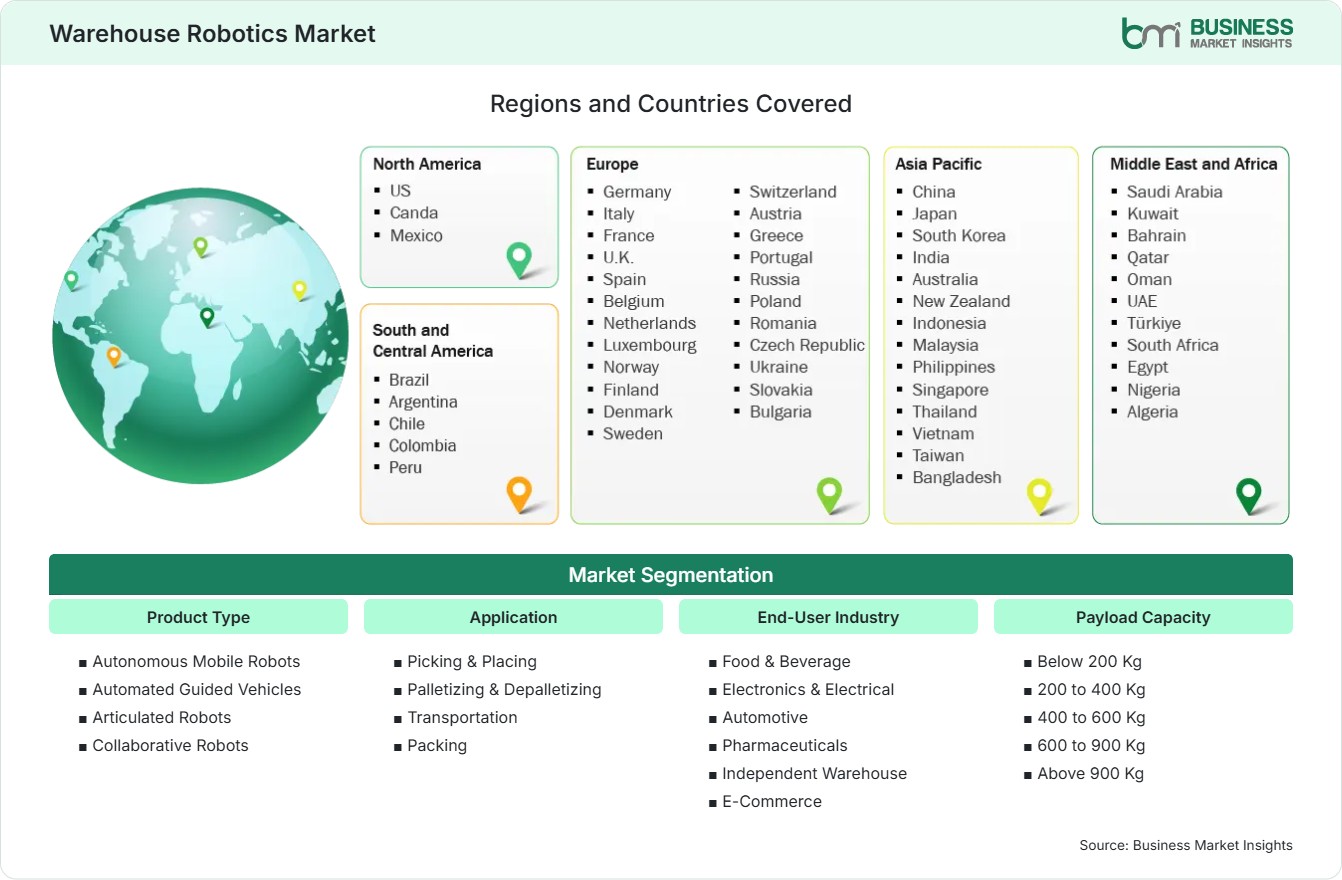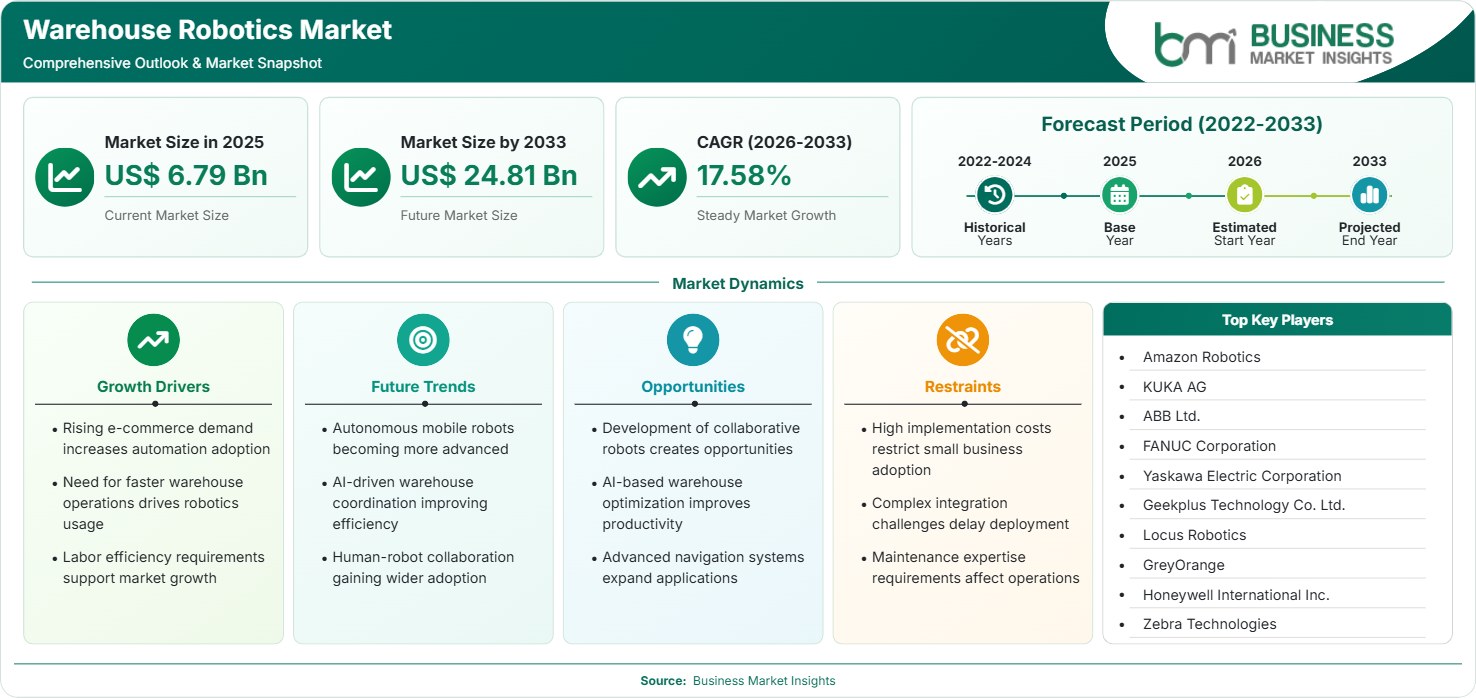
Warehouse Robotics Market Regional Highlights
North America Warehouse Robotics Market
North America represents a modeled 29%–32% share in 2025 and is projected to grow at a CAGR of 16.8%–17.5% during 2026–2033. Demand is concentrated around e-commerce fulfillment, retail distribution, third-party logistics, and industrial warehousing. The U.S. dominates regional activity, while Canada provides additional opportunities through food, retail, and industrial distribution.
- E-commerce fulfillment Mobile and picking robots address SKU growth, faster delivery, seasonal peaks, and throughput demands.
- 3PL adoption Modular robotics enable flexible scaling across multiple customer accounts.
- Brownfield facilities Robots integrate with existing racks, conveyors, workers, and equipment with minimal modifications.
- Software integration Unified platforms improve visibility across robots, inventory, labor, and exceptions.
US Warehouse Robotics Market
The U.S. represents a modeled 82%–85% Warehouse Robotics Market share of North American activity in 2025 and is projected to register a CAGR of 17.0%–17.7% during 2026–2033. Large fulfillment networks, advanced logistics infrastructure, and high expectations for delivery speed support adoption. Demand is shifting toward flexible automation that can increase throughput while allowing employees to manage exceptions, replenishment, quality control, and complex handling requirements.
- Fulfillment operators are combining mobile robots, robotic arms, and intelligent software to automate material handling while retaining human oversight.
- Retail and 3PL facilities are adopting flexible robotics to manage changing order profiles with less fixed infrastructure.
- Pharmaceutical, electronics, automotive, and consumer-goods warehouses are increasing automation to improve traceability, consistency, and material movement.
Europe Warehouse Robotics Market
Europe accounts for a modeled 23%–26% share in 2025 and is projected to expand at a CAGR of 16.1%–16.9% during 2026–2033. Germany, the United Kingdom, and France remain leading deployment markets, while Poland, Italy, and the Netherlands provide high-growth opportunities. Demand is supported by logistics modernization, manufacturing automation, space constraints, labor efficiency objectives, and increasing interest in modular warehouse technologies that can adapt to variable facility configurations.
- Germany remains a key robotics market, driven by automotive, manufacturing, and logistics.
- The UK is expanding automation across retail, e-commerce, and fulfillment.
- France is adopting mobile robotics in retail, food, and industrial warehousing.
- Central Europe is seeing rising investment in warehouse expansion and modernization.
Asia Pacific Warehouse Robotics Market
Asia Pacific represents a modeled 31%–34% share in 2025 and is projected to record a CAGR of 18.2%–19.0% during 2026–2033, making it the fastest-growing region. China, Japan, and South Korea are leading adoption, while India and Southeast Asian economies provide strong expansion potential. Manufacturing scale, e-commerce growth, logistics modernization, and domestic robotics capabilities are strengthening regional deployment across diverse warehouse environments.
- China remains a major robotics market, driven by manufacturing and e-commerce automation.
- Japan is adopting robotics to improve efficiency and address workforce constraints.
- India offers strong long-term potential through growing retail, e-commerce, manufacturing, and 3PL automation.
- Southeast Asia is expanding as distribution hubs grow and demand scalable warehouse automation.
Rest of World Warehouse Robotics Market
Rest of World accounts for a modeled 11%–14% Warehouse Robotics Market share in 2025 and is projected to expand at a CAGR of 17.1%–18.0% during 2026–2033. Latin America, the Middle East, and Africa are gradually increasing automation adoption as distribution networks modernize. Brazil and Mexico provide leading Latin American opportunities, while the United Arab Emirates and Saudi Arabia are emerging Middle Eastern deployment markets supported by logistics infrastructure development.
Latin American warehouses are prioritizing automation where labor productivity and distribution consistency are becoming more important. Middle Eastern logistics hubs are emphasizing sophisticated fulfillment infrastructure, while selected African markets are beginning with targeted automation in large distribution and retail facilities.
- Brazil and Mexico are expanding warehouse automation across retail, food, consumer products, and 3PL.
- The UAE is investing in high-throughput logistics and flexible fulfillment.
- Saudi Arabia is modernizing logistics infrastructure with opportunities for robotic integration.
- Africa remains a selective market, led by large retailers, manufacturers, and logistics operators.