
Robotic Wing Assembly Systems Market Outlook: Size, Share, Trends, Growth Analysis, Competitive Landscape & Forecast, 2026-2033

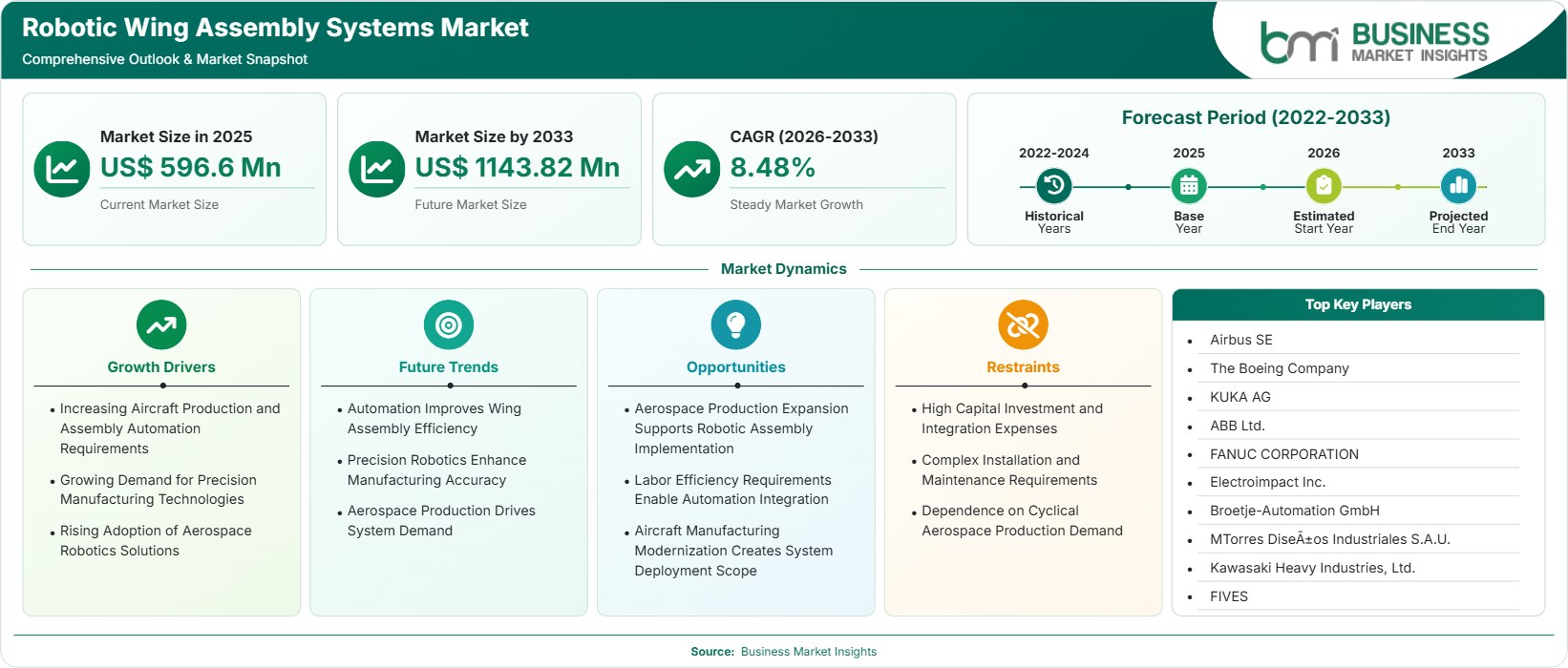
The Robotic Wing Assembly Systems Market size was valued at US$ 596.6 Million in 2025 and is projected to reach US$ 1143.82 Million by 2033, growing at a CAGR of 8.48% during 2026–2033, driven by aircraft production expansion, composite wing adoption, automation investments, precision requirements, digital manufacturing, and flexible assembly technologies.

Report Coverage
  • Aircraft Type: Commercial Aircraft, Military Aircraft, Others
  • Automation Level: Fully Automated Systems, Semi-Automated Systems, Others
  • Application: Wing Skin Drilling & Fastening, Wing Panel & Spar Assembly, Composite Wing Assembly, Others
US$ 596.6 Mn Market size in 2025
US$ 1143.82 Mn Market Size by 2033
8.48% CAGR, 2026 - 2033
2026-2033 Forecast Period

AI Overview

Robotic Wing Assembly Systems Market Summary

  • North America: North America holds market share of 36%–40% in 2025, growing with a CAGR of 7.8%–8.4% during 2026–2033, influenced by commercial aircraft production, defense programs, automated drilling, fastening demand, digital factories, supplier modernization, and precision requirements across complex wing structures. The US market is expanding at an estimated 7.9%–8.5% CAGR, supported by Boeing production programs, defense aerospace investment, automated fastening, composite structures, and advanced manufacturing integration.
  • Fastest Growing Region: Asia Pacific holds market share of 20%–24% in 2025, growing with a CAGR of 9.0%–9.7% during 2026–2033, driven by expanding aircraft manufacturing capacity, Chinese commercial aviation programs, Japanese aerospace engineering, Indian aerospace localization, robotics adoption, and increasing demand for digitally controlled assembly equipment.
  • Leading Segment: Commercial Aircraft holds market share of 61%–65% in 2025, growing with a CAGR of 8.1%–8.6% during 2026–2033, supported by narrow-body production expansion, backlog conversion, aircraft modernization, lightweight structures, composite wing manufacturing, automated fastening, production-rate increases, and stringent dimensional-quality requirements.
  • High Growth Segment: Composite Wing Assembly holds market share of 22%–26% in 2025, growing with a CAGR of 9.0%–9.6% during 2026–2033, benefiting from lightweight structures, advanced composite materials, automated positioning, digitally controlled joining, improved repeatability, reduced rework, and next-generation aircraft programs requiring higher structural efficiency.
  • Key Market Opportunity: The strongest opportunity lies in integrated robotic cells combining machine vision, adaptive drilling, automated fastening, digital twins, metrology, and predictive analytics for flexible multi-aircraft production environments.
  • Major Market Players: Airbus SE, The Boeing Company, KUKA AG, ABB Ltd., FANUC CORPORATION, Electroimpact Inc., Broetje-Automation GmbH, MTorres Diseños Industriales S.A.U., Kawasaki Heavy Industries, Ltd., and FIVES.
Strategic Insights

Robotic Wing Assembly Systems Market: Strategic Insights

Robotic Wing Assembly Systems Market Strategic Framework
FREE PDF
Request your free sample
Request free sample
Stakeholder View

Key Takeaways

  • The value chain is evolving from stand-alone machine suppliers toward integrated automation ecosystems involving robot manufacturers, CNC providers, metrology specialists, aerospace OEMs, system integrators, software developers, and tooling companies. Suppliers capable of delivering validated end-to-end cells can capture greater project value.
  • Composite wing assembly offers the strongest application upside because large composite structures require controlled positioning, adaptive tooling, accurate drilling, automated fastening, and dimensional verification. Growing adoption of lightweight structures increases the need for automation capable of managing low-stiffness components.
  • Innovation is moving toward sensor-rich robotic cells with machine vision, adaptive path planning, digital twins, automated inspection, and closed-loop process correction. These technologies reduce dependence on fixed templates and support faster engineering changes across aircraft programs.
  • Asia Pacific provides an attractive investment case because aircraft industrialization is expanding beyond established production centers. China, Japan, India, and emerging Southeast Asian aerospace clusters can create demand for localized automation, integration, service, and retrofit capabilities.
  • Investment priorities are increasingly connected to production-rate readiness rather than isolated robot deployment. Partnerships between OEMs, automation integrators, robotics companies, and research organizations can accelerate qualification and reduce implementation risk.
  • Lifecycle services represent an additional strategic opportunity. Calibration, software upgrades, predictive maintenance, tooling replacement, process optimization, and operator training can create recurring revenue after initial robotic cell installation.
Geographic Outlook

Robotic Wing Assembly Systems Market Regional Highlights

North America Robotic Wing Assembly Systems Market

North America represented 36%–40% Robotic Wing Assembly Systems Market share in 2025 and is projected to record a 7.8%–8.4% CAGR through 2033. The region benefits from established aircraft OEMs, defense programs, advanced automation suppliers, and mature aerospace manufacturing infrastructure. The US accounts for the dominant regional demand base, while Canada contributes through aerostructure manufacturing and aerospace supply chains. Automated drilling, fastening, robotic positioning, and composite processing remain major investment priorities as manufacturers address production-rate requirements and workforce constraints. The region also benefits from established technology validation capabilities.

  • Defense aircraft programs encourage investment in high-precision robotic drilling, fastening, inspection, and positioning systems where repeatability and documentation are essential for structural manufacturing.
  • Large commercial aerospace production programs support automation investment because suppliers need repeatable processes capable of maintaining quality while increasing throughput and reducing manual handling.
  • Advanced robotics ecosystems provide North American manufacturers with access to machine vision, CNC controls, metrology, adaptive tooling, and software integration capabilities.
  • Digital manufacturing initiatives are increasing demand for connected equipment that records process parameters, supports traceability, and enables engineering teams to identify deviations before final inspection.

US Robotic Wing Assembly Systems Market

The US represented approximately 30%–34% of the global share in 2025 and is estimated to grow at 7.9%–8.5% CAGR during the Robotic Wing Assembly Systems Market Forecasts. Boeing production programs, military aircraft manufacturing, composite structures, and domestic automation capabilities support demand. The US also maintains a deep ecosystem of specialized aerospace automation suppliers. Electroimpact has extensive experience in automated wing drilling and fastening, while Boeing continues developing composite wing structures for new aircraft programs, reinforcing the need for advanced production systems.

  • Boeing’s composite wing manufacturing programs create opportunities for automated fiber placement, positioning, drilling, fastening, inspection, and integrated production-control technologies.
  • Defense manufacturing requires highly repeatable structural processes, increasing demand for robotic systems capable of maintaining accuracy across complex geometries and demanding production environments.
  • Aerospace suppliers are investing in automation to address skilled-labor shortages while preserving quality standards and reducing physically demanding manual assembly activities.

Europe Robotic Wing Assembly Systems Market

Europe accounted for 27%–31% Robotic Wing Assembly Systems Market share in 2025 and is projected to expand at 8.0%–8.6% CAGR through 2033. Germany, France, the UK, Spain, and Italy form the principal industrial base, with the UK and Germany representing particularly important automation and aerostructure centers. Airbus wing production, European defense programs, composite manufacturing, and advanced machinery suppliers sustain demand. Airbus continues developing automated wing technologies through Wing of Tomorrow, while European integrators supply drilling, fastening, positioning, and digitally connected production systems.

  • The UK remains strategically important because Broughton manufactures Airbus wings and supports advanced wing research, automation engineering, digital manufacturing, and next-generation production technologies.
  • Germany benefits from a dense aerospace manufacturing and industrial automation ecosystem, creating demand for robotic assembly cells, metrology, tooling, and digitally integrated production systems.
  • France benefits from Airbus industrial activity and specialized aerospace machinery suppliers, while government-backed research supports automated assembly and advanced manufacturing development.
  • Spain remains relevant through aerostructure manufacturing and specialized automation expertise, creating opportunities for robotic wing assembly, composite processing, and automated joining technologies.

Asia Pacific Robotic Wing Assembly Systems Market

Asia Pacific represented 20%–24% share in 2025 and is forecast to achieve the highest regional growth at 9.0%–9.7% CAGR through 2033. China leads regional expansion through commercial aircraft industrialization, while Japan provides advanced aerospace engineering and robotics capabilities. India is emerging as a manufacturing and maintenance hub, creating longer-term opportunities for localized assembly automation. Increasing aircraft demand, domestic production ambitions, supply-chain localization, and investments in advanced manufacturing are strengthening the regional case for robotic wing systems.

  • China’s commercial aircraft manufacturing ecosystem creates opportunities for automated wing drilling, fastening, metrology, composite processing, and production-line integration.
  • Japan combines sophisticated robotics capabilities with established aerospace manufacturing, supporting adoption of precision automation for structural assembly and quality-critical operations.
  • India offers a developing aerospace manufacturing base where localized production, defense programs, and supplier development can increase demand for modular and scalable automation.
  • Southeast Asian aerospace clusters provide opportunities for suppliers offering flexible automation cells, process integration, maintenance services, and training aligned with international aerospace production standards.

Rest of World Robotic Wing Assembly Systems Market

Rest of World accounted for 8%–12% Robotic Wing Assembly Systems Market share in 2025 and is estimated to expand at 7.2%–8.0% CAGR through 2033. South and Central America benefit from aerospace maintenance, aerostructure manufacturing, and expanding supplier participation. Brazil remains the principal regional aerospace manufacturing center, supported by established aircraft production capabilities and supplier networks.

Middle East and Africa represent an emerging opportunity, particularly where defense aerospace investment, aircraft maintenance, manufacturing localization, and industrial diversification programs encourage adoption of advanced production technologies. The region’s opportunity remains smaller but increasingly strategic for modular automation deployments.

  • Brazil provides the strongest South American opportunity through established aerospace manufacturing capabilities and demand for production technologies supporting structural quality and throughput.
  • Gulf aerospace investments can encourage automation adoption where aircraft manufacturing, maintenance, defense, and industrial diversification programs converge.
  • Mexico’s aerospace supply chain provides an additional manufacturing opportunity because international suppliers require standardized processes, traceability, and repeatable structural production.
  • Emerging markets are more likely to adopt modular robotic systems that can be scaled progressively rather than large fully automated lines requiring substantial initial capital.
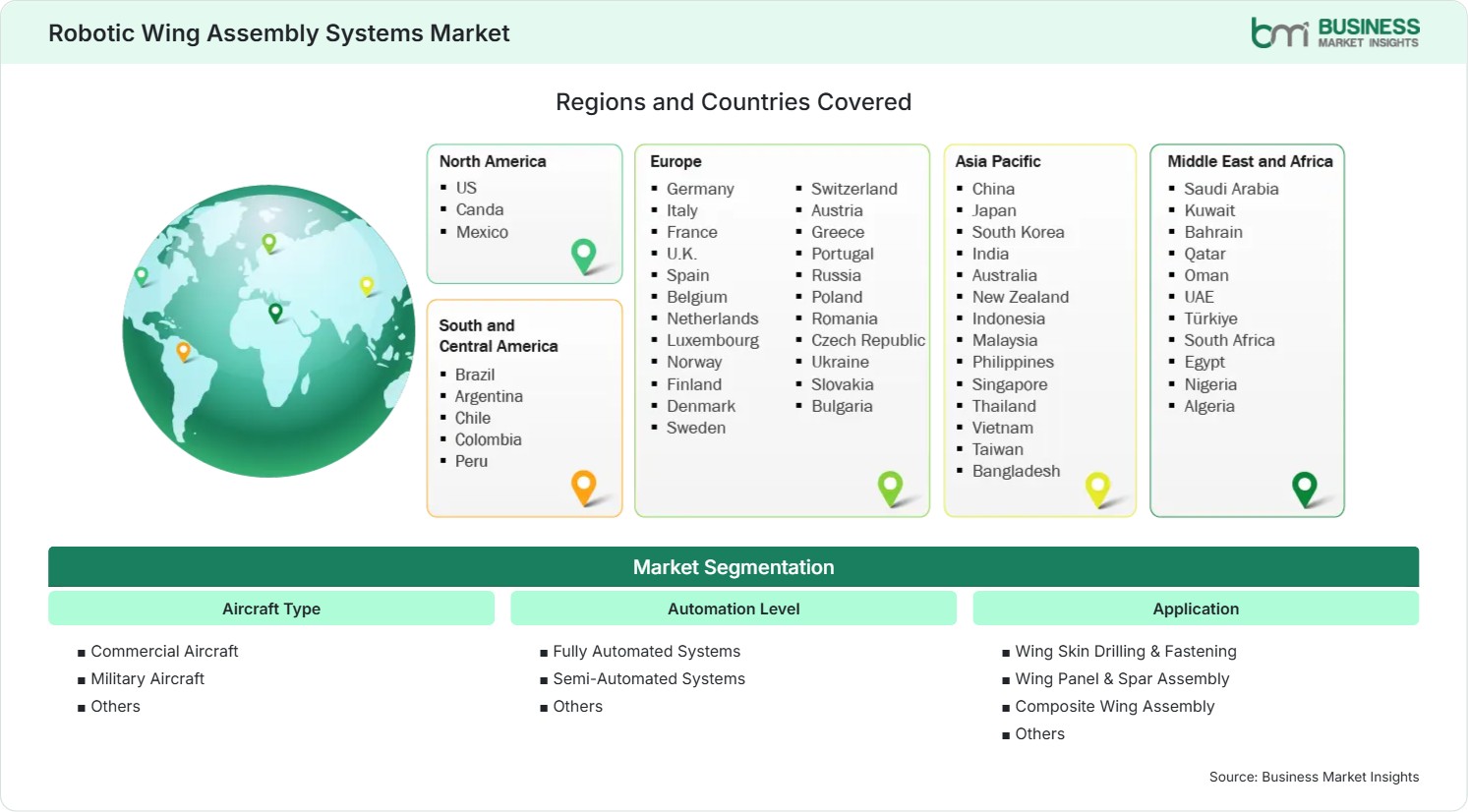
Global Market Geography
FREE PDF
Request your free sample
Request free sample
Segment Analysis

Robotic Wing Assembly Systems Market Segmentation

Aircraft Type

Commercial Aircraft represented approximately 61%–65% share in 2025, with a 8.1%–8.6% CAGR during 2026–2034. Passenger aircraft production rates, composite wing programs, and backlog fulfillment support investment in automated drilling, fastening, positioning, and inspection systems across global aerospace manufacturing networks.

  • Commercial Aircraft: High production volumes favor automation because repeatable drilling, fastening, inspection, and positioning reduce cycle variation while supporting stringent structural quality requirements and production-rate increases.
  • Military Aircraft: Defense programs require adaptable automation capable of handling lower production volumes, complex configurations, specialized materials, secure manufacturing environments, and strict dimensional verification throughout structural assembly.

Automation Level

Fully Automated Systems accounted for approximately 47%–51% share in 2025, with a 8.4%–8.9% CAGR during 2026–2034. Automation intensity rises as manufacturers prioritize consistent cycle times, digital traceability, worker safety, and scalable production. Semi-automated platforms remain important where manual access is still required.

  • Fully Automated Systems: Integrated robotics, CNC equipment, metrology, vision, fastening, and process software enable repeatable structural assembly while reducing manual intervention and supporting higher production throughput.
  • Semi-Automated Systems: Hybrid cells combine operator flexibility with robotic assistance, making them suitable for complex geometries, engineering changes, lower production volumes, and processes requiring skilled human judgment.

Application

Wing Panel & Spar Assembly represented approximately 34%–38% share in 2025, while Composite Wing Assembly is the fastest-growing application at a 9.0%–9.6% CAGR during 2026–2034. Large structures require accurate positioning and controlled joining across extensive surfaces.

  • Wing Skin Drilling & Fastening: Automated drilling and fastening improves hole consistency, reduces repetitive manual work, and supports digital process monitoring across aluminum and composite structural components.
  • Wing Panel & Spar Assembly: Robotic positioning and joining improve dimensional control while enabling large panels, spars, ribs, and structural components to be assembled with repeatable alignment.
  • Composite Wing Assembly: Advanced robotics address low-stiffness structures through controlled handling, adaptive positioning, automated joining, and inspection, supporting lightweight aircraft architectures and next-generation wing designs.
Market Forces

Robotic Wing Assembly Systems Market Dynamics

Key Market Drivers

Higher Aircraft Production Rates Require Repeatable Automation

Airplane companies are becoming increasingly automated due to the fact that any increase in production rate increases the significance of manual errors. For instance, in the case of the Boeing 777-8 Freighter, the company has wing spars that exceed 100 feet in length. Additionally, Airbus is working towards wing industrialization with the help of its Wing of Tomorrow project. These requirements support Robotic Wing Assembly Systems Market growth owing to the ability to automate drilling, fastening, positioning, and inspection in order to standardize repetitive tasks. The market is headed towards an integrated cell that can collect and process data and compensate for dimensional variations. Higher production rates increase automation economics due to the increased use of capital-intensive systems.

Composite Structures Increase Demand for Adaptive Assembly Technologies

Composite wings result in production conditions that are distinct from those of metallic constructions in that light parts are more prone to deformation when they are being manipulated and positioned. Literature on aerospace automation in 2026 refers to large aerospace parts as difficult since they have large sizes, low rigidity, complicated interface, and precise assembly tolerances. Such a technical setting justifies spending money on robotics for positioning, vision and measurement systems, adaptive tools, and closed-loop control. Hence, there is potential for market development not only in drilling but also in robotic comprehension of part geometry. Robotic Wing Assembly Systems Market trends increasingly connect automation hardware with digital models, real-time measurement, trajectory planning, and process correction to improve structural accuracy without excessive fixed tooling.

Digital Manufacturing Improves Traceability and Process Control

Through digitalization, the aerospace assembly process will move from being machine-centered to being production workstream-enabled. Some of the aspects of industrial transformation according to Airbus include digitalization of the manufacturing process, robotics, and co-design. Through digital continuity, engineering data can be integrated into manufacturing operations, while connected machines provide production data for process optimization and quality management. These capabilities support Robotic Wing Assembly Systems Market Adoption because of the necessity to document process structure in the manufacturing industry of aerospace. It can be used even for risk reduction during the commissioning by means of modeling and optimization of assembly processes before their physical realization. This is explained in one of the research presentations that were delivered at the International Conference on Mechatronics and Robotics Engineering in 2026.

Key Market Opportunities

Integrated Robotic Cells for Composite Wing Manufacturing

Composite wing production provides a forward-looking opportunity because next-generation aircraft increasingly prioritize lightweight structures and aerodynamic efficiency. While the Airbus A350F wing utilizes composite materials, Wing of Tomorrow focuses on developing long and light wings, along with over 100 manufacturing and assembly techniques. Value creation in suppliers’ domain will be possible through the integration of robot handling, adaptive tooling, drilling, fastening, metrology, and digital process control in a single validated cell. The commercial feasibility is high when the equipment can handle various types of airplanes with minimal changes to the setup. Opportunities in the Robotic Wing Assembly Systems Market include equipping existing production units with flexible robot cells instead of new assembly lines altogether.

Expansion of Aerospace Automation in Emerging Production Centers

Aerospace manufacturing localization creates opportunities for automation suppliers outside traditional production centers. Emerging aerospace supply chains in China, India, Southeast Asia, and elsewhere require the development of supplier capacity and facilities, leading to a need for manufacturing equipment that will meet international quality standards. Suppliers may distinguish themselves via modular design, localization, training, diagnostics, and lifecycle services. The key value proposition here is not only to sell robotics but to provide a proven manufacturing process that includes tooling, software, metrology, documentation, and operators. Flexible equipment will also allow emerging aerospace manufacturers to handle different levels of production volume and different aircraft variations. Partnering with aerospace institutes, OEMs, and tier suppliers locally will help overcome qualification hurdles.

Digital Twins and Closed-Loop Quality Systems

Digital twins represent a high-value opportunity because wing assembly involves large structures, numerous interfaces, and tight dimensional requirements. A digital twin is capable of linking engineering geometry, machinery attributes, metrology, tool state, and process history, thus enabling manufacturers to detect abnormalities early on. In research findings from 2026, digital twins are able to capture real-time process information and interfere in process control. This shows the possibility of digital twins, other than the ability to visualize. By incorporating digital twins into robotic drilling, fastening, measuring, and positioning processes, suppliers are able to differentiate their platform offerings by increasing the software components in them. There is also room for predictive maintenance and virtual commissioning, which reduces downtime and the time taken for deployments.

Market Restraints and Challenges

High Capital Requirements and Complex System Qualification

Factor: Robotic wing assembly cells require expensive robotics, tooling, CNC equipment, metrology, software, safety systems, integration engineering, and aerospace qualification. Large systems can also require customized fixtures and extensive commissioning before production approval.

Impact: A higher initial investment may delay the adoption of such technology among lower-tier suppliers and manufacturers with lower production volumes. In situations where changes in the design of the airplane lead to tooling changes or software validation, the cost of such initial investment is even higher. This situation forces buyers to choose modular solutions, which can be further scaled up along with the growing volume of production. There should be evidence that investments are justified by savings in cycle times, rework, labor, and quality variance.

Integration Complexity Across Legacy Aerospace Production Systems

Factor: Legacy tooling, custom-built manufacturing software, various robots, inspection technology, and even manual work have been developed in aerospace factories for several different aircraft programs.

Impact: Using new robotic equipment in such an environment raises a number of concerns relating to interoperability, data, cybersecurity, training, and qualification. A technically sound robot might be able to contribute very little to productivity due to a lack of effective data exchange between engineering and production, or poor access to process data for operators. Open interfaces, good middleware, proper data models, and extensive validation efforts are needed. Companies providing system integration can help to overcome these issues, yet the time and costs of integration will grow accordingly. The issue is especially acute in cases where automation should operate on several types of aircraft at once.

Company Analysis

Competitive Landscape

The Robotic Wing Assembly Systems Market analysis shows that there is a competitive structure, which consists of aerospace OEMs, industrial robotics firms, aerospace-specific automation system integrators, and production system providers. Competitiveness now rests increasingly on precision, integration, software, flexibility, aerospace qualification, and lifecycle support.

Company Name

Overview

Products and Services relevant to this market

Airbus SE

Major European aircraft OEM with extensive wing engineering and manufacturing capabilities and advanced industrial automation initiatives.

Wing manufacturing, automated assembly development, composite structures, digital manufacturing, Wing of Tomorrow technologies, production engineering.

The Boeing Company

Major US aerospace OEM with advanced composite wing manufacturing and highly engineered commercial and defense aircraft production programs.

Composite wing production, automated manufacturing, structural assembly, production engineering, digital factory technologies, aircraft integration.

KUKA AG

German industrial automation company supplying robotic and automated manufacturing technologies across demanding industrial sectors.

Industrial robots, robotic assembly, automation cells, controllers, simulation, aerospace manufacturing integration, automated handling.

ABB Ltd.

Global automation and robotics provider offering connected robotic systems and industrial digitalization solutions.

Industrial robots, collaborative robots, controllers, machine vision, digital automation, manufacturing software, aerospace process automation.

FANUC CORPORATION

Japanese robotics and CNC specialist with aerospace automation applications spanning machining and assembly operations.

CNC systems, industrial robots, collaborative robots, drilling applications, controls, automation integration, aerospace production technologies.

Electroimpact Inc.

US specialist in aerospace automation with extensive experience in automated drilling, fastening, wing assembly, and large structures.

Automated drilling, fastening, wing panel assembly, robotic manipulation, mobile machinery, turnkey aerospace assembly systems.

Broetje-Automation GmbH

German aerospace automation specialist providing integrated production systems and automated assembly solutions.

Automated drilling and fastening, panel assembly cells, robotic assembly, positioning, production lines, composite processing, digital factory solutions.

MTorres Diseños Industriales S.A.U.

Spanish industrial technology company specializing in advanced aerospace manufacturing and automated production systems.

Aerospace automation, composite processing, assembly systems, material handling, drilling, fastening, production engineering.

Kawasaki Heavy Industries, Ltd.

Japanese aerospace manufacturer involved in aircraft structures and advanced industrial engineering programs.

Aircraft structures, aerospace manufacturing, robotic technologies, automated production, engineering systems, structural assembly capabilities.

FIVES

French industrial engineering group supplying advanced manufacturing and automation technologies across aerospace applications.

Aerospace assembly systems, machining, automation, production engineering, robotics integration, digital manufacturing, turnkey industrial solutions.

Trust & Transparency

Research Methodology

The market analysis combines proprietary research with secondary data from government agencies, company disclosures, regulatory filings, industry databases and expert interviews. Market estimates are validated through data triangulation, cross-market benchmarking and analyst review.

View Full Research Methodology

Questions Answered

Frequently Asked Questions

What is the Robotic Wing Assembly Systems Market Report useful for?

The Robotic Wing Assembly Systems Market Report can support strategic planning by helping manufacturers, automation suppliers, investors, and technology providers assess regional opportunities, application priorities, automation levels, competitive positioning, and technology adoption pathways._________________________________________________________________________________________

What role do digital twins play in wing assembly?

Digital twins connect engineering models with production data, machine behavior, measurement results, and process parameters. They can support virtual commissioning, process optimization, deviation detection, and adaptive automation before and during physical production.__________________________________________________________________________________________

Which application has the strongest long-term potential?

Composite Wing Assembly has strong long-term potential because next-generation aircraft designs increasingly emphasize lightweight structures, aerodynamic efficiency, and advanced composite materials. Automation can address the precision and handling requirements associated with these structures.__________________________________________________________________________________________

Why are composite wings increasing automation requirements?

Composite wings are lightweight, large, and comparatively flexible, making positioning and dimensional control more challenging. Robotic systems can combine adaptive tooling, measurement, controlled handling, and automated joining to improve repeatability.__________________________________________________________________________________________

What is a robotic wing assembly system?

A robotic wing assembly system is an integrated manufacturing platform using robots, CNC equipment, tooling, sensors, metrology, and software to perform aircraft wing drilling, fastening, positioning, panel assembly, spar integration, and related structural operations.__________________________________________________________________________________________

Access the Full Robotic Wing Assembly Systems Market Report

Get segment-level forecasts, regional estimates, competitive benchmarking, company profiles and downloadable Excel datasets.

Access the full Robotic Wing Assembly Systems Market Report
350 pages PDF & Excel | 2026-09-21
Similar Research

Related Market Reports