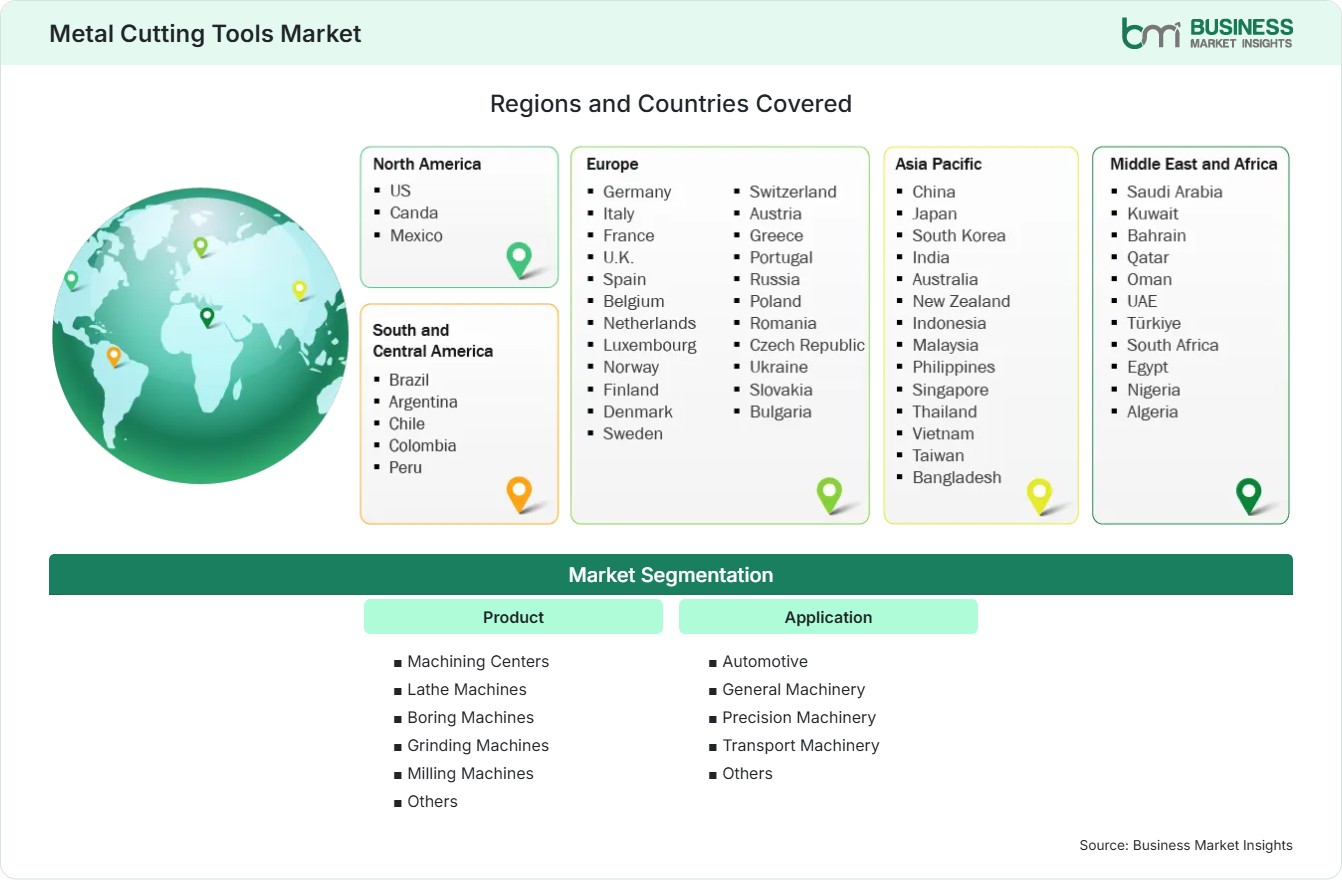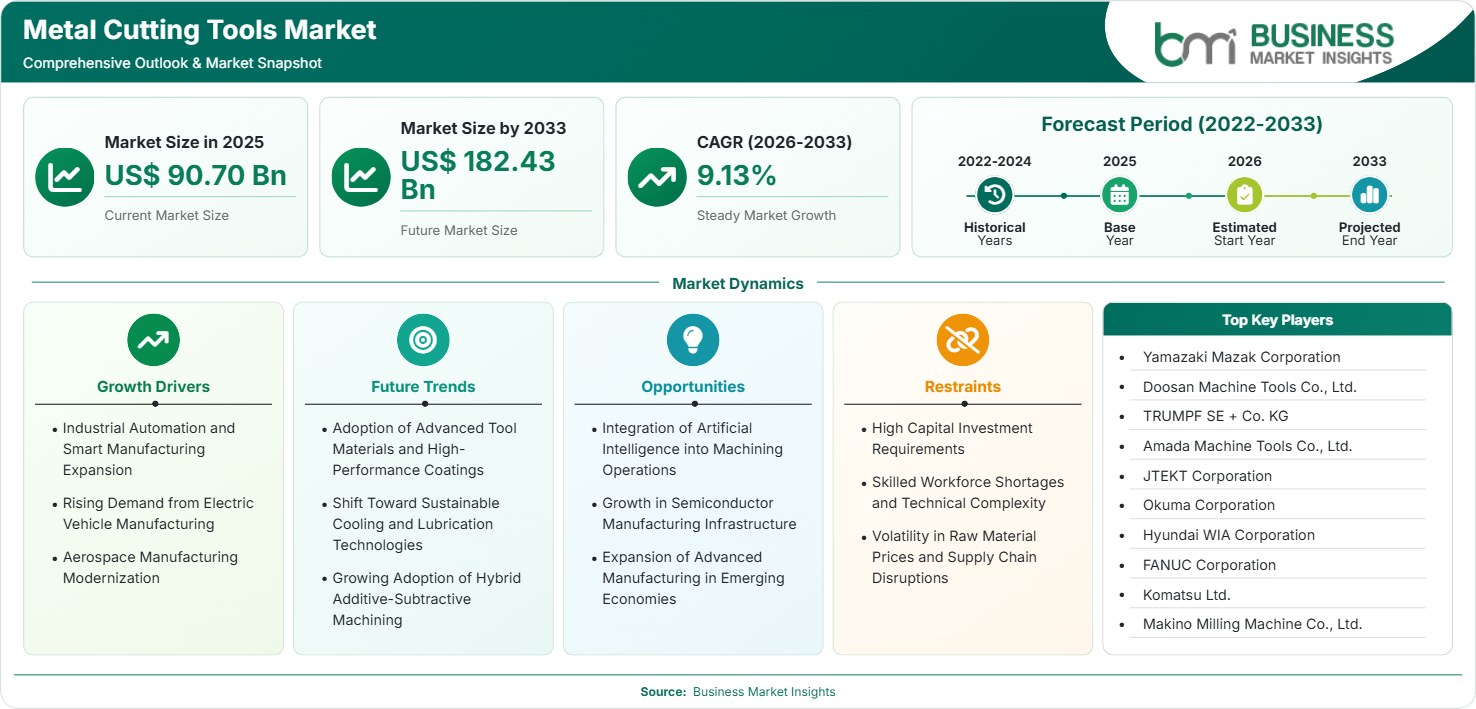
Metal Cutting Tools Market Regional Highlights
North America Metal Cutting Tools Market
North America accounts for approximately 26%–29% of global demand in 2025 and is projected to grow at a CAGR of 8.2%–8.8% through 2033. Aerospace manufacturing, advanced automobile manufacturing, military modernization projects, and automation initiatives help boost the regional growth. Higher use of computer numerical control (CNC) machining systems and growing reshoring trends keep improving the manufacturing base in the region. Moreover, high spending on semiconductors, energy, and precision engineering add up to the regional strength. The Metal Cutting Tools Market share is high owing to the developed industrial base and technology-driven manufacturing segments.
- Aerospace companies are continuously investing in modern machining centers that can make lightweight structures and turbine components and high-end assemblies through production efficiencies and simplified manufacturing processes.
- Reshoring initiatives in the industrial world are leading to the adoption of automation-based machines by manufacturers, resulting in greater demand for digitally connected machine tools and precision machining systems.
- Investments in semiconductor fabrication necessitate precision machining systems, thus driving up the need for cutting-edge machining technologies.
- Defense initiatives geared towards modernization lead to investments in precision-engineered components, thereby providing opportunities for machine tool suppliers for aerospace and defense manufacturing facilities.
US Metal Cutting Tools Market
The United States Metal Cutting Tools Market represents approximately 82%–86% of regional demand and is expected to register a CAGR of 8.4%–8.9% through 2033. Aerospace production, automation, and advanced manufacturing investments continue to drive equipment purchasing. Industrial policies for semiconductor manufacturing and production capacity increases also improve market opportunities.
- The manufacture of aerospace components is one of the biggest sources of demand, since it needs precision machinery that can meet tight tolerance levels as well as material usage efficiency.
- The government incentives for making semiconductors within the U.S. motivate the purchase of precise manufacturing equipment and machinery.
- The automotive industry continues to install automated machining systems for the production of electric vehicles and processing of lightweight materials.
- Medical technology producers increasingly require precision machining solutions for implants, instruments, and complex device components with demanding quality specifications.
Europe Metal Cutting Tools Market
Europe holds a market share of approximately 22%–25% in 2025 and is forecast to grow at a CAGR of 8.0%–8.5% during 2026–2033. Engineering proficiency, automotive manufacturing expertise, and industrial automation are some of the elements that help meet demand in the region. Germany is still the leading market in terms of countries, whereas countries in Eastern Europe have been expanding faster due to manufacturing investments and industrial diversification. Sustainable manufacturing practices and smart factory solutions are helping modernize machining facilities.
- Germany acts as a regional leader with its robust automotive, machinery, and industrial equipment industries that keep its CAGR within the regional average through constant upgrading of their manufacturing plants.
- The countries of Poland and Czech Republic have shown fast-paced industrial growth due to foreign direct investments, diversified chains, and production localization efforts.
- The manufacturers in Europe are still investing in energy-efficient machining systems in line with sustainable initiatives.
- Industrial digitalization initiatives promote adoption of connected machine tools capable of supporting predictive maintenance and advanced process monitoring.
Asia Pacific Metal Cutting Tools Market
Asia Pacific commands approximately 39%–42% of global demand in 2025 and is expected to expand at a CAGR of 10.2%–10.8% through 2033, making it the fastest-growing region. Industrialization, increase in manufacturing production, and investments in automation technologies drive growth. China is the leading market, and India is growing at the fastest rate due to its industrialization and government’s manufacturing policies. Manufacturing of electronics, automobiles, and machinery continues to support equipment demand in the region.
- China retains its leadership role through significant manufacturing operations, high usage of machine tools, and large investments in industry modernization and automation.
- India sees the fastest regional growth fueled by Make in India programs, development of industrial corridors, and rising localization efforts in manufacturing.
- Investments in semiconductor and electronics manufacturing in South Korea, Taiwan, and Southeast Asia offer great potential to precision machining equipment suppliers.
- Growth in automotive manufacturing in China, India, Thailand, and Indonesia fuels the need for advanced cutting and machining technologies.
- Industrial robotics adoption continues accelerating throughout the region, supporting investments in automated machining centers and digitally integrated production systems.
Rest of World Metal Cutting Tools Market
Rest of World accounts for approximately 10%–13% of global demand in 2025 and is projected to grow at a CAGR of 8.8%–9.4% through 2033. Automotive production capacity increase and industrial advancement are advantageous to South and Central America. On the other hand, development of infrastructure and industrial diversification in the Middle East and Africa are contributing towards momentum creation for these regions. Continued localization policies and rising industrial production are providing opportunities for machine tools producers.
- Brazil leads South and Central America through automotive production, industrial equipment manufacturing, and modernization of machining infrastructure supporting domestic manufacturing competitiveness.
- Mexico benefits from nearshoring trends and strong integration with North American supply chains, encouraging investments in advanced machining technologies.
- Saudi Arabia and the United Arab Emirates continue investing in industrial diversification initiatives that support manufacturing development and machinery procurement.
- Mining, energy, and heavy equipment sectors across Africa create demand for durable machining solutions supporting industrial production activities.
- Expanding industrial clusters and infrastructure projects strengthen long-term equipment demand across developing economies.