
Metal Forming Tools Market Outlook: Size, Share, Trends, Growth Analysis, Competitive Landscape & Forecast, 2026-2033

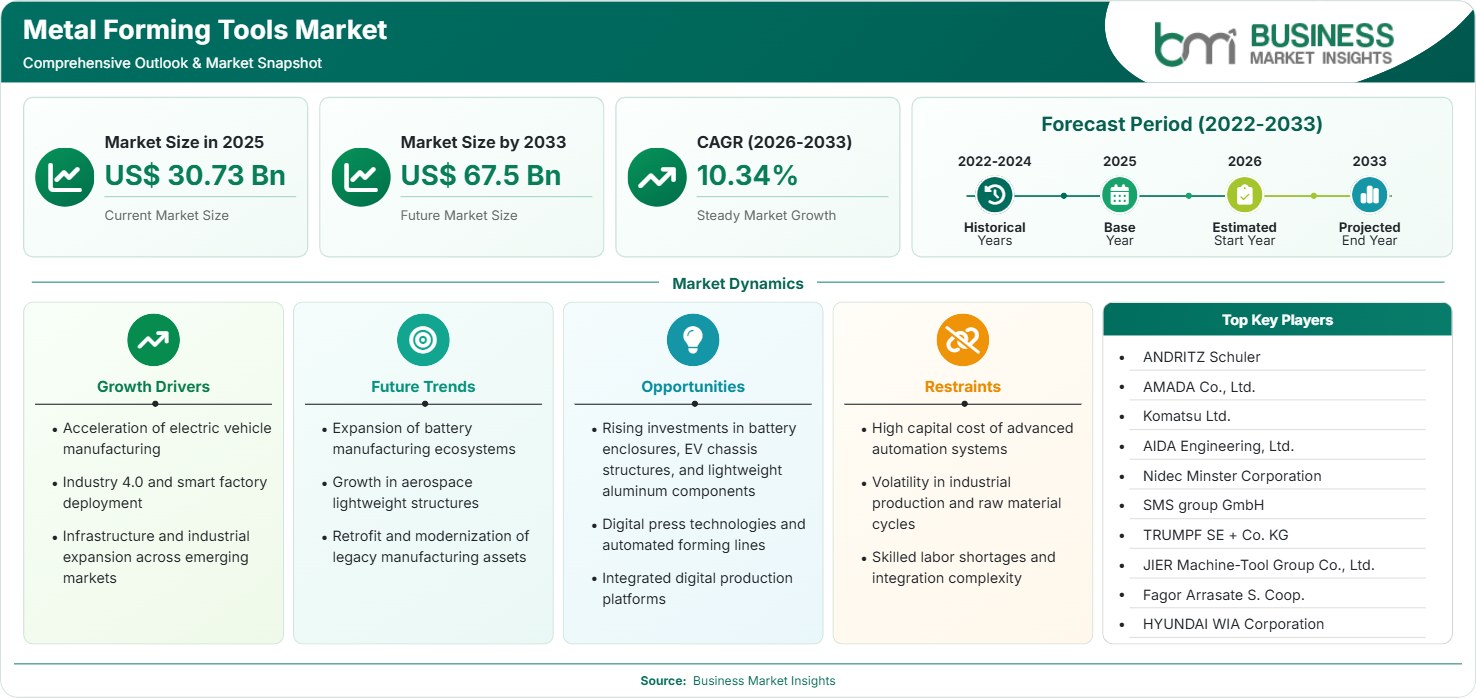
The Metal Forming Tools Market size was valued at US$ 30.73 Billion in 2025 and is projected to reach US$ 67.5 Billion by 2033, growing at a CAGR of 10.34% during 2026–2033, driven by industrial automation, EV manufacturing expansion, lightweight material processing, smart factory investments, and increasing demand for precision-engineered metal components across high-value industries.

Report Coverage
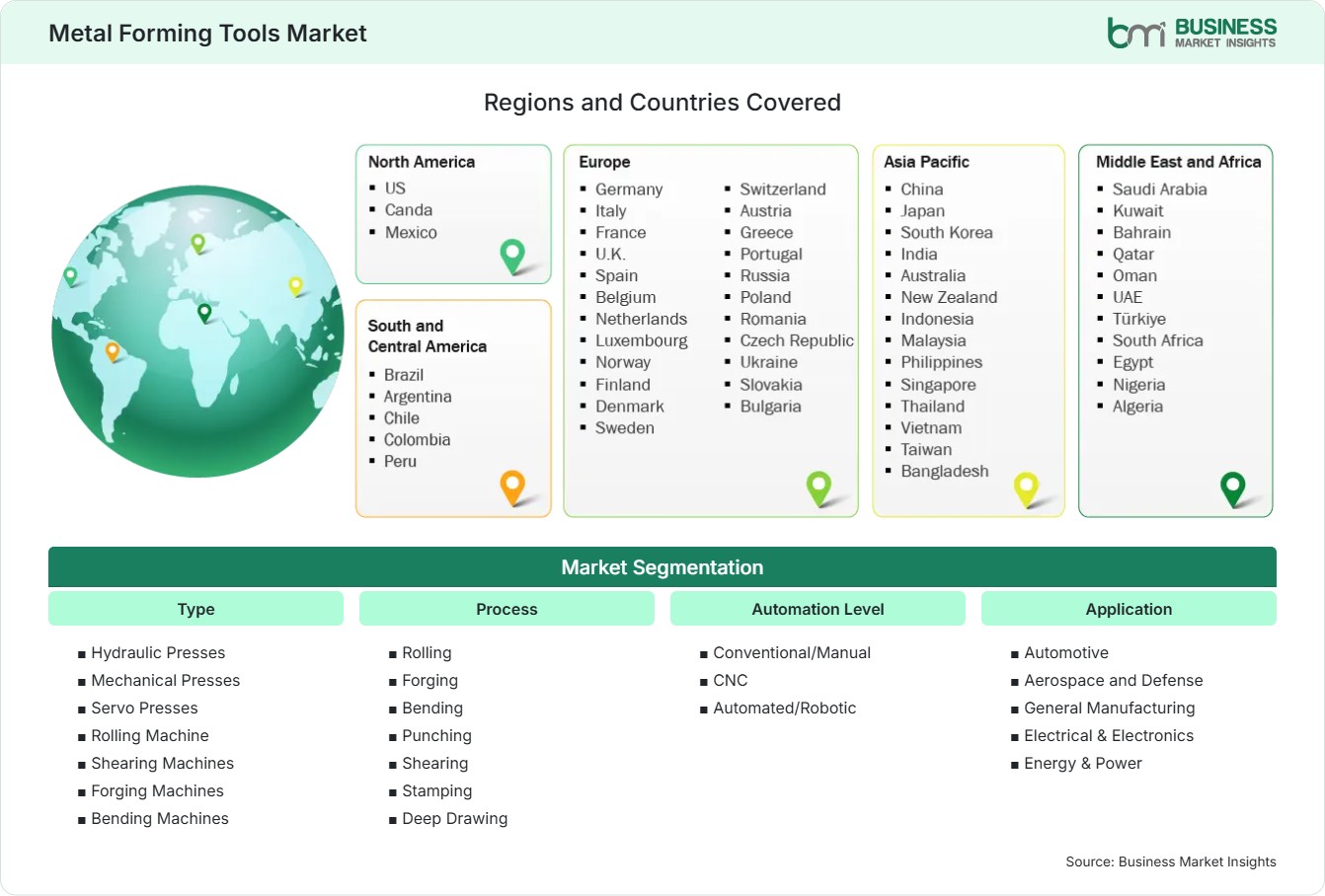
  • Type: Hydraulic Presses, Mechanical Presses, Servo Presses, Rolling Machine, Shearing Machines, Forging Machines, Bending Machines
  • Process: Rolling, Forging, Bending, Punching, Shearing, Stamping, Deep Drawing
  • Automation Level: Conventional/Manual, CNC, Automated/Robotic
  • Application: Automotive, Aerospace and Defense, General Manufacturing, Electrical & Electronics, Energy & Power
US$ 30.73 Bn Market size in 2025
US$ 67.5 Bn Market Size by 2033
10.34% CAGR, 2026 - 2033
2026-2033 Forecast Period

AI Overview

Metal Forming Tools Market Summary

  • North America Region: Holds 28%–31% share in 2025, growing at a CAGR of 8.8%–9.4%. Demand is supported by reshoring initiatives, aerospace investments, automated stamping lines, and advanced manufacturing upgrades. Opportunity stems from digital press technologies and EV supply chains.
    US: Largest regional contributor, benefiting from automotive localization and smart manufacturing investments, with 9.0%–9.6% CAGR.
  • Fastest Growing Region: Asia Pacific accounts for 41%–44% share in 2025 and advances at 11.8%–12.5% CAGR. Industrialization, EV production, infrastructure spending, and electronics manufacturing expansion continue generating strong equipment replacement and greenfield demand.
  • Leading Segment: Automotive holds 34%–37% share in 2025 and grows at 10.0%–10.8% CAGR. Adoption is supported by lightweight vehicle platforms, high-strength steel processing, precision stamping requirements, and increased electric vehicle component manufacturing.
  • High Growth Segment: Automated/Robotic systems represent 22%–25% share in 2025 and expand at 12.5%–13.4% CAGR. Labor shortages, productivity targets, predictive maintenance, and Industry 4.0 integration accelerate deployment across fabrication facilities.
  • Key Market Opportunity: Rising investments in battery enclosures, EV chassis structures, and lightweight aluminum components create substantial opportunities for advanced servo presses, automated forming lines, and integrated digital production platforms.
  • Major Market Players: ANDRITZ Schuler, AMADA Co., Ltd., Komatsu Ltd., AIDA Engineering, Ltd., Nidec Minster Corporation, SMS group GmbH, TRUMPF SE + Co. KG, JIER Machine-Tool Group Co., Ltd., Fagor Arrasate S. Coop., and HYUNDAI WIA Corporation.
Strategic Insights

Metal Forming Tools Market: Strategic Insights

Metal Forming Tools Market Strategic Framework
FREE PDF
Request your free sample
Request free sample
Stakeholder View

Key Takeaways

  • Supply chains increasingly favor integrated machinery ecosystems combining presses, tooling, automation, software, and predictive maintenance services.
  • Automotive electrification offers the strongest demand upside through battery casings, structural body parts, and lightweight platform manufacturing.
  • Servo-electric technologies are replacing conventional hydraulic systems in precision applications because of better energy performance and control.
  • India, Vietnam, and Mexico present compelling investment cases due to manufacturing relocation and industrial policy support.
  • Industry consolidation increasingly focuses on automation, digital manufacturing, and specialty forming capabilities.
  • Sustainability targets are accelerating adoption of energy-efficient equipment with reduced material wastage and higher productivity.
Geographic Outlook

Metal Forming Tools Market Regional Highlights

North America Metal Forming Tools Market

North America commands 28%–31% market share in 2025 and records a CAGR of 8.8%–9.4% through 2033. Regional demand arises from aerospace production, automotive modernization, defense manufacturing, and industrial reshoring. Metal Forming Tools Market share remains supported by investment in advanced manufacturing facilities and digital production systems. Equipment replacement cycles increasingly favor servo and robotic systems capable of optimizing productivity while reducing operational costs across high-volume metalworking environments.

  • Automotive localization incentivizes advanced stamping and forming infrastructure.
  • Aerospace manufacturers prioritize precision presses for lightweight alloy fabrication.
  • Labor shortages accelerate robotic integration and intelligent process controls.
  • Energy-efficient equipment procurement remains a strategic purchasing criterion.

US Metal Forming Tools Market

The United States accounts for 74%–78% of regional demand and is projected to advance at a CAGR of 9.0%–9.6%. Strong aerospace output, EV investment, and factory modernization support growth. Producers increasingly deploy automated systems to enhance throughput and traceability while maintaining stringent quality requirements in critical manufacturing applications.

  • EV battery supply chains stimulate demand for advanced forming equipment.
  • High-value defense production supports premium machine adoption.
  • Digital twin technologies improve process optimization and maintenance planning.
  • Reshoring initiatives strengthen domestic equipment investments.

Europe Metal Forming Tools Market

Europe represents 23%–26% share in 2025 and expands at 8.5%–9.2% CAGR. Germany remains the leading market due to advanced automotive engineering, while Eastern European manufacturing hubs deliver faster expansion exceeding 9%. Sustainability regulations and energy efficiency objectives continue influencing purchasing decisions. Equipment suppliers increasingly emphasize digitally connected machines and resource-efficient forming technologies.

  • Germany leads regional demand through automotive and industrial machinery.
  • Poland and Czech Republic exhibit strong manufacturing investment activity.
  • Low-carbon production targets encourage efficient machinery upgrades.
  • Aerospace production sustains high-precision forming requirements.

Asia Pacific Metal Forming Tools Market

Asia Pacific holds 41%–44% share in 2025 and delivers the strongest CAGR of 11.8%–12.5%. China remains the largest market, while India represents the fastest-growing major economy. Metal Forming Tools Market growth benefits from industrial expansion, electronics manufacturing, infrastructure spending, and automotive output. Regional producers increasingly invest in smart manufacturing solutions to improve competitiveness and export capabilities.

  • China dominates capacity additions and equipment deployment.
  • India benefits from production-linked industrial initiatives.
  • Electronics manufacturing drives precision forming requirements.
  • Regional EV expansion creates substantial component demand.
  • Automation adoption continues accelerating among medium-sized manufacturers.

Rest of World Metal Forming Tools Market

Rest of World contributes 8%–11% share and advances at 9.5%–10.3% CAGR. South America benefits from automotive production and industrial development programs. Middle East and Africa markets gain momentum from diversification investments and metal fabrication capacity expansion. Brazil leads South America, while Saudi Arabia and the UAE represent notable growth markets across the Middle East.

  • Brazil remains the largest regional manufacturing center.
  • GCC industrial diversification initiatives support machinery purchases.
  • Mining and energy sectors drive fabricated metal demand.
  • Infrastructure spending strengthens local production capabilities.
Global Market Geography
FREE PDF
Request your free sample
Request free sample
Segment Analysis

Metal Forming Tools Market Segmentation

Type

Type segment accounts for core industry revenues, with hydraulic and mechanical systems maintaining substantial installed bases. Servo technologies are gaining traction. The segment contributes 31%–34% share in 2025 and advances at 10.2%–10.9% CAGR. Metal Forming Tools Market scope continues expanding through automation, precision engineering, and energy-efficiency improvements.

  • Hydraulic Presses: Preferred for heavy-duty applications requiring high force and flexibility across industrial manufacturing environments.
  • Mechanical Presses: Widely adopted in high-volume production where speed and repeatability remain operational priorities.
  • Servo Presses: Demand rises due to precision control, programmable motion profiles, and energy-efficient operation.
  • Rolling Machine: Critical for sheet, plate, and structural metal processing operations.
  • Shearing Machines: Extensively used for material preparation and efficient fabrication workflows.
  • Forging Machines: Support production of high-strength components for automotive and industrial sectors.
  • Bending Machines: Increasingly automated to improve consistency and production speed.

Process

Process segmentation reflects diverse industrial manufacturing methods. Rolling and stamping remain dominant applications, while deep drawing experiences increasing use in lightweight structures. The segment holds 28%–31% share and grows at 10.5%–11.2% CAGR. Metal Forming Tools Market trends increasingly favor precision-driven production capabilities.

  • Rolling: Supports large-scale production of sheets, strips, and structural materials.
  • Forging: Produces durable components for demanding industrial environments.
  • Bending: Essential for fabricated products across construction and transportation.
  • Punching: Enables efficient production of high-volume metal parts.
  • Shearing: Delivers accurate material cutting before secondary processing.
  • Stamping: Widely adopted in automotive and appliance manufacturing.
  • Deep Drawing: Gains traction in battery enclosures and lightweight assemblies.

Automation Level

Automation transformation continues reshaping manufacturing economics. This segment contributes 24%–27% share in 2025 and records 11.3%–12.0% CAGR. Automated systems deliver productivity gains, quality consistency, and improved data visibility.

  • Conventional/Manual: Maintains relevance for lower-volume operations and specialized fabrication.
  • CNC: Enhances precision, repeatability, and operational flexibility.
  • Automated/Robotic: Expands rapidly through Industry 4.0 adoption and labor optimization initiatives.

Application

Applications remain diversified across transportation, industrial, and electronics sectors. Automotive is the leading segment with 34%–37% share and 10.0%–10.8% CAGR.

  • Automotive: Dominates demand through body structures, chassis, and EV components.
  • Aerospace and Defense: Requires precision forming and high-performance alloy processing.
  • General Manufacturing: Supports broad industrial fabrication requirements.
  • Electrical & Electronics: Benefits from miniaturized precision components.
  • Energy & Power: Uses formed metal products across generation and infrastructure systems.
Market Forces

Metal Forming Tools Market Dynamics

Key Market Drivers

Acceleration of Electric Vehicle Manufacturing

Electric vehicle manufacturing is accelerating rapidly, creating strong demand for advanced metal forming and fabrication equipment. Stamping of EVs calls for use of lightweight metals like aluminum, secure battery cases, and highly accurate structures to enhance efficiency and safety. To ensure that the requirements are met, there will be increased investments in presses and stamping equipment with high capacities and advanced capabilities to handle both aluminum and high-strength steel. An increase in demand for stamping, bending, deep drawing, among others, is anticipated due to the increasing usage of EVs globally, according to IEA Mobility Trends.

Industry 4.0 and Smart Factory Deployment

The implementation of Industry 4.0 technologies such as connected machinery, analytics, IoT technology, and robotic automation is becoming common practice in factories. Such innovations allow for improving the performance of the production process by increasing machine availability, minimizing waste of materials, and obtaining information about the process in real time. According to Metal Forming Tools Market analysis, digital integration is becoming a crucial procurement factor for major manufacturers. Organizations are investing in smart factory capabilities to boost productivity, ensure consistent product quality, lower operating costs, and address ongoing labor shortages through greater automation and data-driven decision-making.

Infrastructure and Industrial Expansion Across Emerging Markets

Rapid industrialization across Asia and several Middle Eastern economies is significantly increasing demand for fabricated metal products and advanced metal processing solutions. Large-scale infrastructure projects that involve the construction of transport infrastructure, the construction of power plants, the erection of commercial buildings, and urbanization efforts require fabrication and forming machinery. At the same time, the growth of industrial ecosystems fueled by government investments and foreign direct investment provides continuous opportunities for machinery makers, technology firms and industrial services companies looking to achieve long-term growth.

Key Market Opportunities

Expansion of Battery Manufacturing Ecosystems

The rapid expansion of battery manufacturing ecosystems is creating significant opportunities for the metal forming industry. As governments and private companies invest heavily in new gigafactories across North America, Europe, and Asia, demand for precision-engineered metal components continues to rise. Battery production requires high-quality casings, busbars, cooling plates, and structural assemblies that depend on advanced metal forming technologies for accuracy and durability. The growing adoption of electric vehicles and energy storage systems further strengthens this trend, supporting positive Metal Forming Tools Market forecasts and encouraging continued investment in specialized manufacturing capabilities.

Growth in Aerospace Lightweight Structures

Aerospace manufacturers are increasingly adopting lightweight structures to improve fuel efficiency, reduce emissions, and enhance overall aircraft performance. This has led to an increase in the usage of alloys and strong materials, which must be handled with great accuracy while manufacturing. With aerospace becoming more sophisticated, companies are making investments in advanced forming methods that can handle stringent quality specifications. Such systems ensure that there is accuracy and consistency in the manufacture of parts and assemblies required for the development of future commercial and defense aircraft.

Retrofit and Modernization of Legacy Manufacturing Assets

Many industrial facilities continue to rely on aging manufacturing equipment that remains structurally sound but lacks modern capabilities. Refurbishment of existing presses by adding digital controls, smart sensors, data analytics, and automation systems is a much more economical choice than replacing old machines. Such solutions help in increasing efficiency, improving the quality of products, minimizing downtimes due to predictive maintenance and real-time performance monitoring. Retrofitting allows organizations to extend the life span of assets and become more productive in the digitally driven environment of industry.

Market Restraints and Challenges

High Capital Cost of Advanced Automation Systems

Factor: Automated presses, robotics, and integrated software platforms require substantial upfront investment.

Impact: The high initial cost of implementing advanced automation systems remains a significant challenge for many manufacturers. Expenses related to purchasing equipment, software integration, infrastructure upgrades, and employee training can place considerable financial pressure on businesses, particularly small and medium-sized enterprises (SMEs). As a result, many companies postpone modernization initiatives despite the potential for increased productivity, improved product quality, reduced labor costs, and enhanced operational efficiency. This financial barrier can slow overall adoption rates, especially in highly competitive and cost-sensitive markets.

Volatility in Industrial Production and Raw Material Cycles

Factor: Fluctuations in industrial production, manufacturing production, steel usage, and capital spending cycles lead to considerable uncertainties in the equipment supply chain.

Impact: Market demand changes usually force firms to hold back or cut down on investments in new equipment and infrastructure projects. Consequently, equipment manufacturers experience delayed procurement processes, postponed projects, and uncertain order quantities. The difficulty of predicting their future orders becomes greater for equipment suppliers. It is hard to plan capacity, manage inventory, assign workforce, and build growth plans amidst such an environment.

Company Analysis

Competitive Landscape

Metal Forming Tools Market analysis highlights a competitive landscape characterized by automation innovation, global service networks, and advanced forming technologies.

Company Name

Overview

Products and Services relevant to this market

ANDRITZ Schuler

Global leader in metal forming technology serving automotive and industrial manufacturers.

Servo presses, forging systems, automation, digital services, press shop solutions.

AMADA Co., Ltd.

Major manufacturer specializing in sheet metal processing and forming technologies.

Presses, press brakes, automation systems, tooling, software platforms.

Komatsu Ltd.

Diversified industrial machinery supplier with strong press equipment portfolio.

Servo presses, mechanical presses, forming systems, manufacturing support.

AIDA Engineering, Ltd.

Recognized leader in stamping and forming equipment.

Servo presses, high-speed presses, automation and monitoring solutions.

Nidec Minster Corporation

Specialist provider of high-speed forming technology.

Precision presses, controls, tooling integration, service offerings.

SMS group GmbH

Industrial engineering company with extensive metals expertise.

Rolling mills, forming solutions, digital production technologies.

TRUMPF SE + Co. KG

Advanced manufacturing technology supplier operating worldwide.

Forming equipment, automation, software, industrial manufacturing systems.

JIER Machine-Tool Group Co., Ltd.

Major Chinese producer of heavy industrial forming machinery.

Large presses, stamping lines, automation and engineering services.

Fagor Arrasate S. Coop.

European specialist with strong automotive customer base.

Forming lines, servo presses, coil handling and automation.

HYUNDAI WIA Corporation

Industrial machinery manufacturer supporting advanced manufacturing.

Press systems, CNC equipment, automation and production technologies.

Trust & Transparency

Research Methodology

The market analysis combines proprietary research with secondary data from government agencies, company disclosures, regulatory filings, industry databases and expert interviews. Market estimates are validated through data triangulation, cross-market benchmarking and analyst review.

View Full Research Methodology

Questions Answered

Frequently Asked Questions

What does a Metal Forming Tools Market Report typically evaluate?

A comprehensive study examines demand drivers, technology trends, competitive positioning, segmentation performance, regional outlooks, investment opportunities, and long-term industry dynamics.

What regions offer the strongest expansion opportunities?

Asia Pacific, particularly India and Southeast Asia, presents significant opportunities due to industrialization, manufacturing investments, and expanding export-oriented production ecosystems.

How is automation changing equipment purchasing decisions?

Buyers increasingly prioritize robotic integration, predictive maintenance capabilities, and digital monitoring functions to improve efficiency and address workforce shortages.

What application generates the largest revenue contribution?

Automotive manufacturing remains the leading application because of extensive use of stamped, forged, bent, and formed components across conventional and electric vehicles.

What factors are driving demand for advanced forming equipment?

Manufacturers seek higher productivity, lightweight material processing, automation, and reduced waste, leading to investment in smart and servo-based forming technologies.

Access the Full Metal Forming Tools Market Report

Get segment-level forecasts, regional estimates, competitive benchmarking, company profiles and downloadable Excel datasets.

Access the full Metal Forming Tools Market Report
350 pages PDF & Excel | 2026-08-31