
CNC Machine Tools Market Outlook: Size, Share, Trends, Growth Analysis, Competitive Landscape & Forecast, 2022-2033

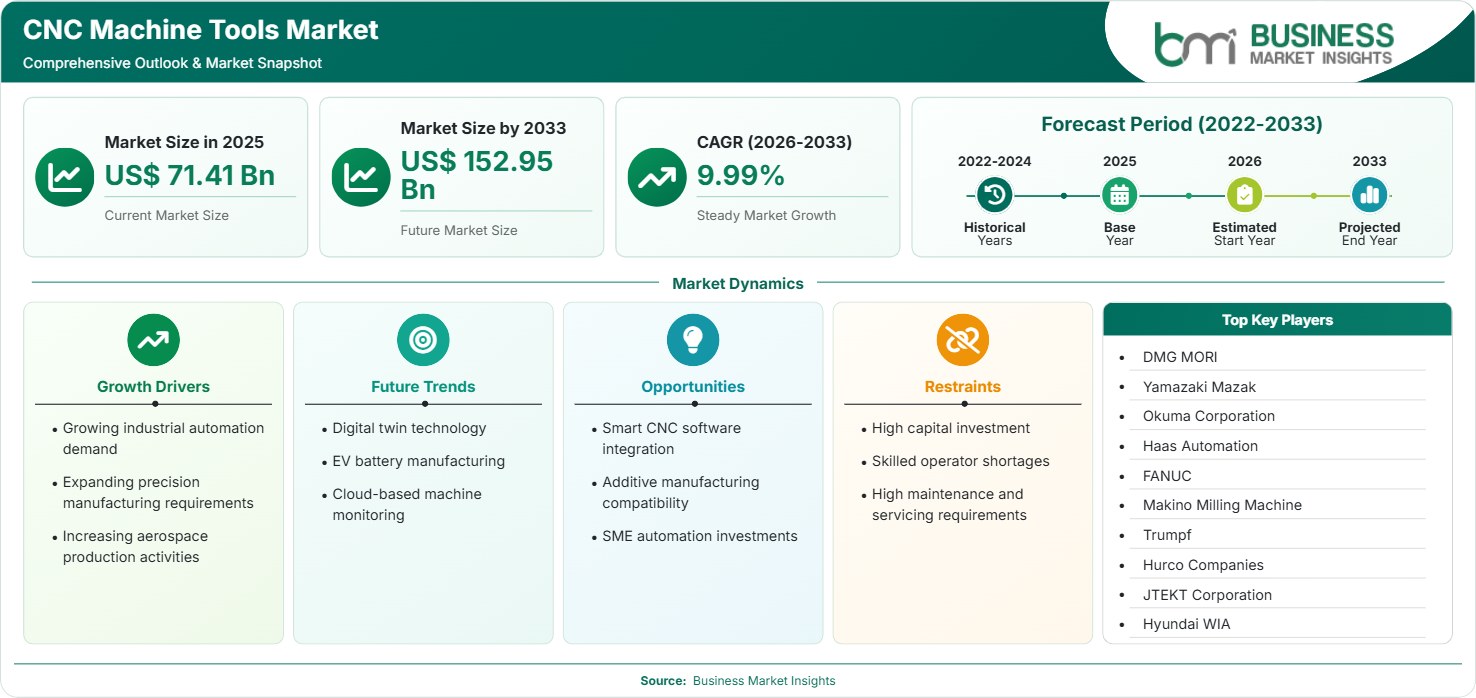
The CNC Machine Tools Market size was valued at US$ 71.41 billion in 2025 and is projected to reach US$ 152.95 billion by 2033, growing at a CAGR of 9.99% during 2026–2033. Rising industrial automation adoption, increasing precision manufacturing requirements, aerospace production expansion, smart factory development, and integration of advanced digital machining technologies are creating new opportunities across global manufacturing industries.

Report Coverage
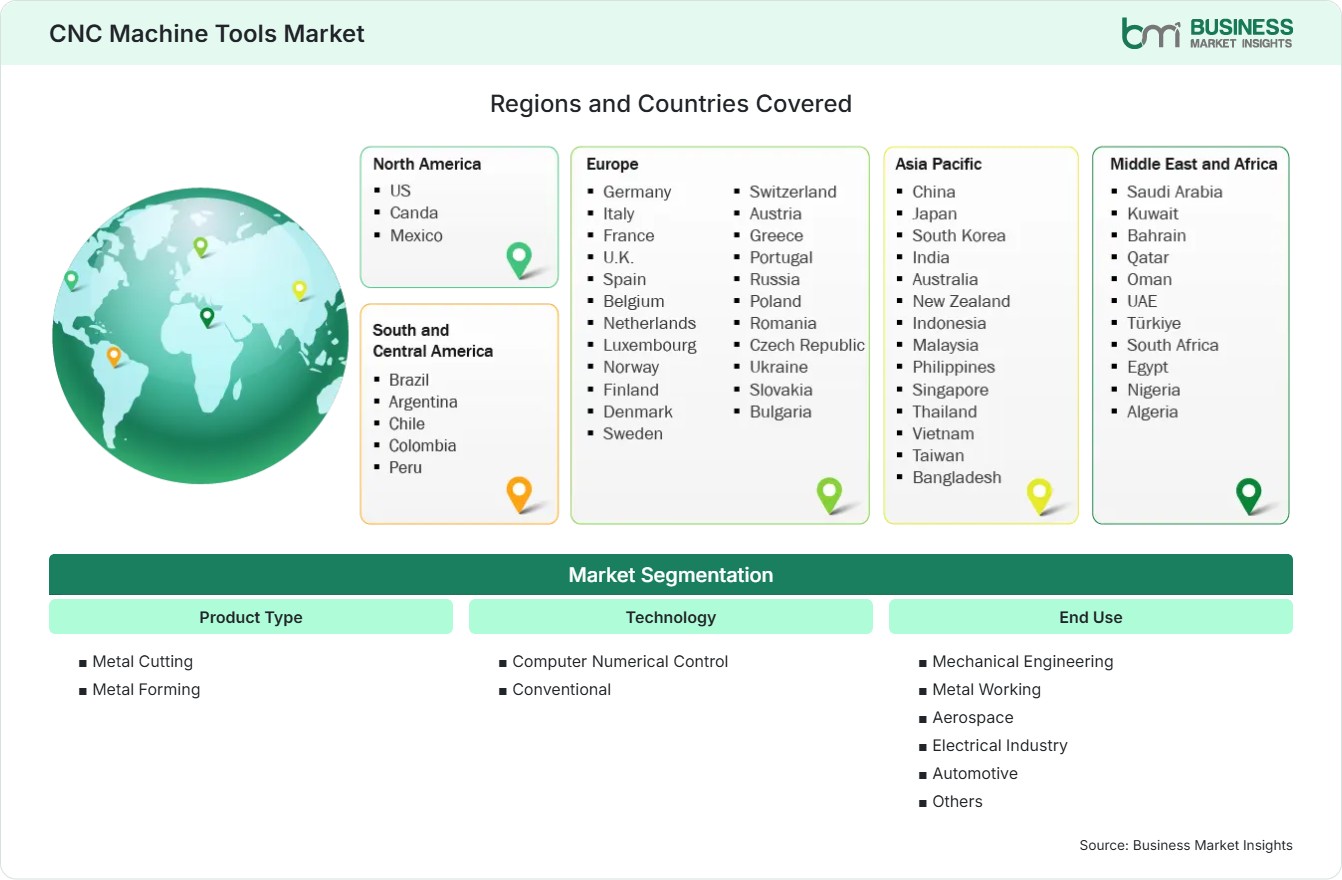
  • Product Type: Metal Cutting, Metal Forming
  • Technology: Computer Numerical Control, Conventional
  • End Use: Mechanical Engineering, Metal Working, Aerospace, Electrical Industry, Automotive, Others
US$ 71.41 Bn Market size in 2025
US$ 152.95 Bn Market Size by 2033
9.99% CAGR, 2026 - 2033
2026-2033 Forecast Period

AI Overview

CNC Machine Tools Market Summary

  • North America Region: North America holds a CNC machine tools market share of 28%–31% in 2025, growing at a CAGR of 8.8%–9.4% during 2026–2033, supported by aerospace manufacturing, reshoring initiatives, automation investments, and demand for high-precision machining. The U.S. benefits from advanced manufacturing adoption, with a CAGR of 8.9%–9.5% driven by aerospace, defense, automotive, and industrial equipment production.
  • Fastest Growing Region: Asia Pacific accounts for 42%–45% share in 2025 and is projected to expand at a CAGR of 10.8%–11.4% through 2033. Growth is driven by expanding manufacturing capacity, rising automation investments, electronics production, automotive manufacturing, and increasing adoption of smart CNC solutions across emerging economies.
  • Leading Segment: Metal Cutting machines represent the leading segment with a share of 62%–65% in 2025 and a CAGR of 9.7%–10.3% during 2026–2033, supported by demand from automotive, aerospace, industrial machinery, and precision engineering applications requiring high accuracy and productivity.
  • High Growth Segment: Computer Numerical Control (CNC) technology holds 72%–76% share in 2025 and is expected to grow at a CAGR of 10.2%–10.8% through 2033. Adoption is accelerated by smart manufacturing initiatives, automation requirements, real-time monitoring, and integration with digital production systems.
  • Key Market Opportunity: Increasing integration of artificial intelligence, industrial IoT, cloud-based monitoring, and advanced automation platforms is creating opportunities for CNC machine tool manufacturers to deliver intelligent, connected, and productivity-focused machining solutions for diverse industries.
  • Major Market Players: DMG MORI, Yamazaki Mazak, Okuma Corporation, Haas Automation, FANUC, Makino Milling Machine Co., Ltd., TRUMPF, Hurco Companies, Inc., JTEKT Corporation, Hyundai WIA.
Strategic Insights

CNC Machine Tools Market: Strategic Insights

CNC Machine Tools Market Strategic Framework
FREE PDF
Request your free sample
Request free sample
Stakeholder View

Key Takeaways

  • Manufacturing ecosystems are shifting toward digitally integrated production environments where CNC machine tool providers, automation companies, robotics suppliers, and software developers collaborate to create connected machining platforms.
  • Metal cutting technologies remain the primary growth contributor due to extensive applications in automotive components, aerospace structures, industrial equipment, and precision engineering products requiring high machining accuracy.
  • Intelligent CNC solutions incorporating AI-based monitoring, predictive maintenance, digital twins, and cloud connectivity are becoming important differentiators as manufacturers prioritize productivity and operational efficiency.
  • Asia Pacific provides the strongest expansion opportunity due to increasing manufacturing capacity in China, India, South Korea, and Southeast Asia, supported by industrial automation investments and supply chain localization.
  • Strategic partnerships and technology collaborations are increasing as machine tool manufacturers seek expertise in automation software, robotics integration, and advanced manufacturing solutions to strengthen competitive positioning.
  • Small and medium-sized manufacturers represent a significant future opportunity as modular CNC systems, financing options, and simplified automation solutions improve accessibility for smaller production facilities.
Geographic Outlook

CNC Machine Tools Market Regional Highlights

North America CNC Machine Tools Market

North America accounted for 28%–31% of global revenue in 2025 and is projected to grow at a CAGR of 8.8%–9.4% during 2026–2033. The region benefits from advanced aerospace manufacturing, automotive production, industrial automation adoption, and reshoring activities aimed at strengthening domestic manufacturing capabilities. The CNC Machine Tools Market share remains supported by demand for high-precision equipment and digitally connected machining solutions across multiple industries.

  • Aerospace and defense manufacturers continue investing in advanced CNC machining centers to produce complex components requiring high dimensional accuracy and repeatable production performance.
  • Automotive manufacturers are adopting automated machining systems to improve production efficiency, support electric vehicle component manufacturing, and reduce operational costs.
  • Industrial automation initiatives are encouraging manufacturers to integrate robotics, sensors, and intelligent software with CNC equipment for improved productivity.
  • The United States remains the dominant regional contributor due to strong manufacturing infrastructure, technological innovation, and increasing investments in advanced production systems.

US CNC Machine Tools Market

The United States represents the largest market within North America, accounting for 22%–25% of global revenue in 2025 and expanding at a CAGR of 8.9%–9.5% through 2033. The CNC machine tools market is supported by aerospace modernization, automotive manufacturing investments, industrial automation adoption, and increasing demand for precision-engineered components across defense, energy, and technology sectors.

  • Aerospace companies are increasing CNC machine investments to support aircraft component production and improve manufacturing efficiency through advanced machining technologies.
  • Manufacturing reshoring initiatives are encouraging domestic companies to upgrade production facilities with automated CNC equipment and digital manufacturing capabilities.
  • Growing adoption of smart factory technologies is increasing demand for connected CNC systems capable of improving machine utilization and production monitoring.

Europe CNC Machine Tools Market

Europe contributes 25%–28% of global revenue in 2025 and is projected to grow at a CAGR of 8.5%–9.1% through 2033. Germany leads regional demand due to its advanced industrial base, automotive engineering expertise, and strong machine tool manufacturing ecosystem. Italy and Switzerland also demonstrate strong growth potential through precision engineering and specialized manufacturing applications.

  • Germany maintains leadership through extensive automotive manufacturing, industrial automation expertise, and strong presence of global machine tool producers.
  • Italy demonstrates increasing demand for CNC solutions through machinery manufacturing, metalworking industries, and specialized engineering applications.
  • Switzerland continues supporting precision machining adoption through high-value manufacturing sectors requiring exceptional accuracy and reliability.
  • European manufacturers are investing in energy-efficient CNC systems to support sustainability targets and improve operational efficiency.

Asia Pacific CNC Machine Tools Market

Asia Pacific represents 42%–45% of global revenue in 2025 and is expected to achieve the highest CAGR of 10.8%–11.4% during 2026–2033. The region benefits from expanding manufacturing facilities, increasing industrial automation, electronics production growth, and rising investments in automotive and aerospace manufacturing. China, Japan, South Korea, and India remain key contributors to regional expansion.

  • China dominates regional demand due to extensive manufacturing capacity, automotive production, electronics manufacturing, and government-backed industrial automation programs.
  • India is experiencing accelerated adoption through manufacturing expansion, infrastructure development, and increasing investments in automated production technologies.
  • Japan continues strengthening its position through advanced machine tool innovation, robotics integration, and precision engineering capabilities.
  • South Korea benefits from semiconductor, electronics, and automotive industries requiring high-performance machining solutions.

Rest of World CNC Machine Tools Market

The Rest of World segment accounts for 10%–13% of global revenue in 2025 and is forecast to expand at a CAGR of 8.2%–8.8% through 2033. South America is gradually adopting CNC technologies through industrial modernization, automotive production, and mining equipment manufacturing. The Middle East and Africa are witnessing increasing investments in industrial diversification and advanced manufacturing infrastructure.

  • Brazil remains a major South American market due to automotive production, metalworking activities, and industrial equipment manufacturing requirements.
  • Mexico demonstrates strong growth potential through manufacturing expansion and integration into global automotive supply chains.
  • Middle Eastern countries are investing in industrial diversification programs that support adoption of advanced machining technologies.
  • African manufacturing development initiatives are gradually increasing demand for automated production equipment and precision machining solutions.
Global Market Geography
FREE PDF
Request your free sample
Request free sample
Segment Analysis

CNC Machine Tools Market Segmentation

Product Type

The product type segment plays a crucial role in determining machining capabilities across industrial applications, with manufacturers selecting equipment based on material requirements, production complexity, and precision needs. This segment accounted for approximately 58%–62% of the CNC machine tools market in 2025 and is projected to grow at a CAGR of 9.6%–10.2% during 2026–2033. Increasing demand for automated machining, complex component manufacturing, and improved production efficiency continues supporting adoption across automotive, aerospace, and industrial sectors.

  • Metal Cutting: Represents the dominant product category due to extensive usage in automotive components, aerospace parts, industrial machinery, and precision engineering applications requiring high-speed and accurate material removal processes.
  • Metal Forming: Gains adoption through applications requiring shaping, bending, and forming operations, particularly in automotive, construction equipment, and heavy machinery manufacturing where efficient material utilization is essential.

Technology

Technology advancement remains a major factor influencing machine tool adoption as manufacturers transition toward digitally controlled and automated production systems. The technology segment accounted for approximately 70%–74% of total revenue in 2025 and is anticipated to expand at a CAGR of 10.1%–10.7% through 2033. The CNC Machine Tools Market growth continues widening as industries increasingly adopt intelligent manufacturing systems, automated programming, and connected production environments.

  • Computer Numerical Control (CNC): Maintains market leadership due to superior precision, automation capabilities, reduced production errors, and compatibility with smart factory technologies, robotics, and digital manufacturing platforms.
  • Conventional: Continues serving smaller workshops and applications requiring lower complexity machining operations, although adoption growth remains comparatively moderate due to increasing preference for automated production solutions.

End Use

The end-use segment demonstrates diverse demand patterns based on manufacturing intensity, component complexity, and automation requirements across industries. This segment represented approximately 64%–68% of CNC machine tools market revenue in 2025 and is expected to register a CAGR of 9.8%–10.4% during the forecast period. Increasing investments in industrial automation, electric vehicle manufacturing, aerospace production, and precision engineering are strengthening adoption across major end-use industries.

  • Mechanical Engineering: Drives demand through extensive machining requirements for industrial equipment, machinery components, and precision-engineered parts requiring consistent production quality and operational reliability.
  • Metal Working: Supports adoption through fabrication, machining, and component manufacturing activities where CNC systems improve productivity, accuracy, and production flexibility across various industrial applications.
  • Aerospace: Experiences strong growth due to increasing aircraft production, lightweight material machining requirements, and demand for high-precision manufacturing technologies capable of producing complex aerospace components.
  • Electrical Industry: Expands CNC adoption through rising electronics manufacturing, semiconductor equipment production, and demand for precision components requiring accurate machining capabilities.
  • Automotive: Remains a significant application area due to vehicle production volumes, electric vehicle component manufacturing, and increasing requirements for automated, high-volume precision machining.
Market Forces

CNC Machine Tools Market Dynamics

Key Market Drivers

Growing industrial automation demand

The increasing adoption of industrial automation is a major driver for the CNC Machine Tools Market as manufacturers seek higher productivity, reduced operational errors, and improved production consistency. Automotive, aerospace, electronics, and industrial machinery companies are investing in automated machining solutions to optimize manufacturing workflows and minimize production downtime.

Integration of robotics, IoT-enabled monitoring systems, and advanced CNC software is enhancing machine efficiency while enabling real-time process control. The transition toward smart factories is accelerating demand for connected CNC equipment capable of supporting flexible production environments and improving overall manufacturing competitiveness, reflecting evolving CNC Machine Tools market trends.

Expanding precision manufacturing requirements

The increased need for precision parts is driving the application of modern CNC machine tools in various industries where there is a need for accurate dimensions and quality in manufacturing processes. Manufacturers in the aerospace, medical devices, semiconductor, and automotive industries use CNC machines to manufacture parts using modern materials with minimal tolerance variations.

Product complexity, usage of light weight materials and requirement of efficient mass customization have made manufacturers shift towards newer techniques of machining. New CNC technology with more efficient control system, automation and monitoring systems has helped manufacturers to be more efficient and accurate in their manufacturing process.

Increasing aerospace production activities

Expansion of aerospace manufacturing activities is creating significant demand for advanced CNC machining solutions capable of producing complex aircraft structures and engine components. Increasing aircraft production, rising demand for lightweight materials, and the need for precision-engineered parts are encouraging aerospace manufacturers to invest in high-performance machining equipment.

CNC technology offers the precision, repeatability, and automation that is necessary for processing titanium alloys, composites, and other advanced materials utilized in aerospace applications. The increased spending on commercial air travel, defense, and space-related products is set to drive continued demand for CNC machine tools, further validating the CNC Machine Tools market forecast.

Key Market Opportunities

Smart CNC software integration

The integration of intelligent software solutions can be seen as an opportunity as the industry tends to embrace connected CNC machines with intelligent analytics and remote monitoring. The use of intelligent CNC software helps in monitoring the machine’s performance, minimizing unexpected downtime, and better production planning.

Manufacturers are developing intelligent machining ecosystems that combine CNC equipment with cloud platforms, digital twins, and industrial IoT technologies. These developments help firms achieve efficient use of resources, improve their operational efficiencies, and facilitate the implementation of flexible manufacturing systems. With increasing demand for automated decision making and connected manufacturing, there will be new business opportunities for providers of technology solutions.

Additive manufacturing compatibility

Compatibility between CNC machining and additive manufacturing processes is resulting in hybrid manufacturing processes where material deposition along with precision finishing is possible. Aerospace industry, automotive industry, and manufacturing of medical devices have increasingly been utilizing hybrid manufacturing approaches to produce intricate designs while saving on materials.

CNC manufacturers developing machines capable of integrating additive processes can address evolving customer requirements for customized and lightweight components. The combination of subtractive and additive technologies enables manufacturers to improve design freedom, shorten production cycles, and enhance manufacturing efficiency across advanced industrial applications.

SME automation investments

Increasing automation investments among small and medium enterprises are creating new opportunities for CNC machine tool manufacturers offering affordable, compact, and user-friendly solutions. SMEs are gradually adopting automated machining systems to improve competitiveness, address labor challenges, and achieve consistent product quality. Development of simplified programming interfaces, modular CNC systems, financing options, and training programs is improving accessibility for smaller manufacturers.

As digital transformation expands beyond large industrial companies, CNC suppliers focusing on scalable automation solutions can capture emerging demand from smaller production facilities seeking improved efficiency and reduced dependence on manual operations, enhancing their CNC Machine Tools market share.

Market Restraints and Challenges

High capital investment

Factor: Advanced CNC systems require significant upfront expenditure for equipment purchase, installation, software integration, maintenance infrastructure, and employee training.

Impact: High acquisition costs can delay automation initiatives, reduce technology adoption rates, and limit modernization efforts among cost-sensitive companies. Although automation provides long-term productivity benefits, the initial financial barrier remains a major consideration for manufacturers evaluating investment decisions, especially in developing markets where access to capital may be limited.

Skilled operator shortages

Factor: Modern CNC systems require specialized expertise in programming, machine setup, digital manufacturing software, and equipment maintenance.

Impact: Shortages of qualified professionals can reduce machine utilization, increase workforce training expenses, and slow implementation of advanced manufacturing systems. As CNC equipment becomes more sophisticated with AI-based controls and connected features, manufacturers must invest in workforce development programs, technical education, and operator training initiatives to maximize productivity and ensure efficient technology adoption.

Company Analysis

Competitive Landscape

The competitive environment of the market is shaped by continuous innovation in automation, digital machining platforms, precision engineering, and smart manufacturing solutions. The CNC Machine Tools Market analysis indicates that leading manufacturers are focusing on intelligent CNC systems, energy-efficient equipment, software integration, and customized machining solutions to strengthen their market position. Companies are also expanding partnerships with automation providers, robotics developers, and industrial software companies to support connected manufacturing ecosystems. Competition is increasing as manufacturers address rising demand from automotive, aerospace, electronics, and industrial machinery sectors.

Company Name

Overview

Products and Services relevant to this market

DMG MORI

Global machine tool manufacturer providing advanced machining technologies, automation solutions, and digital manufacturing platforms for industrial customers.

CNC turning machines, milling machines, machining centers, automation systems, digital manufacturing solutions, and industrial software platforms.

Yamazaki Mazak

Leading Japanese machine tool producer specializing in advanced CNC systems and multi-tasking manufacturing technologies.

CNC turning centers, machining centers, laser processing machines, automation solutions, and smart manufacturing technologies.

Okuma Corporation

Develops high-precision CNC machine tools and control systems supporting diverse manufacturing applications worldwide.

CNC lathes, machining centers, CNC controls, factory automation systems, and intelligent manufacturing solutions.

Haas Automation

Major CNC machine tool supplier offering affordable and reliable manufacturing equipment for industrial and commercial users.

CNC machining centers, turning centers, rotary products, automation solutions, and CNC control technologies.

FANUC

Global automation technology company specializing in CNC systems, robotics, and factory automation solutions for manufacturers.

CNC controllers, industrial robots, machining systems, automation software, and intelligent factory solutions.

Makino Milling Machine Co., Ltd.

Precision machine tool manufacturer focused on high-performance machining technologies for demanding industries.

Vertical and horizontal machining centers, EDM systems, automation solutions, CNC technologies, and precision manufacturing systems.

TRUMPF

Industrial technology company specializing in machine tools, laser processing, and digital manufacturing solutions.

CNC laser cutting machines, punching systems, bending solutions, automation technologies, and smart factory software.

Hurco Companies, Inc.

Machine tool manufacturer providing CNC solutions designed for flexible manufacturing and job shop applications.

CNC machining centers, CNC lathes, conversational programming systems, and manufacturing software solutions.

JTEKT Corporation

Automotive and industrial equipment supplier developing machine tools and precision manufacturing technologies.

CNC grinding machines, machining systems, industrial automation solutions, and precision engineering technologies.

Hyundai WIA

Korean manufacturer offering machine tools and industrial automation systems for global manufacturing industries.

CNC turning centers, machining centers, automation systems, and precision manufacturing equipment.

Industry Activity

Recent Developments

April 2026

Okuma Corporation introduced a new High-Pressure Coolant System for CNC machine tools, expanding its peripheral manufacturing solutions to improve machining efficiency, tool life, and production performance.

March 2026

DMG MORI Co., Ltd. launched the NMV 3000 / 5000 DCG 2nd Generation 5-axis vertical machining centers, incorporating improved machining performance, higher productivity, and advanced digital manufacturing capabilities for aerospace, semiconductor, and mobility applications.

August 2025

FANUC Corporation announced the new FS500i-A high-performance CNC series ahead of EMO Hannover 2025, featuring enhanced user interface, process control, digital connectivity, cybersecurity, and networking technologies for next-generation CNC machine tools.

March 2025

DN Solutions launched the DNX 2100S and DNX 2100SB, next-generation multi-tasking CNC machine tools designed to improve productivity through integrated turning and milling capabilities.

Trust & Transparency

Research Methodology

The market analysis combines proprietary research with secondary data from government agencies, company disclosures, regulatory filings, industry databases and expert interviews. Market estimates are validated through data triangulation, cross-market benchmarking and analyst review.

View Full Research Methodology

Questions Answered

Frequently Asked Questions

What opportunities exist for CNC machine tool manufacturers?

Major opportunities in the CNC Machine Tools Market include smart CNC software integration, additive manufacturing compatibility, and increasing automation investments among small and medium enterprises. Manufacturers developing connected, flexible, and cost-efficient CNC systems can address growing demand for intelligent manufacturing solutions while helping businesses improve productivity, reduce waste, and modernize production operations.

Which industries are major users of CNC machine tools?

Major end-use industries include automotive, aerospace, mechanical engineering, metal working, and electrical manufacturing. These industries require high-precision machining capabilities for producing complex components, lightweight structures, electronic equipment parts, and industrial machinery. Growing automation adoption across these sectors continues creating sustained demand for advanced CNC solutions.

Why is CNC technology gaining higher adoption compared with conventional machining?

CNC technology is gaining preference because it provides improved automation, precision, repeatability, and integration with digital manufacturing platforms. CNC systems enable manufacturers to produce complex components efficiently while reducing manual intervention, production errors, and operational downtime. Increasing demand for smart manufacturing further accelerates the transition toward CNC-based production systems.

Which product type dominates the market?

Metal Cutting machines represent the leading product category due to their extensive application across automotive components, aerospace parts, industrial equipment, and precision engineering. Their ability to deliver high accuracy, faster production cycles, and compatibility with automated manufacturing systems continues supporting widespread adoption across global industries.

What factors are highlighted in the CNC Machine Tools Market Report?

The market is driven by increasing industrial automation, rising demand for precision manufacturing, expanding aerospace production, and growing adoption of smart factory technologies. Manufacturers across automotive, electronics, aerospace, and industrial machinery sectors are investing in advanced CNC systems to improve productivity, reduce operational costs, and achieve higher production accuracy.

Access the Full CNC Machine Tools Market Report

Get segment-level forecasts, regional estimates, competitive benchmarking, company profiles and downloadable Excel datasets.

Access the full CNC Machine Tools Market Report
350 pages PDF & Excel | 2026-08-03
Similar Research

Related Market Reports