Market Summary
Executive Summary and Global Market Analysis
Machine tools are power-driven manufacturing systems used to cut, shape, form, grind, and finish metal components with controlled dimensional accuracy. They serve as the production backbone for repeatable machining tasks across industrial environments, where precision, throughput, and process consistency directly influence output quality. Their role spans fabrication lines, tool rooms, and highly automated plants that require stable performance across diverse part geometries and material conditions.
Procurement momentum is supported by modernization of manufacturing assets, tighter tolerance requirements, and the wider use of digitally controlled production systems. Automotive and aerospace programs continue to require flexible machining platforms that reduce setup time and support consistent part quality. At the same time, electronics and medical production environments favor equipment that can deliver fine surface finishes and dependable repeatability across shorter product cycles.
Across segmentation, metal cutting systems retain broad industrial relevance because they address core machining operations used in complex component production. CNC machines hold a central position within product demand as manufacturers seek programmable control, lower variability, and improved process integration. Conventional equipment maintains relevance in workshops and cost-sensitive facilities, while EDM and grinding machines remain essential where profile complexity or finishing accuracy determines production success.
Technology evolution within this sector is centered on automation architecture, software-assisted machining, and shop-floor connectivity that improves production visibility. Automatic and semi-automatic platforms are increasingly selected to stabilize cycle performance and support multi-stage operations. These developments are reshaping buyer expectations toward machines that combine mechanical rigidity with adaptive control, diagnostics, and compatibility with broader digital manufacturing workflows.
Competitive conditions reflect a market where product differentiation depends on machining capability, software integration, after-sales support, and application-specific engineering. Suppliers are refining portfolios to address both high-volume automation needs and specialized precision requirements. As end users prioritize lifecycle efficiency and production resilience, the industry continues to favor manufacturers that align machine performance with evolving factory strategies.
Segment Analysis
Machine Tools Market Segmentation
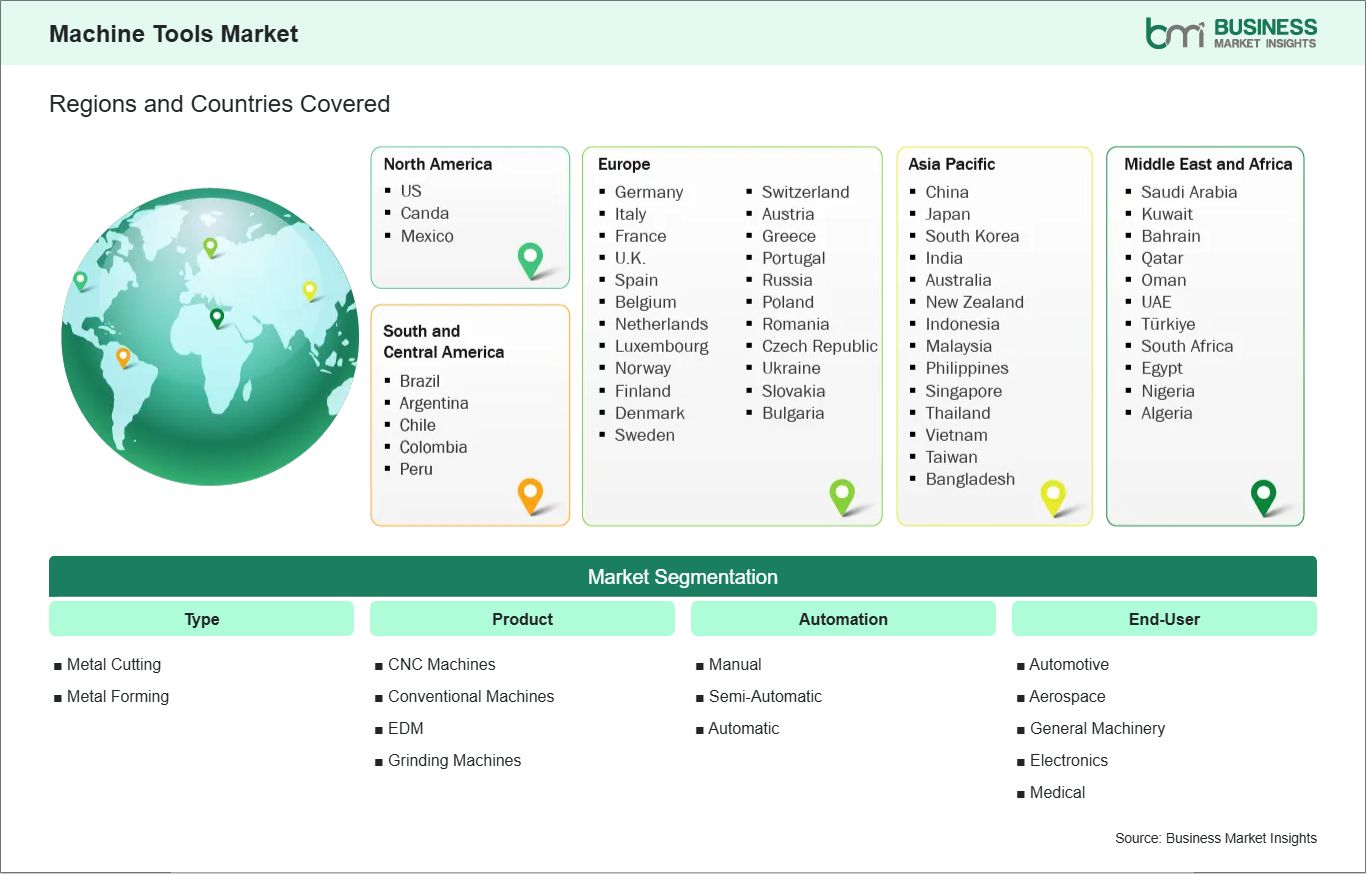
The Machine Tools market is segmented by type, product, automation, and end-user, reflecting distinct production priorities across industrial settings.
By Type
- Metal Cutting: Supports precision shaping across high-volume and high-specification component manufacturing.
- Metal Forming: Enables repeatable deformation processes for structural and industrial part production.
By Product
- CNC Machines: Deliver programmable accuracy for complex parts and reduced manual intervention.
- Conventional Machines: Remain suitable for repair shops and flexible low-volume operations.
- EDM: Handles intricate geometries and hard materials with non-contact machining capability.
- Grinding Machines: Provide fine finishing performance where surface quality and tolerance control matter.
By Automation
- Manual: Preferred where operator control and lower capital commitment remain important.
- Semi-Automatic: Balances labor input with repeatability in mixed production environments.
- Automatic: Supports continuous machining with stronger process consistency and production efficiency.
By End-User
- Automotive: Requires high-throughput machining for engines, transmission systems, and structural components.
- Aerospace: Demands precision equipment for hard alloys and strict dimensional conformity.
- General Machinery: Uses versatile platforms for broad industrial fabrication and maintenance needs.
- Electronics: Favors compact, accurate machining for small-format and high-specification parts.
- Medical: Relies on controlled machining for instruments, implants, and specialized components.
Market Forces
Machine Tools Market Drivers and Opportunities
Manufacturing Modernization Across Precision-Driven Industries
Manufacturers are upgrading legacy equipment to meet stricter precision targets, shorter production cycles, and broader part complexity. This shift creates a clear need for machine tools that can deliver stable machining conditions, repeatable output, and better compatibility with automated workflows. As product designs become more exacting, end users are prioritizing equipment that reduces rework and supports dependable process control across production stages.
The effect is especially visible in automotive, aerospace, and medical manufacturing, where tolerance discipline shapes procurement decisions. Machine tools that improve utilization, streamline setup transitions, and maintain dimensional consistency carry stronger relevance in these environments. This dynamic supports continued investment across facilities seeking resilient production systems that align machining capability with evolving quality and throughput expectations.
Automation-Linked Expansion in High-Mix Production Environments
High-mix manufacturing is creating space for machine tools that combine flexible programming, automated handling, and application-specific process optimization. Innovation in control systems, software integration, and unattended machining is widening the use case for advanced equipment across medium-scale and specialized production lines. This trend is particularly relevant where buyers need faster changeovers without sacrificing machining precision or operating consistency.
Over time, this opens broader scope in electronics, general machinery, and medical applications that demand adaptable yet reliable production assets. Expanding deployment of semi-automatic and automatic systems can strengthen capacity planning while lowering dependence on repetitive manual intervention. The opportunity therefore lies in solutions that extend machining flexibility, support digital monitoring, and improve production economics across varied end-user settings.
Size and Share Analysis
Machine Tools Market Size and Share Analysis
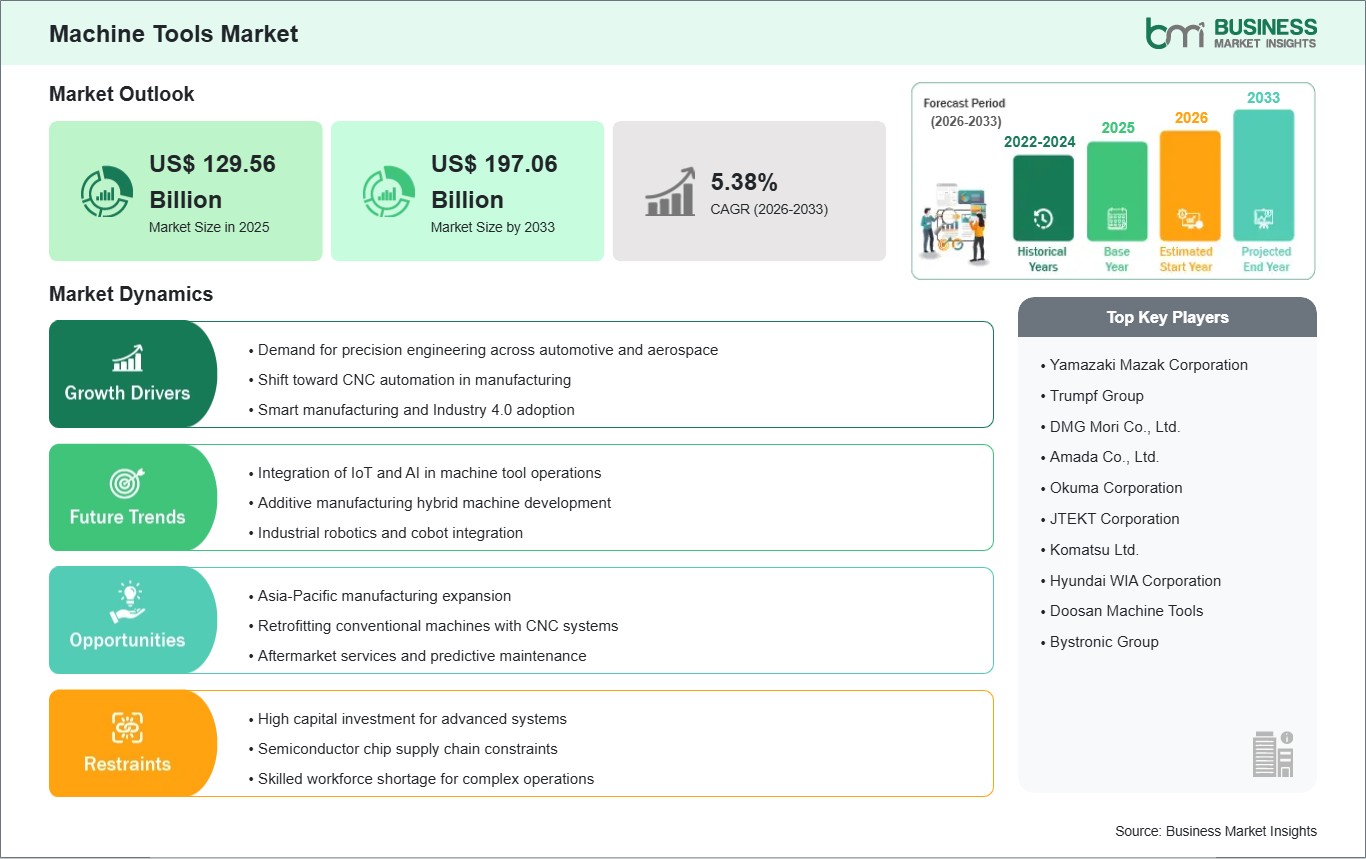
The Machine Tools market size is expected to reach US$ 197.06 Billion by 2033 from US$ 129.56 Billion in 2025. The market is estimated to record a CAGR of 5.38% from 2025 to 2033. This trajectory reflects sustained capital allocation toward precision manufacturing platforms and gradual expansion of automated machining capacity across industrial supply chains.
By segment, metal cutting retains the broadest industrial footprint because it supports essential machining requirements across component-intensive manufacturing. Among products, CNC machines command stronger positioning as buyers seek programmable control and repeatable production quality. Conventional machines continue to serve maintenance-led and workshop settings, while EDM and grinding systems remain indispensable in applications requiring profile detail and refined finishing capability.
From an application standpoint, automotive represents a major area of machine tool utilization due to continuous demand for efficient component manufacturing. Aerospace maintains strong relevance where exact machining standards and material challenges shape equipment choice. General machinery, electronics, and medical production also contribute meaningful demand through their need for accuracy, workflow control, and specialized machining performance.
Report Coverage
Machine Tools Market Report Coverage and Deliverables
The "Machine Tools Market Size and Forecast (2022-2033)" report provides a detailed analysis of the market covering the areas below:
- Market size and forecast at global, regional, and country levels for all the key market segments covered under the scope
- Market trends, as well as market dynamics such as drivers, restraints, and key opportunities
- Market analysis covering key market trends, global and regional framework, major players, regulations, and recent market developments
- Industry landscape and competition analysis covering market concentration, heat map analysis, prominent players, and recent developments for the market
- Detailed company profiles, including SWOT analysis
Geographic Insights
Machine Tools Market Geographic Insights
The Machine Tools market shows diverse regional adoption patterns influenced by manufacturing maturity, capital investment priorities, and the pace of production automation across industrial economies. Globally, procurement behavior reflects a mix of replacement demand, capacity upgrades, and application-specific equipment selection. End users are increasingly aligning machine purchases with productivity targets, precision requirements, and digital integration strategies that support more controlled factory operations.
North America maintains a strong position through established aerospace, automotive, and medical manufacturing bases that favor advanced machining systems. Buyers in this region typically emphasize software-enabled control, aftermarket service reliability, and equipment capable of handling complex materials and exacting specifications. Replacement of aging shop-floor assets also contributes to procurement activity, particularly where production resilience and process transparency are becoming more important.
Asia Pacific continues to represent a broad manufacturing center for machine tools due to its extensive industrial supply chains, export-oriented production, and ongoing factory modernization. Demand is reinforced by automotive assembly, electronics fabrication, and general machinery output, all of which require scalable machining capacity. The region also benefits from an expanding base of users seeking semi-automatic and automatic platforms that improve throughput without compromising production flexibility.
Europe retains relevance through its concentration of precision engineering, industrial equipment manufacturing, and specialized machining applications. Demand often centers on efficient, high-accuracy systems suited to technically demanding production environments. Beyond these established regions, emerging markets are showing gradual uptake as local manufacturing capabilities expand and industrial operators seek more dependable machining infrastructure to support domestic production development.
Industry Activity
Recent Developments
The Machine Tools Market is evaluated by gathering qualitative and quantitative data post primary and secondary research, which includes important corporate publications, association data, and databases. Recent developments and news in the market include:
- In February 2026, Nidec Corporation (TSE: 6594; OTC US: NJDCY) (the “Company”) has announced the opening of its new “Technical Center” in Ritto City, Shiga Prefecture, Japan, on February 5. This facility will serve as a hub for the joint operations of the four group companies within Nidec’s Machine Tool Business Unit (i.e., Nidec Machine Tool Corporation (“Nidec Machine Tool”), Nidec OKK Corporation (“Nidec OKK”), PAMA S.p.A. (“PAMA”), and Takisawa Machine Tool Co., Ltd. (“Takisawa Machine Tool”)) (collectively referred to as the “four companies”).
- In December 2025, Seco France confirmed its position as an industry leader in machining by actively participating in major industry events at machine tool manufacturers' facilities. From Open Days at Mazak France to technical demonstrations at DMG MORI and Huron Week, our teams shared their expertise and showcased innovative machining solutions built for today's production challenges.
Trust & Transparency
Research Methodology
The market analysis combines proprietary research with secondary data from government agencies, company disclosures, regulatory filings, industry databases and expert interviews. Market estimates are validated through data triangulation, cross-market benchmarking and analyst
review.
View Full Research Methodology
Key Sources Referred:
World Bank: Global Trade IndicatorsWorld Trade Organization (WTO)International Monetary Fund (IMF)International Trade Administration (ITA)Company WebsitesCompany Annual ReportsCompany Investor Presentations