
Carbide Tools Market Outlook: Size, Share, Trends, Growth Analysis, Competitive Landscape & Forecast, 2026-2033

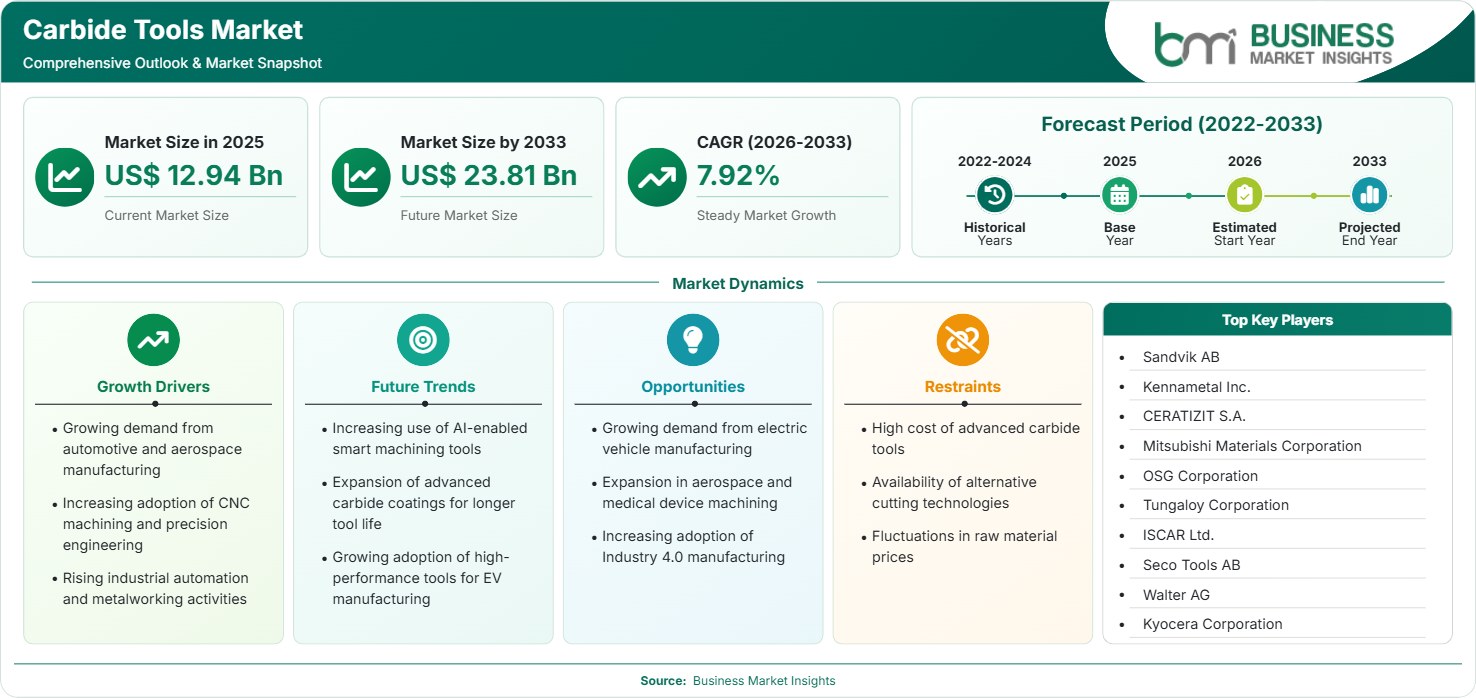
The Carbide Tools Market size was valued at US$ 12.94 Billion in 2025 and is projected to reach US$ 23.81 Billion by 2033, growing at a CAGR of 7.92% during 2026–2033, driven by rising precision manufacturing demand, expanding automotive and aerospace production, CNC machining adoption, industrial automation, and advanced metalworking requirements.

Report Coverage
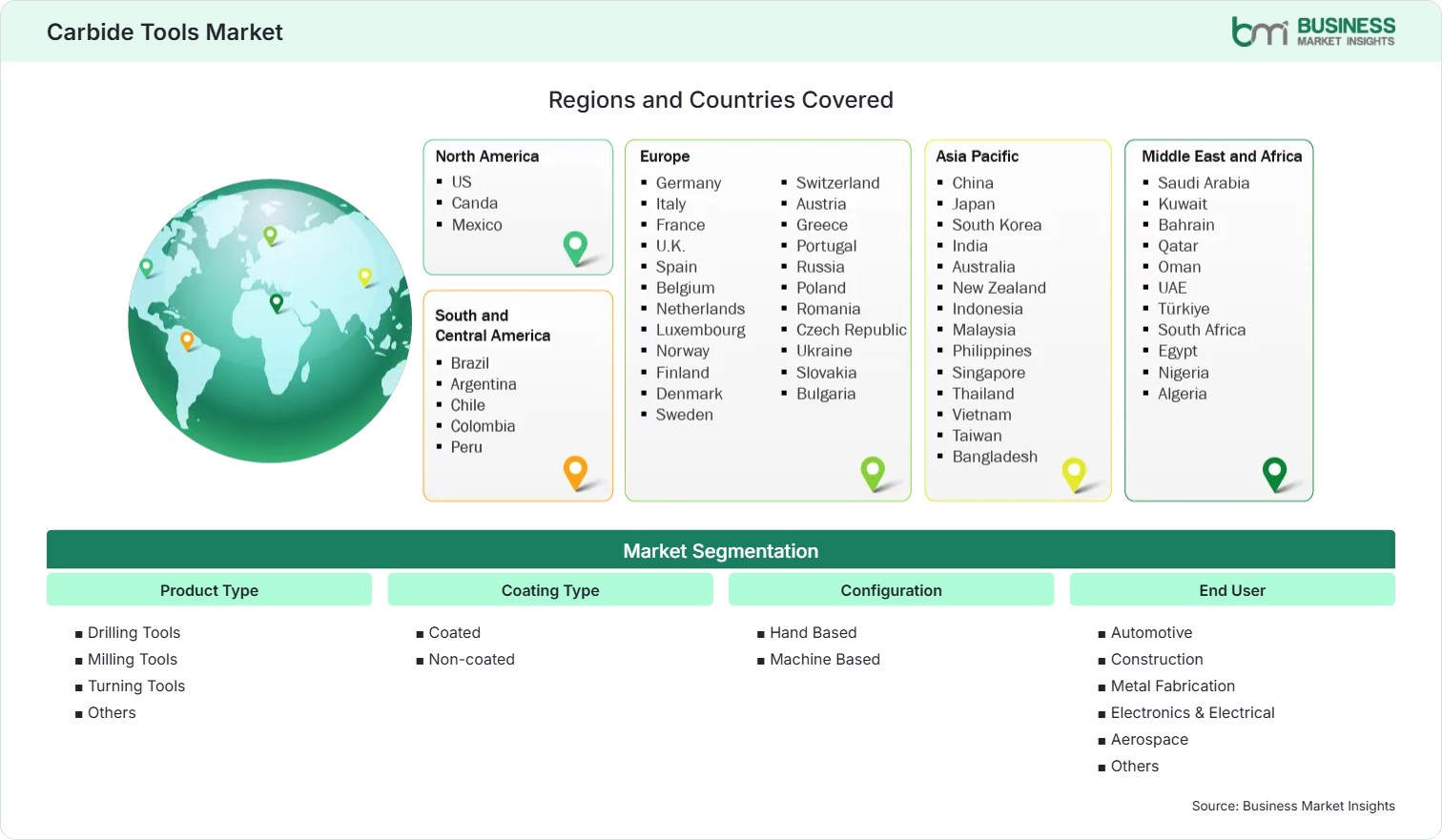
  • Product Type: Drilling Tools, Milling Tools, Turning Tools, Others
  • Coating Type: Coated, Non-coated
  • Configuration: Hand Based, Machine Based
  • End User: Automotive, Construction, Metal Fabrication, Electronics & Electrical, Aerospace, Others
US$ 12.94 Bn Market size in 2025
US$ 23.81 Bn Market Size by 2033
7.92% CAGR, 2026 - 2033
2026-2033 Forecast Period

AI Overview

Carbide Tools Market Summary

  • North America Region: North America holds a 26%–30% share in 2025, expanding at a CAGR of 7.5%–8.0% during 2026–2033, supported by automotive manufacturing, aerospace production, industrial automation, and precision engineering investments. The US market demonstrates strong growth with a CAGR of 7.6%–8.1% from 2026–2033 due to advanced machining capabilities, manufacturing reshoring, and demand for high-performance cutting tools.
  • Fastest Growing Region: Asia Pacific represents a 40%–44% share in 2025, advancing at a CAGR of 8.2%–8.7% during 2026–2033, driven by expanding automotive production, electronics manufacturing, industrial automation, infrastructure development, and increasing adoption of precision machining technologies.
  • Leading Segment: Milling Tools account for a 32%–36% share in 2025, growing at a CAGR of 7.8%–8.3% during 2026–2033, supported by complex component manufacturing, automotive applications, aerospace machining requirements, and demand for improved productivity and tool life.
  • High Growth Segment: Machine Based configuration represents a 70%–74% share in 2025, expanding at a CAGR of 8.0%–8.5% during 2026–2033, supported by CNC machining growth, automated production systems, precision manufacturing, and Industry 4.0 adoption.
  • Key Market Opportunity: The market opportunity is concentrated in electric vehicle manufacturing, aerospace component machining, smart factories, and advanced manufacturing applications requiring durable and high-precision cutting solutions.
  • Major Market Players: Sandvik AB, Kennametal Inc., CERATIZIT S.A., Mitsubishi Materials Corporation, OSG Corporation, Tungaloy Corporation, ISCAR Ltd., Seco Tools AB, Walter AG, and Kyocera Corporation.
Strategic Insights

Carbide Tools Market: Strategic Insights

Carbide Tools Market Strategic Framework
FREE PDF
Request your free sample
Request free sample
Stakeholder View

Key Takeaways

  • The value chain is shifting toward integrated tooling solutions, where manufacturers combine carbide materials, coating technologies, tool design expertise, and digital machining support to improve customer productivity.
  • Automotive electrification and lightweight component manufacturing are creating new demand opportunities for carbide tools capable of machining advanced alloys, composites, and complex geometries.
  • Tool manufacturers are investing in advanced coatings, micro-grain carbide materials, and optimized cutting designs to increase durability, precision, and machining speed.
  • Asia Pacific presents the strongest investment opportunity due to expanding automotive production, electronics manufacturing hubs, infrastructure development, and increasing adoption of automated machining systems.
  • Market consolidation is increasing through technology partnerships, product portfolio expansion, and strategic investments as leading tooling companies seek stronger positions in high-growth manufacturing segments.
  • Smart manufacturing adoption is creating demand for connected tooling solutions that enable real-time monitoring, predictive maintenance, and improved machining process control.
Geographic Outlook

Carbide Tools Market Regional Highlights

North America Carbide Tools Market

North America accounted for a 26%–30% share in 2025 and is projected to grow at a CAGR of 7.5%–8.0% during 2026–2033. The region benefits from established manufacturing capabilities, aerospace production, automotive innovation, and increasing automation investments. The Carbide Tools Market share remains concentrated in the US, supported by advanced machining infrastructure and demand for high-performance cutting solutions. Canada and Mexico contribute through automotive supply chains, metal fabrication activities, and industrial manufacturing expansion.

  • The US maintains regional leadership through aerospace manufacturing, automotive production, and increasing adoption of advanced CNC machining technologies.
  • Manufacturing reshoring initiatives are supporting investments in domestic machining capabilities and increasing demand for durable precision cutting tools.
  • Aerospace component production is creating demand for carbide solutions capable of machining high-strength alloys and complex engineered parts.
  • Tool manufacturers are developing advanced coatings and carbide grades to improve productivity across demanding industrial applications.

US Carbide Tools Market

The US represented a 22%–25% share in 2025 and is estimated to expand at a CAGR of 7.6%–8.1% during 2026–2033. The country remains a major market due to strong industrial capabilities, aerospace manufacturing, automotive production, and increasing adoption of automated machining systems. The Carbide Tools Market in the US is supported by demand for precision components, manufacturing modernization, and investments in advanced production technologies. Growth is further influenced by increasing use of CNC-based manufacturing processes.

  • Automotive manufacturers are adopting high-performance carbide tools to improve machining efficiency for conventional and electric vehicle components.
  • Aerospace companies are increasing demand for precision tooling solutions for lightweight materials, engine parts, and structural components.
  • Metal fabrication industries are upgrading equipment, creating opportunities for advanced carbide cutting technologies and customized tooling solutions.
  • Digital manufacturing adoption is encouraging integration of smart tooling systems with automated machining environments.

Europe Carbide Tools Market

Europe represented a 24%–28% share in 2025 and is expected to grow at a CAGR of 7.3%–7.8% during 2026–2033. The region benefits from advanced engineering capabilities, strong automotive manufacturing, aerospace expertise, and industrial automation adoption. Germany, Italy, France, and the UK are key contributors due to established manufacturing ecosystems. The Carbide Tools Market growth in Europe is supported by increasing demand for efficient machining solutions, sustainable production practices, and advanced manufacturing technologies.

  • Germany leads regional demand due to strong automotive production, precision engineering capabilities, and extensive industrial automation adoption.
  • Italy supports market expansion through metalworking industries, machinery production, and growing demand for high-quality machining tools.
  • France and the UK contribute through aerospace manufacturing activities requiring precision cutting solutions and advanced tooling performance.
  • European manufacturers are investing in Industry 4.0 technologies to optimize machining processes and improve production efficiency.

Asia Pacific Carbide Tools Market

Asia Pacific accounted for a 40%–44% share in 2025 and is projected to register the fastest growth at a CAGR of 8.2%–8.7% during 2026–2033. The region benefits from large manufacturing bases, automotive production growth, electronics manufacturing, and infrastructure development. China, Japan, South Korea, and India are major contributors. The region offers significant opportunities due to increasing CNC machining adoption and expansion of industrial automation across manufacturing sectors.

  • China remains the largest regional contributor due to extensive manufacturing activity, automotive production, and large-scale machining operations.
  • Japan supports demand through advanced precision engineering, robotics integration, and high-value component manufacturing industries.
  • India is experiencing increasing adoption of carbide tools due to expanding automotive, aerospace, and industrial manufacturing sectors.
  • South Korea contributes through electronics manufacturing, semiconductor equipment production, and advanced machining applications.

Rest of World Carbide Tools Market

South America accounted for a 4%–6% share in 2025 and is projected to expand at a CAGR of 7.0%–7.5% during 2026–2033, supported by automotive manufacturing and mining-related industrial activities. Brazil and Mexico represent important markets due to industrial development and manufacturing investments. The Middle East and Africa accounted for a 3%–5% Carbide Tools Market share in 2025, growing at a CAGR of 6.5%–7.0% through infrastructure development and increasing industrial diversification.

  • Brazil is developing machining capabilities through automotive production growth and expanding metal fabrication activities.
  • Mexico benefits from manufacturing investments, automotive supply chains, and increasing demand for precision machining solutions.
  • Middle Eastern countries are adopting advanced manufacturing technologies as part of industrial diversification strategies.
  • African markets are gradually developing manufacturing infrastructure, creating future opportunities for tooling suppliers.
Global Market Geography
FREE PDF
Request your free sample
Request free sample
Segment Analysis

Carbide Tools Market Segmentation

Product Type

Product Type segmentation represents a significant component of the Carbide Tools market, with milling tools maintaining leadership due to broad application across automotive, aerospace, and industrial machining operations. The segment accounted for a 32%–36% share in 2025 and is projected to grow at a CAGR of 7.8%–8.3% during 2026–2033. Increasing demand for complex component manufacturing and improved machining productivity is supporting segment expansion.

  • Drilling Tools: Drilling tools are widely used in automotive, aerospace, and construction applications due to their ability to deliver accurate hole machining and extended operational performance.
  • Milling Tools: Milling tools dominate demand through versatile applications in component manufacturing, surface finishing, and precision machining across multiple industries.
  • Turning Tools: Turning tools support high-volume manufacturing by enabling efficient material removal, dimensional accuracy, and improved production cycle times.

Coating Type

Coating Type segmentation is influenced by demand for improved tool durability, higher cutting speeds, and enhanced resistance against heat and wear. Coated carbide tools represented a 65%–69% share in 2025 and are expected to grow at a CAGR of 8.0%–8.5% during 2026–2033. Manufacturers are increasingly adopting advanced coatings to improve machining efficiency and reduce replacement frequency.

  • Coated: Coated carbide tools provide enhanced wear resistance, improved cutting performance, and longer tool life for demanding machining applications.
  • Non-coated: Non-coated tools remain relevant for specific applications requiring cost-effective solutions and machining of less demanding materials.

Configuration

Configuration segmentation reflects increasing automation across manufacturing environments. Machine Based configurations represented a 70%–74% share in 2025 and are projected to grow at a CAGR of 8.0%–8.5% during 2026–2033. The segment benefits from CNC adoption, automated production lines, and precision engineering requirements. The Carbide Tools Market scope continues expanding as industries integrate advanced machining systems.

  • Hand Based: Hand-based carbide tools support portable machining applications, maintenance operations, and smaller-scale industrial requirements.
  • Machine Based: Machine-based carbide tools are expanding through CNC machining adoption, automated manufacturing systems, and high-volume production environments.

End User

End User segmentation reflects broad industrial adoption across automotive, aerospace, electronics, construction, and metal fabrication industries. Automotive applications represented a leading demand area in 2025 due to high-volume component production and precision machining requirements. Increasing industrial automation and advanced manufacturing investments are supporting future growth across end-user categories.

  • Automotive: Automotive manufacturers use carbide tools for engine components, transmission parts, electric vehicle components, and precision machining applications.
  • Construction: Construction industries utilize carbide tools for equipment manufacturing, metal processing, and heavy-duty component production.
  • Metal Fabrication: Metal fabrication industries rely on carbide tools for efficient cutting, shaping, and finishing of industrial materials.
  • Electronics & Electrical: Electronics manufacturers adopt precision carbide tools for machining complex components requiring high accuracy.
  • Aerospace: Aerospace companies use advanced carbide tools for machining lightweight alloys, structural parts, and high-performance components.
Market Forces

Carbide Tools Market Dynamics

Key Market Drivers

Growing Demand from Automotive and Aerospace Manufacturing

The growing demand from automotive and aerospace manufacturing is strengthening adoption of advanced carbide tools due to increasing requirements for precision, durability, and high-speed machining. Carbide solutions are being used by the automotive industry for engines, transmissions, electric vehicles, and lightweight materials. High-performance tooling is required by the aerospace industry for machining titanium, composite and structural components. The factors that support market growth include production of vehicles and aircraft as well as machining advancements. The Carbide Tools Market trends indicate a shift toward specialized tooling solutions that improve productivity, reduce downtime, and enhance component accuracy. Manufacturers are developing improved carbide grades and coatings to address evolving industrial requirements.

Increasing Adoption of CNC Machining and Precision Engineering

Increased use of computer numerical control machining and precision engineering is fueling demand for carbide tooling within industries. CNC machinery requires tooling that can perform precisely and efficiently throughout the automatic manufacturing process. The automotive, aerospace, electronics, and medical equipment manufacturing industries are developing precision engineering capabilities to increase production efficiency. There are several benefits associated with carbide tools, such as hardness, high wear resistance, and suitability for sophisticated machining processes. Toolmakers are developing specialized tool designs and coatings to meet more complex manufacturing needs. With the rise in automated machining operations, tool companies have new opportunities to offer products that increase productivity and reduce errors.

Rising Industrial Automation and Metalworking Activities

Increased automation in industry and increased metal working operations are creating demand for high quality cutting solutions in all major manufacturing industries around the globe. The automated processes need reliability in terms of performance of their tools to ensure smooth functioning and reduction of any kind of disruption. Increased spending on smart manufacturing facilities, robotic processes, and automated assembly lines is prompting manufacturers to use high-quality carbide tools. As a result of incorporating digital monitoring technologies, there has been increased efficiency in tool use and the implementation of predictive maintenance practices. Such practices have resulted in market expansion due to increased demand for high-quality tools.

Key Market Opportunities

Growing Demand for Electric Vehicle Manufacturing

The production of electric vehicles is offering considerable growth opportunities for the manufacturers of carbide tools because there is a need for highly technical machining operations for battery parts, electric motors, and light weight structural parts. Electric vehicle production involves materials such as aluminum alloy and composites. Companies are also working on investing in carbide tools that have better wear resistance and performance during cutting operations to produce EV components efficiently. The use of electrified vehicles has prompted companies to change their manufacturing process technology. The suppliers who have experience in high-performance technology could gain an advantage by aligning themselves with the makers of EVs and components. Rising investments in electric mobility around the world should create continuous demand for tooling using carbides.

Expansion in Aerospace and Medical Device Machining

The development of machining operations for aerospace and medical devices has presented opportunities to carbide tool makers due to the rise in requirements for precise machined products and complex materials. The production of aerospace machinery demands tools that are capable of machining titanium alloy, nickel-based superalloys, and composites precisely. Precision machining is also essential in medical devices such as implants, surgical devices, and other types of equipment. There are several advantages associated with the use of carbide tools in such machining operations including strength, precision, and capability to withstand harsh machining operations. More growth is expected due to the growing market for healthcare equipment and aircrafts.

Increasing Adoption of Industry 4.0 Manufacturing

The use of Industry 4.0 technologies opens new opportunities using smart manufacturing systems that include the combination of automation, analytics, and interconnection technologies within the process of production. The manufacturers of carbide tools are implementing digital solutions that allow them to monitor, analyze, and predict performance and maintenance. The ability to create smart tools allows manufacturers to lower downtime, find optimal machining parameters, and increase the level of production efficiency. With the shift towards connected manufacturing environments, there is a growing need for tools suitable for use in automated production processes. Companies that invest in smart tooling and intelligent manufacturing can capture new opportunities.

Market Restraints and Challenges

High Cost of Advanced Carbide Tools

Factor: High cost of advanced carbide tools creates challenges for small and medium-sized manufacturers due to higher initial investment requirements compared with conventional cutting tools. Premium carbide grades, advanced coatings, and specialized geometries increase production costs because of complex manufacturing processes and material requirements. Impact: Higher tool costs can limit adoption among price-sensitive users, increase operational expenses, and affect purchasing decisions in developing markets. The manufacturers are tackling this problem by improving tool life, design, and cost-effective manufacturing techniques. While the use of advanced carbide tools gives advantages due to low replacement and better machining performance, affordability is one of the key issues determining the popularity of such tools.

Availability of Alternative Cutting Technologies

Factor: Availability of alternative cutting technologies, including ceramic tools, cubic boron nitride tools, and diamond-based solutions, creates competitive pressure for carbide tool manufacturers. Different materials offer advantages in specific machining applications, particularly high-temperature operations and specialized material processing. Impact: Alternative technologies may reduce carbide tool adoption in certain industries and limit market opportunities for conventional carbide solutions. The manufacturers are meeting the challenge by enhancing the performance of carbides via coatings, metallurgy, and design. Carbide tools have been able to retain their popularity because of the versatility, reliability, and performance-to-cost ratio of these tools. Nevertheless, continued development is critical to competing with new tooling technologies.

Company Analysis

Competitive Landscape

The Carbide Tools Market analysis highlights a competitive environment driven by global tooling manufacturers focusing on product innovation, advanced materials, coating technologies, and digital machining solutions. Companies are expanding their portfolios through research, manufacturing improvements, and industry-specific tooling solutions.

Company Name

Overview

Products and Services relevant to this market

Sandvik AB

Global engineering company specializing in advanced machining solutions and industrial tooling technologies.

Provides carbide cutting tools, milling solutions, drilling systems, and precision machining products.

Kennametal Inc.

Industrial technology company focused on metal cutting solutions and wear-resistant products.

Supplies carbide inserts, cutting tools, tooling systems, and machining solutions for industries.

CERATIZIT S.A.

Advanced hard material manufacturer specializing in carbide products and cutting technologies.

Produces carbide tools, inserts, and precision machining solutions for industrial applications.

Mitsubishi Materials Corporation

Japanese materials company offering advanced tooling and manufacturing technologies.

Provides carbide cutting tools, inserts, and machining solutions for automotive and industrial sectors.

OSG Corporation

Precision tooling manufacturer serving global manufacturing industries.

Produces carbide drills, end mills, taps, and specialized cutting tools.

Tungaloy Corporation

Cutting tool company specializing in innovative machining solutions and carbide technologies.

Offers carbide inserts, turning tools, milling tools, and precision cutting products.

ISCAR Ltd.

Global manufacturer of advanced metal cutting tools and machining solutions.

Provides carbide tools, inserts, and customized solutions for industrial manufacturing.

Seco Tools AB

Precision tooling company focused on machining productivity and engineering support.

Supplies carbide milling, turning, drilling tools, and application-based machining solutions.

Walter AG

German tooling company providing precision machining products and technical expertise.

Offers carbide tools, cutting inserts, and solutions for aerospace, automotive, and industrial applications.

Kyocera Corporation

Diversified technology company producing advanced ceramic and carbide cutting solutions.

Manufactures carbide tools, precision components, and machining products for manufacturing industries.

Trust & Transparency

Research Methodology

The market analysis combines proprietary research with secondary data from government agencies, company disclosures, regulatory filings, industry databases and expert interviews. Market estimates are validated through data triangulation, cross-market benchmarking and analyst review.

View Full Research Methodology

Questions Answered

Frequently Asked Questions

Which industries are major users of carbide tools market report?

Automotive, aerospace, metal fabrication, electronics, construction equipment, and industrial machinery sectors are major users due to their requirement for precise and reliable machining solutions.

What role does Industry 4.0 play in carbide tooling?

Industry 4.0 enables smart tooling through real-time monitoring, predictive maintenance, automated machining optimization, and digital performance tracking, improving productivity and reducing manufacturing downtime.

How are electric vehicles influencing carbide tool demand?

Electric vehicle manufacturing is increasing demand for advanced carbide tools used in machining lightweight materials, battery components, electric motors, and complex vehicle structures requiring precision manufacturing.

Why are carbide tools preferred over conventional cutting tools?

Carbide tools are preferred due to high hardness, wear resistance, thermal stability, longer operational life, and ability to maintain accuracy during high-speed machining operations.

What is driving demand for carbide tools market forecasts globally?

Demand is driven by automotive production growth, aerospace component manufacturing, CNC machining adoption, industrial automation, and increasing requirements for precision, durability, and efficient material processing across manufacturing industries.

Access the Full Carbide Tools Market Report

Get segment-level forecasts, regional estimates, competitive benchmarking, company profiles and downloadable Excel datasets.

Access the full Carbide Tools Market Report
350 pages PDF & Excel | 2026-08-06
Similar Research

Related Market Reports