
Cutting Equipment Market Outlook: Size, Share, Trends, Growth Analysis, Competitive Landscape & Forecast, 2026-2033

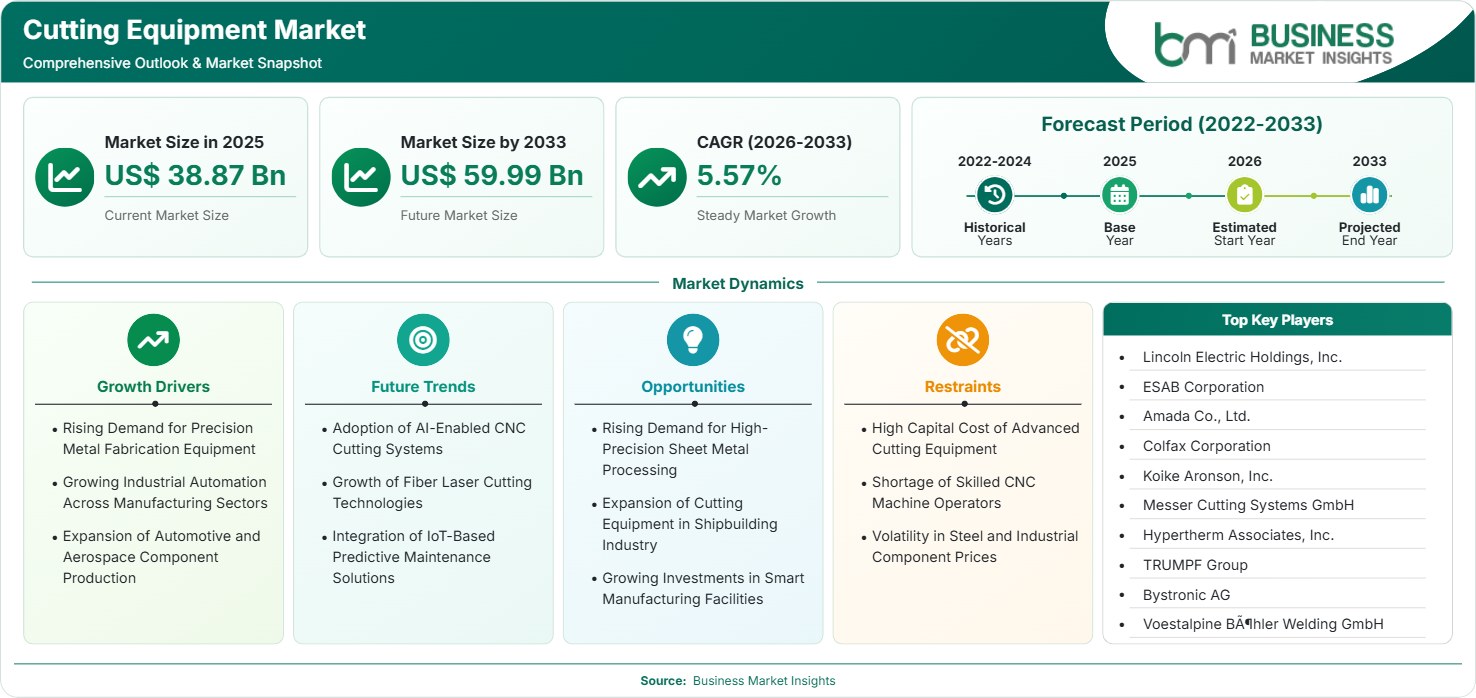
The Cutting Equipment Market size was valued at US$ 38.87 Billion in 2025 and is projected to reach US$ 59.99 Billion by 2033, growing at a CAGR of 5.57% during 2026–2033. Rising industrial automation, expanding metal fabrication activities, growing infrastructure investments, and increasing adoption of precision cutting technologies continue driving demand across manufacturing industries.

Report Coverage
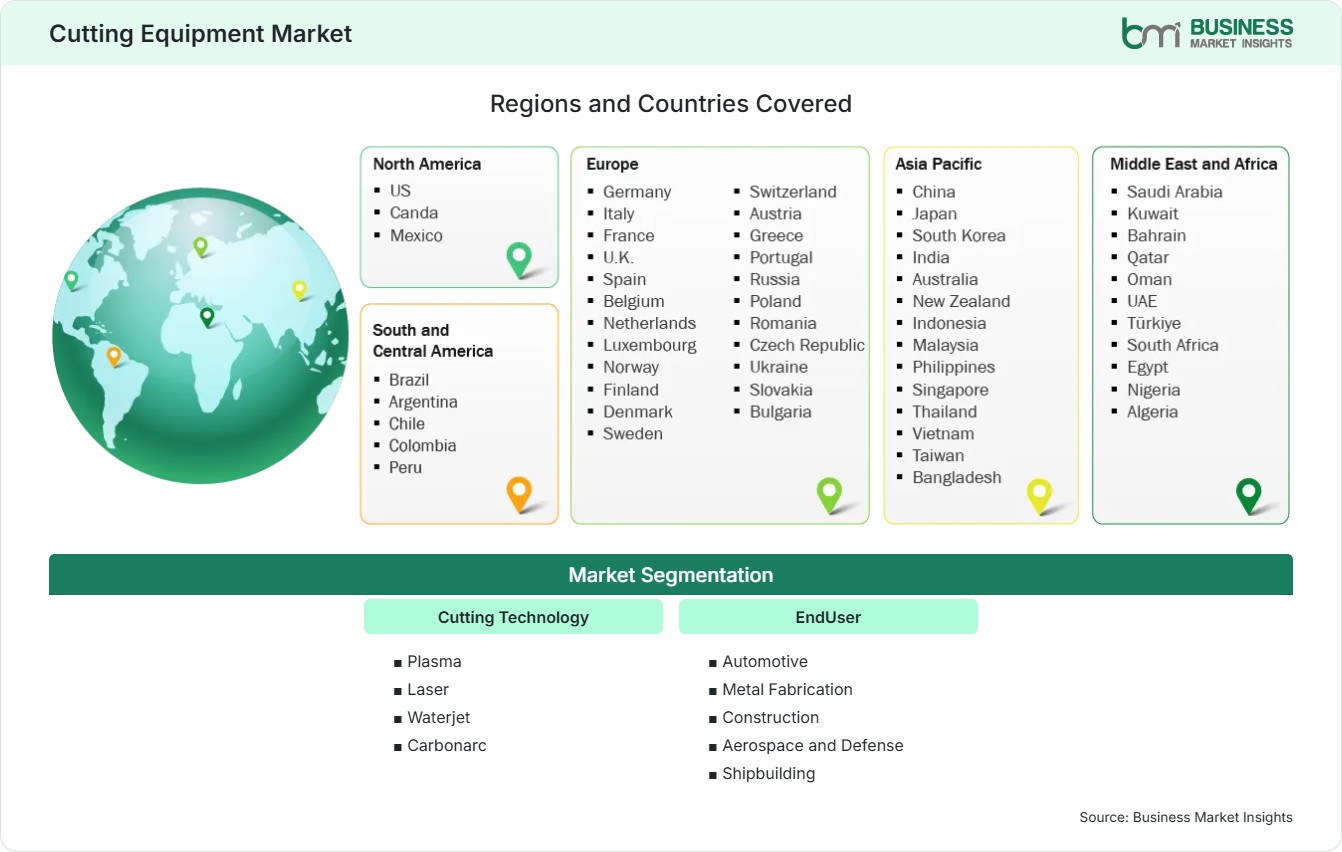
  • Cutting Technology: Plasma, Laser, Waterjet, Carbonarc
  • EndUser: Automotive, Metal Fabrication, Construction, Aerospace and Defense, Shipbuilding
US$ 38.87 Bn Market size in 2025
US$ 59.99 Bn Market Size by 2033
5.57% CAGR, 2026 - 2033
2026-2033 Forecast Period

01 AI Overview

Cutting Equipment Market Summary

  • North America Region: North America holds a cutting equipment market share of 33%–36% in 2025, growing with a CAGR of 5.0%–5.4% during 2026–2033. Manufacturing modernization, automation investments, aerospace production growth, industrial upgrading initiatives, and demand for precision fabrication solutions continue supporting regional expansion. The U.S. market benefits from strong industrial activity, advanced manufacturing technologies, and growing automation adoption, expanding at 5.1%–5.6% CAGR.
  • Fastest Growing Region: Asia Pacific accounts for 28%–31% share in 2025 and is projected to grow at a CAGR of 6.5%–7.0% through 2033. Industrialization, infrastructure development, shipbuilding expansion, manufacturing investments, and increasing adoption of advanced cutting technologies continue accelerating regional demand.
  • Leading Segment: Laser technology represents 36%–39% share in 2025 and is expected to grow at a CAGR of 5.8%–6.3% through 2033. Demand for precision cutting, high productivity, automation compatibility, reduced material waste, and advanced manufacturing capabilities continues supporting adoption.
  • High Growth Segment: Aerospace and Defense accounts for 14%–17% share in 2025 and is forecast to grow at a CAGR of 6.8%–7.3% during 2026–2033. Aircraft production expansion, defense modernization programs, precision engineering requirements, and increasing use of advanced materials are driving equipment investments.
  • Key Market Opportunity: Growing adoption of smart manufacturing platforms integrating automation, robotics, digital monitoring, and precision cutting systems is creating long-term revenue opportunities for equipment manufacturers and technology suppliers.
  • Major Market Players: Illinois Tool Works Inc., AMADA WELD TECH, The Lincoln Electric Company, Colfax Corporation, Koike Aronson, Inc., GCE Group, Ador Welding Limited, OMAX Corporation, Hypertherm, Inc., Jet Edge, Inc.
02 Strategic Insights

Cutting Equipment Market: Strategic Insights

Cutting Equipment Market Strategic Framework
FREE PDF
Request your free sample
Request free sample
03 Stakeholder View

Key Takeaways

  • Manufacturing value chains increasingly prioritize precision fabrication technologies capable of delivering higher productivity, lower material waste, and improved operational efficiency.
  • Aerospace and defense applications are emerging as attractive investment areas due to strict tolerance requirements and growing production activity.
  • Laser-based systems continue gaining preference because they support automation, accuracy, flexibility, and efficient processing of diverse materials.
  • Within the regional cutting equipment market, Asia Pacific offers strong long-term opportunities driven by industrial expansion, infrastructure development, and growing manufacturing investments.
  • Strategic partnerships between equipment manufacturers, automation providers, and software companies are becoming increasingly important for competitive differentiation.
  • Digital manufacturing and Industry 4.0 initiatives are creating demand for intelligent cutting systems capable of delivering real-time performance monitoring and process optimization.
04 Geographic Outlook

Cutting Equipment Market Regional Highlights

North America Cutting Equipment Market

North America accounts for 33%–36% Cutting Equipment Market share in 2025 and is expected to grow at a CAGR of 5.0%–5.4% through 2033. Strong aerospace production, industrial automation adoption, advanced manufacturing capabilities, and continued investments in precision fabrication support regional leadership. Manufacturers are increasingly replacing legacy equipment with high-performance cutting systems that improve productivity and reduce operating costs. Growing demand from automotive, construction, and heavy industrial sectors continues strengthening market fundamentals across the region.

  • Aerospace manufacturers continue investing in advanced cutting technologies to support precision component production and material processing requirements.
  • Industrial automation initiatives are encouraging deployment of digitally integrated cutting systems capable of improving throughput and process consistency.
  • Automotive production facilities increasingly utilize advanced cutting solutions to enhance manufacturing efficiency and precision.
  • Infrastructure and construction projects continue supporting demand for fabrication equipment used in structural steel processing applications.
  • Manufacturers are prioritizing productivity improvement and material optimization strategies through advanced cutting technologies.

US Cutting Equipment Market

The United States contributes approximately 77%–81% of North American revenue and is projected to register a CAGR of 5.1%–5.6% through 2033. Advanced manufacturing capabilities, strong industrial investment, aerospace production activity, and growing adoption of automated fabrication technologies continue driving equipment demand. Expanding modernization initiatives across production facilities are supporting deployment of intelligent cutting systems capable of delivering higher accuracy, efficiency, and operational flexibility.

  • Aerospace and defense industries remain major purchasers of advanced cutting systems for precision component manufacturing.
  • Adoption of automated fabrication technologies continues expanding across industrial production environments.
  • Strong investment in metal processing capabilities supports stable equipment demand across manufacturing sectors.
  • Modernization of production facilities continues increasing adoption of digitally connected fabrication systems.

Europe Cutting Equipment Market

Europe represents 25%–28% of global revenue in 2025 and is anticipated to expand at a CAGR of 5.2%–5.7% through 2033. Advanced manufacturing capabilities, industrial modernization programs, and demand for high-quality fabrication solutions support regional growth. Germany remains the leading regional cutting equipment market due to its strong industrial sector, while Poland demonstrates faster growth momentum supported by manufacturing expansion and industrial investment activities.

  • Germany leads regional demand through strong engineering, automotive manufacturing, and industrial production capabilities.
  • Poland is among the fastest-growing markets with an estimated CAGR of 6.0%–6.5%, supported by expanding manufacturing operations.
  • Investments in industrial automation continue encouraging adoption of advanced cutting technologies.
  • Metal fabrication companies increasingly prioritize efficiency and material optimization initiatives.
  • Aerospace manufacturing activity remains a key demand contributor across several European economies.

Asia Pacific Cutting Equipment Market

Asia Pacific accounts for 28%–31% of total revenue in 2025 and is expected to achieve the fastest CAGR of 6.5%–7.0% through 2033. Rapid industrialization, infrastructure development, growing fabrication activities, and expansion of manufacturing sectors continue supporting regional demand. China leads overall equipment consumption, while India demonstrates strong future growth supported by industrial development and manufacturing investment initiatives.

  • China remains the largest regional market due to extensive manufacturing and metal processing activities.
  • India is expected to record approximately 7.0%–7.5% CAGR, supported by industrial expansion and infrastructure investments.
  • Growing shipbuilding activities continue contributing to demand for advanced cutting equipment.
  • Manufacturing companies increasingly invest in automation-enabled fabrication technologies.
  • Expanding construction activity supports demand for metal processing and material cutting solutions.

Rest of World Cutting Equipment Market

Rest of World accounts for 10%–13% of global revenue in 2025 and is projected to grow at a CAGR of 5.5%–6.0% through 2033. Latin America benefits from industrial development and construction investments, while the Middle East and Africa are witnessing increasing demand from infrastructure and energy-related projects. Ongoing manufacturing diversification initiatives support broader adoption of modern fabrication technologies.

  • Brazil remains a significant contributor due to manufacturing growth and industrial modernization efforts.
  • The UAE continues investing in industrial infrastructure projects requiring advanced fabrication capabilities.
  • Saudi Arabia is expected to register approximately 6.2%–6.8% CAGR supported by industrial diversification programs.
  • Energy and infrastructure projects are creating opportunities for precision cutting equipment suppliers.
  • Expanding fabrication capacity across developing economies continues supporting long-term equipment demand.
Global Market Geography
FREE PDF
Request your free sample
Request free sample
05 Segment Analysis

Cutting Equipment Market Segmentation

Cutting Technology

The cutting technology segment constitutes the technological backbone of industrial fabrication and material processing operations. The segment accounts for approximately 36%–39% share in 2025 and is expected to grow at a CAGR of 5.8%–6.3% through 2033. The expanding Cutting Equipment Market scope is supported by increasing automation, higher precision requirements, manufacturing modernization, and growing adoption of advanced cutting systems capable of processing diverse materials with improved efficiency and reduced waste.

  • Plasma: Plasma cutting remains widely utilized for conductive metals due to its high cutting speed, cost efficiency, operational flexibility, and suitability for heavy fabrication and industrial manufacturing applications.
  • Laser: Laser cutting represents the largest technology category, driven by demand for precision processing, high productivity, automation compatibility, minimal material waste, and superior cutting quality across industries.
  • Waterjet: Waterjet technology is increasingly adopted for applications requiring cold-cutting processes, material integrity preservation, minimal heat-affected zones, and the ability to process diverse materials.
  • Carbon-arc: Carbon-arc cutting continues to serve industrial maintenance, repair, dismantling, and heavy fabrication operations where robust material removal and flexibility are important requirements.

End-User

End-user demand remains closely tied to industrial production activity, infrastructure development, transportation manufacturing, and technological advancement. This segment accounts for approximately 34%–37% share in 2025 and is projected to register a CAGR of 5.6%–6.1% through 2033. Current Cutting Equipment Market trends indicate growing investment in automation-enabled fabrication systems, precision engineering capabilities, and digitally integrated manufacturing environments across multiple industries.

  • Automotive: Automotive manufacturers utilize cutting equipment extensively for body structures, chassis components, precision parts, and fabrication processes supporting vehicle production efficiency and quality.
  • Metal Fabrication: Metal fabrication remains a major end-user category due to widespread demand for cutting, shaping, and processing metal components across industrial and commercial applications.
  • Construction: Construction companies rely on cutting technologies for structural steel processing, infrastructure projects, building component fabrication, and large-scale engineering developments.
  • Aerospace and Defense: Aerospace and defense organizations require advanced cutting systems capable of delivering exceptional precision, repeatability, and performance for high-value engineered components.
  • Shipbuilding: Shipbuilders increasingly deploy advanced cutting equipment to process large metal structures efficiently while improving productivity, quality, and material utilization across production operations.
06 Market Forces

Cutting Equipment Market Dynamics

Key Market Drivers

Rising Demand for Precision Metal Fabrication Equipment

Manufacturers across automotive, aerospace, industrial machinery, construction, and heavy engineering sectors are increasingly prioritizing precision fabrication capabilities to improve product quality and production efficiency. Modern cutting equipment enables precise processing of metals with minimal waste, higher repeatability, and improved dimensional accuracy. The demand for complex engineered components and tighter manufacturing tolerances is encouraging replacement of conventional fabrication methods with advanced cutting technologies. Precision-focused production environments require systems that can consistently deliver high-quality outputs while supporting automation and operational efficiency. These requirements continue driving investment in advanced fabrication solutions, strengthening demand for technologically sophisticated cutting equipment across global manufacturing industries.

Growing Industrial Automation Across Manufacturing Sectors

Industrial facilities are accelerating automation initiatives to improve throughput, reduce operating costs, and maintain consistent production quality. Advanced cutting equipment is increasingly integrated with robotics, CNC systems, industrial software platforms, and automated material handling solutions. Such integration improves production efficiency while minimizing human intervention and operational errors. Automated fabrication environments also help manufacturers optimize resource utilization and reduce processing time. Growing adoption of Industry 4.0 technologies, smart factories, and digitally connected production systems is further enhancing the value of advanced cutting technologies. As industrial organizations continue modernizing manufacturing operations, automation-driven equipment investments remain a major contributor to cutting equipment market expansion.

Expansion of Automotive and Aerospace Component Production

Automotive and aerospace industries continue increasing production volumes to meet growing demand for vehicles, aircraft, and advanced transportation systems. These industries require cutting technologies capable of processing metals and engineered materials with exceptional accuracy and consistency. Manufacturers rely on advanced cutting systems to support fabrication of structural components, body assemblies, engine parts, and aerospace-grade materials. Increasing adoption of lightweight materials and complex component designs further strengthens demand for precise cutting capabilities. As production programs expand and quality standards become more stringent, manufacturers continue investing in modern cutting technologies to improve fabrication efficiency and meet demanding industry specifications.

Key Market Opportunities

Rising Demand for High-Precision Sheet Metal Processing

Growing utilization of sheet metal components across automotive, electronics, construction, aerospace, and industrial manufacturing sectors is creating significant opportunities for cutting equipment suppliers. Manufacturers increasingly require technologies capable of delivering high precision, material efficiency, and superior edge quality during processing operations. Laser and waterjet systems are gaining wider acceptance because of their ability to handle complex designs and diverse material specifications. Rising customization requirements and shorter production cycles are also driving demand for flexible fabrication technologies. Equipment manufacturers that can offer advanced processing capabilities, automation compatibility, and productivity improvements are positioned to capitalize on expanding industry requirements.

Expansion of Cutting Equipment in Shipbuilding Industry

Global shipbuilding activities are generating substantial demand for heavy-duty fabrication technologies capable of processing large metal structures efficiently. Modern shipyards increasingly utilize advanced cutting equipment to improve production productivity, material utilization, and construction accuracy. The expansion of commercial shipping fleets, naval modernization programs, and offshore infrastructure projects continues supporting investment in fabrication technologies. Advanced cutting solutions help shipbuilders manage large-scale production requirements while maintaining quality standards and reducing operating costs. As shipyard operators pursue modernization and digital transformation initiatives, opportunities for technologically advanced cutting equipment providers are expected to expand steadily.

Growing Investments in Smart Manufacturing Facilities

The transition toward smart manufacturing environments is creating attractive growth opportunities for cutting equipment suppliers. Industrial organizations are investing in digital production systems that combine automation, data analytics, predictive maintenance, and real-time monitoring capabilities. Intelligent cutting solutions equipped with software-driven controls and connectivity features are becoming increasingly important within modern fabrication facilities. These systems help improve productivity, reduce downtime, and optimize production performance. Long-term Cutting Equipment Market Forecasts remain supported by continued investment in digital manufacturing strategies as organizations seek greater operational efficiency, flexibility, and competitiveness across global industrial markets.

Market Restraints and Challenges

High Capital Cost of Advanced Cutting Equipment

Factor: Advanced laser, waterjet, and automated cutting systems require substantial upfront investment costs along with expenditures related to installation, software integration, training, and ongoing maintenance. Small and medium-sized manufacturers often face budget limitations when evaluating modernization projects. Impact: High acquisition costs can delay equipment replacement cycles and reduce the pace of technology adoption across cost-sensitive industries. Organizations may continue operating conventional systems despite productivity advantages offered by modern equipment. This limitation can affect market penetration for advanced technologies and slow revenue growth opportunities for equipment manufacturers targeting a broader customer base.

Shortage of Skilled CNC Machine Operators

Factor: Modern cutting equipment increasingly depends on skilled CNC operators and technicians capable of programming, operating, troubleshooting, and maintaining advanced fabrication systems. Many industrial regions continue experiencing shortages of personnel with the required technical expertise. Impact: Workforce gaps can reduce equipment utilization rates, increase operational inefficiencies, and extend implementation timelines for new fabrication technologies. Manufacturers may face higher training costs and productivity challenges when skilled labor availability remains limited. This issue can influence purchasing decisions and create barriers to wider adoption of sophisticated cutting systems, particularly among organizations lacking extensive technical resources.

07 Company Analysis

Competitive Landscape

The Cutting Equipment Market analysis indicates a competitive landscape characterized by continuous innovation in laser, plasma, waterjet, and automated cutting technologies. Market participants are focusing on improving cutting precision, automation compatibility, energy efficiency, digital integration, and operational productivity. Strategic investments in smart manufacturing solutions, CNC-enabled systems, and advanced fabrication technologies continue shaping competitive positioning across industrial end-use sectors.

Company Name

Overview

Products and Services relevant to this market

Illinois Tool Works Inc.

Diversified industrial manufacturer serving welding, fabrication, automotive, and industrial customers through advanced equipment and engineered solutions.

Industrial cutting equipment, welding systems, fabrication technologies, automation solutions, metal processing equipment, and industrial productivity tools.

AMADA WELD TECH

Provider of precision welding, cutting, marking, and joining technologies serving industrial manufacturing and engineering applications.

Laser cutting systems, precision manufacturing solutions, welding technologies, automation platforms, and high-accuracy fabrication equipment.

The Lincoln Electric Company

Global manufacturer of welding, cutting, automation, and fabrication technologies supporting diverse industrial sectors.

Plasma cutting systems, automated fabrication solutions, welding equipment, CNC-integrated systems, and industrial manufacturing technologies.

Colfax Corporation

Industrial technology company with operations supporting fabrication, metal processing, and advanced manufacturing applications.

Industrial cutting technologies, fabrication equipment, process optimization solutions, automated manufacturing systems, and engineering services.

Koike Aronson, Inc.

Specialized manufacturer of thermal cutting and positioning equipment for fabrication and metal processing industries.

Plasma cutting systems, oxy-fuel cutting equipment, CNC cutting machines, positioning systems, and automated fabrication technologies.

GCE Group

Provider of gas control equipment and industrial solutions supporting cutting, welding, and manufacturing operations worldwide.

Gas cutting systems, pressure control equipment, industrial gas technologies, fabrication support solutions, and welding accessories.

Ador Welding Limited

Industrial engineering company supplying cutting and welding solutions across manufacturing, infrastructure, and fabrication industries.

Cutting equipment, welding systems, industrial consumables, fabrication solutions, and engineering support services.

OMAX Corporation

Leading provider of precision waterjet cutting technologies serving manufacturing, aerospace, and industrial applications.

Abrasive waterjet systems, precision cutting platforms, CNC-controlled cutting solutions, and advanced material processing technologies.

Hypertherm, Inc.

Developer of industrial cutting technologies focused on improving productivity, precision, and fabrication efficiency.

Plasma cutting systems, software solutions, CNC controls, robotic cutting technologies, and industrial automation platforms.

Jet Edge, Inc.

Manufacturer specializing in high-pressure waterjet cutting systems for demanding industrial processing applications.

Waterjet cutting equipment, motion control systems, precision fabrication technologies, high-pressure pumps, and industrial cutting solutions.

10 Trust & Transparency

Research Methodology

The market analysis combines proprietary research with secondary data from government agencies, company disclosures, regulatory filings, industry databases and expert interviews. Market estimates are validated through data triangulation, cross-market benchmarking and analyst review.

View Full Research Methodology

11 Questions Answered

Frequently Asked Questions

Which industries generate the strongest demand for cutting equipment?

Metal fabrication, automotive, aerospace and defense, construction, and shipbuilding industries remain major end users due to their extensive requirements for precision material processing and fabrication capabilities.

What does this cutting equipment market report cover?

This report covers technology assessment, end-user analysis, regional opportunities, competitive benchmarking, growth drivers, market challenges, and strategic developments influencing industry expansion through 2033.

Why is Asia Pacific considered the fastest-growing regional market?

Asia Pacific benefits from rapid industrialization, expanding manufacturing capacity, infrastructure development projects, growing shipbuilding activities, and increasing investments in advanced production technologies.

Which cutting technology segment currently leads the market?

Laser cutting technology remains the leading segment due to its precision, productivity, automation compatibility, reduced material wastage, and capability to process complex industrial components efficiently.

What is the primary factor supporting demand for cutting equipment worldwide?

Growing demand for precision fabrication, manufacturing automation, and industrial productivity improvements is supporting equipment adoption across automotive, aerospace, metal fabrication, construction, and shipbuilding sectors.

Access the Full Cutting Equipment Market Report

Get segment-level forecasts, regional estimates, competitive benchmarking, company profiles and downloadable Excel datasets.

Access the full Cutting Equipment Market Report
350 pages PDF & Excel | 2026-08-07