
Plasma Cutting Machine Market Outlook: Size, Share, Trends, Growth Analysis, Competitive Landscape & Forecast, 2026-2033

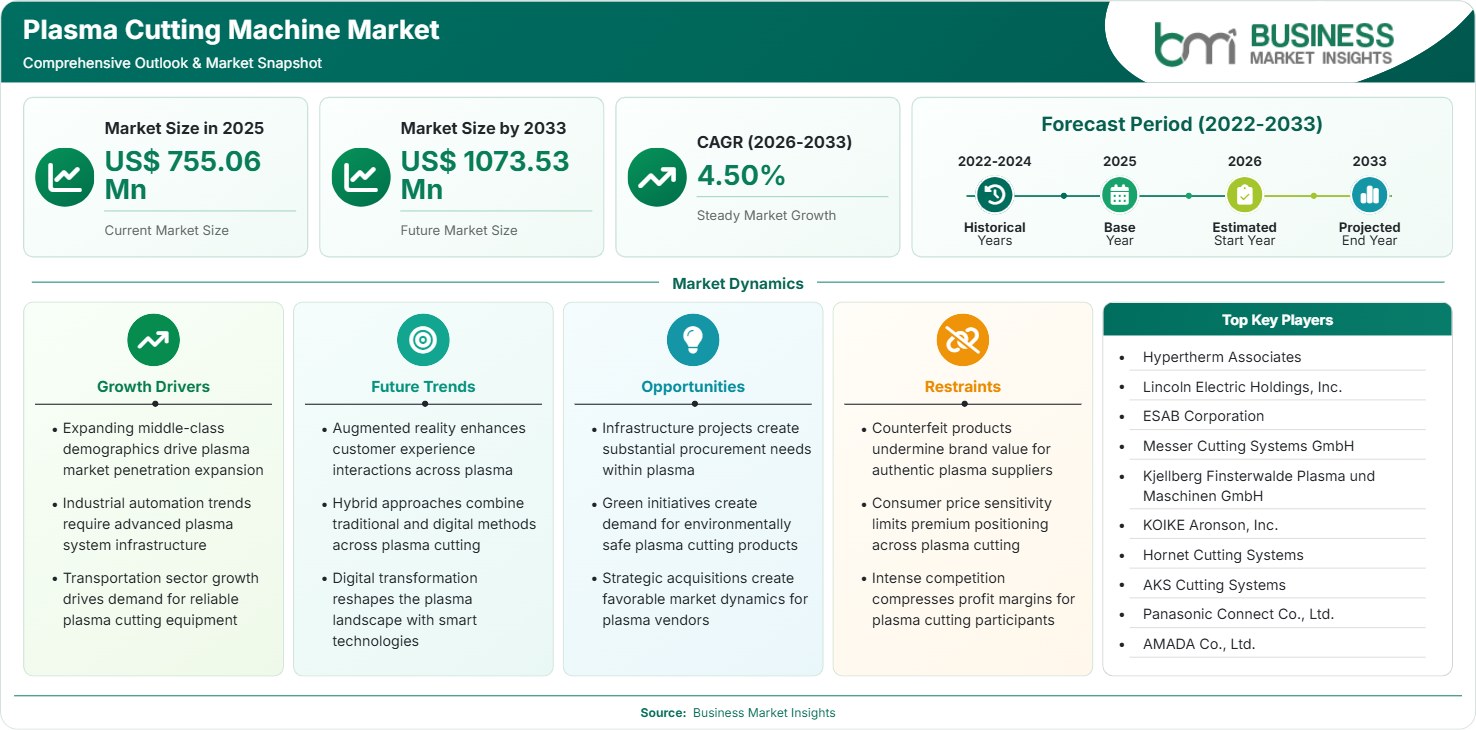
The Plasma Cutting Machine Market size was valued at US$ 755.06 Million in 2025 and is projected to reach US$ 1073.53 Million by 2033, growing at a CAGR of 4.50% during 2026–2033, driven by industrial automation, metal fabrication demand, infrastructure investments, shipbuilding modernization, and opportunities in smart CNC-integrated cutting systems.

Report Coverage
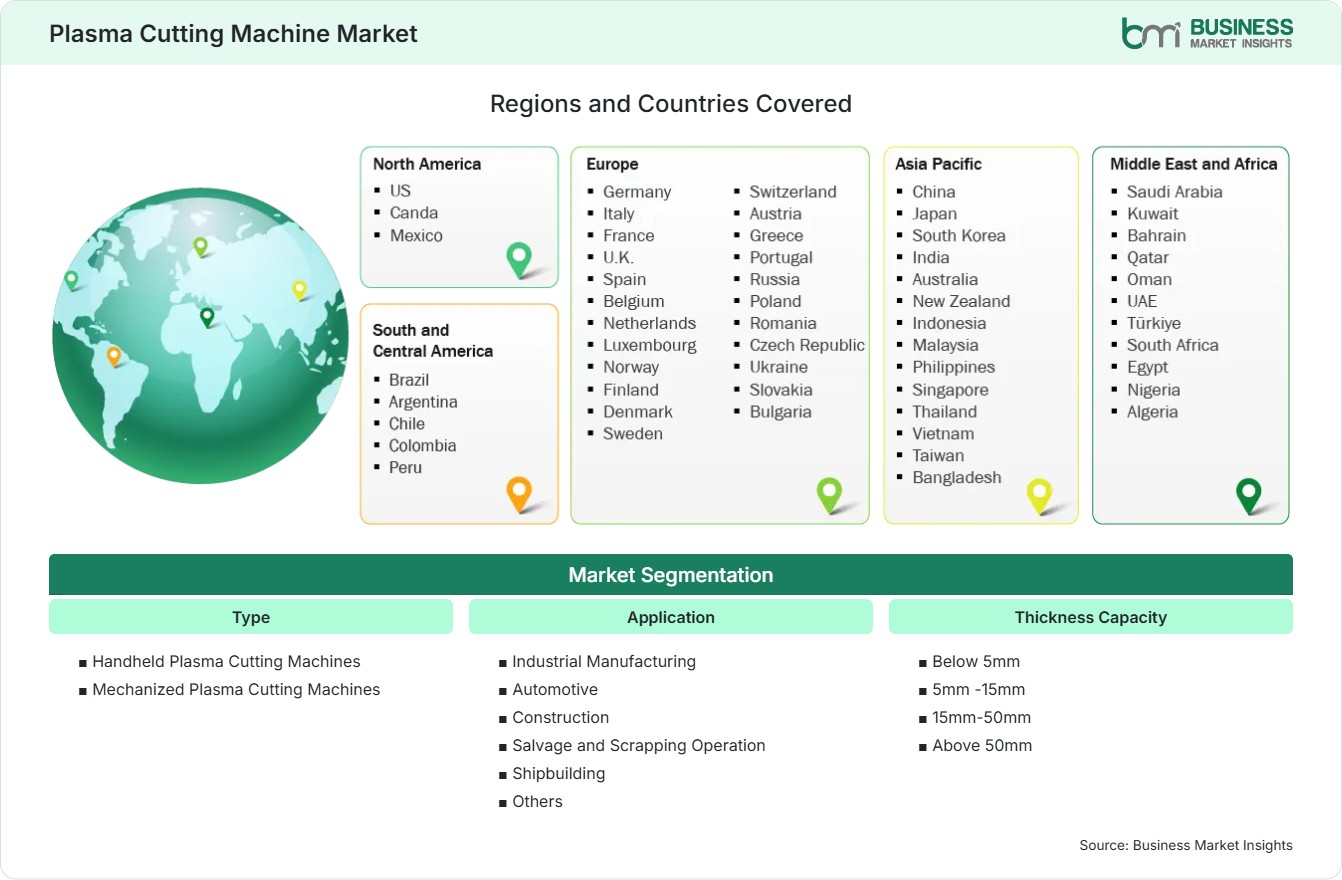
  • Type: Handheld Plasma Cutting Machines, Mechanized Plasma Cutting Machines
  • Application: Industrial Manufacturing, Automotive, Construction, Salvage and Scrapping Operation, Shipbuilding, Others
  • Thickness Capacity: Below 5mm, 5mm -15mm, 15mm-50mm, Above 50mm
US$ 755.06 Mn Market size in 2025
US$ 1073.53 Mn Market Size by 2033
4.50% CAGR, 2026 - 2033
2026-2033 Forecast Period

AI Overview

Plasma Cutting Machine Market Summary

  • North America Region: North America holds a 34%–37% share in 2025, growing at a CAGR of 3.8%–4.2% during 2026–2033. Growth is supported by advanced fabrication facilities, reshoring investments, aerospace production upgrades, energy-sector maintenance demand, automation adoption, digitally connected equipment deployment, workforce productivity requirements, aftermarket services expansion, and precision manufacturing initiatives. US market benefits from strong fabrication activity, manufacturing modernization programs, and estimated CAGR of 3.9%–4.3%.
  • Fastest Growing Region: Asia Pacific holds a 30%–33% share of the Plasma Cutting Machine Market in 2025, expanding at a CAGR of 5.4%–5.9% during 2026–2033. Industrial capacity additions, automotive production growth, infrastructure development, shipyard investments, manufacturing relocation, export-oriented fabrication demand, smart factory deployment, rising steel consumption, and equipment localization support sustained expansion.
  • Leading Segment: Industrial Manufacturing accounts for a 34%–38% share in 2025 and advances at a CAGR of 4.3%–4.8%. Demand stems from fabrication workshops, machinery production, precision metal processing, automation integration, replacement requirements, productivity optimization, operating-cost reductions, digital controls adoption, and expanding contract manufacturing activities globally.
  • High Growth Segment: Mechanized Plasma Cutting Machines represent a 56%–60% share in 2025 and grow at a CAGR of 5.1%–5.6%. Adoption is accelerated by CNC integration, higher throughput requirements, consistent cut quality, labor optimization, automated production lines, advanced nesting software, industrial digitalization, and large-scale fabrication projects.
  • Key Market Opportunity: Smart cutting ecosystems combining IoT monitoring, predictive maintenance, cloud analytics, automated nesting software, robotic handling integration, and energy-efficient power systems create substantial productivity improvements and recurring service revenues.
  • Major Market Players: Hypertherm Associates, Lincoln Electric Holdings, Inc., ESAB Corporation, Messer Cutting Systems GmbH, Kjellberg Finsterwalde Plasma und Maschinen GmbH, KOIKE Aronson, Inc., Hornet Cutting Systems, AKS Cutting Systems, Panasonic Connect Co., Ltd., and AMADA Co., Ltd.
Strategic Insights

Plasma Cutting Machine Market: Strategic Insights

Plasma Cutting Machine Market Strategic Framework
FREE PDF
Request your free sample
Request free sample
Stakeholder View

Key Takeaways

  • The value chain increasingly integrates software developers, CNC system providers, consumable suppliers, robotics firms, and fabrication equipment manufacturers, creating recurring revenue opportunities beyond equipment sales.
  • Mechanized systems and industrial manufacturing applications offer the strongest upside due to demand for precision, repeatability, and higher throughput in large-scale fabrication environments.
  • Innovation is shifting toward automated parameter optimization, cloud-connected diagnostics, predictive maintenance, advanced torch technologies, and robotics-enabled cutting cells.
  • Asia Pacific presents the most compelling investment case due to manufacturing relocation trends, infrastructure expansion, and sustained growth in steel-consuming industries.
  • Strategic acquisitions emphasize software capabilities, automation expertise, and integrated cutting solutions that enhance productivity while strengthening aftermarket service portfolios.
  • Customers increasingly evaluate equipment based on lifecycle operating costs, consumable performance, uptime, and digital integration rather than solely on initial acquisition expense.
Geographic Outlook

Plasma Cutting Machine Market Regional Highlights

North America Plasma Cutting Machine Market

North America accounted for 34%–37% of global demand in 2025 and is projected to expand at a CAGR of 3.8%–4.2% through 2033. The region benefits from established metal fabrication industries, advanced manufacturing technologies, aerospace production, and energy infrastructure projects. Plasma Cutting Machine Market share remains supported by strong replacement demand and automation investments. OEMs increasingly focus on connected systems, productivity enhancement, and workforce efficiency. Industrial reshoring initiatives and fabrication capacity expansion continue strengthening equipment demand across multiple end-use sectors.

  • Aerospace manufacturers increasingly adopt automated thermal cutting systems to improve throughput, material utilization, and production consistency across high-value metallic components.
  • Fabrication companies prioritize digital monitoring capabilities, remote diagnostics, and predictive maintenance functions to reduce downtime and improve operational efficiency.
  • Energy infrastructure refurbishment programs create demand for cutting equipment used in maintenance, retrofitting, and replacement of metal-intensive assets.
  • Workforce shortages encourage greater use of mechanized systems that deliver repeatable quality while reducing operator dependency.

US Plasma Cutting Machine Market

The United States accounts for 76% to 80% of regional demand and has a CAGR of 3.9% to 4.3% during the forecast period. This growth is driven by the modernization of the manufacturing industry, the production of transportation equipment, spending on maintenance activities in industries, and the increased adoption of digitally connected fabrication machines. Industrial plants emphasize precision and productivity, leading to investments in high-end cutting machines. Higher infrastructure investments, energy projects, and manufacturing facilities drive steady replacement and installation of equipment.

  • Infrastructure-related fabrication activity supports demand for heavy-duty cutting systems used in structural steel processing and industrial construction.
  • Automotive suppliers continue investing in precision cutting technologies to improve quality consistency and production flexibility.
  • Technology adoption remains high among mid-sized fabrication shops seeking operational efficiency and labor-cost optimization.

Europe Plasma Cutting Machine Market

Europe accounted for 24%-27% of the market in 2025 and is projected to grow at a CAGR of 3.7%-4.1%. Engineering, machinery manufacturing, and investments in sustainable manufacturing drive demand. Germany is the largest market in Europe, but Poland and some Eastern European countries grow faster than other countries in the region, with higher-than-average growth rates. Energy efficiency, automation, and accuracy are priorities for manufacturers. Demand is driven by replacement needs, industry modernization, and high-end manufacturing in the transportation and industrial equipment sectors.

  • German manufacturers invest in integrated cutting and automation platforms to maintain production competitiveness and operational performance.
  • Eastern Europe attracts fabrication capacity expansion due to cost advantages and increasing industrial investment flows.
  • Sustainability targets encourage adoption of efficient equipment with optimized power consumption and reduced material waste.
  • Shipbuilding, rail equipment, and industrial machinery sectors remain important procurement channels across regional markets.

Asia Pacific Plasma Cutting Machine Market

Asia Pacific captures 30%–33% of global revenue in 2025 and records the fastest CAGR of 5.4%–5.9% through 2033. China leads the regional market, while India demonstrates the highest growth momentum owing to manufacturing expansion and infrastructure investments. Plasma Cutting Machine Market share gains are supported by industrialization, steel consumption growth, and rising fabrication activities. Growing exports, automotive production, and shipbuilding investments further stimulate demand. Localization strategies and industrial policy support encourage adoption across small, medium, and large manufacturing facilities.

  • China continues leading consumption through extensive industrial manufacturing capacity and large-scale metal fabrication activity.
  • India benefits from infrastructure development, industrial corridors, and manufacturing incentives supporting equipment purchases.
  • Expanding shipbuilding activity strengthens demand for high-capacity automated cutting technologies across coastal economies.
  • Electronics, machinery, and automotive sectors increasingly require precision metal processing capabilities.

Rest of World Plasma Cutting Machine Market

Rest of World accounted for 9%-12% of global demand in 2025 and is advancing at a CAGR of 4.6%-5.0% to 2033. Latin American economies have their strengths in mining, maintenance, and infrastructure growth. The Middle East & Africa economy draws its strength from the energy sector, industrial diversification, and construction activities. Adoption of equipment is becoming oriented towards increasing efficiency and fabrication capabilities. The modernization of the manufacturing industry and industrial growth will continue to create new procurement opportunities for developing economies.

  • Brazil remains the leading Latin American market due to fabrication activity, mining operations, and industrial equipment maintenance needs.
  • Saudi Arabia demonstrates strong growth through industrial diversification initiatives and manufacturing investment programs.
  • Mining and energy sectors create recurring requirements for repair, maintenance, and fabrication applications.
  • Increasing industrial localization supports demand for advanced cutting systems across emerging production facilities.
Global Market Geography
FREE PDF
Request your free sample
Request free sample
Segment Analysis

Plasma Cutting Machine Market Segmentation

Type

This category has captured 56%-60% of market share through mechanized machines in 2025 and is anticipated to grow at a 5.1%-5.6% CAGR. The Plasma Cutting Machine Market size is increasing, mainly due to manufacturers' need for automation, accuracy, reduced waste, and faster production. Hand-held machines are useful in field operations, while mechanized machines are preferred in fabrication plants.

  • Handheld Plasma Cutting Machines: Widely used for maintenance, repair, construction, and mobile fabrication activities where portability, flexibility, and lower investment costs remain critical purchasing factors.
  • Mechanized Plasma Cutting Machines: Increasingly deployed in automated production lines, delivering higher precision, repeatability, material utilization efficiency, and compatibility with CNC manufacturing environments.

Application

Industrial Manufacturing has a market share of 34%-38% in 2025, growing at a CAGR of 4.3%-4.8%. The demand comes from machinery manufacturing, metal-fabricated products, component manufacturing, and assembly of industrial equipment. The Plasma Cutting Machine Market trends show growing automation and software use to increase productivity.

  • Industrial Manufacturing: Core demand segment driven by precision metal processing requirements, operational efficiency goals, and widespread deployment in fabrication facilities.
  • Automotive: Supports component manufacturing, chassis fabrication, prototype development, and production flexibility needs across vehicle manufacturing supply chains.
  • Construction: Utilized for structural steel preparation, infrastructure projects, and fabrication requirements associated with commercial and industrial development activities.
  • Salvage and Scrapping Operations: Applied for dismantling heavy metal structures, recycling operations, and material recovery processes requiring efficient cutting performance.
  • Shipbuilding: Benefits from rising vessel construction activity and modernization programs requiring heavy-duty and automated thermal cutting solutions.

Thickness Capacity

The 5 mm - 15 mm category holds the largest market share, at 31%-35%, in 2025, while the thicker material categories are driven by industrial infrastructure investments. Adoption is determined by application needs, with efficiency and quality taking precedence in purchasing decisions. New power systems increase efficiency and material capability.

  • Below 5mm: Preferred for precision fabrication, light industrial processing, and applications requiring clean edges with minimal secondary finishing.
  • 5mm -15mm: Extensively used across manufacturing facilities due to versatility, cost-effectiveness, and broad applicability in routine fabrication workflows.
  • 15mm-50mm: Supports heavy industrial fabrication, machinery production, construction components, and demanding structural steel processing requirements.
  • Above 50mm: Utilized in specialized heavy-duty industries where thick-material cutting capacity and operational reliability remain critical.
Market Forces

Plasma Cutting Machine Market Dynamics

Key Market Drivers

Industrial Automation Across Metal Fabrication

Global manufacturers continue to invest in automated manufacturing systems to increase efficiency, reduce reliance on labor, and improve process consistency. International manufacturing and industrial investments tracked by organizations such as the OECD and the World Bank indicate that automation remains a key focus for advanced manufacturing processes. Current plasma systems come with computerized numerical control, robotics, and software-based optimization features. This is a major driver for equipment replacement and installation at fabrication plants. Increased output, reduced scrap rates, and better material utilization make investments economically feasible. This plays a direct role in facilitating the Plasma Cutting Machine Market growth.

Expansion of Infrastructure and Industrial Projects

The rise in large investments in sectors such as transportation, energy, industry, and urban infrastructure has increased the demand for fabricated steel and metals. The ongoing construction of global infrastructure projects continues to create demand for cutting and fabricating equipment. Structural fabrication solutions are needed by contractors, machinery suppliers, and steel producers. The need is present not only in already industrialized countries but also in emerging economies pursuing industrialization policies. The rising load of fabrication creates opportunities for sales of portable and mechanical systems. Plasma Cutting Machine Market trends move towards larger, more productive equipment capable of supporting large-volume industrial applications with consistent operational performance.

Growth in Shipbuilding and Heavy Manufacturing

The shipbuilding, offshore facilities, industrial machinery, and transportation equipment sectors need highly efficient metal-cutting technologies capable of processing materials of varying thicknesses. The growth in vessel upgrading schemes and the construction of marine facilities increases the need for highly productive cutting systems. In heavy industrial applications, modern plasma cutting is preferred due to higher productivity compared to traditional alternatives. The use of automated nesting and control systems adds to material efficiency and increases productivity. With a focus on equipment quality and productivity, manufacturers can enjoy growing demand for replacements and improvements.

Key Market Opportunities

Integration of Smart Manufacturing Platforms

Industry 4.0 offers great prospects for equipment suppliers through the implementation of cloud computing and analytics for predictive maintenance. Equipment suppliers need real-time information on productivity, consumable performance, and equipment status. The use of enterprise software offers additional integration advantages beyond lower costs. Service-based business models and digital subscriptions are sources of revenue. Plasma Cutting Machine Market forecasts often include demand for intelligent systems. Hardware combined with software capabilities helps vendors improve their position in a competitive industrial environment.

Growing Demand from Emerging Manufacturing Hubs

The growth of industry in Southeast Asia, India, the Middle East, and certain African economies presents numerous opportunities for equipment manufacturers. The governments of these regions are promoting the localization of production via incentives and other measures, such as infrastructure investment and industrial development initiatives. The fabrication plants to be established will need efficient, economical cutting solutions for multiple applications. Manufacturers who have distribution channels in the region will benefit from their positioning. The demand will be for applications including automotive, industrial, metal fabrication, renewable, and construction sectors.

Robotic Cutting Cell Adoption

The increasing use of industrial robots in the fabrication setting creates a need for an integrated cutting system. The robots offer precision, consistency, safety, and productivity when handling complex shapes. With the declining cost of robots, their adoption is growing, reaching even medium and small companies. Collaboration between equipment vendors, software developers, and automation suppliers will boost their performance capabilities. Sectors such as automotive, heavy equipment, aerospace, and metal fabrication are increasingly considering the use of robots for cutting. Suppliers that develop application-specific systems and implementation services can access new growth avenues while improving long-term customer relationships.

Market Restraints and Challenges

High Initial Capital Investment Requirements

Factor: Advanced mechanized systems incorporating CNC controls, robotics, software integration, and high-capacity power sources require substantial upfront expenditure. Impact: Small and medium-sized fabricators often delay procurement decisions or extend equipment replacement cycles. Budget constraints limit adoption despite potential productivity benefits. Financing availability influences purchasing behavior, particularly in developing economies. Additional implementation expenses, including operator training, facility modifications, and software integration, further elevate investment thresholds. These challenges slow penetration in price-sensitive customer segments and create barriers for suppliers targeting smaller fabrication businesses.

Competition from Alternative Cutting Technologies

Factor: Laser cutting and waterjet cutting technologies continue advancing in performance, precision, and application versatility. Impact: Certain end users evaluate alternative processes depending on material type, thickness, tolerance requirements, and operating economics. Improvements in competing technologies intensify pricing pressure and differentiation challenges. Industrial customers increasingly compare total ownership costs, cut quality outcomes, and production flexibility before selecting equipment. Suppliers must continuously innovate to maintain value propositions. Competitive technology landscapes may moderate adoption rates in applications where alternative solutions provide stronger performance advantages.

Company Analysis

Competitive Landscape

Plasma Cutting Machine Market analysis indicates competition is centered on automation capabilities, software integration, consumable performance, service networks, and productivity-enhancing technologies.

Company Name

Overview

Products and Services relevant to this market

Hypertherm Associates

Global specialist in industrial cutting solutions with extensive plasma technology expertise and worldwide distribution.

Plasma cutting systems, CNC solutions, consumables, software platforms, automation tools, and technical support services.

Lincoln Electric Holdings, Inc.

Major welding and fabrication technology provider serving industrial manufacturing and construction sectors.

Plasma cutters, welding systems, automation equipment, fabrication technologies, service solutions, and consumables.

ESAB Corporation

International manufacturer focused on welding and cutting technologies across industrial applications.

Plasma cutting equipment, automation systems, welding products, digital solutions, and consumable offerings.

Messer Cutting Systems GmbH

Thermal cutting technology provider with strong presence in industrial fabrication markets.

CNC cutting machines, plasma systems, software platforms, automation technologies, and engineering services.

Kjellberg Finsterwalde Plasma und Maschinen GmbH

German technology company recognized for advanced plasma cutting innovation and industrial systems.

Plasma power sources, cutting technologies, automated solutions, consumables, and industrial support services.

KOIKE Aronson, Inc.

Established supplier of cutting and positioning solutions for fabrication industries.

Plasma machines, oxyfuel systems, positioning equipment, automation solutions, and accessories.

Hornet Cutting Systems

North American manufacturer specializing in CNC thermal cutting platforms.

Plasma tables, CNC cutting equipment, fabrication software, and integration support.

AKS Cutting Systems

Provider of customized cutting solutions for industrial fabrication environments.

CNC plasma machines, gantry systems, software integration, and aftermarket services.

Panasonic Connect Co., Ltd.

Industrial automation and manufacturing technology company serving global markets.

Robotic cutting technologies, automation solutions, industrial controls, and integrated manufacturing systems.

AMADA Co., Ltd.

Prominent metalworking equipment manufacturer with an advanced fabrication technology portfolio.

Cutting systems, automation platforms, manufacturing software, and metal processing solutions.

Trust & Transparency

Research Methodology

The market analysis combines proprietary research with secondary data from government agencies, company disclosures, regulatory filings, industry databases and expert interviews. Market estimates are validated through data triangulation, cross-market benchmarking and analyst review.

View Full Research Methodology

Questions Answered

Frequently Asked Questions

What is the long-term technology direction of the industry?

The industry is advancing toward connected equipment, predictive maintenance, robotic integration, cloud analytics, intelligent process optimization, and digitally managed fabrication ecosystems.

How does the Plasma Cutting Machine Market Report help stakeholders?

It provides insights into demand patterns, technology evolution, regional prospects, competitive positioning, investment opportunities, and strategic developments supporting planning and decision-making.

What factors influence equipment purchasing decisions?

Buyers increasingly consider lifecycle operating costs, consumable efficiency, software integration, service support, uptime performance, and automation compatibility rather than only upfront pricing.

Why are mechanized systems gaining preference over handheld alternatives?

Mechanized platforms provide superior repeatability, higher throughput, CNC compatibility, reduced material waste, and improved productivity, making them attractive for large-scale fabrication environments.

Which industries generate the highest demand for plasma cutting equipment?

Industrial manufacturing, automotive production, construction fabrication, shipbuilding, and heavy equipment manufacturing remain the largest end-use sectors due to continuous metal processing requirements and productivity-focused operations.

Access the Full Plasma Cutting Machine Market Report

Get segment-level forecasts, regional estimates, competitive benchmarking, company profiles and downloadable Excel datasets.

Access the full Plasma Cutting Machine Market Report
350 pages PDF & Excel | 2026-08-31
Similar Research

Related Market Reports