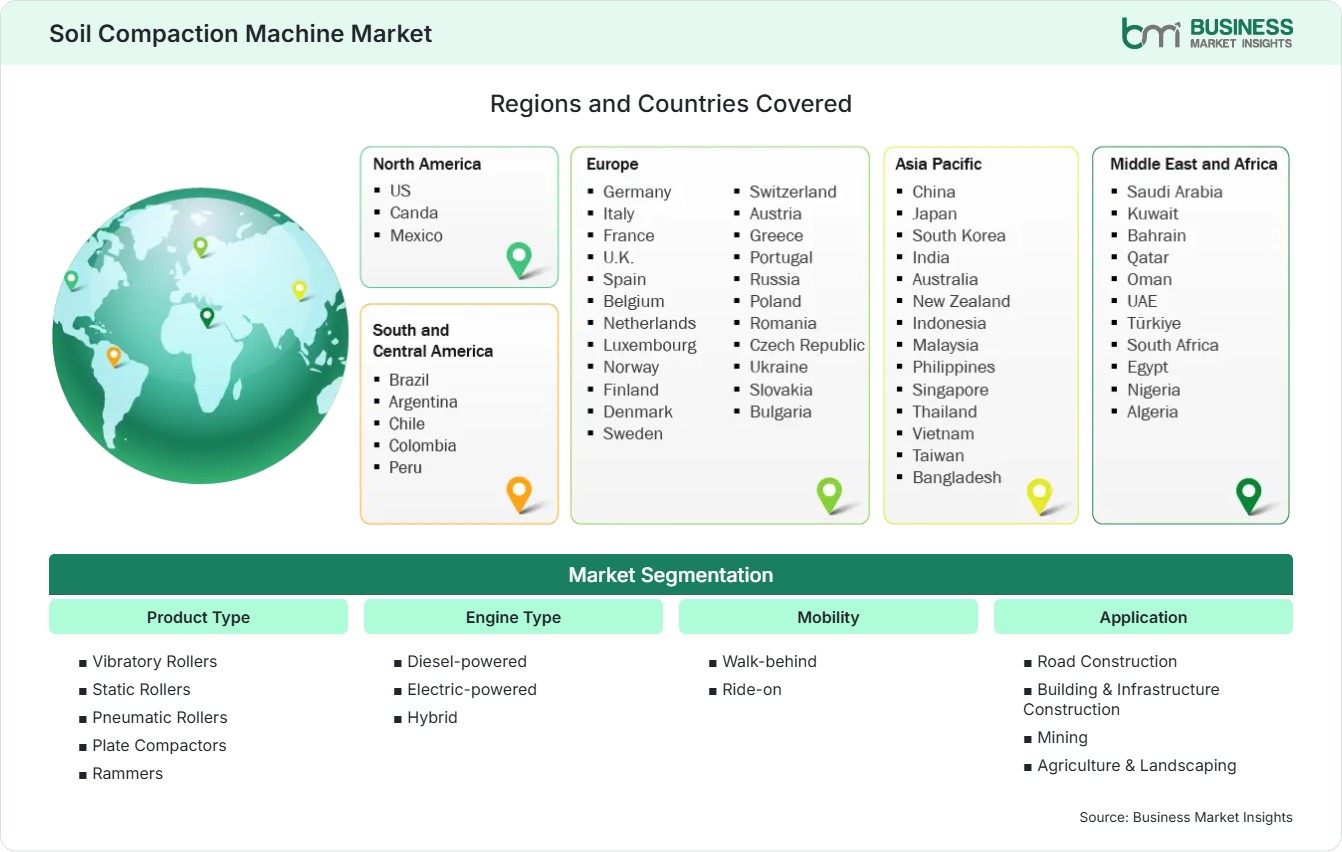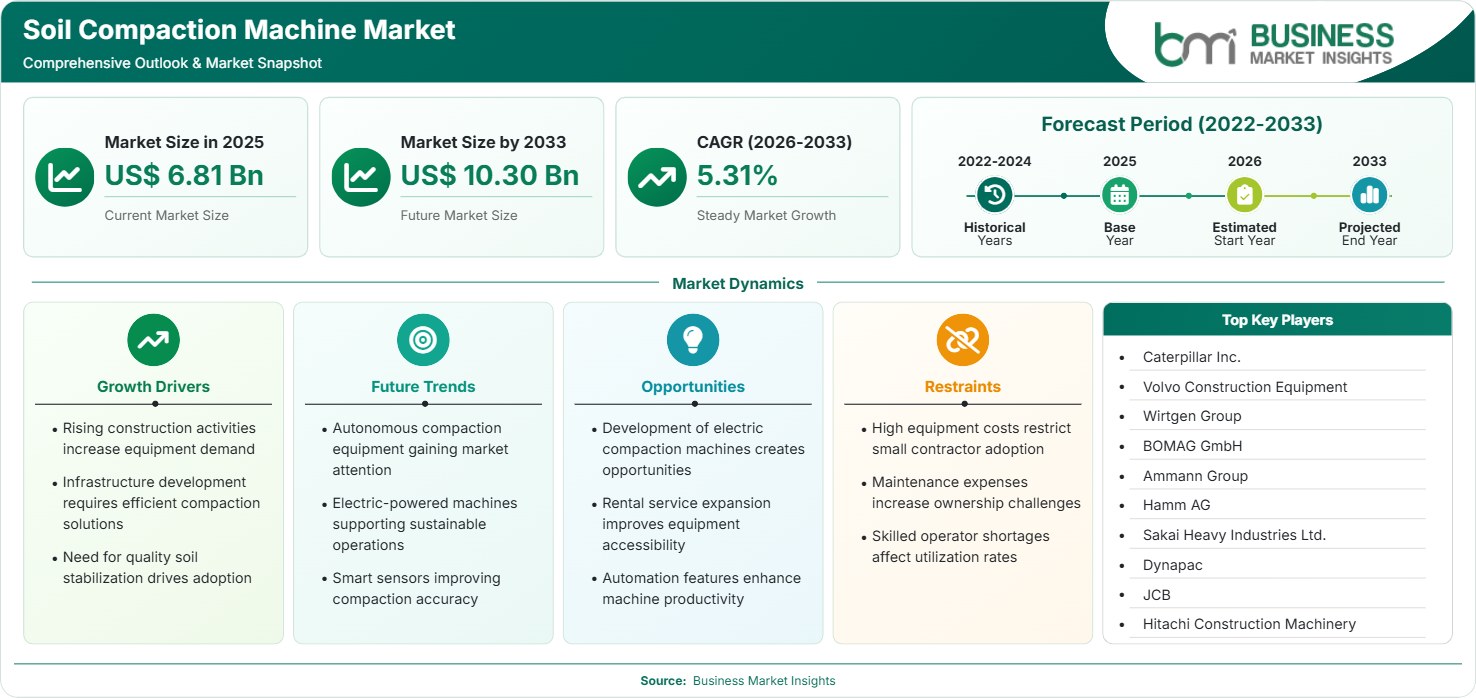
Soil Compaction Machine Market Regional Highlights
North America Soil Compaction Machine Market
North America accounted for 24%–27% Soil Compaction Machine Market share in 2025 and is expected to grow at a CAGR of 4.8%–5.3% during 2026–2033. Regional demand is supported by highway rehabilitation, commercial construction, municipal infrastructure, and replacement of aging machinery. The United States remains the largest contributor because of its extensive construction base, established equipment rental ecosystem, and demand for high-productivity machinery. Contractors increasingly prioritize equipment reliability, fuel efficiency, operator comfort, and maintenance support when replacing machines.
- Highway rehabilitation programs support replacement demand for vibratory rollers and compactors, particularly among contractors requiring dependable machines for recurring road maintenance and resurfacing projects.
- Equipment rental remains important for smaller contractors because flexible access to machinery reduces upfront capital requirements while enabling temporary capacity expansion during infrastructure and commercial construction peaks.
- Manufacturers are emphasizing telematics and service connectivity to improve fleet visibility, maintenance scheduling, utilization monitoring, and machine uptime across geographically distributed construction operations.
- Urban construction is encouraging interest in compact electric equipment where reduced exhaust emissions and lower operating noise can improve suitability for densely populated project locations.
US Soil Compaction Machine Market
The United States contributes 82%–85% of North American demand and is projected to register a CAGR of 4.9%–5.4% during 2026–2033. Demand benefits from road construction, commercial development, housing projects, utility work, and equipment replacement. Contractors continue to favor machines combining high productivity with operating efficiency, while rental companies support broader access to newer equipment. Large infrastructure projects also encourage demand for advanced rollers capable of maintaining consistent compaction quality across extensive work zones.
- Road rehabilitation remains a major demand source because contractors require reliable rollers and compactors for resurfacing, pavement preparation, and soil stabilization across transportation projects.
- Rental fleets are increasing equipment accessibility, allowing contractors to select machines according to project duration, site conditions, required compaction depth, and available operating capacity.
- Electrification is gaining application potential in urban projects where reduced emissions, lower noise, and compact machine configurations provide operational advantages compared with conventional equipment.
- Replacement demand is supported by aging construction fleets, with operators increasingly evaluating fuel consumption, service requirements, productivity, and digital monitoring when selecting new machinery.
Europe Soil Compaction Machine Market
Europe represents 25%–28% Soil Compaction Machine Market share in 2025 and is anticipated to grow at a CAGR of 4.6%–5.1% during 2026–2033. Germany remains a leading market because of its established machinery manufacturing ecosystem and extensive construction base. France and the United Kingdom provide additional demand through transportation, commercial, and civil engineering projects. Interest in lower-emission machinery is strengthening opportunities for electric and hybrid equipment, particularly in urban construction environments with tighter operating requirements.
- Germany remains an important equipment market because advanced construction practices, machinery expertise, and infrastructure requirements sustain demand for technologically developed compaction solutions.
- France offers opportunities through road rehabilitation, public infrastructure, commercial development, and contractors seeking machinery that improves productivity while controlling operating costs.
- The United Kingdom supports demand through infrastructure construction, housing development, utilities, and urban projects requiring compact equipment with improved maneuverability and lower environmental impact.
- Electric and hybrid machines are gaining attention as contractors evaluate alternatives that can reduce fuel consumption and improve suitability for environmentally sensitive construction locations.
Asia Pacific Soil Compaction Machine Market
Asia Pacific holds 40%–43% Soil Compaction Machine Market share in 2025 and is projected to achieve the highest CAGR of 6.2%–6.7% during 2026–2033. China remains the leading regional market because of its broad construction base and extensive infrastructure activity, while India represents a high-growth opportunity supported by transportation development and urbanization. Southeast Asian markets are also expanding as industrial, residential, and logistics infrastructure increases equipment utilization.
- China maintains strong equipment demand through transportation construction, urban development, industrial projects, and extensive contractor requirements for productive soil stabilization machinery.
- India is a high-growth market as road construction, housing development, industrial corridors, and infrastructure expansion increase requirements for rollers, compactors, and tampers.
- Southeast Asia is generating additional demand through logistics infrastructure, industrial facilities, urban development, and expanding construction activity across developing economies.
- Equipment rental is becoming increasingly relevant as contractors seek flexible access to modern machinery without committing substantial capital to ownership.
Rest of World Soil Compaction Machine Market
The Rest of World region accounts for 6%–9% Soil Compaction Machine Market share in 2025 and is expected to expand at a CAGR of 5.0%–5.5% during 2026–2033. South and Central America are supported by road development, urban construction, mining-related infrastructure, and agricultural projects. Brazil represents a leading opportunity because of its large construction and infrastructure base, while Mexico contributes through industrial and commercial development.
The Middle East and Africa provide additional opportunities through transport infrastructure, urban development, industrial projects, and land preparation requirements. Saudi Arabia and the United Arab Emirates represent important demand centers, while South Africa provides opportunities through infrastructure, mining, and construction activity. Contractors increasingly require machines capable of operating efficiently under challenging site conditions and demanding utilization cycles.
- Brazil supports equipment demand through transportation infrastructure, urban construction, agriculture-related development, and industrial projects requiring reliable compaction machinery.
- Saudi Arabia provides opportunities through large-scale urban, transportation, commercial, and industrial construction programs requiring high-capacity rollers and specialized compactors.
- South Africa supports demand through mining, infrastructure, road development, and commercial construction, creating requirements for durable equipment capable of operating under demanding conditions.