
Milling Machine Market Outlook: Size, Share, Trends, Growth Analysis, Competitive Landscape & Forecast, 2022-2033

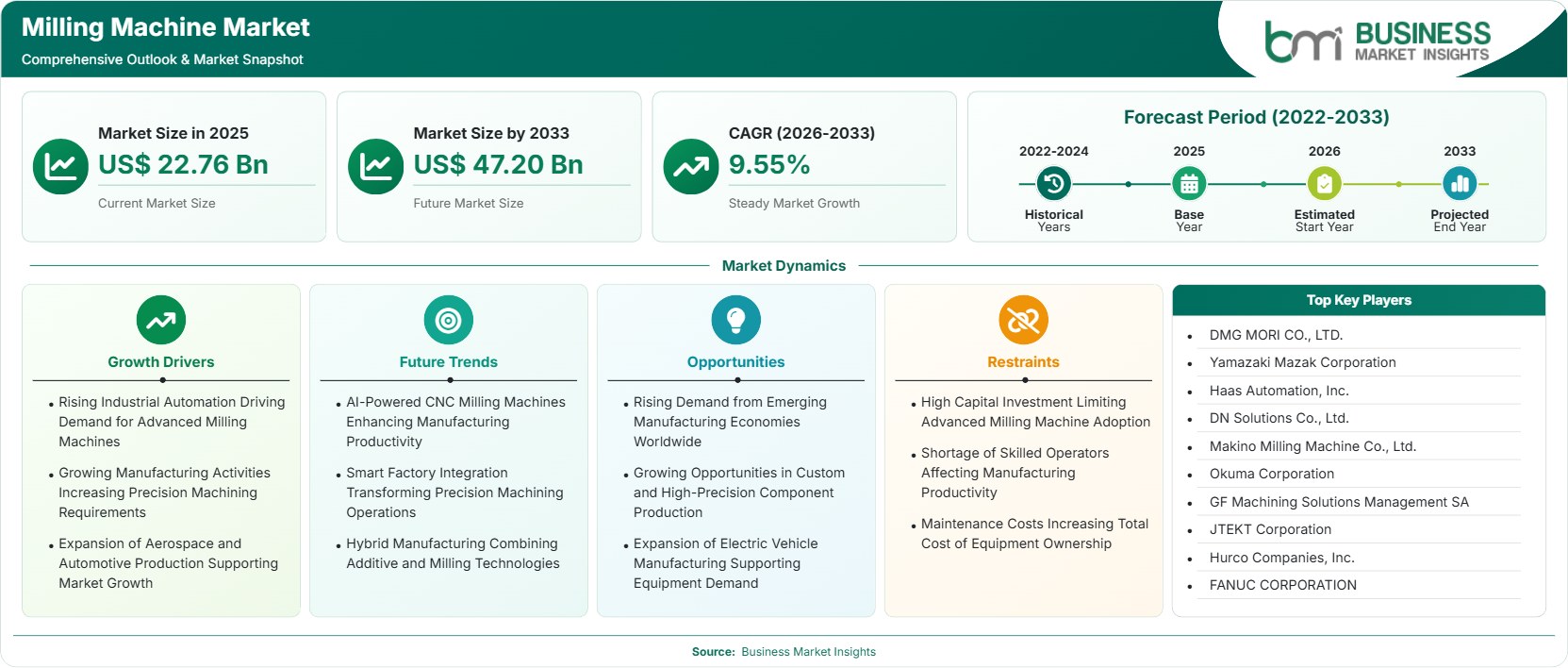
The Milling Machine Market size was valued at US$ 22.76 billion in 2025 and is projected to reach US$ 47.20 billion by 2033, growing at a CAGR of 9.55% during 2026–2033, driven by industrial automation, precision manufacturing, aerospace and automotive production, emerging manufacturing economies, customized components, and electric vehicle investments.

Report Coverage
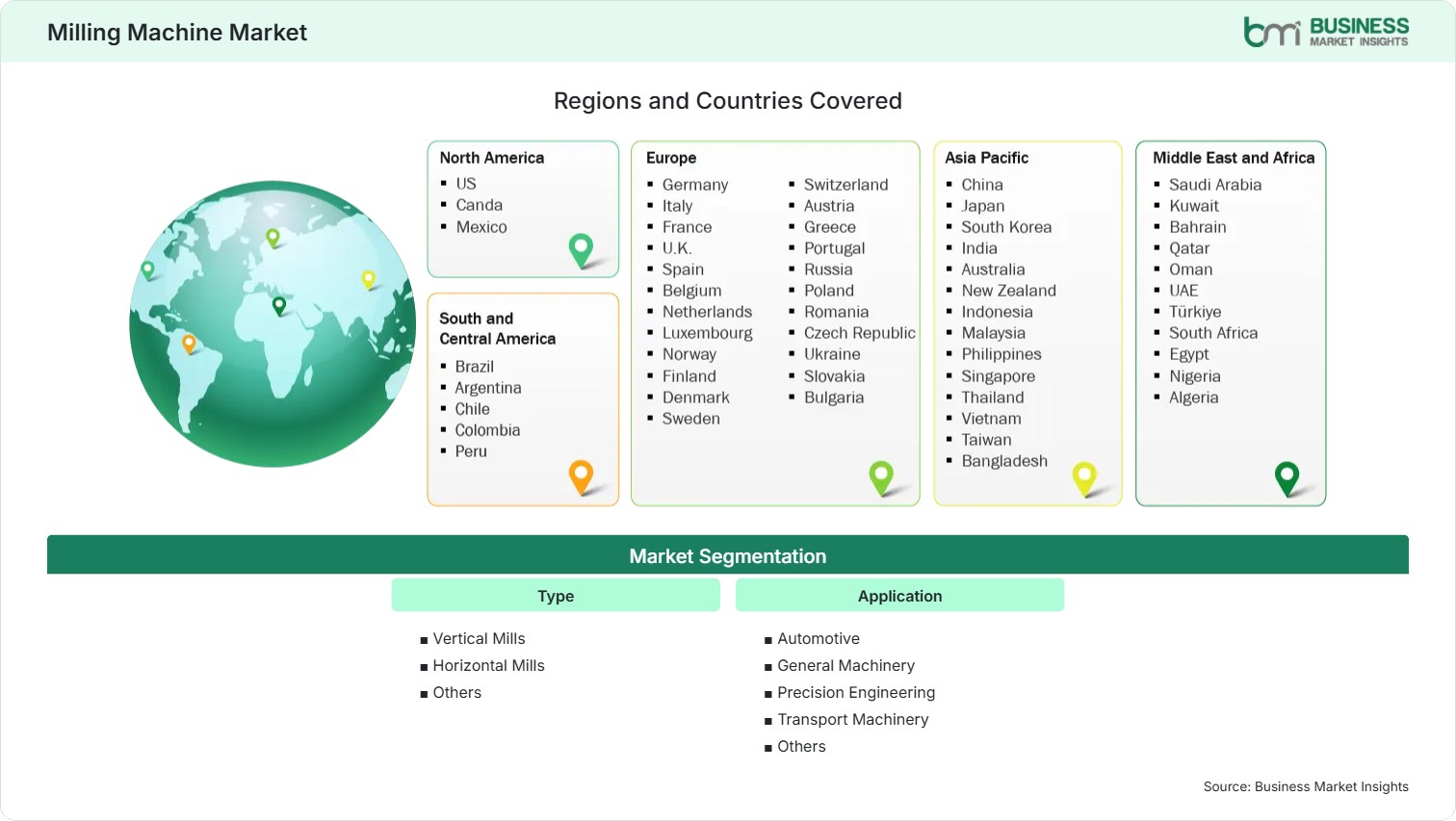
  • Type: Vertical Mills, Horizontal Mills, Others
  • Application: Automotive, General Machinery, Precision Engineering, Transport Machinery, Others
US$ 22.76 Bn Market size in 2025
US$ 47.20 Bn Market Size by 2033
9.55% CAGR, 2026 - 2033
2026-2033 Forecast Period

01 AI Overview

Milling Machine Market Summary

  • North America Region: North America holds a 24%–28% share in 2025, growing with a CAGR of 8.5%–9.5%, influenced by aerospace production, automotive reshoring, defense manufacturing, industrial automation, and demand for digitally connected CNC machining equipment. The US market is growing at an 8.5%–9.5% CAGR, supported by reshoring initiatives, aerospace investment, advanced automotive production, and modernization of aging machine tools.
  • Fastest Growing Region: Asia Pacific holds a 45%–49% share in 2025, growing with a CAGR of 10.5%–11.5%, supported by manufacturing expansion, industrial automation, automotive production, electronics manufacturing, infrastructure investment, and increasing adoption of advanced CNC machining.
  • Leading Segment: Vertical Mills hold a 53%–57% share in 2025, growing with a CAGR of 9.0%–10.0%, driven by versatile machining capabilities, compact footprints, broad application suitability, and demand from automotive and general machinery manufacturers.
  • High Growth Segment: Precision Engineering holds a 18%–22% milling machine market share in 2025, growing with a CAGR of 10.0%–11.0%, supported by tighter component tolerances, aerospace requirements, medical manufacturing, advanced tooling, and increasing demand for complex engineered parts.
  • Key Market Opportunity: Emerging manufacturing hubs, electric vehicle production, aerospace localization, and high-precision component requirements create opportunities for CNC machine suppliers offering automation, digital monitoring, multi-axis capabilities, and flexible production.
  • Major Market Players: DMG MORI CO., LTD., Yamazaki Mazak Corporation, Haas Automation, Inc., DN Solutions Co., Ltd., Makino Milling Machine Co., Ltd., Okuma Corporation, GF Machining Solutions Management SA, JTEKT Corporation, Hurco Companies, Inc., and FANUC CORPORATION.
02 Strategic Insights

Milling Machine Market: Strategic Insights

Milling Machine Market Strategic Framework
FREE PDF
Request your free sample
Request free sample
03 Stakeholder View

Key Takeaways

  • The industry ecosystem spans machine tool manufacturers, CNC control suppliers, robotics companies, cutting-tool producers, software providers, distributors, integrators, and after-sales service networks, making technology integration a major competitive factor.
  • Precision engineering and electric vehicle component manufacturing offer attractive growth potential because both require tighter tolerances, complex geometries, repeatable production, and increasingly automated machining processes.
  • Machine builders are prioritizing multi-axis machining, AI-assisted process optimization, digital twins, predictive maintenance, automated tool management, and connected factory platforms to improve machine utilization and production intelligence.
  • India, China, Vietnam, and selected Southeast Asian economies offer compelling expansion opportunities as manufacturers diversify supply chains, expand industrial capacity, and invest in localized production capabilities.
  • Strategic consolidation is increasingly focused on combining machine tool expertise with CNC controls, robotics, software, automation, and industrial data capabilities to create integrated manufacturing ecosystems.
  • After-sales service, machine uptime, operator training, retrofit capabilities, and access to spare parts are becoming increasingly important purchasing criteria as manufacturers seek to maximize the lifecycle value of high-cost equipment.
04 Geographic Outlook

Milling Machine Market Regional Highlights

North America Milling Machine Market

North America accounted for a 24%–28% share in 2025 and is projected to grow at an 8.5%–9.5% CAGR during 2026–2033. The region benefits from aerospace and defense manufacturing, automotive reshoring, advanced industrial automation, and investment in domestic production capacity. The US dominates regional demand, while Canada provides opportunities through aerospace, transportation equipment, energy machinery, and precision manufacturing. Digital CNC modernization is supporting replacement demand.

  • Expanding aircraft and defense production requires high-precision machining of complex components, supporting demand for multi-axis mills capable of maintaining tight tolerances and consistent production quality.
  • Manufacturers relocating production closer to domestic markets are investing in modern CNC equipment to improve productivity, reduce supply-chain dependence, and support flexible low-to-medium volume manufacturing.
  • Labor constraints are encouraging manufacturers to integrate robotic loading, automated tool management, and digital monitoring with milling systems to increase machine utilization and reduce operator dependency.
  • Aging machine fleets are creating replacement opportunities as manufacturers upgrade to connected CNC platforms offering improved accuracy, energy efficiency, diagnostics, and productivity.

US Milling Machine Market

The US milling machine market represented a 20%–24% share in 2025 and is expected to expand at an 8.5%–9.5% CAGR through 2033. Demand is supported by aerospace, defense, automotive, medical equipment, and general industrial manufacturing. Reshoring initiatives are encouraging investment in domestic production capacity, while labor shortages are accelerating automation.

  • High-value aerospace and defense components require precision machining and complex geometries, creating sustained demand for advanced multi-axis milling technologies and integrated inspection capabilities.
  • Domestic vehicle and component manufacturing expansion is supporting demand for flexible CNC equipment capable of machining diverse parts across conventional and electric vehicle platforms.
  • Persistent shortages of experienced machinists are encouraging manufacturers to adopt automation, simplified programming, remote monitoring, and process intelligence to reduce dependence on manual intervention.

Europe Milling Machine Market

Europe held a 21%–25% share in 2025 and Europe milling machine market forecast to register an 8.0%–9.0% CAGR through 2033. Germany leads regional demand through automotive, aerospace, machinery, and industrial engineering capabilities. Italy and Switzerland remain important precision manufacturing markets, while Poland is projected to grow at a 9.5%–10.5% CAGR as industrial investment and manufacturing localization expand.

  • Germany's automotive, aerospace, machinery, and industrial equipment sectors generate strong demand for high-precision milling systems with advanced automation and integrated process monitoring.
  • Italy's specialized machinery and industrial manufacturing base supports demand for flexible CNC equipment serving small and medium-sized manufacturers producing customized and complex components.
  • Switzerland's high-value precision engineering ecosystem creates demand for sophisticated machining technologies capable of achieving exceptional tolerances across specialized industrial and medical applications.
  • Poland's expanding manufacturing base and increasing integration into European industrial supply chains are supporting investment in modern CNC machinery and production automation.

Asia Pacific Milling Machine Market

Asia Pacific captured a 45%–49% share in 2025 and is expected to achieve a 10.5%–11.5% CAGR through 2033, making it the largest and fastest-growing regional market. China leads demand, while Japan and South Korea maintain advanced machine tool ecosystems. India is projected to grow at a 12.0%–13.0% CAGR as automotive, aerospace, infrastructure, electronics, and industrial manufacturing investment accelerates.

  • China's extensive manufacturing ecosystem and large automotive, electronics, machinery, and infrastructure sectors create substantial demand for both conventional and advanced CNC milling equipment.
  • Japan remains a leading technology center for precision machine tools, supported by sophisticated manufacturing capabilities, automation expertise, and strong domestic demand for high-performance CNC systems.
  • India's expanding automotive and aerospace industries, manufacturing localization, and infrastructure investment are driving demand for modern machine tools and automated production systems.
  • South Korea's automotive, electronics, shipbuilding, and industrial machinery sectors support demand for advanced machining technologies offering precision, productivity, and high-volume production capabilities.

Rest of World Milling Machine Market

South and Central America represented a 5%–8% share in 2025 and are expected to grow at a 7.5%–8.5% CAGR through 2033, led by Brazil and Mexico. Middle East and Africa accounted for a 4%–7% share, expanding at a 7.0%–8.0% CAGR. Mexico benefits from industrial localization, while Brazil's automotive and machinery sectors support demand. Gulf economies offer opportunities through industrial diversification programs.

  • Brazil's automotive, agricultural machinery, aerospace, and industrial equipment sectors provide opportunities for machine tool suppliers supporting modernization and increased domestic manufacturing capabilities.
  • Mexico's integration with North American automotive and industrial supply chains is encouraging manufacturers to invest in CNC equipment for localized component production and export-oriented manufacturing.
  • Saudi Arabia and the UAE are expanding industrial manufacturing capabilities, creating opportunities for machine tool suppliers supporting localization, energy equipment, transportation, and advanced industrial production.
  • Selected African markets are developing manufacturing capacity in automotive assembly, industrial equipment, and infrastructure-related industries, creating longer-term opportunities for cost-effective CNC machining technologies.
Global Market Geography
FREE PDF
Request your free sample
Request free sample
05 Segment Analysis

Milling Machine Market Segmentation

Type

Vertical Mills accounted for a 53%–57% share in 2025 and are projected to grow at a 9.0%–10.0% CAGR during 2026–2034. Their broad application range, easier accessibility, and suitability for diverse component geometries support widespread adoption. Horizontal Mills serve demanding high-volume applications requiring efficient chip removal and rigidity.

  • Vertical Mills: Vertical configurations offer versatility, accessibility, and broad application suitability, supporting demand from general machinery, automotive components, job shops, and precision manufacturing operations.
  • Horizontal Mills: Horizontal mills provide strong rigidity and efficient chip evacuation, making them suitable for high-volume production, heavy cutting, complex components, and demanding industrial machining applications.
  • Others: Specialized configurations include multi-axis and hybrid milling systems that address complex geometries, advanced materials, flexible production requirements, and increasingly automated manufacturing environments.

Application

Automotive represented a 27%–31% share in 2025 and is expected to grow at an 8.5%–9.5% CAGR through 2026–2034. General Machinery remains a major application due to broad component requirements, while Precision Engineering offers faster growth as tolerances tighten. Transport Machinery benefits from aerospace, rail, and marine manufacturing investment.

  • Automotive: Automotive manufacturers use milling machines for engine, transmission, chassis, tooling, and EV components, requiring repeatability, productivity, flexibility, and increasingly automated production.
  • General Machinery: General machinery applications span diverse industrial components, supporting demand for versatile milling equipment capable of handling varying batch sizes, materials, geometries, and production requirements.
  • Precision Engineering: Precision engineering requires advanced CNC capabilities, tight tolerances, multi-axis machining, and integrated inspection for aerospace, medical, electronics, and specialized industrial components.
  • Transport Machinery: Rail, aerospace, marine, and other transport equipment manufacturers require robust machining systems capable of producing large, complex, and high-strength components with consistent dimensional accuracy.
  • Others: Other applications include energy equipment, tooling, construction machinery, and specialized manufacturing, creating demand for adaptable machines with application-specific performance capabilities.
06 Market Forces

Milling Machine Market Dynamics

Key Market Drivers

Rising Industrial Automation Driving Demand for Advanced Milling Machines

Industrial automation is driving the requirement for sophisticated milling machines as companies are demanding more output, consistency, and better machine utilization. The Milling Machine Market growth is becoming highly dependent on the use of CNC control, robotics, automatic tool change, machine vision, and production monitoring. Through automation, manufacturing companies can achieve less set up time, less manual work, and consistency in their manufacturing operations. Digital connectivity also enables remote diagnostics and predictive maintenance, helping reduce unexpected downtime.

Growing Manufacturing Activities Increasing Precision Machining Requirements

Growing manufacturing activities are creating greater need for machinery that can produce complicated parts with tight tolerances and consistency in operation. The manufacturers of automobiles, aircrafts, medical devices, electronic equipment, and heavy machinery are increasingly manufacturing parts with complex configurations and dimensions. This trend is driving the need for adoption of CNC milling machines with multiple axes of movement, fast spindles, sophisticated controls, and measuring systems. Milling Machine Market trends are also shifting toward flexible equipment capable of handling shorter production runs and frequent product changes.

Expansion of Aerospace and Automotive Production Supporting Market Growth

Growth in aerospace and automotive production is increasing demand for milling machines capable of handling complex, high-value parts. There is a need for precision machining in aerospace companies to manufacture structural parts, engines, and systems. On the other hand, there is a need for high-volume machines to manufacture parts of the power train, chassis, tooling, and electric vehicles. Investment in manufacturing is growing and prompting suppliers to upgrade their production capacity to use CNC machines.

Key Market Opportunities

Rising Demand from Emerging Manufacturing Economies Worldwide

Emerging manufacturing economies are providing substantial room for growth since firms are expanding their footprint in manufacturing, and the local governments are encouraging the development of industrial capabilities. There are multiple countries that are getting investments in the field of manufacturing, including India, Vietnam, Indonesia, Mexico, and certain countries from Eastern Europe, in fields such as automotive, electronics, machinery, and industrial equipment. There is a demand for new machines apart from the existing machines that would get replaced. Suppliers could leverage these chances through scalable CNC systems, technical services, training, financing, and service networks. Entry-level automation can provide a pathway for smaller manufacturers to transition from conventional equipment toward digitally connected production.

Growing Opportunities in Custom and High-Precision Component Production

The growing complexity of industrial components is creating opportunities for high-precision milling technologies capable of producing customized parts in smaller batches. Aerospace, medical devices, robotics, semiconductor equipment, and specialized machinery increasingly require components with complex geometries and tight tolerances. Advanced multi-axis milling can reduce the number of setups while improving dimensional consistency and surface quality. This creates a favourable environment for machines equipped with sophisticated CNC controls, high-speed spindles, probing systems, and integrated inspection.

Expansion of Electric Vehicle Manufacturing Supporting Equipment Demand

Manufacturing electric vehicles will increase demand for machine tools, as the production of motors, batteries, electronic controls, lightweight construction, and special components must be established. Though electric vehicle engines have fewer moving mechanical parts compared to the internal combustion engine, manufacturers need to provide precise enclosures, cooling systems, tooling, and structural components. There is also increased demand for machines used in the manufacturing of batteries and production equipment and special components. This investment is most lucrative in regions that develop their own electric-vehicle ecosystems.

Market Restraints and Challenges

High Capital Investment Limiting Advanced Milling Machine Adoption

Factor: Highly advanced CNC milling machines that are multi-axis, automated, fast-spinning, have integrated measurements, and digital connectivity require substantial upfront capital expenditure. Small companies may find it difficult to make investments in such machinery, especially when production levels are not certain or when capital restrictions exist.

Impact: Initial cost issues may slow down modernization, leading to a continued use of old machines and hindering productivity gains or advancement of technology. The challenge is particularly significant among small and medium-sized manufacturers that face competing capital requirements.

Shortage of Skilled Operators Affecting Manufacturing Productivity

Factor: The milling process is becoming more dependent on employees who are able to program CNC machines, control tools, read blueprints, set machining parameters and maintain automated cells. The lack of qualified machinists and CNC operators could become a hindrance for new machinery’s productivity.

Impact: The companies will be forced to work with the expensive equipment in less than optimum mode or go through longer learning periods without having the necessary people on board.

07 Company Analysis

Competitive Landscape

The Milling Machine Market analysis reflects a highly competitive global landscape comprising established machine tool manufacturers, CNC specialists, automation providers, and integrated industrial technology companies. Competitive positioning increasingly depends on machine precision, spindle performance, multi-axis capabilities, automation integration, software intelligence, and energy efficiency.

Company Name

Overview

Products and Services relevant to this market

DMG MORI CO., LTD.

Global machine tool manufacturer offering advanced CNC equipment and integrated digital manufacturing solutions across industrial sectors.

CNC milling machines, machining centers, multi-axis systems, automation, digital manufacturing, and lifecycle services.

Yamazaki Mazak Corporation

Japanese machine tool manufacturer recognized for advanced CNC systems serving automotive, aerospace, and general manufacturing.

Vertical and horizontal machining centers, multi-tasking machines, CNC systems, automation, and manufacturing software.

Haas Automation, Inc.

Major CNC machine tool manufacturer serving manufacturers, job shops, education, and industrial customers worldwide.

CNC vertical and horizontal machining centers, rotary products, automation, and machining accessories.

DN Solutions Co., Ltd.

Global machine tool company providing CNC machining solutions across automotive, aerospace, and general industries.

CNC milling machines, machining centers, multi-axis systems, automation, and integrated manufacturing solutions.

Makino Milling Machine Co., Ltd.

Japanese precision machine tool company specializing in high-performance machining for demanding industrial applications.

Vertical and horizontal machining centers, five-axis machines, high-speed machining, automation, and digital solutions.

Okuma Corporation

Japanese manufacturer offering CNC machine tools and control systems for advanced manufacturing environments.

CNC machining centers, vertical and horizontal mills, CNC controls, automation, and smart manufacturing technologies.

GF Machining Solutions Management SA

Swiss manufacturing technology provider focused on precision machining and advanced production solutions.

Milling machines, high-speed machining, automation, software, and precision manufacturing solutions.

JTEKT Corporation

Japanese industrial manufacturer supplying machine tools and manufacturing technologies alongside automotive and industrial products.

CNC machining centers, grinding technologies, machine tools, automation, and production engineering solutions.

Hurco Companies, Inc.

CNC machine tool manufacturer known for conversational programming and solutions targeting flexible manufacturing operations.

CNC mills, machining centers, controls, automation, and integrated programming technologies.

FANUC CORPORATION

Global industrial automation and CNC technology provider supporting highly automated manufacturing operations worldwide.

CNC controls, machining centers, industrial robots, automation systems, digital manufacturing, and factory integration solutions.


10 Trust & Transparency

Research Methodology

The market analysis combines proprietary research with secondary data from government agencies, company disclosures, regulatory filings, industry databases and expert interviews. Market estimates are validated through data triangulation, cross-market benchmarking and analyst review.

View Full Research Methodology

11 Questions Answered

Frequently Asked Questions

What is the biggest challenge for small manufacturers?

High capital expenditure remains a major challenge. Smaller manufacturers may also face limited access to skilled CNC operators, financing, and technical support.

What technologies are improving milling machine market report productivity?

Automation, multi-axis machining, digital twins, predictive maintenance, machine monitoring, AI-assisted optimization, automated tool management, and integrated inspection are improving productivity.

How are electric vehicles affecting milling machine demand?

EV manufacturing is creating demand for equipment used to produce motor housings, battery-related components, lightweight structures, tooling, and specialized production equipment.

Why is Asia Pacific the largest regional market?

Asia Pacific combines large-scale automotive and industrial production with extensive electronics, machinery, and infrastructure manufacturing.

Which industries are the largest users of milling machines?

Automotive, aerospace, general machinery, precision engineering, transportation equipment, energy, medical devices, and industrial tooling are major users.

Access the Full Milling Machine Market Report

Get segment-level forecasts, regional estimates, competitive benchmarking, company profiles and downloadable Excel datasets.

Access the full Milling Machine Market Report
350 pages PDF & Excel | 2026-08-03