
Machine Automation Controllers Market Outlook: Size, Share, Trends, Growth Analysis, Competitive Landscape & Forecast, 2026-2033

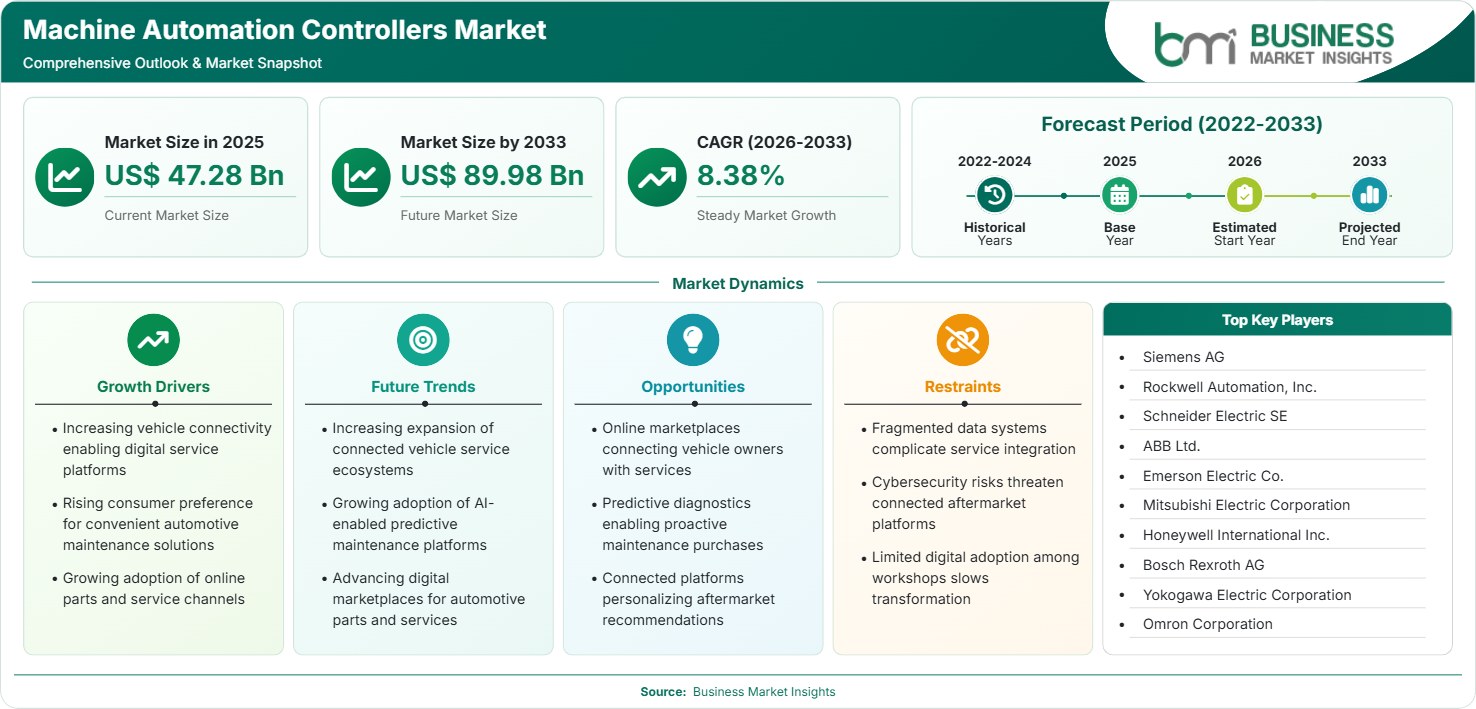
The Machine Automation Controllers Market size was valued at US$ 47.28 Billion in 2025 and is projected to reach US$ 89.98 Billion by 2033, growing at a CAGR of 8.38% during 2026–2033. Growth is supported by Industry 4.0 adoption, smart factory investments, industrial AI integration, advanced robotics deployment, predictive maintenance initiatives, and expanding automation requirements across automotive, electronics, pharmaceutical, and process industries.

Report Coverage
  • Machine Operation Type: Discrete Manufacturing, Batch Process, Continuous Process
  • End Use Industry: Automotive, Electronics & Semiconductors, Food & Beverage Processing, Chemicals & Petrochemicals, Oil & Gas, Pharmaceuticals & Biotechnology, Others
US$ 47.28 Bn Market size in 2025
US$ 89.98 Bn Market Size by 2033
8.38% CAGR, 2026 - 2033
2026-2033 Forecast Period

AI Overview

Machine Automation Controllers Market Summary

  • North America Region: North America holds a market share of 28%–31% in 2025, growing at a CAGR of 7.7%–8.1% during 2026–2033. Growth stems from industrial digitalization, smart manufacturing investments, workforce optimization requirements, cybersecurity-focused automation upgrades, and integration of AI-enabled industrial control platforms. The US market benefits from reshoring initiatives, advanced manufacturing investments, and industrial software adoption, supporting a CAGR of 7.8%–8.2%.
  • Fastest Growing Region: Asia Pacific holds a market share of 38%–41% in 2025, growing at a CAGR of 9.4%–9.8% during 2026–2033. Growth is driven by electronics manufacturing expansion, factory modernization, robotics deployment, government industrial policies, local automation investments, and increasing demand for connected production systems.
  • Leading Segment: Programmable Logic Controllers holds a market share of 33%–36% in 2025, growing at a CAGR of 7.8%–8.3% during 2026–2033. Adoption remains strong due to reliability, scalable architectures, simplified programming, widespread industrial compatibility, and growing use in automated production environments.
  • High Growth Segment: Programmable Automation Controllers holds a market share of 12%–15% in 2025, growing at a CAGR of 10.0%–10.5% during 2026–2033. Demand rises as manufacturers require integrated control, analytics, motion management, network connectivity, and flexible automation performance.
  • Key Market Opportunity: Edge-enabled industrial control platforms that combine operational technology, AI analytics, digital twins, and cloud connectivity deliver measurable productivity gains while supporting sustainability, predictive maintenance, and asset lifecycle optimization.
  • Major Market Players: Siemens AG, Rockwell Automation, Inc., Schneider Electric SE, ABB Ltd., Emerson Electric Co., Mitsubishi Electric Corporation, Honeywell International Inc., Bosch Rexroth AG, Yokogawa Electric Corporation, Omron Corporation.
Strategic Insights

Machine Automation Controllers Market: Strategic Insights

Machine Automation Controllers Market Strategic Framework
FREE PDF
Request your free sample
Request free sample
Stakeholder View

Key Takeaways

  • Control platforms are increasingly positioned as the core intelligence layer connecting sensors, industrial networks, robotics, and enterprise software across manufacturing ecosystems.
  • Electronics, semiconductor fabrication, battery production, and pharmaceutical manufacturing offer some of the strongest automation investment opportunities through 2033.
  • Vendors are prioritizing open architectures, AI-assisted programming, edge analytics, and cybersecurity-focused designs to differentiate next-generation controller portfolios.
  • Asia Pacific presents the strongest capacity-expansion opportunity, supported by industrial policy initiatives in China, India, South Korea, and Southeast Asia.
  • Strategic acquisitions increasingly focus on industrial software, digital twin technologies, machine vision, and industrial cybersecurity capabilities.
  • Sustainability objectives are encouraging deployment of controllers capable of monitoring energy consumption, emissions performance, and production efficiency in real time.
Geographic Outlook

Machine Automation Controllers Market Regional Highlights

North America Machine Automation Controllers Market

North America accounts for approximately 28%–31% share in 2025 and is anticipated to grow at a CAGR of 7.7%–8.1% through 2033. Strong demand stems from automotive production, warehouse automation, food-processing modernization, and industrial AI adoption. Investments in factory digitization, industrial cybersecurity, and reshoring initiatives continue to support demand. The region benefits from a mature automation ecosystem, extensive software integration capabilities, and high adoption of connected manufacturing technologies. The Machine Automation Controllers Market share remains substantial due to continuous technology upgrades.

  • Automotive and aerospace facilities increasingly deploy advanced controller architectures to enhance production flexibility and reduce unplanned downtime.
  • Industrial cybersecurity investments support the replacement of aging equipment and accelerate the adoption of secure networked automation platforms.
  • AI-enabled analytics and predictive maintenance capabilities are becoming standard features across new automation projects.
  • Growing deployments of warehouse automation and logistics robotics are expanding controller demand beyond traditional manufacturing environments.

US Machine Automation Controllers Market

The United States represents 76%–80% of regional revenue and records CAGR of 7.8%–8.2%. Government support for advanced manufacturing and domestic semiconductor capacity expansion strengthens automation spending. Industrial operators continue modernizing legacy plants through integrated control, software, and analytics solutions. Demand remains particularly strong in automotive, semiconductor, logistics, defense, and pharmaceutical sectors.

  • Semiconductor fabrication investments increase demand for highly reliable and scalable automation infrastructure.
  • Digital transformation initiatives encourage the adoption of software-centric industrial control environments.
  • Pharmaceutical manufacturing expansion supports sophisticated batch processing automation requirements.

Europe Machine Automation Controllers Market

Europe captures 24%–27% share in 2025 and advances at a CAGR of 7.5%–7.9%. Germany remains the leading regional market while Eastern European manufacturing hubs demonstrate faster growth near 8.5%–9.0%. Industrial sustainability objectives, smart factory initiatives, and energy-efficiency requirements continue to shape purchasing decisions. Manufacturers increasingly prioritize interoperable automation solutions supporting diverse production environments.

  • Germany leads regional demand through advanced automotive, machinery, and industrial engineering sectors.
  • Italy and France continue investing in factory modernization and digital manufacturing technologies.
  • Sustainability regulations encourage the deployment of intelligent control systems for energy optimization.
  • Industrial cybersecurity compliance contributes to the replacement of outdated automation infrastructure.

Asia Pacific Machine Automation Controllers Market

Asia Pacific holds 38%–41% share in 2025 and records the fastest CAGR of 9.4%–9.8%. China leads regional revenue generation, while India and Southeast Asia are among the fastest-growing investment destinations. The Machine Automation Controllers Market growth in this region is supported by electronics manufacturing expansion, robotics adoption, industrial policy programs, and electric vehicle supply-chain development. Strong manufacturing activity creates sustained controller demand.

  • China remains the largest consumer of automation equipment across electronics, machinery, and automotive industries.
  • India benefits from industrial incentives, manufacturing diversification, and growing investments in digitalization.
  • Semiconductor investments in Taiwan and South Korea create demand for advanced control platforms.
  • Rising labor costs encourage broader adoption of automation across production facilities.

Rest of World Machine Automation Controllers Market

Rest of World accounts for 8%–10% Machine Automation Controllers Market share and grows at a CAGR of 8.3%–8.7%. South and Central America benefit from food processing, mining, and packaging automation investments. Meanwhile, adoption in the Middle East and Africa is supported by industrial diversification and energy-sector modernization initiatives. Countries including Brazil, Saudi Arabia, and the UAE increasingly deploy automation solutions to improve operational efficiency.

  • Brazil leads Latin American adoption through manufacturing modernization and industrial productivity initiatives.
  • Mining automation investments support controller deployment across resource-intensive industries.
  • Gulf countries invest heavily in industrial digital transformation programs.
  • Energy sector modernization encourages the implementation of advanced process control.
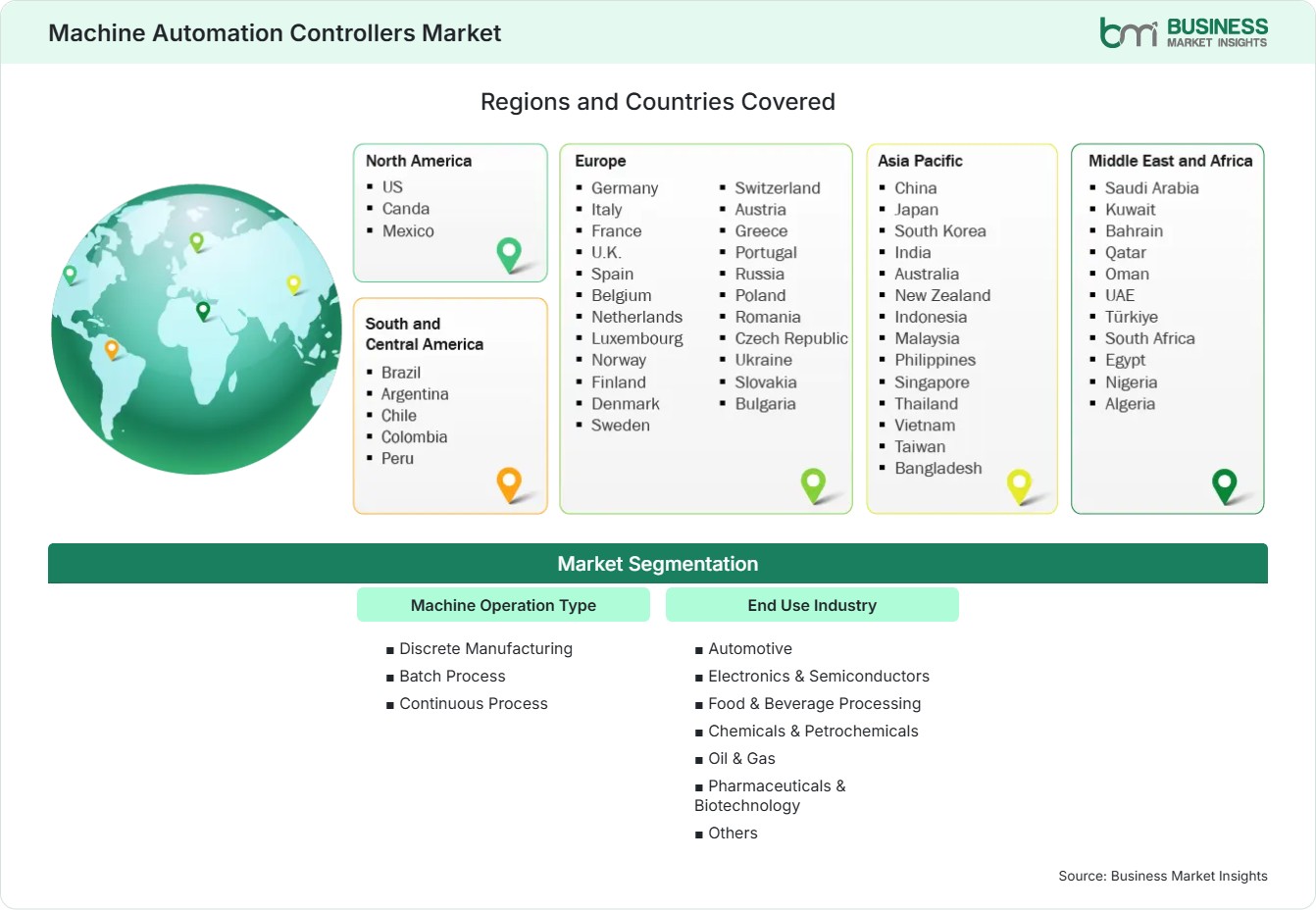
Global Market Geography
FREE PDF
Request your free sample
Request free sample
Segment Analysis

Machine Automation Controllers Market Segmentation

Controller Type

Controller Type represents the largest revenue contribution, with Programmable Logic Controllers maintaining leadership. The segment accounts for 33%–36% share in 2025 and grows at 7.8%–8.3% CAGR. Machine Automation Controllers Market scope continues expanding as manufacturers adopt intelligent, connected, and software-driven control platforms integrating analytics and operational visibility.

  • Programmable Logic Controllers: Widely used across manufacturing operations because of reliability, ease of programming, robust performance, and compatibility with extensive industrial communication protocols.
  • Programmable Automation Controllers: Increasing adoption across complex production environments requiring integrated control, motion coordination, networking capabilities, and real-time operational intelligence.
  • Distributed Control Systems: Preferred in process-intensive industries where centralized monitoring, reliability, and scalability are essential for plant-wide operational management.
  • Industrial PC-Based Controllers (IPC/Soft PLC): Growing demand stems from computing flexibility, software integration benefits, data processing capabilities, and advanced analytics functionality.
  • Dedicated Motion Controllers: Utilized in robotics, packaging, and precision manufacturing applications requiring synchronized movement, accuracy improvements, and high-speed operation.
  • CNC Controllers: Critical for machine tool automation, supporting precise manufacturing, customization requirements, and efficient production workflows.

Machine Operation Type

Discrete manufacturing dominates this segment with an estimated 46%–49% Machine Automation Controllers Market share in 2025 and CAGR of 8.0%–8.5%. Increasing automation investment across automotive, electronics, and machinery production facilities continues supporting demand.

  • Discrete Manufacturing: Extensive use of robotics, machine vision, and production automation sustains demand for advanced multi-function controller platforms.
  • Batch Process: Strong adoption in pharmaceuticals, chemicals, and food industries where production flexibility and process consistency remain critical objectives.
  • Continuous Process: Process industries leverage controllers for operational stability, safety management, and uninterrupted production performance.

End Use Industry

Automotive remains a leading industrial user group, accounting for approximately 18%–21% share in 2025. Machine Automation Controllers Market trends indicate accelerating investment across electronics, semiconductor, and pharmaceutical production environments as factories seek higher productivity and precision.

  • Automotive: Demand driven by robotics integration, electric vehicle manufacturing growth, and requirements for flexible production architectures.
  • Electronics & Semiconductors: Precision manufacturing, cleanroom automation, and semiconductor capacity expansion support sustained controller adoption.
  • Food & Beverage Processing: A growing focus on quality assurance, traceability, and operational efficiency is strengthening automation investments.
  • Chemicals & Petrochemicals: Companies deploy advanced control systems to improve safety, asset utilization, and process optimization.
  • Oil & Gas: Harsh operating environments and process complexity drive demand for robust, secure control platforms.
  • Pharmaceuticals & Biotechnology: Regulatory compliance, batch control precision, and digital manufacturing strategies encourage advanced automation adoption.
Market Forces

Machine Automation Controllers Market Dynamics

Key Market Drivers

Industry 4.0 and Smart Factory Deployment

Governments and manufacturers are continuing to invest heavily in digital manufacturing and smart factory initiatives. The growing use of Industrial IoT connectivity, digital twins, and real-time operational intelligence is driving the need for advanced controllers that serve as central platforms for factory automation. Manufacturers want systems that can connect production equipment, collect operational data, support analytics, and manage different processes from a more integrated environment. The wider adoption of collaborative robots and intelligent manufacturing systems is also supporting controller demand. As factories focus on improving productivity, reducing manual intervention, and making better use of production data, the Machine Automation Controllers Market growth remains closely connected with smart factory deployment and the expansion of digital manufacturing infrastructure worldwide.

Rising Robotics and Motion Control Integration

The greater extent to which industrial robots are being used in fields such as automotive manufacturing, electronics, logistics, and packaging is driving increased demand for sophisticated automation controllers. Since modern robots require control systems that can coordinate movement, communication, and real-time decision-making while ensuring accuracy and speed, this is becoming increasingly important. Manufacturers are also adopting automation to cope with labor shortages, enhance product quality, and achieve higher productivity. With robotics becoming more closely linked to edge analytics and other intelligent technologies, the controller systems in use are becoming both more capable and more complex. The ever-increasing use of autonomous material-handling equipment and fast production machines is opening up further possibilities for intelligent control systems. These systems enable different machines and processes to be coordinated, which in turn allows manufacturers to improve their operational efficiency, keep their output consistent, and make better use of the resources at their disposal.

Need for Operational Efficiency and Downtime Reduction

Companies across industries are under continual pressure to keep operating costs under control, boost production efficiency, and achieve better performance from their current equipment. By using modern automation controllers, these objectives can be achieved through real-time monitoring, predictive maintenance, process optimization, and better equipment management. Rather than relying on machines to break down, operators can use data and advanced diagnostic tools to detect potential problems earlier and make the necessary corrections before a major production disruption occurs. Moreover, automation systems can assist manufacturers in monitoring their energy consumption and identifying ways to reduce unnecessary usage, thus helping them meet their broader sustainability goals. Since businesses expect clear returns on their investments in digital transformation, there is a growing demand for control systems that provide actionable operational data, enhance equipment reliability, and improve production outcomes in both discrete and process manufacturing settings.

Key Market Opportunities

Expansion of Edge Intelligence in Industrial Control

The growing adoption of edge computing is creating significant opportunities for machine automation controller providers. By processing data closer to production equipment rather than sending all data to a remote system, edge-enabled controllers can help manufacturers achieve faster response times, lower latency, and better operational control. This capability is useful for applications such as predictive maintenance, quality monitoring, machine optimization, and increasingly autonomous production processes. Machine Automation Controllers Market Forecasts are therefore increasingly influenced by demand for decentralized automation solutions that combine control functions with analytics and cybersecurity capabilities. Manufacturers also benefit from being able to respond to production conditions more quickly. Vendors that can offer scalable edge platforms with cloud connectivity and AI-based functionality may be well-positioned to capture long-term opportunities as factories continue moving toward more intelligent and connected automation environments.

Automation Investments in Emerging Manufacturing Economies

The fact that manufacturing is expanding in India, Vietnam, Indonesia, Mexico, and other developing countries is leading to great prospects for suppliers of automation equipment. When companies set up new production facilities or shift some of their manufacturing to these areas, they can integrate modern automation systems from the start rather than relying on outdated infrastructure. The demand can thus be generated for controllers, software, integration services, supporting hardware, and long-term maintenance. Since investment is increasing in the production of electric vehicles, renewable energy equipment, electronics, and other sophisticated industries, the need for efficient production technologies is also rising. Those suppliers who understand the requirements of the local market and who offer cost-effective products together with technical support and local services can achieve a competitive advantage. As the manufacturing abilities of developing economies improve, automation suppliers will have the opportunity to build up long-term relationships with new industrial customers.

Industrial AI and Autonomous Operations Development

Artificial intelligence is increasingly impacting industrial control strategies by enabling manufacturers to make quicker, more informed decisions. Automation controllers are increasingly becoming more than just simple hardware; many current systems offer AI-driven optimization, production analytics, predictive insights, and adaptive automation. Manufacturers are looking into these features to improve their production planning, detect equipment faults, manage quality control, and respond to changing operating conditions. The demand for generative AI engineering tools and for autonomous operational functions is also leading to the emergence of new areas of development for controller suppliers. Those companies that invest in industrial software ecosystems, data platforms, and machine-learning applications can set their solutions apart from those based solely on traditional hardware performance. This change also opens up opportunities for recurring revenue from software and digital services while enabling vendors to build stronger relationships with their customers. As factories move towards more autonomous operations, intelligent controllers are expected to become an increasingly important element of modern industrial automation systems.

Market Restraints and Challenges

High Integration Complexity Across Legacy Environments

Many facilities are still using automation infrastructure that was developed over a span of several technology generations. This leads to greater integration difficulties, longer deployment times, higher engineering costs, and more stringent system validation needs. Companies frequently encounter compatibility problems relating to communication protocols, software environments, and hardware architectures. Such limitations can slow modernization initiatives and reduce the speed of implementation. For smaller manufacturers, it is difficult to justify replacing their entire control system due to the risks of operational disruption and the capital expenditure required. Consequently, adoption rates can vary greatly across industry sectors and geographic areas.

Industrial Cybersecurity Risks and Skills Shortages

The greater the level of connectivity, the more industrial networks are exposed to cybersecurity threats, and the higher the demand for automation specialists. As a result, companies are forced to spend more on network protection, compliance, and workforce development. There is often a lack of engineers among industrial operators who have skills in advanced automation, analytics, and cybersecurity. Growing security concerns can delay deployment decisions, especially in the case of critical infrastructure. Overcoming these problems requires a major investment in training, governance frameworks, and secure technology architectures to safeguard production continuity.

Company Analysis

Competitive Landscape

Machine Automation Controllers Market analysis indicates competition is centered on integrated automation ecosystems, industrial software capabilities, cybersecurity features, and lifecycle service offerings.

Company Name

Overview

Products and Services relevant to this market

Siemens AG

Global automation leader with extensive industrial software and digital manufacturing portfolio.

SIMATIC PLCs, industrial controllers, motion systems, digital twin platforms, industrial software.

Rockwell Automation, Inc.

Major provider of industrial automation and digital transformation solutions.

ControlLogix controllers, FactoryTalk software, motion control and networked automation solutions.

Schneider Electric SE

Focuses on industrial automation, energy management, and digital operations.

Modicon PLCs, EcoStruxure platforms, industrial control and automation software.

ABB Ltd.

Strong presence across robotics, process automation, and electrification.

PLCs, DCS platforms, motion control technologies, industrial analytics solutions.

Emerson Electric Co.

Major process automation specialist serving multiple industries.

DeltaV systems, programmable controllers, process monitoring and optimization tools.

Mitsubishi Electric Corporation

Leading supplier of factory automation equipment and control systems.

MELSEC PLCs, motion controllers, CNC solutions, industrial networking products.

Honeywell International Inc.

Significant participant in industrial automation and process industries.

Distributed control systems, industrial software, safety and automation platforms.

Bosch Rexroth AG

Industrial motion and automation technology specialist.

Motion controllers, drive systems, automation software, connected factory solutions.

Yokogawa Electric Corporation

Process automation provider with global industrial presence.

DCS platforms, control systems, industrial monitoring and optimization solutions.

Omron Corporation

Automation company focused on sensing and control technologies.

PLCs, machine automation controllers, safety systems, industrial sensing solutions.

Trust & Transparency

Research Methodology

The market analysis combines proprietary research with secondary data from government agencies, company disclosures, regulatory filings, industry databases and expert interviews. Market estimates are validated through data triangulation, cross-market benchmarking and analyst review.

View Full Research Methodology

Questions Answered

Frequently Asked Questions

What does a Machine Automation Controllers Market Report typically evaluate?

It assesses market size, competitive positioning, technology evolution, regional dynamics, growth opportunities, customer demand patterns, regulatory influences, and future industry outlook.

How does AI influence automation controller development?

AI supports predictive maintenance, intelligent diagnostics, production optimization, autonomous decision-making, and enhanced engineering productivity within modern automation ecosystems.

Which region presents the strongest growth potential?

Asia Pacific offers the strongest expansion prospects because of manufacturing growth, automation investments, electronics production, and supportive industrial development initiatives.

Which controller type currently leads industry demand?

Programmable Logic Controllers remain the leading category due to their reliability, scalability, ease of integration, and widespread deployment in manufacturing environments.

What is driving adoption of machine automation controllers across industries?

Increasing demand for productivity, quality consistency, labor optimization, predictive maintenance, and digital manufacturing capabilities is accelerating deployment across both discrete and process industries.

Access the Full Machine Automation Controllers Market Report

Get segment-level forecasts, regional estimates, competitive benchmarking, company profiles and downloadable Excel datasets.

Access the full Machine Automation Controllers Market Report
350 pages PDF & Excel | 2026-09-10
Similar Research

Related Market Reports