
Die Casting Machines Market Outlook: Size, Share, Trends, Growth Analysis, Competitive Landscape & Forecast, 2026-2033

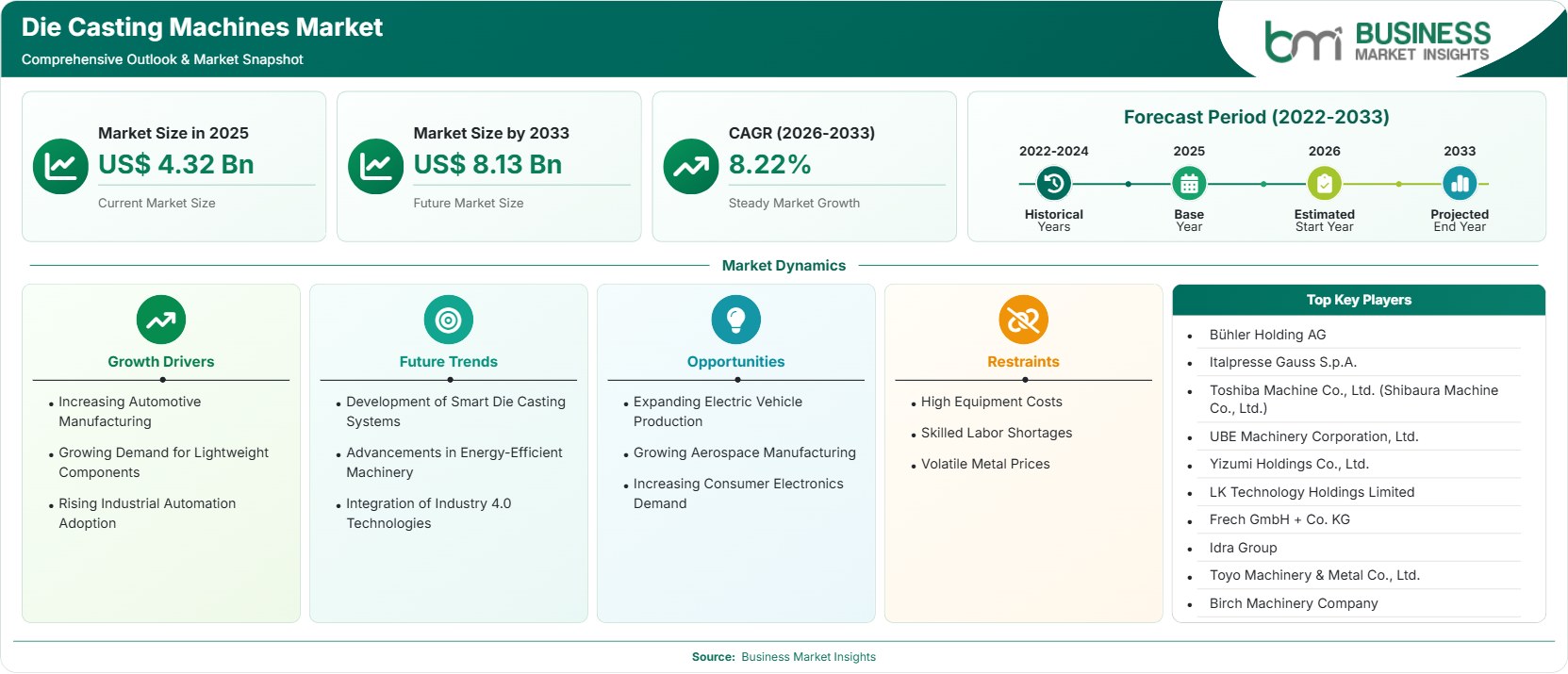
The Die Casting Machines Market size was valued at US$ 4.32 Billion in 2025 and is projected to reach US$ 8.13 Billion by 2033, growing at a CAGR of 8.22% during 2026–2033, driven by automotive electrification, lightweight component demand, industrial automation, and advanced manufacturing investments.

Report Coverage
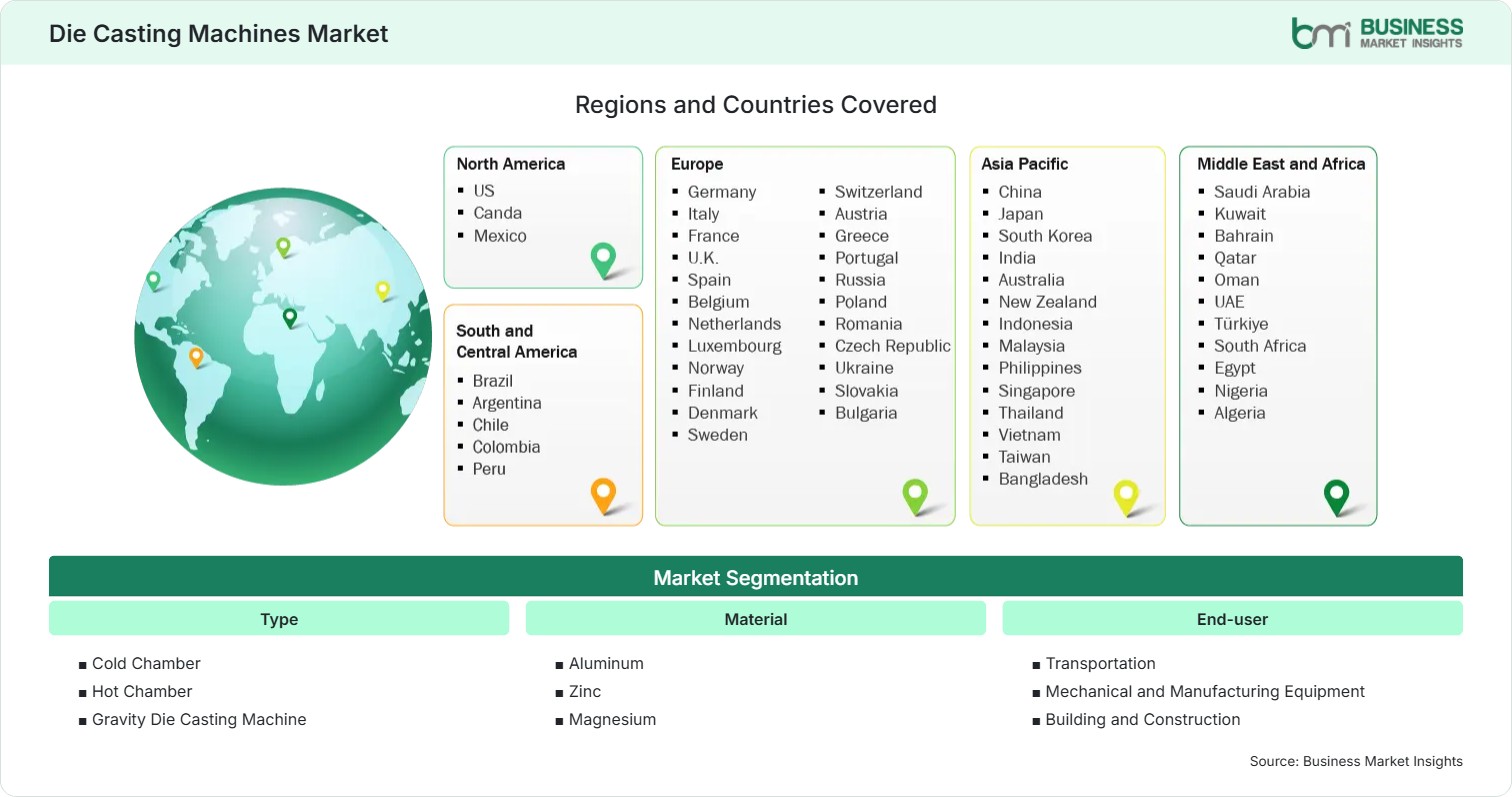
  • Type: Cold Chamber, Hot Chamber, Gravity Die Casting Machine
  • Material: Aluminum, Zinc, Magnesium
  • End-user: Transportation, Mechanical and Manufacturing Equipment, Building and Construction
US$ 4.32 Bn Market size in 2025
US$ 8.13 Bn Market Size by 2033
8.22% CAGR, 2026 - 2033
2026-2033 Forecast Period

01 AI Overview

Die Casting Machines Market Summary

  • North America Region: North America holds a 28%–31% share in 2025, expanding at a CAGR of 7.5%–8.0% during 2026–2033, supported by automotive manufacturing, electric vehicle production, automation adoption, and industrial modernization initiatives. The US market demonstrates strong manufacturing recovery with a CAGR of 7.7%–8.2% between 2026–2033, supported by vehicle electrification, factory automation, and domestic production investments.
  • Fastest Growing Region: Asia Pacific represents a 38%–42% share in 2025, growing at a CAGR of 8.8%–9.3% during 2026–2033, driven by automotive expansion, industrial investments, manufacturing capacity development, and rising demand for lightweight components across China, India, Japan, and Southeast Asia.
  • Leading Segment: Cold Chamber Die Casting Machines account for a 52%–56% share in 2025, growing at a CAGR of 8.3%–8.8%, supported by aluminum component production, automotive applications, high-pressure casting requirements, and increasing demand for structural vehicle parts.
  • High Growth Segment: Magnesium die casting applications represent a 9.0%–9.5% CAGR opportunity between 2026–2033, driven by lightweighting requirements, electric vehicle efficiency goals, aerospace applications, and increasing adoption of advanced metal alloys.
  • Key Market Opportunity: Expansion of electric vehicle manufacturing, mega casting adoption, smart factory integration, and demand for energy-efficient machines create opportunities for manufacturers developing automated, high-performance die casting solutions globally.
  • Major Market Players: Bühler Holding AG; Italpresse Gauss S.p.A.; Shibaura Machine Co., Ltd.; UBE Machinery Corporation, Ltd.; Yizumi Holdings Co., Ltd.; LK Technology Holdings Limited; Frech GmbH + Co. KG; Idra Group; Toyo Machinery & Metal Co., Ltd.; Birch Machinery Company.
02 Strategic Insights

Die Casting Machines Market: Strategic Insights

Die Casting Machines Market Strategic Framework
FREE PDF
Request your free sample
Request free sample
03 Stakeholder View

Key Takeaways

  • The value chain consists of machine builders, metal providers, component makers, automotive firms, manufacturers of industrial equipment, and end-users. Cooperation between equipment makers and manufacturers helps to increase the efficiency of production processes and offers custom solutions for casting.
  • Automotive applications represent the strongest demand opportunity as manufacturers increasingly require lightweight aluminum and magnesium components for conventional vehicles, electric vehicles, and advanced mobility platforms.
  • Technological development will contribute to the development of intelligent casting systems featuring automated control, preventive maintenance, monitoring, and optimization of production.
  • Asia Pacific provides the strongest investment opportunity due to expanding automotive manufacturing, increasing industrial capacity, and government-backed manufacturing initiatives across China, India, and Southeast Asian countries.
  • Strategic investments and partnerships are increasing as companies focus on expanding machine portfolios, developing large-scale casting technologies, and strengthening capabilities for electric vehicle component manufacturing.
  • Sustainability considerations are influencing equipment development, with manufacturers focusing on energy-efficient machines, reduced material waste, improved recycling compatibility, and environmentally optimized production processes.
04 Geographic Outlook

Die Casting Machines Market Regional Highlights

North America Die Casting Machines Market

North America accounted for a 28%–31% share in 2025 and is projected to expand at a CAGR of 7.5%–8.0% during 2026–2033. The region benefits from advanced manufacturing capabilities, automotive production investments, industrial automation adoption, and reshoring initiatives. The Die Casting Machines Market share remains supported by strong demand from vehicle manufacturers, especially for lightweight aluminum components. The United States leads regional consumption, while Canada and Mexico contribute through automotive supply chain expansion and manufacturing investments.

  • Automotive manufacturers are investing in advanced casting equipment to support lightweight vehicle production, improve manufacturing efficiency, and meet growing requirements for electric vehicle component integration.
  • The United States is strengthening domestic manufacturing capacity through automation investments, supporting adoption of high-pressure casting systems across automotive and industrial applications.
  • Mexico is becoming an important production hub due to expanding automotive manufacturing activities, increasing foreign investments, and rising demand for efficient casting technologies.
  • Demand for smart manufacturing solutions is encouraging adoption of connected die casting machines with improved monitoring, automation, and predictive maintenance capabilities.

US Die Casting Machines Market

The United States represented a 23%–26% share of the North American market in 2025 and is estimated to grow at a CAGR of 7.7%–8.2% between 2026–2033. The country maintains strong demand due to automotive manufacturing, aerospace applications, industrial modernization, and electric vehicle investments. Domestic production initiatives and technology upgrades are encouraging manufacturers to replace older equipment with automated and energy-efficient die casting systems.

  • Electric vehicle production expansion is increasing demand for large-scale casting technologies capable of manufacturing lightweight structural components and battery-related parts.
  • Automotive suppliers are upgrading production facilities with automated machines to improve efficiency, reduce labor dependency, and enhance manufacturing consistency.
  • Industrial automation adoption is supporting integration of digital controls, real-time monitoring systems, and advanced process optimization across manufacturing facilities.

Europe Die Casting Machines Market

Europe held a 24%–27% share in 2025 and is expected to grow at a CAGR of 7.0%–7.6% during 2026–2033. The region benefits from established automotive manufacturing, sustainability-focused industrial policies, and strong demand for lightweight components. Germany, Italy, and France remain leading markets due to advanced engineering capabilities, while Eastern European countries are experiencing increasing manufacturing investments. The Die Casting Machines Market growth in Europe is influenced by electric mobility expansion and factory modernization.

  • Germany continues leading adoption through automotive engineering expertise, advanced manufacturing facilities, and investments in automated casting technologies.
  • Italy supports regional demand through established machinery manufacturers, metal processing expertise, and strong industrial equipment production capabilities.
  • France is increasing adoption of advanced casting solutions as automotive manufacturers focus on electric vehicle platforms and lightweight structural components.
  • Eastern European countries are attracting manufacturing investments through competitive production costs and expanding automotive component supply chains.

Asia Pacific Die Casting Machines Market

Asia Pacific accounted for a 38%–42% share in 2025 and is projected to record a CAGR of 8.8%–9.3% from 2026–2033. The region represents the largest market due to extensive automotive manufacturing, industrial expansion, and increasing production capacity. China, Japan, India, and South Korea are major contributors. The Die Casting Machines Market trends are shaped by electric vehicle growth, smart factory adoption, and increasing demand for high-volume manufacturing.

  • China dominates regional demand through large automotive production volumes, electric vehicle manufacturing leadership, and extensive industrial machinery investments.
  • India is expanding manufacturing capacity through automotive growth, infrastructure development, and government-supported initiatives promoting domestic industrial production.
  • Japan continues adopting advanced casting systems through precision engineering capabilities, automation integration, and demand for high-quality components.
  • South Korea is strengthening demand through electric vehicle supply chain development and advanced manufacturing investments by automotive companies.

Rest of World Die Casting Machines Market

Rest of World accounted for a 5%–8% share in 2025 and is expected to grow at a CAGR of 6.5%–7.0% between 2026–2033. South and Central America are gradually expanding manufacturing capabilities, while Middle East and Africa markets are developing through industrial diversification initiatives. Brazil, Mexico, Saudi Arabia, and the UAE represent important opportunities due to automotive, construction, and manufacturing investments.

  • Brazil is improving industrial capacity through automotive manufacturing expansion and increasing demand for efficient metal casting equipment.
  • South American manufacturers are adopting advanced machinery solutions to improve productivity, reduce operational costs, and strengthen local manufacturing competitiveness.
  • Middle Eastern countries are investing in industrial diversification programs that encourage adoption of modern manufacturing technologies and equipment.
  • Saudi Arabia and the UAE are developing industrial ecosystems through manufacturing investments, infrastructure projects, and technology-focused initiatives.
  • African markets present emerging opportunities as industrial development, automotive assembly, and manufacturing infrastructure continue expanding across selected economies.
Global Market Geography
FREE PDF
Request your free sample
Request free sample
05 Segment Analysis

Die Casting Machines Market Segmentation

Type

Type segmentation represents a major factor influencing equipment selection based on production requirements, material compatibility, and manufacturing applications. This segment accounted for a 50%–54% share in 2025 and is projected to grow at a CAGR of 8.0%–8.5% during 2026–2034. The Die Casting Machines Market scope continues expanding as industries require efficient machines for complex, lightweight, and high-volume components.

  • Cold Chamber: Cold chamber machines are widely used for aluminum and magnesium casting applications, particularly in automotive manufacturing requiring durable and lightweight structural components.
  • Hot Chamber: Hot chamber machines support efficient zinc and similar alloy processing, offering faster production cycles and suitability for smaller precision components.
  • Gravity Die Casting Machine: Gravity die casting machines provide reliable production for applications requiring controlled filling, lower tooling complexity, and consistent metal component quality.

Material

Material segmentation reflects increasing demand for lightweight metals and application-specific casting performance. This segment represented a 35%–39% share in 2025 and is anticipated to grow at a CAGR of 8.2%–8.7% during 2026–2034. Material innovation continues influencing machine requirements, particularly in automotive and industrial applications focused on weight reduction and efficiency.

  • Aluminum: Aluminum remains the preferred material due to lightweight properties, corrosion resistance, recyclability, and extensive usage in automotive, transportation, and industrial components.
  • Zinc: Zinc supports precision casting applications requiring excellent dimensional accuracy, surface finish quality, and efficient production of smaller complex components.
  • Magnesium: Magnesium adoption is increasing due to lightweight characteristics, supporting applications where weight reduction and improved fuel or energy efficiency are priorities.

End-user

End-user segmentation highlights demand from industries requiring high-performance casting equipment for component manufacturing. This segment accounted for a 20%–24% share in 2025 and is expected to expand at a CAGR of 7.8%–8.3% during 2026–2034. The Die Casting Machines Market trends are influenced by automotive transformation, industrial production growth, and infrastructure development.

  • Transportation: Transportation industries represent a major application area due to increasing demand for lightweight vehicle components, electric mobility parts, and efficient production technologies.
  • Mechanical and Manufacturing Equipment: This segment uses die casting systems for machinery components requiring durability, precision, and consistent manufacturing quality across industrial applications.
  • Building and Construction: Construction applications utilize cast components for hardware, structural elements, and specialized products requiring reliable production efficiency and material performance.
06 Market Forces

Die Casting Machines Market Dynamics

Key Market Drivers

Increasing Automotive Manufacturing

Increase in the global production of automobiles along with that of automotive components forms a key aspect of the market for Die Casting Machines. The Die Casting Machines Market growth is driven by the increasing demand for aluminium, electrical vehicles parts, and integration casting. High pressure die casting has been used by automakers for the purpose of lowering the complexity of their assembly line. Growth in the production capacity of the automotive industry in the Asia-Pacific region and North America remains positive for this market trend.

Growing Demand for Lightweight Components

The growing emphasis on efficiency, fuel savings, and the use of electric automobiles is driving the need for lightweight metal parts that are produced by means of die casting techniques. Alloys of aluminium and magnesium are growing in importance due to their ability to be strong and decrease weight. Industries like automotive and aerospace are increasingly using die casting methods in order to create strong and durable parts while at the same time decreasing the amount of material used. The shift towards electric cars is increasing the demand for lightweight parts that can hold batteries and are part of the structure itself.

Rising Industrial Automation Adoption

Automation is revolutionizing die casting with increased efficiency, reduced mistakes in production, and real-time process control. Manufacturers are implementing automation in their factories with robotics, sensors, artificial intelligence analytics, and automatic material handling systems. With the rise in use of smart factories, there is an increased need for automated die casting machines that can predict their maintenance needs and maximize their use of resources. Automation solves issues of production consistency, efficiency, and labor shortages in production facilities.

Key Market Opportunities

Expanding Electric Vehicle Production

Electric vehicle production growth provides a major opportunity for die casting machine makers since car producers need light-weight and integrated parts for increased efficiency of vehicles. Castings for chassis, batteries and engines, and large castings are raising the demand for advanced high pressure casting systems. Die Casting Machines Market Forecasts indicate an increase in chances for those companies making investments into building gigafactories, electric vehicle platforms, and localization. The production of large-sized, automated and energy efficient machines will profit from this market trend. Electrification of cars leads to the creation of new casting technologies that require fewer assembling processes and increased speed of manufacturing.

Growing Aerospace Manufacturing

Manufacturers of airplanes and their suppliers are concentrating on material efficiency, production efficiency, and modern manufacturing techniques in order to enhance their efficiency. Despite the need for high quality standards in aerospace applications, developments in alloy design and precise casting technology have widened the scope of applications. Companies that will have dedicated equipment, quality control systems, and automated production facilities can cater to the needs of the aerospace industry. Increase in the demand for commercial aircraft, defense products, and space industry has fueled the demand for metal processing machines.

Increasing Consumer Electronics Demand

Rising demand for consumer electronics products is creating opportunities for precision die casting equipment used in manufacturing compact and complex metal components. Electronics manufacturers require accurate casting solutions for housings, frames, heat management components, and structural parts. Product miniaturization and the need for superior product designs are encouraging manufacturers to use casting processes that can produce high-quality products. The increase in the number of smartphones, computer devices, connected products, and industrial electronic devices is helping manufacturers get more opportunities to apply their products.

Market Restraints and Challenges

High Equipment Costs

Factor: High initial investment requirements for advanced die casting machines, automation systems, tooling, and maintenance infrastructure increase capital expenditure for manufacturers. Impact: Small-scale businesses and emerging manufacturers may tend to hold off on upgrading their machines because of financial constraints, thus hindering their ability to use more efficient casting machines. New machines, which are automatic and energy efficient, are expensive as opposed to normal machines. Businesses have to consider the productivity level of new machines before expanding their manufacturing capacity. In competitive markets, where financing is a challenge and market demands are uncertain, cost may be an important factor in buying machines.

Skilled Labor Shortages

Factor: Limited availability of skilled technicians capable of operating, programming, and maintaining advanced die casting systems creates workforce challenges. Impact: Labor shortages can reduce equipment utilization, increase maintenance risks, and delay adoption of sophisticated automated production technologies. Modern die casting machines need professional skills in the areas of process optimization, robotics technology, quality control, and digital systems management. It is necessary for manufacturers to organize the educational processes of their workers to get the best results from the use of machinery. The problem of the lack of skilled personnel is especially acute for small manufacturers switching to automation.

07 Company Analysis

Competitive Landscape

The Die Casting Machines Market analysis indicates a competitive environment shaped by global equipment manufacturers, automation technology providers, and specialized casting solution companies. Leading companies focus on developing energy-efficient systems, expanding large-scale casting capabilities, and integrating digital technologies to improve manufacturing performance. Strategic partnerships, product innovations, and geographic expansion remain important approaches as manufacturers seek stronger positions across automotive, industrial, and emerging electric vehicle applications.

Company Name

Overview

Products and Services relevant to this market

Bühler Holding AG

Bühler is a global industrial technology company providing advanced manufacturing equipment and processing solutions.

Provides high-pressure die casting machines, automation systems, and integrated casting solutions for automotive and industrial applications.

Italpresse Gauss S.p.A.

Italpresse Gauss specializes in die casting machinery and automated production solutions for global manufacturers.

Offers cold chamber die casting machines, robotic systems, and customized casting equipment for metal components.

Shibaura Machine Co., Ltd.

Shibaura Machine develops industrial machinery including advanced molding and casting technologies.

Supplies die casting machines, automation solutions, and precision manufacturing equipment for industrial applications.

UBE Machinery Corporation, Ltd.

UBE Machinery provides industrial equipment with expertise in large-scale casting technologies and manufacturing solutions.

Manufactures large die casting machines, injection systems, and equipment supporting automotive component production.

Yizumi Holdings Co., Ltd.

Yizumi is a manufacturing technology company producing industrial equipment for global markets.

Provides die casting machines, intelligent manufacturing systems, and automation solutions for metal processing industries.

LK Technology Holdings Limited

LK Technology develops advanced machinery solutions for die casting and manufacturing sectors worldwide.

Offers die casting machines, integrated production systems, and automated solutions for automotive manufacturers.

Frech GmbH + Co. KG

Frech specializes in zinc die casting machinery and related production technologies.

Provides hot chamber die casting machines, automation systems, and casting process solutions.

Idra Group

Idra Group develops innovative die casting equipment for automotive and industrial applications.

Supplies high-pressure die casting machines, large casting systems, and advanced manufacturing technologies.

Toyo Machinery & Metal Co., Ltd.

Toyo Machinery manufactures precision industrial equipment with applications in metal processing.

Provides die casting machines, control systems, and manufacturing solutions for component producers.

Birch Machinery Company

Birch Machinery supplies used and new die casting equipment for manufacturing industries.

Offers die casting machinery, equipment services, and production solutions for metal component manufacturers.

10 Trust & Transparency

Research Methodology

The market analysis combines proprietary research with secondary data from government agencies, company disclosures, regulatory filings, industry databases and expert interviews. Market estimates are validated through data triangulation, cross-market benchmarking and analyst review.

View Full Research Methodology

11 Questions Answered

Frequently Asked Questions

What insights are included in the Die Casting Machines Market Report?

The report covers market dynamics, technology advancements, regional opportunities, segmentation analysis, competitive strategies, and future trends influencing the global adoption of die casting equipment.

What challenges affect die casting machine adoption?

High equipment investment costs, tooling expenses, maintenance requirements, and shortages of skilled operators can restrict adoption. Manufacturers must evaluate productivity improvements and long-term operational benefits before investing in advanced casting systems.

How are automation technologies changing die casting operations?

Automation is improving productivity through robotics, digital monitoring, predictive maintenance, and real-time process control. Smart manufacturing systems help reduce defects, optimize production parameters, and improve operational efficiency across automotive and industrial manufacturing facilities.

Why are electric vehicles influencing die casting machine adoption?

Electric vehicles require lightweight structural components, battery housings, and integrated parts that can be efficiently produced through advanced die casting. Automakers are adopting large-scale casting technologies to reduce assembly complexity, improve production speed, and optimize vehicle weight.

What industries are driving demand for die casting machines market?

Automotive, electric vehicles, aerospace, industrial equipment, consumer electronics, and construction industries are major demand contributors. These sectors require lightweight, durable, and precision-engineered components, increasing adoption of advanced die casting technologies for efficient high-volume manufacturing.

Access the Full Die Casting Machines Market Report

Get segment-level forecasts, regional estimates, competitive benchmarking, company profiles and downloadable Excel datasets.

Access the full Die Casting Machines Market Report
350 pages PDF & Excel | 2026-08-12