
Rolling Dies Market Outlook: Size, Share, Trends, Growth Analysis, Competitive Landscape & Forecast, 2026-2033

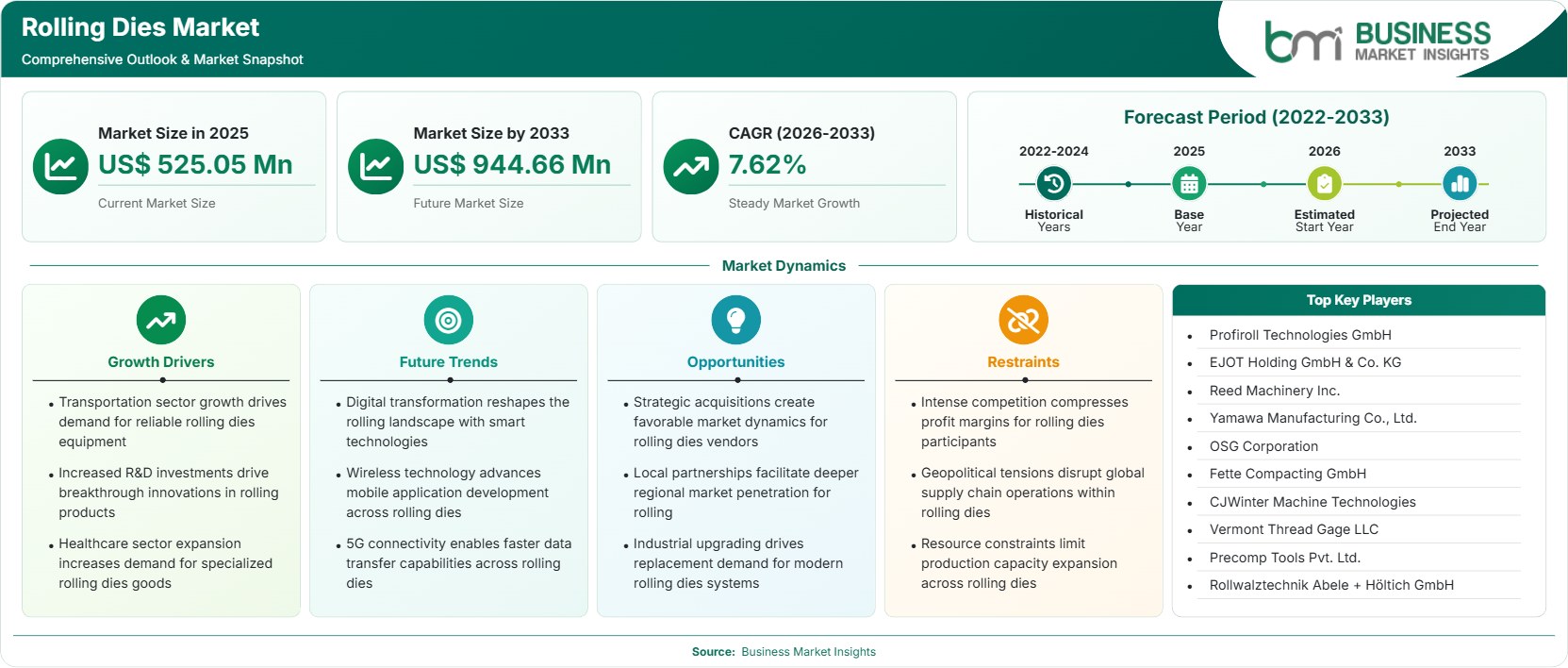
The Rolling Dies Market size was valued at US$ 525.05 Million in 2025 and is projected to reach US$ 944.66 Million by 2033, growing at a CAGR of 7.62% during 2026–2033. Key drivers include automotive fastener production, precision cold-forming adoption, industrial automation, and advanced tooling demand, while opportunities arise from EV manufacturing, medical components, aerospace fastening systems, and high-performance die materials.

Report Coverage
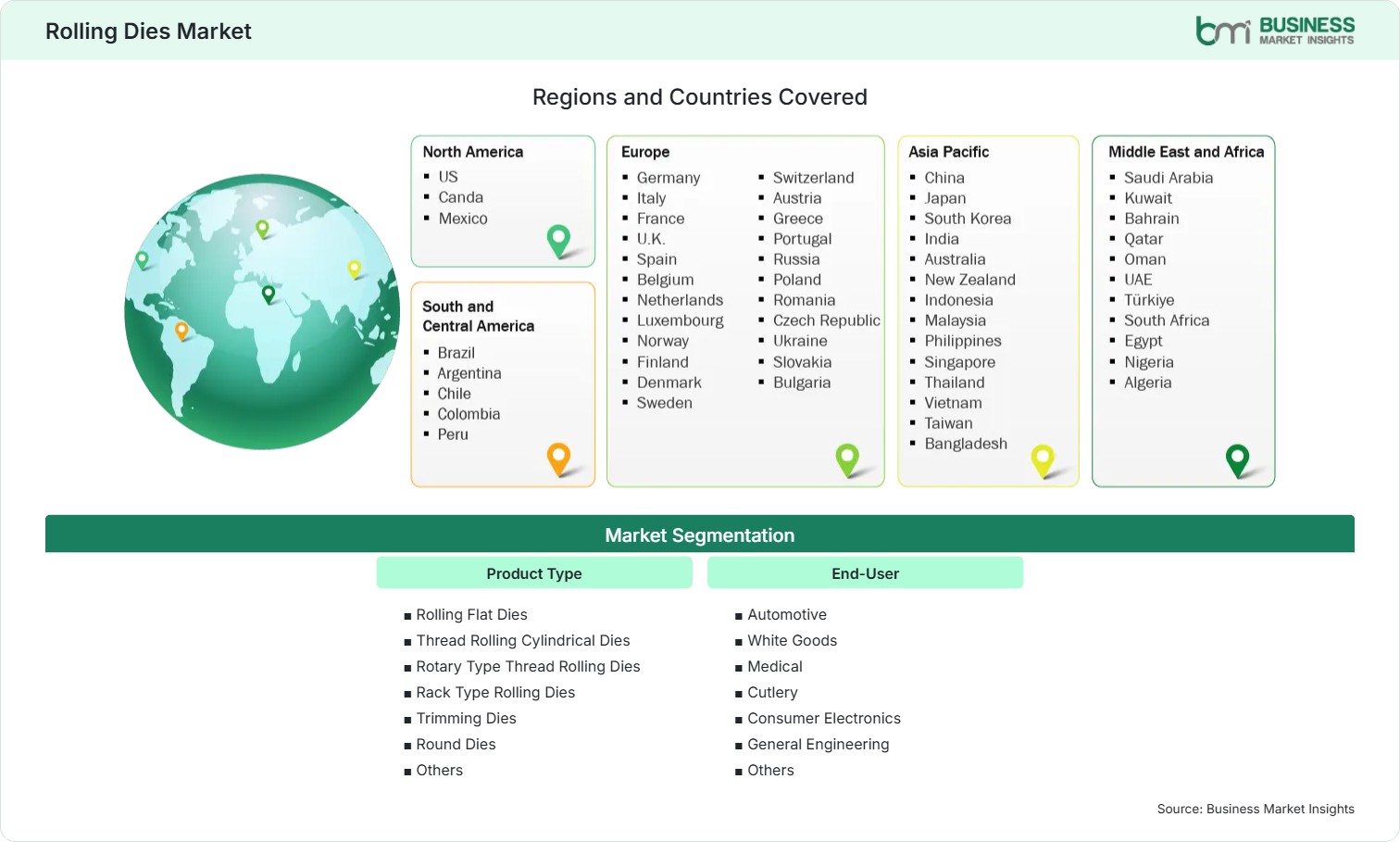
  • Product Type: Rolling Flat Dies, Thread Rolling Cylindrical Dies, Rotary Type Thread Rolling Dies, Rack Type Rolling Dies, Trimming Dies, Round Dies, Others
  • End-User: Automotive, White Goods, Medical, Cutlery, Consumer Electronics, General Engineering, Others
US$ 525.05 Mn Market size in 2025
US$ 944.66 Mn Market Size by 2033
7.62% CAGR, 2026 - 2033
2026-2033 Forecast Period

AI Overview

Rolling Dies Market Summary

  • North America Region: North America holds a market share of 34%–37% in 2025, growing at a CAGR of 6.4%–6.9% during 2026–2033. Growth is supported by automotive reshoring, aerospace fastening demand, factory automation investments, tooling replacement cycles, advanced cold-forming processes, productivity improvement initiatives, precision manufacturing expansion, supply-chain localization, industrial modernization, and durable die adoption. US market benefits from automotive fastener production expansion and aerospace machining investments, advancing at a CAGR of 6.5%–7.0%.
  • Fastest Growing Region: Asia Pacific accounts for 29%–32% share in 2025 and is forecast to expand at a CAGR of 8.7%–9.3% during 2026–2033. Growth is driven by industrialization, electronics manufacturing, automotive production, export-oriented engineering sectors, infrastructure development, localized tooling ecosystems, machine upgrades, component manufacturing investments, productivity targets, and fastener consumption growth.
  • Leading Segment: Thread Rolling Cylindrical Dies represents 28%–31% share in 2025 and grows at a CAGR of 7.3%–7.8% through 2033. Demand stems from high-volume fastener manufacturing, superior thread consistency, longer tool life, reduced material waste, improved surface finish, automated production compatibility, engineering applications, automotive assemblies, industrial equipment requirements, and process efficiency.
  • High Growth Segment: Medical end-user accounts for 7%–9% share in 2025 and records a CAGR of 9.1%–9.8% during 2026–2033. Expansion is supported by surgical instrument production, implant manufacturing, precision threading requirements, regulatory compliance standards, advanced stainless-steel component demand, miniaturization trends, healthcare investments, specialized tooling needs, quality assurance requirements, and production scalability.
  • Key Market Opportunity: Increasing production of EV drivetrains, battery systems, and lightweight assemblies creates demand for precision fastening components, enabling premium tooling solutions, advanced die coatings, automation-compatible products, and higher-value manufacturing contracts.
  • Major Market Players: Profiroll Technologies GmbH, EJOT Holding GmbH & Co. KG, Reed Machinery Inc., Yamawa Manufacturing Co., Ltd., OSG Corporation, Fette Compacting GmbH, CJWinter Machine Technologies, Vermont Thread Gage LLC, Precomp Tools Pvt. Ltd., Rollwalztechnik Abele + Höltich GmbH.
Strategic Insights

Rolling Dies Market: Strategic Insights

Rolling Dies Market Strategic Framework
FREE PDF
Request your free sample
Request free sample
Stakeholder View

Key Takeaways

  • Supply chains increasingly integrate steel suppliers, heat-treatment specialists, coating providers, die manufacturers, and fastener producers, creating a highly interconnected tooling ecosystem focused on productivity and quality consistency.
  • Medical devices, consumer electronics, and EV-related fastening applications offer the strongest medium-term revenue expansion potential due to increasing precision requirements and higher value-added component production.
  • R&D activity is accelerating around nano-coated dies, carbide substrates, digital inspection systems, and wear-prediction analytics that extend operating life while reducing tooling replacement frequency.
  • Asia Pacific presents the most compelling manufacturing expansion opportunity, supported by large-scale industrial output, growing exports, and investments in precision engineering infrastructure.
  • Strategic acquisitions increasingly target tooling specialists with proprietary grinding, coating, and profile-generation capabilities, enabling manufacturers to strengthen differentiated product offerings.
  • Sustainability objectives are encouraging cold-forming adoption because of reduced scrap rates, lower material loss, and improved production efficiency compared with traditional cutting processes.
Geographic Outlook

Rolling Dies Market Regional Highlights

North America Rolling Dies Market

North America accounts for 34%–37% of global revenue in 2025 and is expected to expand at a CAGR of 6.4%–6.9% through 2033. The region benefits from advanced aerospace manufacturing, automotive production recovery, and strong industrial automation penetration. The Rolling Dies Market share remains supported by demand for premium threaded components and high-precision fastening systems. Manufacturers continue investing in localized tooling production, digital quality monitoring, and advanced coatings to enhance die life and operating efficiency.

  • Aerospace fastener manufacturing supports premium tooling demand through strict dimensional requirements and long-term supply contracts.
  • Automotive reshoring programs stimulate investment in cold-forming operations and higher-performance tooling solutions.
  • Industrial automation increases throughput requirements, encouraging adoption of durable precision die technologies.
  • Infrastructure and energy projects generate sustained consumption of threaded assemblies and engineered fasteners.
  • Replacement demand remains resilient due to wear management and productivity optimization initiatives.

US Rolling Dies Market

The United States accounts for 72%–76% of the North American Rolling Dies Market revenue and is advancing at a CAGR of 6.5%–7.0% through 2033. Strong automotive, defense, aerospace, and industrial equipment sectors underpin demand. Production modernization programs emphasize quality consistency, reduced scrap, and improved cycle efficiency. Investments in domestic manufacturing capacity and advanced machine tools continue to strengthen demand for specialized rolling die technologies.

  • Aerospace suppliers emphasize precision-threaded components, supporting advanced tooling procurement.
  • EV manufacturing facilities increase demand for engineered fastening and cold-forming solutions.
  • Industrial machinery producers require customized dies for complex profiles and specialized applications.
  • Domestic sourcing initiatives help strengthen regional tooling supply chains.

Europe Rolling Dies Market

Europe holds 25%–28% of the Rolling Dies Market share in 2025 and is projected to register a CAGR of 6.8%–7.4% through 2033. Germany remains the leading market, while Poland and Czechia demonstrate faster industrial expansion. Advanced engineering, automotive manufacturing, and machinery exports support tooling consumption. Regional producers emphasize sustainability, process efficiency, and precision manufacturing, strengthening adoption of advanced rolling technologies.

  • Germany leads regional demand with strong automotive and industrial machinery production.
  • Poland records among the fastest expansion rates at approximately 7.5%–8.0% due to manufacturing investment.
  • EU industrial modernization initiatives support process automation and tooling upgrades.
  • Renewable-energy equipment manufacturing increases demand for precision fastening systems.
  • High-productivity factories prioritize longer-life coated die solutions.

Asia Pacific Rolling Dies Market

Asia Pacific accounts for 29%–32% of global revenue in 2025 and records the fastest CAGR of 8.7%–9.3% during 2026–2033. China leads regional consumption, while India and Vietnam display high-growth momentum. Expanding electronics, automotive, white goods, and engineering industries support demand. Large manufacturing clusters, export activity, and continuous tooling investments reinforce the region's leadership in production capacity expansion.

  • China remains the largest manufacturing base for fasteners and engineered components.
  • India benefits from industrial policies supporting localized manufacturing and tooling investments.
  • Vietnam shows rapid expansion due to electronics exports and supply-chain diversification.
  • Consumer electronics production drives precision-threading requirements.
  • Continuous factory expansion strengthens demand for automation-compatible tooling.

Rest of World Rolling Dies Market

The Rest of World region represents 8%–11% market share and is expected to grow at a CAGR of 7.1%–7.7% through 2033. South and Central America benefit from automotive and industrial production investments, while the Middle East and Africa gain support from infrastructure and energy projects. Rolling Dies Market share improvement is linked to expanding local manufacturing capabilities and import substitution initiatives.

  • Brazil leads South American demand through automotive and engineering production activities.
  • Mexico benefits from export-oriented manufacturing and supply-chain integration.
  • Saudi Arabia supports industrial diversification initiatives centered on local manufacturing.
  • UAE investments in precision engineering strengthen tooling demand.
  • Regional industrial expansion supports long-term utilization of threaded components.
Global Market Geography
FREE PDF
Request your free sample
Request free sample
Segment Analysis

Rolling Dies Market Segmentation

Product Type

This segment accounts for approximately 58%–61% of overall demand and expands at a CAGR of 7.4%–7.9%. The Rolling Dies Market scope continues broadening as manufacturers prioritize higher throughput, precision-threading capability, improved surface finish, and longer tool life across automotive, engineering, and industrial applications.

  • Rolling Flat Dies: Widely used for high-volume fastener production, offering consistent thread formation, reduced material waste, and compatibility with automated cold-forming environments.
  • Thread Rolling Cylindrical Dies: Dominant tooling category supporting precision thread generation, superior repeatability, and extensive use in automotive and industrial manufacturing operations.
  • Rotary Type Thread Rolling Dies: Preferred for continuous production systems requiring high efficiency, improved output rates, and reliable dimensional consistency.
  • Rack Type Rolling Dies: Utilized in specialized profile generation applications where controlled movement and precision geometry are critical.
  • Trimming Dies: Support finishing operations by maintaining dimensional accuracy and improving product quality across mass-production environments.
  • Round Dies: Favored in diverse fastener applications due to durability, repeatability, and adaptability to multiple thread profiles.
  • Drill Point Dies: Designed for self-drilling screw production, enabling efficient formation of complex geometries and precision point configurations.

End-User

End-user industries account for 39%–42% of revenue and are projected to record a CAGR of 7.8%–8.3%. Rolling Dies Market trends indicate increasing penetration across advanced manufacturing sectors where precision, repeatability, and production efficiency remain critical competitive factors.

  • Automotive: Largest application area driven by extensive use of threaded fasteners, lightweight assemblies, and high-volume production requirements.
  • White Goods: Appliance manufacturers utilize advanced tooling to ensure component reliability, assembly efficiency, and cost-effective production.
  • Medical: Demand grows from surgical instruments, implants, and precision-engineered components requiring stringent quality standards.
  • Cutlery: Producers rely on specialized forming technologies to achieve dimensional accuracy and premium surface characteristics.
  • Consumer Electronics: Miniaturization trends increase demand for precision fastening solutions and specialized die configurations.
  • General Engineering: Broad industrial applications generate recurring tooling replacement demand and customized product requirements.
  • Marine: Corrosion-resistant components and durable fastening systems support steady adoption in marine engineering environments.
Market Forces

Rolling Dies Market Dynamics

Key Market Drivers

Expansion of Global Fastener Manufacturing Capacity

Automotive, industrial machinery, electronics, and construction sectors continue increasing fastener consumption, directly supporting tooling requirements. The global automotive industry, as well as the manufacturing and engineering industries, have constant requirements for threaded fasteners. More companies opt for the process of rolling as opposed to the traditional one of cutting due to several advantages provided by the former. In order to increase the volume of work, the company should invest in equipment that can guarantee consistent results on a mass scale.

Adoption of Automation and Smart Manufacturing Systems

The modern production units are focusing on automated production lines that need tooling which can perform consistently under tough cycle requirements. With digital monitoring, predictive maintenance, and real-time inspection, there is now a higher expectation for wear resistance and dimensional stability. Rolling Dies Market growth benefits from manufacturers seeking lower downtime, reduced scrap generation, and repeatable output quality. Advanced coatings, optimized die geometries, and data-enabled process control systems are becoming increasingly important differentiators within competitive manufacturing environments.

Growing Demand for High-Precision Engineered Components

Medical devices, aerospace assemblies, and advanced industrial systems require components with precise thread geometry and superior mechanical properties. Roll forming processes have a tendency to improve flow properties within grains and enhance the quality of the final components that are produced. The greater the need for tight tolerances, the more likely it is that manufacturers will opt for higher-quality tooling options that can endure longer periods of usage.

Key Market Opportunities

Electric Vehicle Component Manufacturing Expansion

Electric mobility platforms require extensive use of precision fasteners, battery-system assemblies, structural components, and thermal-management hardware. Manufacturers are expanding production capacity globally, creating opportunities for customized tooling solutions. Rolling Dies Market Forecasts are becoming more indicative of increasing demands from EV supply chains where consistent quality and efficiency in production become critical requirements. Those suppliers that can provide coating technologies, fast customizations, and efficient tooling will be able to win lucrative deals with automotive and battery makers.

Rising Demand for Medical-Grade Fastening Systems

Healthcare investment and aging populations continue supporting production of surgical tools, implants, diagnostic equipment, and medical assemblies. Such threads need special designs, rigorous quality control, and traceable manufacturing processes. Manufacturers who have knowledge in stainless steel, titanium machining, and geometric precision design can avail themselves of lucrative business prospects, especially considering that end-user demand is relatively stable.

Localized Manufacturing and Supply Chain Regionalization

Many countries are promoting domestic manufacturing capacity to improve supply-chain resilience. Such a tendency promotes investment in local machinery, tooling development, and engineering expertise. Regional manufacturing centers are actively seeking local suppliers who would be able to decrease the delivery time and react quicker to their needs. Such an approach can be used by firms that create local networks for such purposes.

Market Restraints and Challenges

Volatile Tool Steel and Raw Material Costs

Factor: Specialized tool steels, carbide materials, and coating inputs experience periodic price fluctuations linked to global industrial demand and supply constraints.

Impact: The manufacturing firms experience challenges with margin and pricing policies, especially within the context of long-term contractual arrangements, where the use of cost pass-through arrangements is constrained. The fluctuations in input costs make it difficult for manufacturers to plan effectively.

Technical Complexity and Skilled Labor Constraints

Factor: Precision die design, grinding, heat treatment, and performance optimization require specialized technical expertise.

Impact: There are difficulties in training because of the shortage of qualified tooling staff. There will be delays in developing the product, higher cost of operation, and inability to maintain quality standards in increased production processes.

Company Analysis

Competitive Landscape

The competitive environment remains characterized by specialized engineering capabilities, customization expertise, coating technologies, and application support services. Rolling Dies Market analysis highlights increasing emphasis on productivity-enhancing tooling solutions.

Company Name

Overview

Products and Services relevant to this market

Profiroll Technologies GmbH

German specialist in rolling technology solutions serving automotive and industrial manufacturing sectors.

Thread rolling dies, spline rolling dies, rolling machines, engineering support, tooling services.

EJOT Holding GmbH & Co. KG

Global fastening and cold-forming technology company with extensive manufacturing expertise.

Fastener tooling, precision thread-forming solutions, engineering and production technologies.

Reed Machinery Inc.

North American provider focused on thread rolling and precision tooling applications.

Rolling dies, threading equipment, maintenance and technical services.

Yamawa Manufacturing Co., Ltd.

Precision threading technology company serving industrial and engineering customers globally.

Threading tools, rolling dies, precision manufacturing solutions.

OSG Corporation

Leading cutting and forming tool manufacturer with broad industrial presence.

Thread rolling dies, threading systems, precision tooling products.

Fette Compacting GmbH

Engineering-driven manufacturer known for advanced production technologies.

Precision tooling, engineered components and forming-related solutions.

CJWinter Machine Technologies

Specialized provider of thread rolling systems and tooling technologies.

Thread rolls, rolling dies, machine systems, technical support.

Vermont Thread Gage LLC

Manufacturer focused on threading quality and precision engineering applications.

Thread verification products, tooling support, application expertise.

Precomp Tools Pvt. Ltd.

Indian precision tooling company serving cold-forming and fastener industries.

Thread rolling dies, spline rolling dies, customized forming tools.

Rollwalztechnik Abele + Höltich GmbH

European specialist in rolling and forming technologies.

Profile rolling dies, thread rolling dies, customized tooling solutions.

Trust & Transparency

Research Methodology

The market analysis combines proprietary research with secondary data from government agencies, company disclosures, regulatory filings, industry databases and expert interviews. Market estimates are validated through data triangulation, cross-market benchmarking and analyst review.

View Full Research Methodology

Questions Answered

Frequently Asked Questions

What does a Rolling Dies Market Report typically evaluate?

It assesses market size, competitive positioning, regional demand patterns, technological developments, segment performance, investment trends, and strategic growth opportunities across the value chain.

Which end-user industries are adopting advanced die technologies fastest?

Medical devices, consumer electronics, EV manufacturing, and aerospace sectors are adopting advanced tooling rapidly because of strict precision and reliability requirements.

How do rolling dies differ from conventional cutting tools?

Rolling dies form threads through material displacement rather than removal, improving material efficiency, surface finish, and mechanical properties while reducing waste generation.

Which region offers the strongest future expansion potential?

Asia Pacific presents the strongest growth potential due to industrialization, manufacturing investments, electronics production expansion, and increasing localization of engineering supply chains.

What factors influence demand for rolling dies most strongly?

Automotive fastener production, industrial machinery manufacturing, electronics output, aerospace applications, and medical component fabrication are the primary demand drivers because they require high-volume precision thread formation.

Access the Full Rolling Dies Market Report

Get segment-level forecasts, regional estimates, competitive benchmarking, company profiles and downloadable Excel datasets.

Access the full Rolling Dies Market Report
350 pages PDF & Excel | 2026-08-31