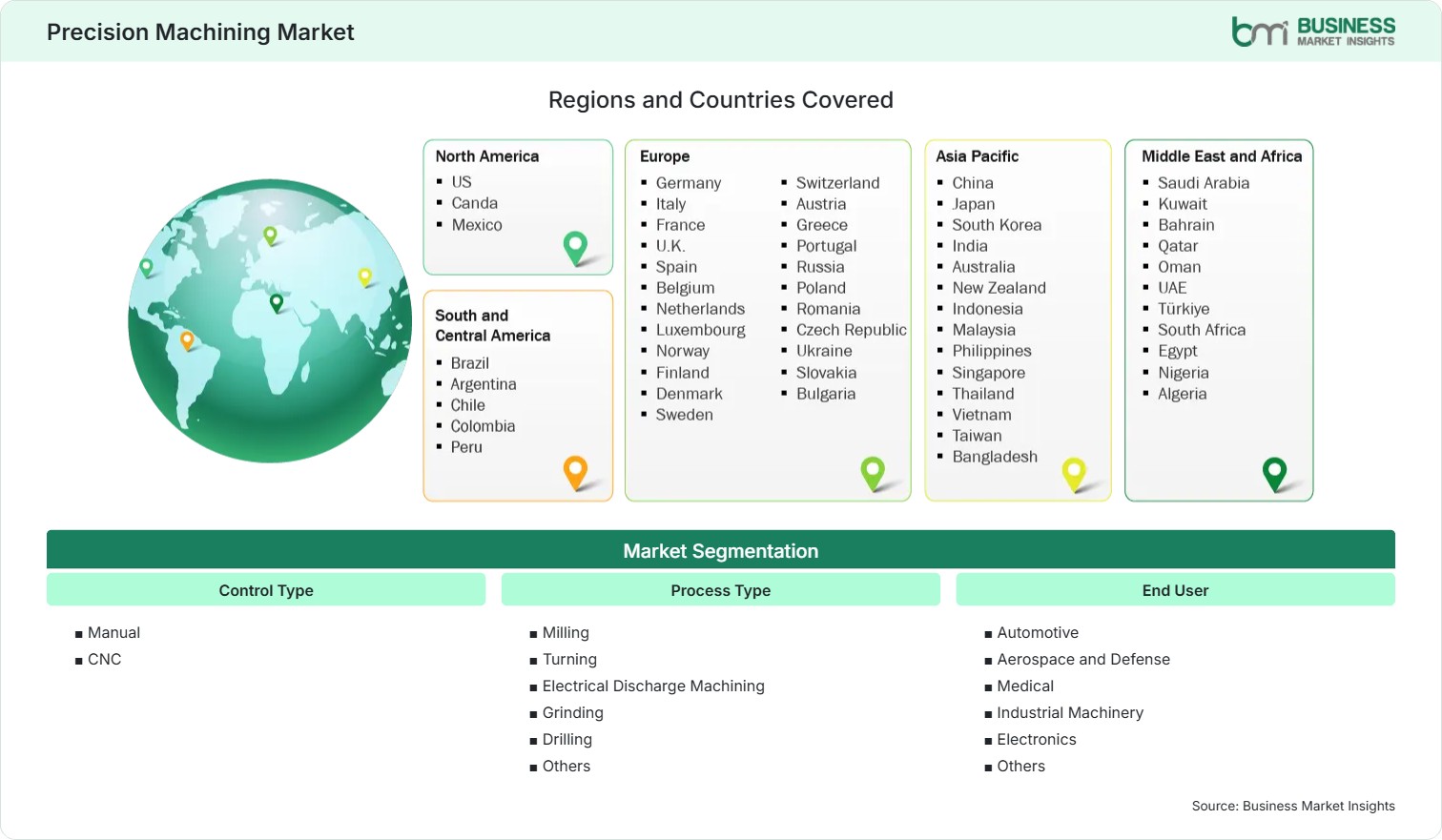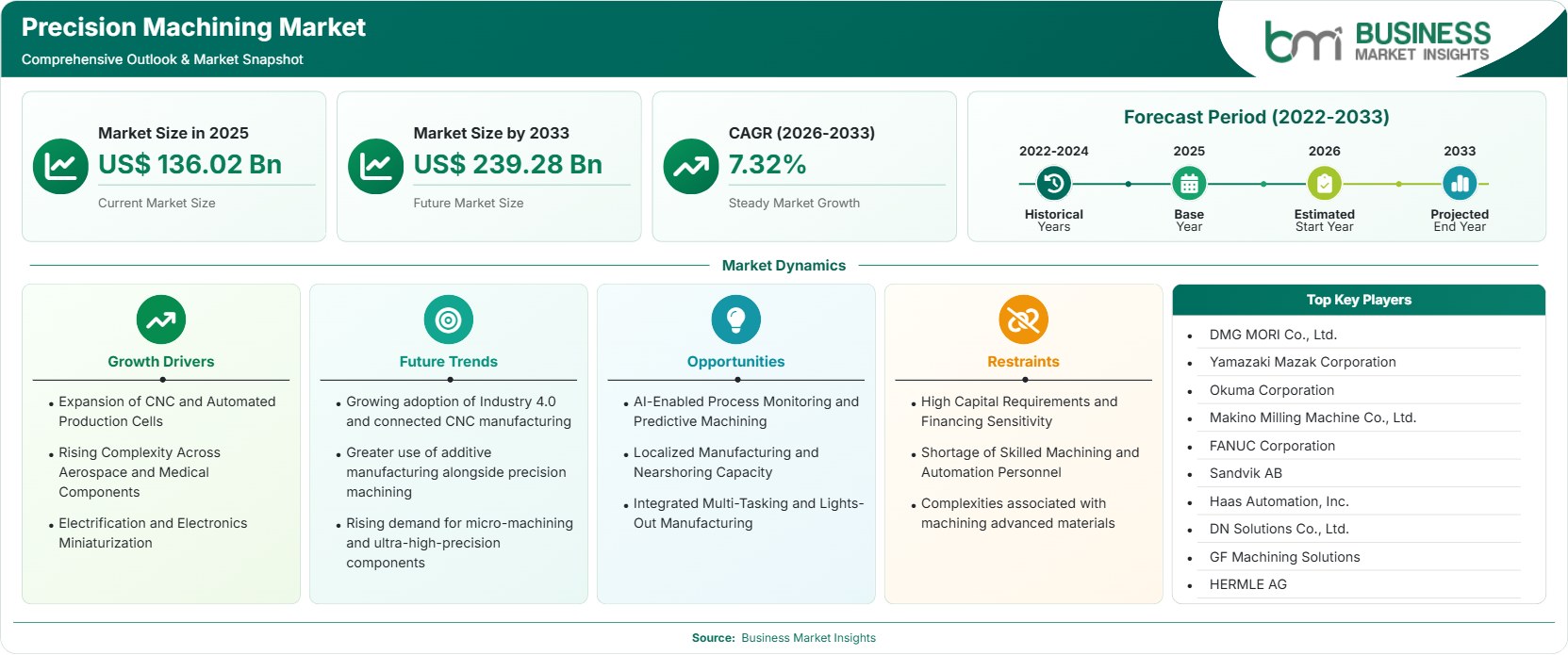
Precision Machining Market Regional Highlights
North America Precision Machining Market
North America accounted for a 23%–26% share in 2025 and is projected to register a 6.6%–7.2% CAGR during 2026–2033. The regional base is supported by aerospace, defense, medical devices, automotive, semiconductor equipment, and industrial machinery. Reshoring is encouraging investment in automated machining cells that reduce labor intensity in Precision Machining Market forecasts. The United States remains the principal demand center, while Mexico benefits from manufacturing integration and nearshoring. Precision requirements for defense systems, aircraft structures, surgical instruments, and electronic components are sustaining demand for advanced CNC equipment, inspection, tooling, and process software.
- The requirement for five-axis machining, hard-to-machine materials, and digitalized manufacturing processes is rising among aerospace and defense companies, thus enabling the use of high-speed machining centers and automatic inspection systems.
- The reshoring and nearshoring trend is urging US and Mexican manufacturers to replace old machines with CNC machines, which can be used effectively through automation and fast set-up.
- The medical manufacturing industry generates further demand for small and intricate parts that have requirements for repeatability and surface quality, especially in implants, surgical tools, diagnostic equipment, and specialty laboratory machinery.
- The semiconductor and electronics industries generate even more demand for precision housings, tooling, fixturing, heat exchanger parts, and machinery parts with stable tolerances.
US Precision Machining Market
The US represented 82%–86% of North American demand in 2025 and is expected to expand at a 6.5%–7.1% CAGR during 2026–2033. Aerospace and defense modernization, semiconductor investment, medical manufacturing, and industrial reshoring support demand in Precision Machining Market. Advanced manufacturing programs are encouraging domestic capacity, while labor shortages increase the economic case for robotic loading and unattended machining.
- Aerospace industry utilizes expensive components with stringent dimensional tolerances, which facilitates the use of multi-axis machine tools, sophisticated cutting tools, process measurement systems, and digital traceability in manufacturing processes.
- Defense industry is preferred because of its preference for domestic manufacture, requirements of customized parts, and higher investments in manufacturing machinery for aircraft, cars, weapon systems, and support equipment.
- Medical and semiconductor industries increase the need for clean, controlled, and highly precise machining environment capable of producing complicated components in comparatively smaller production runs.
Europe Precision Machining Market
Europe held a 20%–23% share in 2025 and is projected to grow at a 6.2%–6.8% CAGR during 2026–2033. Germany remains the leading regional manufacturing base, while Italy, France, and the United Kingdom maintain important automotive, aerospace, industrial, and medical ecosystems in Precision Machining Market. Germany is estimated to expand at 6.4%–7.0%, supported by advanced machinery and automotive engineering, while the United Kingdom is positioned among faster-growing markets at 6.8%–7.4%. Energy efficiency, automation, and production digitization remain central investment priorities for European manufacturers.
- Germany’s sophisticated machine-tool ecosystem supports demand for multi-axis machining, automated cells, advanced controls, and process-integrated manufacturing across automotive and industrial equipment applications.
- France and the United Kingdom benefit from aerospace programs requiring precision structures, engine components, landing-system parts, and specialized tooling manufactured from demanding materials.
- European manufacturers are increasingly evaluating automation to offset labor constraints while improving energy utilization, machine availability, quality consistency, and production traceability.
- Automotive electrification is shifting machining requirements toward motor housings, transmission components, battery structures, thermal-management parts, and lightweight components with increasingly complex geometries.
Asia Pacific Precision Machining Market
Asia Pacific represented 39%–42% of the global share in 2025 and is expected to record an 8.0%–8.6% CAGR during 2026–2033, making it the fastest-growing region. China, Japan, South Korea, and India form the principal manufacturing centers. China maintains scale advantages, Japan leads in advanced machine tools, and India is expanding aerospace, automotive, defense, and electronics production in Precision Machining Market. India is estimated to grow at 8.5%–9.2%, supported by manufacturing localization, electronics investment, and expanding technical-service networks.
- China’s extensive automotive, electronics, industrial equipment, and aerospace supply chains sustain high demand for CNC systems, tooling, automated production cells, and precision components.
- Japan remains a technology-intensive market where machine-tool manufacturers emphasize multi-tasking, five-axis machining, robotics, digital monitoring, and energy-efficient production technologies.
- South Korea benefits from semiconductor, electronics, automotive, and industrial manufacturing, creating demand for tight-tolerance machining and highly automated production environments.
- India offers strong growth potential as domestic automotive, aerospace, defense, electronics, and industrial clusters increase their use of CNC machining and factory automation.
Rest of World Precision Machining Market
Rest of World accounted for approximately 12%–16% in 2025 and is forecast to grow at a 6.0%–6.7% CAGR during 2026–2033. South and Central America benefit from automotive manufacturing, industrial equipment, and nearshoring, while Brazil and Mexico remain important production centers. Middle Eastern markets are investing in industrial diversification, aerospace, energy equipment, and defense manufacturing. The UAE and Saudi Arabia are developing advanced manufacturing ecosystems, while South Africa supports mining, automotive, and industrial machinery supply chains in Precision Machining Market.
- Brazil’s automotive and industrial manufacturing base supports machining demand, particularly for drivetrain, heavy-equipment, agricultural machinery, and replacement components requiring repeatable production.
- Mexico benefits from integrated North American manufacturing networks, attracting automotive, aerospace, electronics, and industrial suppliers seeking shorter supply chains and competitive production economics.
- Saudi Arabia and the UAE are expanding localized industrial capabilities, creating opportunities for precision machining suppliers serving aerospace, defense, energy, and advanced manufacturing programs.
- South Africa’s automotive and industrial sectors provide a foundation for CNC adoption, while mining equipment and maintenance requirements support demand for durable precision-machined replacement parts.