
Investment Casting Market Outlook: Size, Share, Trends, Growth Analysis, Competitive Landscape & Forecast, 2026-2033

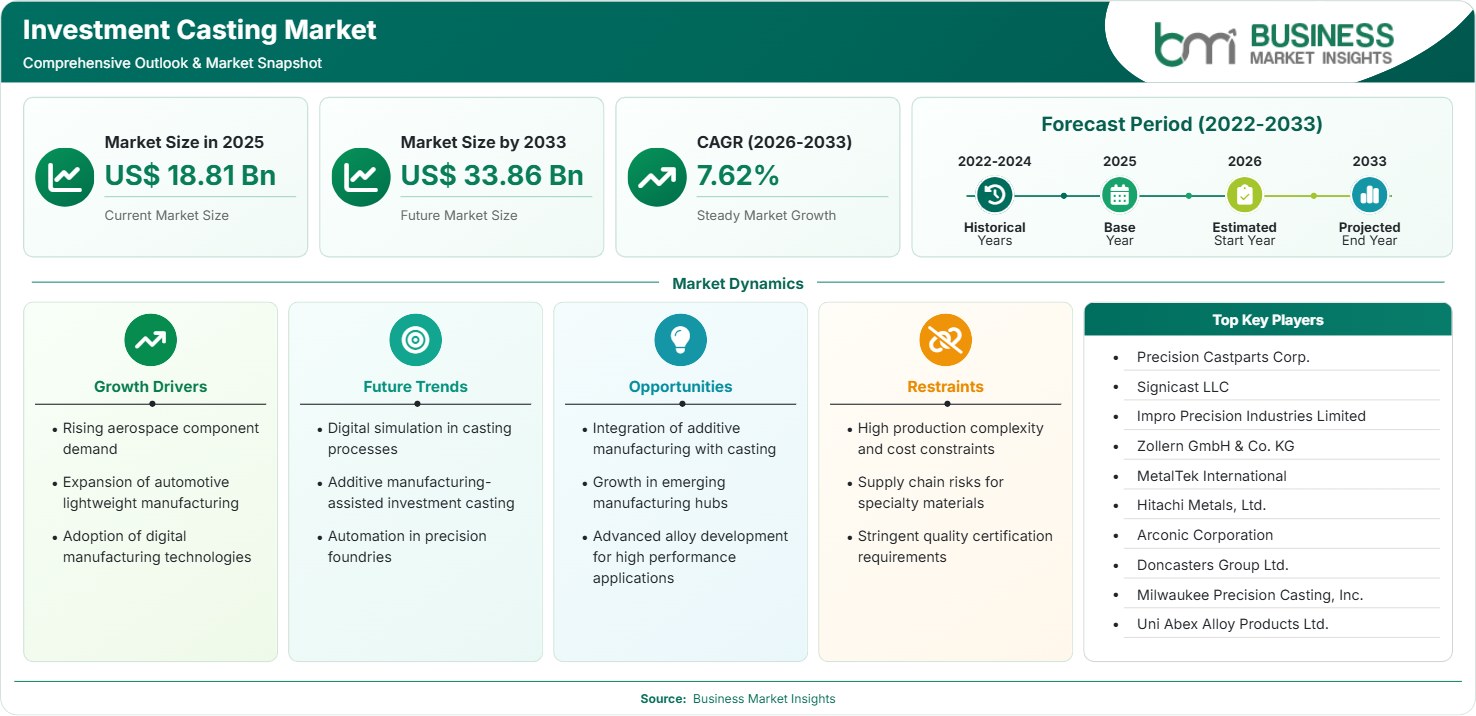
The Investment Casting Market size was valued at US$ 18.81 billion in 2025 and is projected to reach US$ 33.86 billion by 2033, growing at a CAGR of 7.62% during 2026–2033, driven by increasing aerospace demand, lightweight component production, automotive electrification, precision manufacturing adoption, and industrial automation investments are driving opportunities across advanced casting applications.

Report Coverage
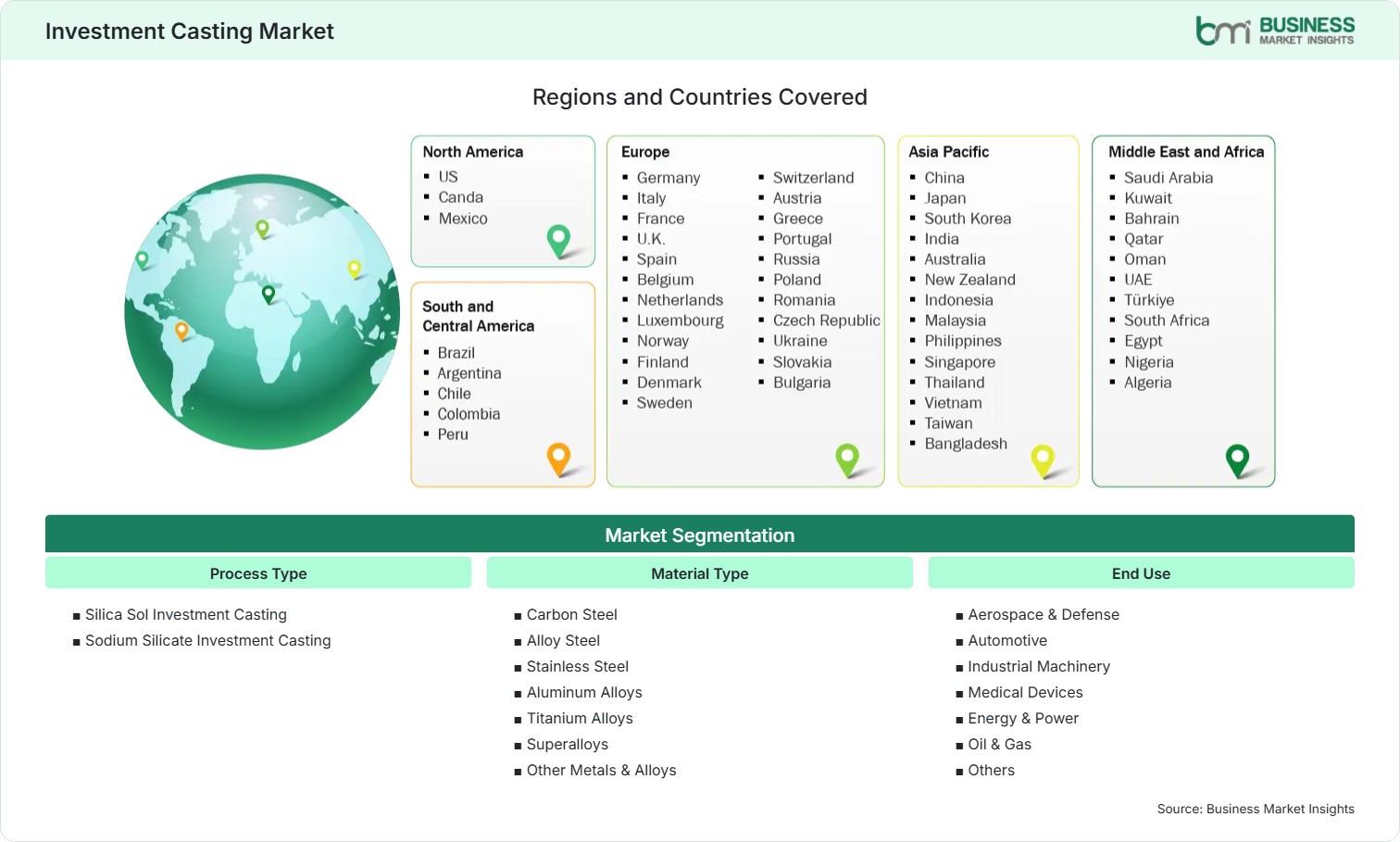
  • Process Type: Silica Sol Investment Casting, Sodium Silicate Investment Casting
  • Material Type: Carbon Steel, Alloy Steel, Stainless Steel, Aluminum Alloys, Titanium Alloys, Superalloys, Other Metals & Alloys
  • End Use: Aerospace & Defense, Automotive, Industrial Machinery, Medical Devices, Energy & Power, Oil & Gas, Others (Marine, Construction Equipment, Agriculture)
US$ 18.81 Bn Market size in 2025
US$ 33.86 Bn Market Size by 2033
7.62% CAGR, 2026 - 2033
2026-2033 Forecast Period

01 AI Overview

Investment Casting Market Summary

  • North America Region: North America holds market share of 30%–33% in 2025, growing with a CAGR of 7%–9% influenced by aerospace manufacturing expansion, defense procurement, precision engineering demand, and industrial modernization. The US market demonstrates strong momentum with a CAGR of 7%–9% through 2033, supported by aerospace component production and advanced manufacturing capabilities.
  • Fastest Growing Region: Asia Pacific maintains market share of 34%–37% in 2025, expanding at a CAGR of 8%–10% due to automotive manufacturing growth, infrastructure development, aerospace investments, and increasing adoption of precision casting technologies.
  • Leading Segment: Aerospace & Defense holds market share of 32%–35% in 2025, growing at a CAGR of 8%–10% driven by aircraft production, defense modernization programs, lightweight components, and demand for complex geometries.
  • High Growth Segment: Titanium Alloys represent market share of 12%–15% in 2025, advancing at a CAGR of 9%–11% due to aerospace lightweighting requirements, corrosion resistance benefits, and increasing use in medical applications.
  • Key Market Opportunity: Adoption of digital casting technologies, simulation software, additive manufacturing integration, and advanced alloys creates opportunities for manufacturers seeking improved efficiency, reduced waste, and higher-value precision components.
  • Major Market Players: Precision Castparts Corp., Signicast LLC, Impro Precision Industries Limited, Zollern GmbH & Co. KG, MetalTek International, Hitachi Metals, Ltd., Arconic Corporation, Doncasters Group Ltd., Milwaukee Precision Casting, Inc., Uni Abex Alloy Products Ltd.
02 Strategic Insights

Investment Casting Market: Strategic Insights

Investment Casting Market Strategic Framework
FREE PDF
Request your free sample
Request free sample
03 Stakeholder View

Key Takeaways

  • The industry value chain is shifting toward integrated manufacturing ecosystems combining alloy suppliers, precision foundries, machining providers, inspection technology companies, and end-use manufacturers.
  • Aerospace and defense applications remain strategic growth areas because investment casting enables production of complex, lightweight, and high-temperature-resistant components required for modern aircraft and defense systems.
  • Material innovation is becoming a competitive differentiator, with manufacturers focusing on titanium alloys, superalloys, and advanced simulation techniques to improve casting performance.
  • Asia Pacific presents strong investment opportunities through expanding aerospace manufacturing, automotive production, industrial infrastructure, and government-backed manufacturing initiatives.
  • Strategic partnerships and acquisitions are increasing as companies seek specialized casting capabilities, advanced production technologies, and broader global customer access.
  • Digital manufacturing adoption is reshaping operational efficiency through automated inspection, process monitoring, and predictive quality management systems.
04 Geographic Outlook

Investment Casting Market Regional Highlights

North America Investment Casting Market

North America accounted for 30%–33% share in 2025 and is projected to expand at a CAGR of 7%–9% from 2026 to 2033. The region benefits from strong aerospace manufacturing, defense spending, advanced industrial capabilities, and established precision engineering networks. Investment Casting Market share remains supported by aircraft production programs, replacement demand, and technology-driven manufacturing upgrades across the United States and Canada.

  • Aerospace manufacturers continue increasing demand for precision components as aircraft production programs require lightweight, durable, and heat-resistant cast parts.
  • Defense modernization initiatives support investment in advanced casting capabilities for engines, propulsion systems, and specialized military equipment components.
  • Industrial manufacturers are adopting automated casting technologies to improve production efficiency, consistency, and quality control processes.
  • Research partnerships between foundries and engineering organizations are advancing alloy development and digital manufacturing capabilities.

US Investment Casting Market

The United States represented 27%–30% share in 2025 and is forecast to grow at a CAGR of 7%–9% during 2026–2033. The country maintains a strong position due to aerospace leadership, defense manufacturing demand, and advanced industrial production capabilities supporting precision casting applications.

  • Aircraft manufacturers continue expanding supply chains for turbine blades, structural components, and complex engine parts requiring investment casting expertise.
  • Defense contractors are increasing demand for specialized cast components supporting next-generation military platforms and equipment modernization programs.
  • Automotive manufacturers are adopting precision casting for lightweight components used in electric and high-performance vehicles.
  • Advanced manufacturing investments are improving domestic production efficiency through automation and digital process monitoring.

Europe Investment Casting Market

Europe accounted for 25%–28% share in 2025 and is expected to grow at a CAGR of 6%–8% through 2033. Strong aerospace industries, automotive engineering expertise, and industrial automation adoption continue supporting regional expansion. Germany, France, and the United Kingdom remain important manufacturing centers due to advanced engineering capabilities and established supply chains.

  • Germany maintains leadership through automotive manufacturing expertise, industrial machinery production, and advanced precision engineering infrastructure.
  • France benefits from aerospace manufacturing strength and increasing demand for aircraft engine and structural components.
  • The United Kingdom continues supporting aerospace supply chains through advanced metallurgy and specialized manufacturing capabilities.
  • European manufacturers are investing in sustainable casting technologies to reduce energy consumption and material waste.
  • Industrial automation adoption is improving production efficiency across precision foundries and component manufacturing facilities.

Asia Pacific Investment Casting Market

Asia Pacific held 34%–37% share in 2025 and is projected to register a CAGR of 8%–10% between 2026 and 2033. The region leads global adoption due to expanding automotive production, aerospace investments, industrial development, and manufacturing cost advantages. China, India, and Japan remain important contributors to regional growth through increasing precision component demand.

  • China continues strengthening its position through large-scale manufacturing capacity, aerospace investments, and automotive component production.
  • India is expanding precision casting capabilities through aerospace localization initiatives and industrial manufacturing development programs.
  • Japan maintains technological advantages through advanced metallurgy, robotics integration, and high-quality manufacturing standards.
  • South Korea is increasing demand through semiconductor equipment, automotive, and industrial machinery applications.
  • Regional foundries are adopting automation and digital inspection systems to compete in global supply chains.

Rest of World Investment Casting Market

Rest of World Investment Casting market accounted for 7%–10% share in 2025 and is expected to grow at a CAGR of 6%–8% during 2026–2033. South America, Middle East, and Africa are gradually expanding through industrial diversification, aerospace investments, energy projects, and infrastructure development. These regions are creating opportunities for international casting suppliers and technology providers.

South American markets are developing manufacturing capabilities linked with automotive, mining, and energy sectors. Middle Eastern economies are investing in aerospace and industrial localization strategies as part of economic diversification programs.

  • Brazil supports demand through automotive production, energy projects, and industrial equipment manufacturing applications.
  • Mexico benefits from manufacturing integration with North American supply chains and growing automotive component production.
  • United Arab Emirates is expanding aerospace capabilities through aviation investments and industrial diversification initiatives.
  • Saudi Arabia is developing manufacturing ecosystems supporting energy equipment and industrial localization programs.
  • African markets are gradually increasing adoption through infrastructure development and industrial modernization projects.
Global Market Geography
FREE PDF
Request your free sample
Request free sample
05 Segment Analysis

Investment Casting Market Segmentation

Process Type

The process type segment represents a core foundation of the market, with silica sol investment casting accounting for 55%–58% share in 2025 and expanding at a CAGR of 8%–10% from 2026–2034. Demand is supported by aerospace, medical, and high-performance industrial applications requiring superior surface finish, dimensional accuracy, and complex geometries.

  • Silica Sol Investment Casting: This process delivers superior surface quality, dimensional precision, and reduced machining requirements, making it preferred for aerospace, medical implants, turbine components, and critical engineering applications.
  • Sodium Silicate Investment Casting: This cost-effective method supports automotive, industrial machinery, and general manufacturing applications where moderate accuracy, production scalability, and economical component fabrication are important factors.

Material Type

Material type remains a significant segment within the Investment Casting Market, with stainless steel holding 28%–31% share in 2025 and growing at a CAGR of 7%–9% between 2026–2034. Material selection is influenced by strength requirements, corrosion resistance, thermal performance, and application-specific durability needs across aerospace, automotive, energy, and medical industries.

  • Carbon Steel: Carbon steel casting supports industrial machinery and structural applications through cost efficiency, mechanical strength, and suitability for components requiring reliable performance under standard operating conditions.
  • Alloy Steel: Alloy steel investment casting provides enhanced strength, wear resistance, and temperature performance for industrial equipment, energy systems, and heavy-duty applications requiring improved component durability.
  • Stainless Steel: Stainless steel remains widely adopted due to corrosion resistance, hygiene properties, and compatibility with medical devices, food processing equipment, aerospace components, and chemical processing systems.
  • Aluminum Alloys: Aluminum alloys support lightweight component production for automotive and aerospace applications, offering weight reduction, thermal conductivity, and improved fuel efficiency benefits.
  • Titanium Alloys: Titanium alloys enable high-performance applications requiring lightweight structures, corrosion resistance, and strength-to-weight advantages, particularly across aerospace systems and medical implant manufacturing.
  • Superalloys: Superalloys are essential for extreme temperature environments, supporting turbine blades, aerospace engines, energy equipment, and other components requiring exceptional thermal stability and mechanical strength.
  • Other Metals & Alloys: Other metals and alloys address specialized requirements across marine, industrial, defense, and customized engineering applications where unique performance characteristics are required.

End Use

The aerospace & defense segment dominates the market with 32%–35% share in 2025 and a CAGR of 8%–10% during 2026–2034. Increasing aircraft production, defense modernization, and demand for lightweight high-performance components are strengthening adoption. The Investment Casting Market scope is expanding as manufacturers integrate precision casting solutions across transportation, healthcare, energy, and industrial applications.

  • Aerospace & Defense: Aerospace and defense applications rely on investment casting for turbine blades, structural components, and engine parts requiring high strength, thermal resistance, and precise manufacturing tolerances.
  • Automotive: Automotive manufacturers utilize investment casting for lightweight drivetrain components, electric vehicle parts, performance systems, and complex designs supporting efficiency improvements and vehicle technology advancements.
  • Industrial Machinery: Industrial machinery applications use cast components for pumps, valves, equipment parts, and mechanical systems requiring durability, dimensional accuracy, and consistent operational performance.
  • Medical Devices: Medical applications leverage investment casting for surgical instruments, orthopedic components, and customized devices requiring biocompatibility, precision manufacturing, and reliable product quality.
  • Energy & Power: Energy sector adoption is driven by turbine components, power generation equipment, and high-temperature applications requiring durable materials and advanced manufacturing capabilities.
  • Oil & Gas: Oil and gas industries utilize investment cast components for valves, pumps, and pressure-handling equipment requiring corrosion resistance and dependable performance in demanding environments.
  • Others (Marine, Construction Equipment, and Agriculture): These industries apply investment casting for specialized machinery components, marine systems, and agricultural equipment requiring strength, reliability, and customized production capabilities.
06 Market Forces

Investment Casting Market Dynamics

Key Market Drivers

Rising Aerospace Component Demand

Growing aircraft production and defense modernization programs are major contributors to market growth as aerospace manufacturers require lightweight, heat-resistant, and geometrically complex components. Due to global aviation growth, there is a rising demand for turbine blades, engines, and structures produced by investment casting. In line with industry aviation forecasts, aircraft deliveries are projected to remain high throughout the decade. The above Investment Casting Market trends are augmented by an increasing usage of modern alloys, digital simulation, and automated inspection processes.

Expansion of Automotive Lightweight Manufacturing

Electric vehicle and fuel efficient modes of transport are leading to an increase in demand for metallic components that are light in weight and have enhanced mechanical strength. Investment casting facilitates production of complex automobile components, minimizes wastage, and offers stability to the structure. The electric vehicle platforms need designs that are specifically suited for batteries, drivetrain parts, and thermal management systems. Increasingly, car companies are working together with high precision foundries to boost their efficiency and product performance. Lightweight mobility is continually fostering demand in automotive applications, especially in cases where conventional manufacturing processes are limited by complexity of parts.

Adoption of Digital Manufacturing Technologies

Digital transformation across foundries is improving process control, production efficiency, and quality assurance. The incorporation of computer simulations, automated pouring technologies, robotics, and other real-time monitoring technologies has become essential for reducing casting problems and increasing consistency. These trends are making competition among precision casting suppliers more intense as they cater to aerospace, medical, and industrial clients. Using advanced analysis and predictive maintenance systems makes it possible to manage operations efficiently and reduce downtime. The increased focus on building smart manufacturing facilities is offering new avenues for firms that have knowledge in both metallurgy and digitized manufacturing.

Key Market Opportunities

Integration of Additive Manufacturing with Casting

The combination of additive manufacturing and investment casting creates opportunities for producing complex components with shorter development cycles and improved design flexibility. Through hybrid manufacturing methods, it is now possible for organizations to develop sophisticated prototypes, tailored components, and geometries for use in aerospace, medical, and other industrial applications. Investing in digital design technology and rapid manufacturing methods is helping foundries to cater to low volume and high value component needs. According to Investment Casting Market Forecasts, organizations leveraging the advantages of an integrated manufacturing process will be able to benefit from new opportunities in specialized applications.

Growth in Emerging Manufacturing Hubs

Developing economies are creating investment opportunities through expanding industrial infrastructure, skilled engineering talent, and increasing localization initiatives. Manufacturing ecosystems are being created in many countries across the Asia-Pacific, Latin American, and Middle Eastern regions to facilitate the growth of their aerospace, automotive, and energy sectors. Government-backed industrial development schemes are spurring investment in modern production equipment and precision engineering technologies. Foreign companies are forging partnerships in the region in order to strengthen their supply chains and get closer to customers.

Advanced Alloy Development for High Performance Applications

Research into titanium alloys, superalloys, and advanced metal compositions is creating opportunities for higher-value casting applications. The aerospace, energy, and medical industries all require materials that can withstand extreme temperatures, pressures, and corrosion. Companies that invest in metallurgical research will be able to develop unique solutions. The collaboration of material producers, research institutes, and parts producers has greatly contributed to the development of alloy properties.

Market Restraints and Challenges

High Production Complexity and Cost Constraints

Factor: Investment casting requires multiple processing stages, including wax pattern creation, ceramic shell formation, melting, and finishing operations, increasing production complexity and operational costs. Impact: Increased production costs will hinder the adoption of such technology by cost-sensitive industries and small manufacturers seeking cost-effective options. In addition, the need for skilled personnel, specialized machinery, and quality control will further increase production costs. There is a need for companies to maintain the balance between accuracy and cost reduction.

Supply Chain Risks for Specialty Materials

Factor: Dependence on specialized alloys, rare metals, and high-performance materials creates vulnerability to raw material price fluctuations and supply disruptions.

Impact: Material availability issues may impact production schedules, raise prices of materials, and generate uncertainty for the producers that manufacture components for the aerospace and defense market sectors. The sourcing of titanium and superalloys demands a controlled strategy due to the high requirements for their application and the small number of suppliers available. This problem is being handled by the diversification of supplies, recycling programs, and long-term purchasing contracts.

07 Company Analysis

Competitive Landscape

The Investment Casting Market analysis highlights competition among global manufacturers focused on aerospace, automotive, industrial machinery, medical, and energy applications. Companies are strengthening capabilities through automation, advanced alloys, strategic partnerships, and expanded production facilities.

Company Name

Overview

Products and Services relevant to this market

Precision Castparts Corp.

Global manufacturer specializing in complex metal components for critical industries.

Aerospace castings, turbine components, structural parts, precision engineered solutions.

Signicast LLC

Precision casting specialist offering automated manufacturing capabilities.

Investment cast components, rapid production, engineering support services.

Impro Precision Industries Limited

Advanced manufacturing provider serving industrial and medical sectors globally.

Precision castings, machining services, engineered metal components.

Zollern GmbH & Co. KG

European metal processing company with advanced casting expertise.

Investment cast parts, turbine components, industrial solutions.

MetalTek International

Metal casting manufacturer focused on engineered alloy solutions.

Alloy castings, corrosion-resistant components, industrial applications.

Hitachi Metals, Ltd.

Materials technology company developing advanced metal products.

Specialty alloys, precision components, high-performance casting materials.

Arconic Corporation

Aerospace-focused manufacturer providing lightweight engineered solutions.

Aerospace castings, aluminum components, advanced manufacturing services.

Doncasters Group Ltd.

Specialist manufacturer serving aerospace and industrial markets.

Turbine components, precision castings, superalloy products.

Milwaukee Precision Casting, Inc.

Precision foundry producing complex metal components.

Investment castings, stainless steel components, engineered solutions.

Uni Abex Alloy Products Ltd.

Manufacturer specializing in alloy-based precision components.

Aerospace castings, industrial alloy products, engineered components.

08 Industry Activity

Recent Developments

July 2026

GF (Georg Fischer) / Consolidated Precision Products (CPP) signed an agreement to divest its aerospace and industrial gas turbine investment casting operations (Precicast Group) to Consolidated Precision Products (CPP). The transaction strengthens CPP’s position in the global investment casting market and expands its aerospace and industrial gas turbine casting capabilities across Europe.

June 2026

DDM Systems, Inc. launched its Digital Foundry platform, a vertically integrated manufacturing approach that uses ceramic 3D printing to eliminate tooling from the investment casting process. The technology delivers precision metal castings in as few as 10 days compared to 52–80 weeks through conventional methods, eliminates 100% of upfront tooling costs, and reduces scrap rates by approximately 90%. The platform is already delivering castings for the U.S. Air Force, gas turbine manufacturers, and aerospace OEMs.

December 2025

Impro Precision Industries announced the commencement of operations at its new investment casting factory in San Luis Potosí, Mexico. The facility expands the company’s North American manufacturing footprint and strengthens its ability to provide integrated casting, machining, and surface-treatment solutions to automotive, aerospace, and industrial customers.

November 2025

Doncasters Precision Castings launched a major expansion of its Bochum, Germany, facility committing $52 million in what stands as one of the boldest capital investment programmes in the company’s recent history. The three-year plan aims to transform Bochum into one of the world’s most advanced manufacturing centres for large industrial gas turbine castings and related superalloy components.

10 Trust & Transparency

Research Methodology

The market analysis combines proprietary research with secondary data from government agencies, company disclosures, regulatory filings, industry databases and expert interviews. Market estimates are validated through data triangulation, cross-market benchmarking and analyst review.

View Full Research Methodology

11 Questions Answered

Frequently Asked Questions

What technologies will influence future casting development?

Digital simulation, additive manufacturing integration, artificial intelligence-based inspection, and advanced alloy research will influence future casting innovation.

Why is the Investment Casting market Report important for manufacturers?

The Investment Casting Report provides insights into industry trends, competitive positioning, application opportunities, technology adoption, and future demand patterns across global markets.

How does automation affect casting manufacturers?

Automation improves production consistency, reduces defects, enhances inspection accuracy, and enables manufacturers to manage complex component requirements efficiently.

What factors influence material selection in investment casting?

Material selection depends on temperature resistance, corrosion performance, strength requirements, weight reduction goals, and operating conditions of the final application.

What industries primarily use investment casting components?

Investment casting components are widely used in aerospace, defense, automotive, medical devices, industrial machinery, energy, and oil and gas industries due to their precision and durability.

Access the Full Investment Casting Market Report

Get segment-level forecasts, regional estimates, competitive benchmarking, company profiles and downloadable Excel datasets.

Access the full Investment Casting Market Report
350 pages PDF & Excel | 2026-07-27