
Grinding Machines Market Outlook: Size, Share, Trends, Growth Analysis, Competitive Landscape & Forecast, 2026-2033

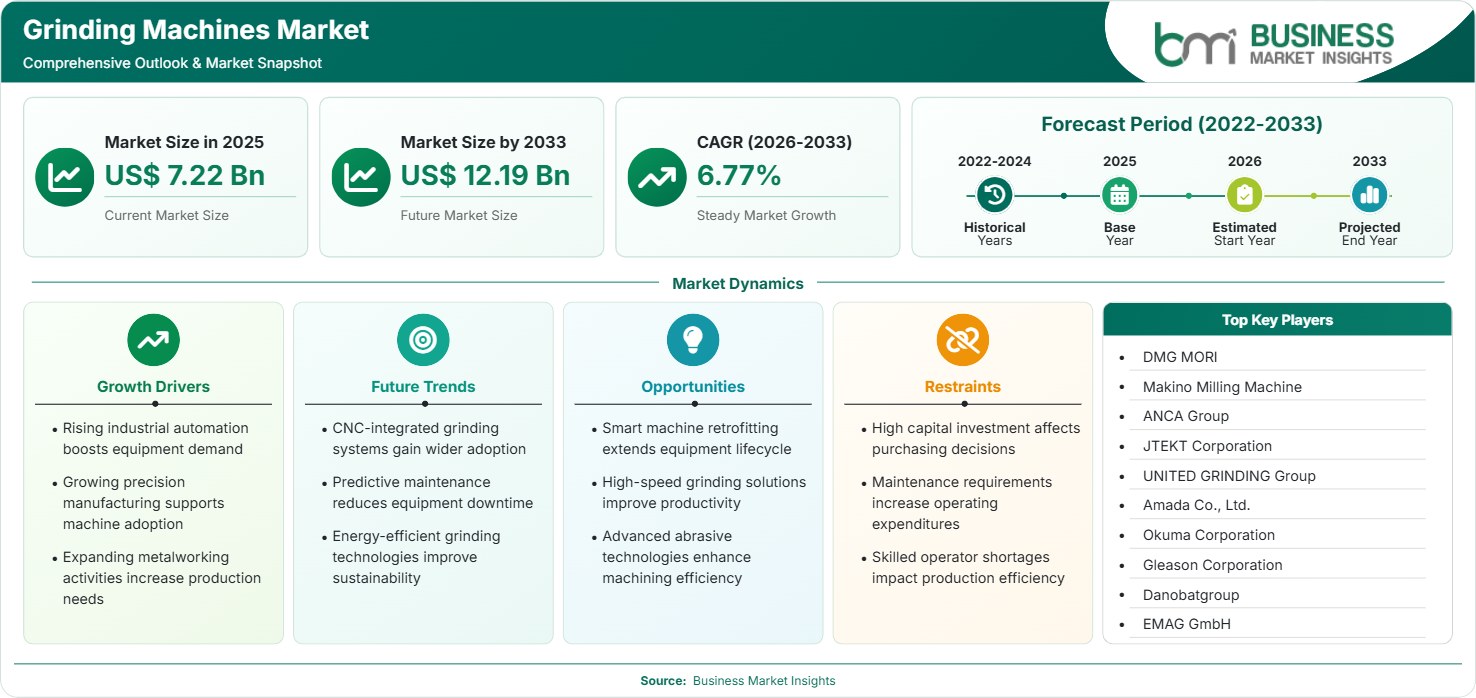
The Grinding Machines Market size was valued at US$ 7.22 billion in 2025 and is projected to reach US$ 12.19 billion by 2033, growing at a CAGR of 6.77% during 2026–2033. Rising industrial automation, expanding precision manufacturing, and increasing metalworking activities continue driving demand for advanced grinding systems across automotive, aerospace, machinery, and industrial manufacturing sectors.

Report Coverage
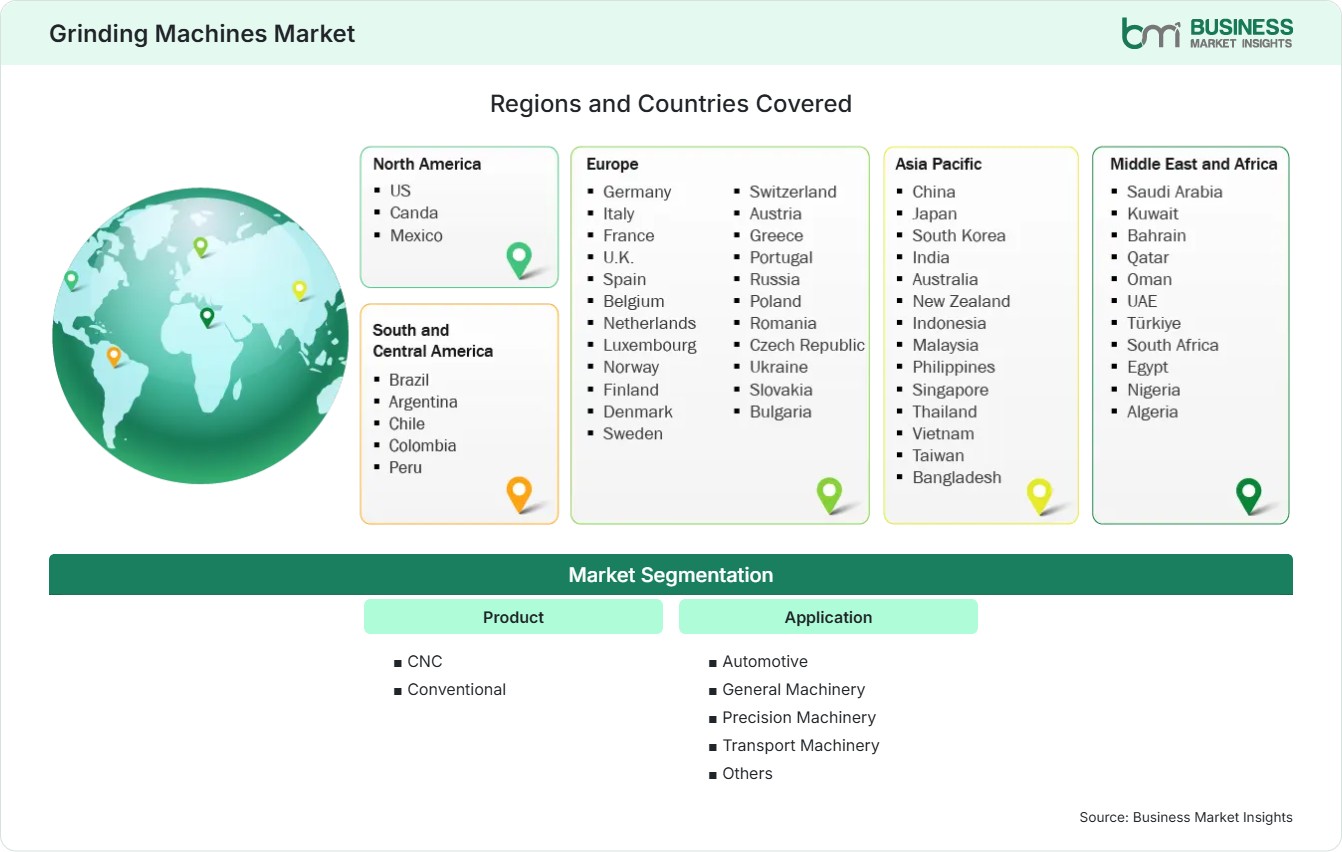
  • Product: CNC, Conventional
  • Application: Automotive, General Machinery, Precision Machinery, Transport Machinery, Others
US$ 7.22 Bn Market size in 2025
US$ 12.19 Bn Market Size by 2033
6.77% CAGR, 2026 - 2033
2026-2033 Forecast Period

AI Overview

Grinding Machines Market Summary

  • North America Region: North America held 24%–27% market share in 2025 and is projected to register a CAGR of 6.2%–6.7% during 2026–2033. Demand is supported by advanced manufacturing, factory automation, and aerospace production. The U.S. remains the largest contributor with a CAGR of 6.3%–6.8%, driven by investments in smart manufacturing, precision machining, and industrial modernization.
  • Fastest Growing Region: Asia Pacific accounted for 44%–47% market share in 2025 and is expected to expand at a CAGR of 7.3%–7.9%, supported by expanding automotive production, industrial automation, precision engineering, and continuous manufacturing investments.
  • Leading Segment: CNC represented 66%–69% market share in 2025 and is projected to grow at a CAGR of 7.0%–7.5%, driven by higher machining accuracy, automation capabilities, and productivity improvements.
  • High Growth Segment: Automotive accounted for 31%–34% market share in 2025 and is anticipated to record a CAGR of 7.2%–7.8%, supported by increasing vehicle production, electric vehicle manufacturing, and precision component requirements.
  • Key Market Opportunity: Growing investments in Industry 4.0 technologies, intelligent machine upgrades, digital manufacturing, and advanced abrasive systems continue creating new opportunities for grinding equipment manufacturers globally.
  • Major Market Players: DMG MORI Co., Ltd., Makino Milling Machine Co., Ltd., ANCA Group, JTEKT Corporation, UNITED GRINDING Group, Amada Co., Ltd., Okuma Corporation, Gleason Corporation, DANOBATGROUP, and EMAG GmbH.
Strategic Insights

Grinding Machines Market: Strategic Insights

Grinding Machines Market Strategic Framework
FREE PDF
Request your free sample
Request free sample
Stakeholder View

Key Takeaways

  • CNC grinding systems continue strengthening their leadership position as manufacturers prioritize automation, precision machining, and higher production efficiency across industrial manufacturing operations.
  • Automotive and precision engineering industries remain the largest demand generators due to increasing production of high-performance mechanical components requiring extremely tight dimensional tolerances.
  • Integration of artificial intelligence, digital monitoring, predictive maintenance, and automated process control continues reshaping equipment design and manufacturing productivity.
  • Asia Pacific offers the strongest long-term investment opportunity owing to expanding industrial production, growing machinery exports, and increasing adoption of automated manufacturing technologies.
  • Strategic investments in smart factory technologies, advanced abrasives, and machine retrofitting continue improving operational efficiency while extending equipment lifecycle across manufacturing industries.
  • Equipment manufacturers increasingly focus on sustainable production, energy-efficient systems, and digital service offerings to strengthen competitiveness within rapidly evolving industrial markets.
Geographic Outlook

Grinding Machines Market Regional Highlights

North America Grinding Machines Market

North America accounted for 24%–27% Grinding Machines Market share in 2025 and is expected to expand at a CAGR of 6.2%–6.7% during 2026–2033. Growth is supported by advanced manufacturing capabilities, industrial automation, aerospace production, and strong investment in smart factory technologies. Manufacturers continue upgrading machining operations with CNC equipment, robotics, and digital process monitoring to improve production quality and operational efficiency.

  • Aerospace manufacturers continue investing in ultra-precision grinding equipment for turbine components and advanced aerospace alloys.
  • Factory automation initiatives are accelerating replacement of conventional grinding equipment with CNC systems.
  • Precision manufacturing supports consistent demand from medical devices, industrial machinery, and semiconductor component production.
  • Growing adoption of predictive maintenance technologies improves equipment reliability and production performance.

US Grinding Machines Market

The United States contributes 80%–83% of North American revenue and is projected to register a CAGR of 6.3%–6.8% during the forecast period. Strong manufacturing investments, industrial automation, and continuous modernization of machining facilities continue supporting long-term equipment demand.

  • Automotive and aerospace industries remain the primary consumers of advanced grinding technologies.
  • Manufacturers increasingly adopt digital machining platforms supporting predictive maintenance and quality monitoring.
  • Skilled workforce development programs continue strengthening adoption of advanced CNC machining systems.
  • Industrial reshoring initiatives encourage investments in precision manufacturing equipment.

Europe Grinding Machines Market

Europe represented 23%–26% market share in 2025 and is expected to register a CAGR of 6.1%–6.6% during the forecast period. Germany remains the leading regional market because of its strong machine tool industry, while Poland records the fastest growth supported by manufacturing investments and industrial expansion. Continuous modernization of production facilities sustains equipment demand throughout the region.

  • Automotive manufacturing continues supporting investments in precision grinding technologies.
  • Industrial digitalization encourages adoption of intelligent CNC machining solutions.
  • Machinery manufacturers increasingly integrate automation with advanced grinding systems.
  • High-quality engineering standards continue supporting premium equipment demand across Europe.

Asia Pacific Grinding Machines Market

Asia Pacific held 44%–47% market share in 2025 and is projected to register the fastest 7.3%–7.9% CAGR during 2026–2033. China remains the largest regional market due to its extensive manufacturing base, while India records the fastest growth through industrial expansion, infrastructure development, and increasing investments in advanced production technologies.

  • Automotive manufacturing expansion continues generating significant equipment demand across regional production facilities.
  • Industrial automation programs accelerate replacement of conventional machining equipment.
  • Electronics, semiconductor, and precision engineering sectors continue increasing investments in high-accuracy grinding systems.
  • Government manufacturing initiatives encourage modernization of industrial production capabilities.

Rest of World Grinding Machines Market

The Rest of World region accounted for 6%–9% market share in 2025 and is expected to expand at a CAGR of 6.4%–6.9% through 2026–2033. Manufacturing diversification, mining equipment production, and infrastructure development continue supporting demand across Latin America, the Middle East, and Africa.

  • Brazil leads regional demand through expanding automotive and industrial manufacturing activities.
  • GCC countries continue investing in industrial diversification and advanced manufacturing infrastructure.
  • Mining and heavy equipment industries support demand for durable precision grinding solutions.
  • Industrial modernization initiatives improve long-term machinery investment across emerging economies.
Global Market Geography
FREE PDF
Request your free sample
Request free sample
Segment Analysis

Grinding Machines Market Segmentation

Component

The component segment plays a vital role in supporting machine performance, productivity, and lifecycle management across manufacturing industries. It accounted for 58%–61% market share in 2025 and is projected to grow at a CAGR of 6.8%–7.3% during 2026–2033. Increasing digitalization, automation, and aftermarket support continue expanding the Grinding Machines Market scope, with manufacturers emphasizing integrated software, maintenance, training, and technical services to improve operational efficiency and equipment utilization.

  • Solutions: Account for the larger share owing to increasing deployment of advanced grinding equipment, CNC control systems, automation technologies, and integrated manufacturing solutions that improve machining precision and production efficiency.
  • Services: Include installation, maintenance, calibration, operator training, remote diagnostics, and technical support, helping manufacturers maximize equipment uptime, extend machine lifespan, and improve long-term production performance.

Application

Application-based solutions continue improving manufacturing visibility throughout the production cycle by enabling process optimization, quality control, and operational efficiency. The segment represented 36%–39% market share in 2025 and is expected to register a CAGR of 6.9%–7.4% during 2026–2033. Growing adoption of digital manufacturing platforms and process automation continues strengthening Grinding Machines Market trends across modern industrial production environments.

  • Pre-Production Management: Supports production planning, process simulation, resource allocation, and machining optimization before manufacturing begins, helping improve production scheduling and operational efficiency.
  • In-Production Management: Enables real-time monitoring, process control, equipment diagnostics, and quality assurance during machining operations, minimizing downtime while improving manufacturing consistency.
  • Post-Production Management: Focuses on quality inspection, production analytics, reporting, maintenance planning, and continuous performance improvement to enhance operational productivity and long-term equipment utilization.

Product

Product innovation continues driving market competitiveness as manufacturers increasingly adopt automated grinding equipment capable of delivering superior accuracy, productivity, and operational flexibility. This segment accounted for 66%–69% market share in 2025 and is projected to expand at a CAGR of 7.0%–7.5% during 2026–2033. Continuous investment in intelligent machine tools, automation, and precision engineering supports sustained adoption across multiple manufacturing industries.

  • CNC (Cylindrical, Surface & Others (Centerless, Gear)): Dominates the market because of superior machining precision, repeatability, automated process control, high production efficiency, and compatibility with Industry 4.0 manufacturing environments.
  • Conventional: Maintains stable demand among small and medium-sized manufacturers performing low-volume production, repair operations, maintenance work, and cost-sensitive machining applications requiring dependable grinding performance.

Application

End-use industries continue determining equipment demand according to machining complexity, production volume, and component precision requirements. The segment captured 31%–34% market share in 2025 and is expected to register a CAGR of 7.2%–7.8% during 2026–2033 as advanced manufacturing investments accelerate globally.

  • Automotive: Represents the largest application owing to high-volume production of engines, transmissions, bearings, gears, brake components, and electric vehicle parts requiring exceptional machining accuracy.
  • General Machinery: Generates consistent demand for grinding equipment used in manufacturing industrial machinery, pumps, compressors, valves, machine tools, and heavy engineering components.
  • Precision Machinery: Supports production of aerospace components, medical devices, semiconductor equipment, and precision instruments where extremely tight dimensional tolerances are essential.
  • Transport Machinery: Continues expanding through railway equipment, marine systems, construction machinery, and commercial vehicle manufacturing requiring durable, high-performance machined components.
Market Forces

Grinding Machines Market Dynamics

Key Market Drivers

Rising industrial automation boosts equipment demand

Manufacturing industries in the automobile, aerospace, medical devices, and industrial machinery continue speeding up automation of their factories to increase efficiency, consistency, and flexibility in production. Automation of the CNC grinding machines using robots that load the machine, automate tool changes, and provide intelligent process control help increase the rate of production while reducing manual operations. These technological advancements continue strengthening Grinding Machines Market growth, as manufacturers increasingly invest in automated machining solutions capable of meeting strict precision requirements while supporting high-volume manufacturing and smart factory initiatives worldwide.

Growing precision manufacturing supports machine adoption

The demand for high-precision components is constantly rising in sectors that require very accurate dimensioning, finishing, and repeatability. The grinding machines are important in manufacturing gears, bearings, shafts, turbine blades, medical implants, and semiconductor tools, where the requirements of micrometer-level precision are highly important. Improvements in the CNC control systems, spindles, and abrasives are contributing to improved machining efficiency while minimizing any mistakes made during the production process. Investment in sophisticated manufacturing units has been continuously encouraging the use of these grinders.

Expanding metalworking activities increase production needs

The globalization of metal fabricating and machining processes has been causing a growing demand for sophisticated grinding machines. Construction of infrastructure, manufacture of industrial machinery and equipment, production of transport equipment, and even renewable energy projects have been causing more and more demand for precision manufactured metal parts. Companies are constantly looking for ways to make their production process more efficient and effective while minimizing waste and maintaining product quality. These developments continue shaping Grinding Machines Market trends while encouraging manufacturers to expand product portfolios and manufacturing capabilities.

Key Market Opportunities

Smart machine retrofitting extends equipment lifecycle

Manufacturing firms are increasingly adopting the approach of retrofitting existing grinding machines with smart sensors and digital monitoring rather than buying new production lines. This is because retrofitting is cost-effective, increases efficiency, improves the life span of the equipment, and makes it compatible with the manufacturing systems of Industry 4.0. Grinding Machines Market Forecasts indicate that retrofitting solutions will continue generating attractive opportunities for equipment manufacturers and service providers as industries pursue cost-effective modernization strategies and digital manufacturing transformation.

High-speed grinding solutions improve productivity

Manufacturers continue investing in high-speed grinding technologies to increase production capacity while maintaining exceptional machining accuracy and surface quality. Superior spindle technology, precise control systems, and cooling systems facilitate higher rates of material removal without degrading the integrity of components. Such techniques have immense utility in the automobile, aerospace, medical devices, and precision engineering sectors since productivity directly impacts their profitability. The future of high-speed machining technology is likely to increase the demand for machinery both in new and established factories.

Advanced abrasive technologies enhance machining efficiency

Continuous innovation in abrasive materials is improving grinding performance, tool life, and machining consistency across demanding industrial applications. Super abrasives, vitrified bond wheels, and engineered ceramic abrasives have improved wear resistance, less heat generation, and increased cutting efficiency when compared to traditional grinding tools. These innovations make it easier for companies to process materials that are hard to machine like titanium, hard steel, and complex alloys. Increasing efforts by companies in R&D are likely to quicken the adoption of future abrasive technology.

Market Restraints and Challenges

High capital investment affects purchasing decisions

Advanced CNC grinding systems require substantial upfront investment due to sophisticated control systems, automation technologies, precision spindles, and integrated software capabilities. Factor: High costs associated with buying make purchase decisions harder for manufacturers that have limited budgets. Impact: Increased time frames to get the go-ahead and delays in equipment replacement can lead to a reduction in demand in the short term, especially within manufacturing businesses that are sensitive to cost.

Maintenance requirements increase operating expenditures

Grinding equipment requires regular maintenance to ensure machining accuracy, operational reliability, and consistent production quality throughout its service life. Factor: Routine calibration, spindle servicing, abrasive wheel replacement, lubrication, and preventive maintenance activities increase operating expenses while requiring skilled technical personnel. Impact: Higher maintenance costs and occasional production interruptions may affect overall equipment profitability, particularly for manufacturers operating multiple production lines. Despite these challenges, proactive maintenance programs remain essential for maximizing machine availability, extending equipment lifespan, and sustaining long-term manufacturing performance.

Company Analysis

Competitive Landscape

The market remains highly competitive as manufacturers focus on automation, digital manufacturing, precision engineering, and energy-efficient machining technologies. Grinding Machines Market analysis shows that leading companies are expanding their global manufacturing footprint through product innovation, CNC advancements, smart machine integration, and strategic partnerships. Investments in Industry 4.0 capabilities, predictive maintenance software, and high-performance grinding solutions continue strengthening competitive positioning across automotive, aerospace, medical device, and industrial manufacturing sectors.

Company Name

Overview

Products and Services Relevant to this Market

DMG MORI Co., Ltd.

Global machine tool manufacturer specializing in advanced machining technologies for precision industrial applications.

CNC grinding machines, digital manufacturing solutions, automation systems, machining centers, and smart production technologies.

Makino Milling Machine Co., Ltd.

Japanese manufacturer recognized for high-precision machine tools serving automotive, aerospace, and industrial markets.

CNC grinding equipment, machining centers, automation solutions, precision manufacturing systems, and process optimization technologies.

ANCA Group

Leading supplier of CNC grinding technology with expertise in precision tool manufacturing equipment.

CNC tool grinders, automation systems, software solutions, tool measurement technologies, and precision grinding equipment.

JTEKT Corporation

Diversified industrial manufacturer offering advanced machining technologies and precision engineering solutions.

Grinding machines, machine tools, bearings, automation equipment, precision manufacturing systems, and industrial technologies.

UNITED GRINDING Group

International machine tool company specializing in precision grinding, eroding, laser, and measuring technologies.

Surface grinders, cylindrical grinders, tool grinding machines, automation solutions, digital manufacturing software, and machine services.

Amada Co., Ltd.

Global manufacturer providing metalworking machinery and advanced fabrication technologies.

Precision grinding equipment, sheet metal machinery, automation systems, tooling solutions, and manufacturing support services.

Okuma Corporation

Machine tool manufacturer delivering intelligent CNC equipment and integrated automation technologies.

CNC grinding machines, machining centers, intelligent controls, factory automation solutions, and precision manufacturing equipment.

Gleason Corporation

Global leader in gear manufacturing technologies and precision machining systems.

Gear grinding machines, gear inspection systems, automation technologies, cutting tools, and manufacturing process solutions.

DANOBATGROUP

Industrial engineering company specializing in advanced machine tools and automated production systems.

Cylindrical grinding machines, rail grinding equipment, customized machining solutions, automation systems, and maintenance services.

EMAG GmbH

German manufacturer focused on precision machining systems for automotive and industrial production.

Vertical grinding machines, CNC machining systems, production automation, precision machining solutions, and manufacturing technologies.

Trust & Transparency

Research Methodology

The market analysis combines proprietary research with secondary data from government agencies, company disclosures, regulatory filings, industry databases and expert interviews. Market estimates are validated through data triangulation, cross-market benchmarking and analyst review.

View Full Research Methodology

Questions Answered

Frequently Asked Questions

What does the Grinding Machines Market Report include?

The Market Report provides comprehensive insights into market dynamics, regional outlook, competitive landscape, segmentation, technology trends, investment opportunities, strategic developments, and long-term industry prospects.

How is digital manufacturing transforming grinding operations?

Digital manufacturing enables predictive maintenance, process monitoring, automated quality control, remote diagnostics, and production analytics, allowing manufacturers to improve machining efficiency while reducing operational downtime and maintenance costs.

Why is Asia Pacific expected to remain the fastest-growing region?

Asia Pacific benefits from expanding automotive manufacturing, industrial automation, precision engineering investments, government-backed manufacturing initiatives, and increasing production of machinery, electronics, and transportation equipment.

Which product segment leads the market?

CNC grinding machines account for the largest market share because they provide superior accuracy, automation, repeatability, productivity, and compatibility with modern smart manufacturing environments.

What factors are driving the Grinding Machines Market?

The market is driven by increasing industrial automation, expanding precision manufacturing, rising metalworking activities, growing demand for CNC equipment, and continuous investments in advanced machining technologies across multiple manufacturing industries.

Access the Full Grinding Machines Market Report

Get segment-level forecasts, regional estimates, competitive benchmarking, company profiles and downloadable Excel datasets.

Access the full Grinding Machines Market Report
350 pages PDF & Excel | 2026-08-24
Similar Research

Related Market Reports