
Industrial Gas Turbine Market Outlook: Size, Share, Trends, Growth Analysis, Competitive Landscape & Forecast, 2026-2033

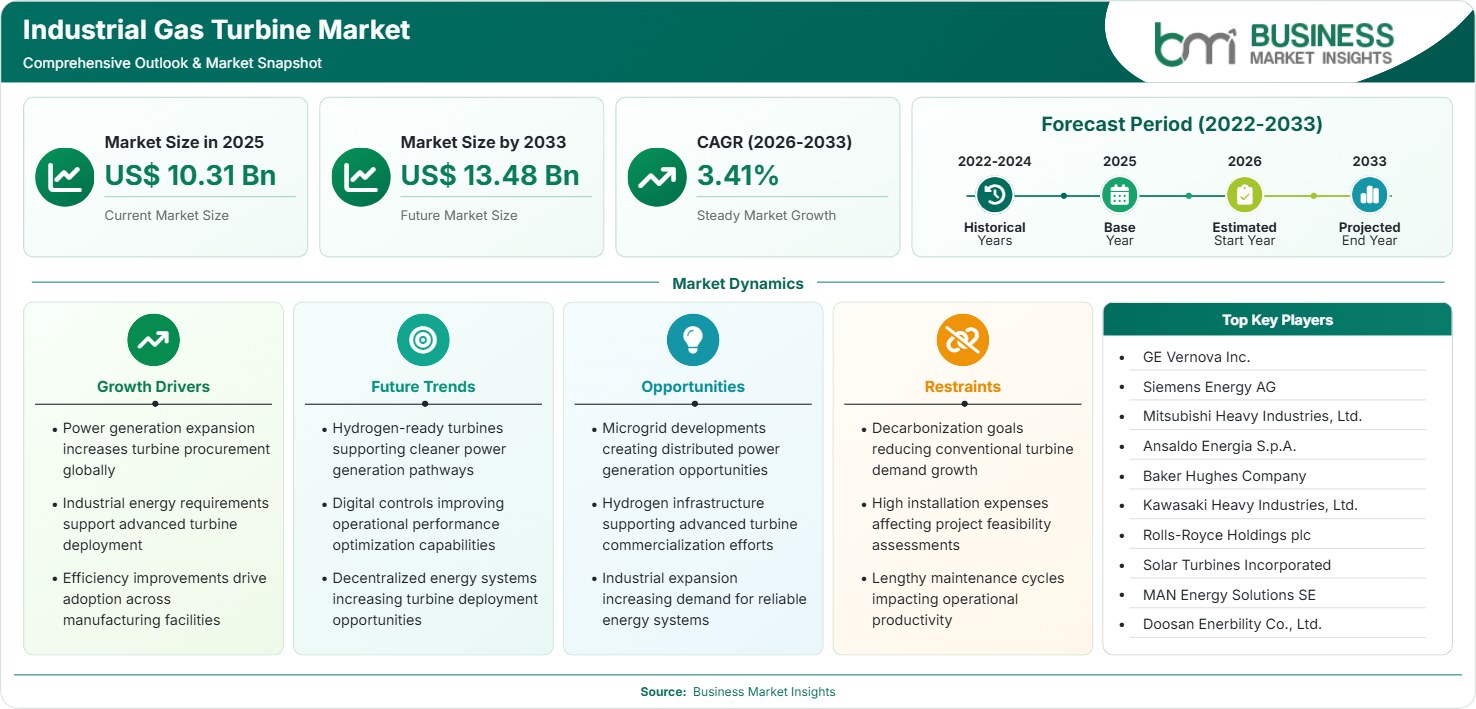
The Industrial Gas Turbine Market size was valued at US$ 10.31 Billion in 2025 and is projected to reach US$ 13.48 Billion by 2033, growing at a CAGR of 3.41% during 2026–2033, driven by data-center power demand, grid flexibility, industrial decarbonization, replacement cycles, combined-cycle efficiency, and demand for dispatchable generation.

Report Coverage
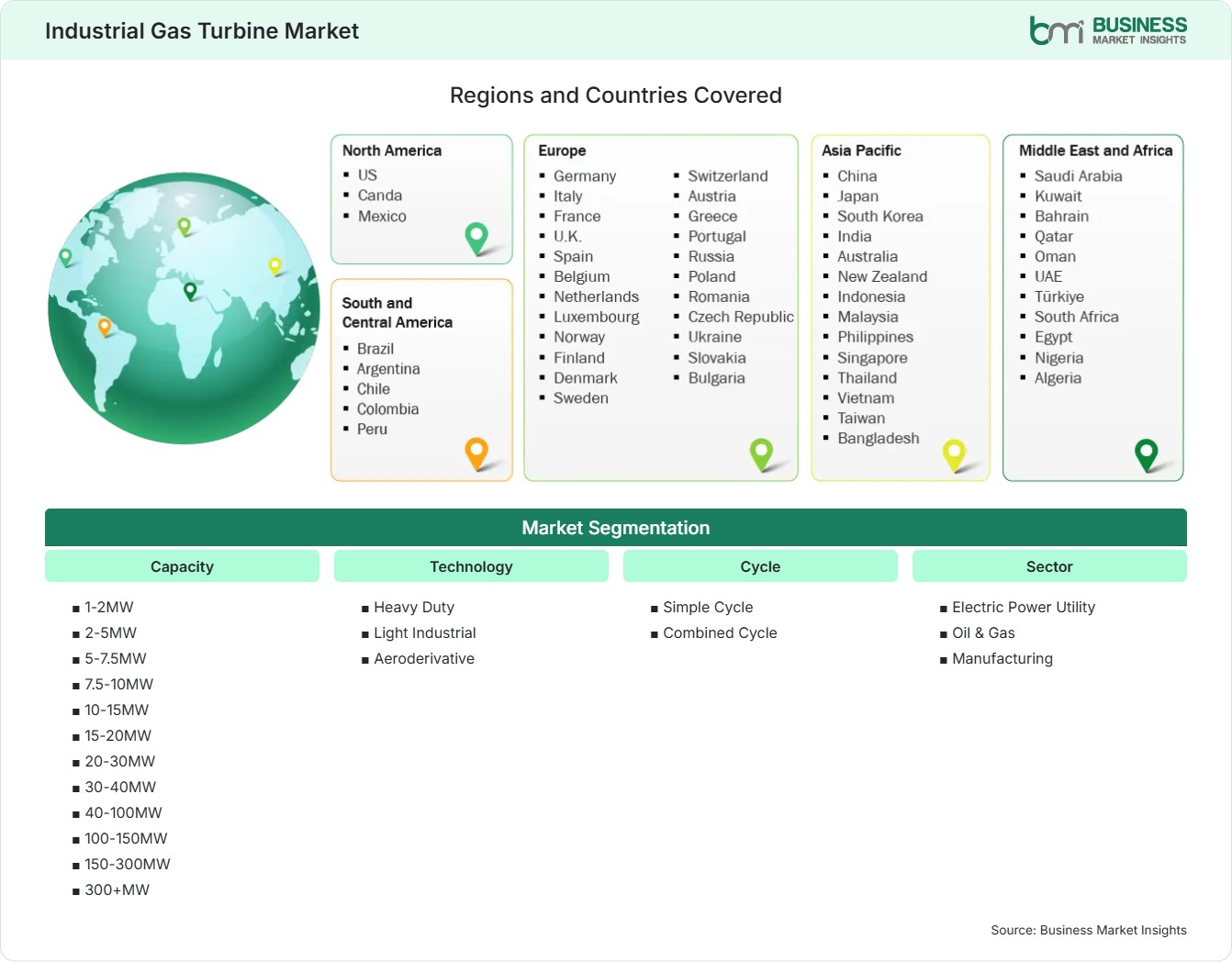
  • Capacity: 1-2MW, 2-5MW, 5-7.5MW, 7.5-10MW, 10-15MW, 15-20MW, 20-30MW, 30-40MW, 40-100MW, 100-150MW, 150-300MW, 300+MW
  • Technology: Heavy Duty, Light Industrial, Aeroderivative
  • Cycle: Simple Cycle, Combined Cycle
  • Sector: Electric Power Utility, Oil & Gas, Manufacturing
US$ 10.31 Bn Market size in 2025
US$ 13.48 Bn Market Size by 2033
3.41% CAGR, 2026 - 2033
2026-2033 Forecast Period

AI Overview

Industrial Gas Turbine Market Summary

  • North America Region: North America holds a market share of 25%–28% in 2025, growing with a CAGR of 2.8%–3.2%, influenced by data centers, grid reliability, gas availability, replacement demand, and flexible generation investments supporting expanding electricity consumption.
  • Fastest Growing Region: Asia Pacific holds market share of 32%–35% in 2025, expanding at a CAGR of 4.0%–4.5%, supported by industrialization, electricity demand, LNG infrastructure, manufacturing investment, urbanization, and replacement of inefficient generation assets across developing economies.
  • Leading Segment: Combined Cycle holds market share of 58%–62% in 2025, growing at a CAGR of 3.5%–3.9%, supported by high efficiency, lower emissions intensity, flexible operation, renewable balancing, and utility-scale replacement of aging thermal plants.
  • High Growth Segment: Aeroderivative technology holds market share of 8%–11% in 2025, advancing at a CAGR of 4.6%–5.2%, driven by rapid-start requirements, distributed generation, industrial applications, data-center resilience, and flexible power requirements.
  • Key Market Opportunity: Behind-the-meter generation for data centers, hydrogen-ready turbines, carbon capture integration, industrial cogeneration, and repowering projects create attractive opportunities as grid connections tighten and electricity demand accelerates across major economies.
  • Major Market Players: GE Vernova Inc.; Siemens Energy AG; Mitsubishi Heavy Industries, Ltd.; Ansaldo Energia S.p.A.; Baker Hughes Company; Kawasaki Heavy Industries, Ltd.; Rolls-Royce Holdings plc; Solar Turbines Incorporated; MAN Energy Solutions SE; Doosan Enerbility Co., Ltd.
Strategic Insights

Industrial Gas Turbine Market: Strategic Insights

Industrial Gas Turbine Market Strategic Framework
FREE PDF
Request your free sample
Request free sample
Stakeholder View

Key Takeaways

  • The turbine manufacturing aspect of the value chain is now shifting towards integrated engineering, long-term service agreements, digital diagnostics, fuel systems, emissions equipment, and component repair, which is making revenue from the entire lifecycle increasingly important to the economics of the original equipment manufacturers.
  • Combined-cycle systems are still the main area for growth, while aeroderivative and smaller industrial setups provide quicker expansion in cases where customers place a priority on rapid deployment, operational flexibility, compact footprints, and the ability to operate as an islanded power source.
  • More emphasis is now being placed on hydrogen-ready combustion, the use of advanced materials, higher firing temperatures, digital performance optimization, faster start-ups, and retrofit packages that allow the operating life to be extended without having to replace the entire plant.
  • Asia Pacific has the most compelling structural investment opportunity since industrialization, the rising demand for electricity, expansion in manufacturing, the availability of liquefied natural gas, and the need to replace outdated power generation facilities all result in a variety of turbine applications within both utility companies and energy-intensive industries.
  • More of the capital is now being directed towards manufacturing capacity, repair infrastructure, service networks, and local supply chains. The fact that GE Vernova is planning to make a US$20 million investment in Singapore is an indication of the strategic value attached to advanced turbine repair capability.
  • The economics of procurement are being altered by data-center power requirements, since these place a higher value on speed-to-power, on-site generation, redundancy, and dispatchability, and as a result are giving rise to a new category of customers beyond those who are traditional utilities and industrial operators.
Geographic Outlook

Industrial Gas Turbine Market Regional Highlights

North America Industrial Gas Turbine Market

North America holds a 25%–28% share in 2025 and is projected to grow at 2.8%–3.2% CAGR through 2033. Demand centers on data centers, grid reliability, gas infrastructure, and replacement of aging thermal assets. The United States represents the dominant regional market, while Canada and Mexico provide additional opportunities through industrial cogeneration, LNG-linked infrastructure, and flexible generation requirements.

  • The construction of data centers is leading to the development of specific generation opportunities, with Baker Hughes having secured orders covering up to 270 MW for projects in the US.
  • Texas and the states adjacent to it are still attractive since the increasing demand for electricity is leading the utility companies to buy dispatchable capacity and to strengthen their reserve margins.
  • Modern turbines are now being specified to handle quick changes in load, to meet emissions requirements, to include digital monitoring, and to be compatible with power systems that have a high proportion of renewable energy.
  • The replacement projects prefer those combined-cycle arrangements that are highly efficient since the fuel economy and the length of time they are operated make it worthwhile to commit a large amount of capital.

US Industrial Gas Turbine Market

The US Industrial Gas Turbine Market represents 72%–76% of North American demand in 2025 and is projected to grow at 2.9%–3.3% CAGR through 2033. Data centers, industrial electrification, manufacturing reshoring, and regional capacity shortages support investment. The IEA reported that data centers accounted for half of US electricity-demand growth in 2025, reinforcing demand for reliable generation.

  • Siemens Energy has received an order for ten gas turbines, the combined output of which is 2,088 MW, at two sites located in Texas and New Mexico.
  • Baker Hughes is providing the Frame 5 turbines for data center projects in Georgia and Texas, which shows that the demand for dedicated generation is increasing.
  • Interest is growing in behind-the-meter projects since conventional connections are delayed by transmission constraints or long interconnection queues.

Europe Industrial Gas Turbine Market

Europe Industrial Gas Turbine Market holds a 22%–25% share in 2025 and is projected to expand at 2.5%–3.0% CAGR. Germany, the United Kingdom, Italy, and France remain important markets, while Poland and Hungary provide higher-growth replacement opportunities.

  • Germany is still important in the fields of industrial cogeneration, replacement projects, and the provision of flexible generation to support the integration of renewables.
  • Hungary is creating gas capacity as a replacement for lignite, a fact shown by the 521 MW Matra project by Ansaldo Energia.
  • Ireland is able to achieve growth by means of flexible peaking capacity which is intended to complement renewable generation and enhance system resilience.
  • In Poland and in Central Europe, there are possibilities for replacing coal, but it is up to the question of financing and emissions policy.

Asia Pacific Industrial Gas Turbine Market

Asia Pacific Industrial Gas Turbine Market holds a 32%–35% share in 2025 and is projected to grow at 4.0%–4.5% CAGR, making it the fastest-growing regional market. China, Japan, South Korea, and India lead installed demand, while Southeast Asia provides faster expansion.

  • The largest opportunity for industrial power generation is still China, covering sectors such as steel, refining, petrochemicals, and utility-scale applications.
  • Japan is still making investments in high-efficiency thermal generation, with GE Vernova's three-turbine Goi project adding more than 2.3 GW.
  • South Korea is enhancing its ability to produce turbines, since Doosan Enerbility has obtained further orders after accumulating more than 15,000 hours of operation.
  • In Southeast Asia, there are opportunities for electricity demand, industrial parks, LNG infrastructure, and grid development, all to move forward.

Rest of World Industrial Gas Turbine Market

Rest of World Industrial Gas Turbine Market represents 17%–20% of 2025 demand and is projected to grow at 3.0%–3.6% CAGR. The Middle East, Brazil, and selected African markets lead opportunities. Oil-to-gas switching, industrial expansion, energy-security investment, and renewable balancing support demand.

  • Middle Eastern projects now use gas turbines more often to replace oil-fired power and save fuel.
  • Brazil has the ability to provide a balance when the hydrological conditions lead to a reduction in hydroelectric power output and an increase in the need for thermal generation.
  • Mexico is still relevant when it comes to industrial and utility projects associated with natural-gas infrastructure and meeting electricity demand.
  • Saudi Arabia and the UAE provide substantial opportunities as a result of their power-system modernization and fuel-switching initiatives.
Global Market Geography
FREE PDF
Request your free sample
Request free sample
Segment Analysis

Industrial Gas Turbine Market Segmentation

Capacity

Capacity structure is led by large utility-scale turbines, while smaller units address industrial, distributed, and cogeneration applications. The Industrial Gas Turbine Market scope increasingly spans flexible capacity, replacement projects, and dedicated generation. Capacity economics depend on operating hours, fuel cost, grid access, emissions requirements, and customer need for rapid deployment.

  • 1-2MW: Compact turbines serve distributed industrial power, remote facilities, and specialized cogeneration where footprint, reliability, and modular deployment outweigh economies of scale.
  • 2-5MW: This range supports small industrial plants, commercial facilities, and distributed generation requiring dependable electricity, heat recovery, and relatively short installation periods.
  • 5-7.5MW: Demand comes from medium industrial sites and utility support applications where customers require flexible output, compact equipment, and improved fuel efficiency.
  • 7.5-10MW: Units address industrial cogeneration, small power plants, and distributed generation, balancing moderate capacity requirements with manageable project complexity.
  • 10-15MW: Applications include manufacturing, oil and gas facilities, and microgrids where dependable generation and heat utilization improve total energy economics.
  • 15-20MW: These turbines support larger industrial loads and distributed utility applications, with demand influenced by fuel availability and replacement of aging equipment.
  • 20-30MW: The range serves industrial clusters, energy-intensive facilities, and flexible generation projects where modular capacity reduces dependence on constrained grids.
  • 30-40MW: Larger industrial users and smaller utility projects use this capacity for reliable generation, cogeneration, and renewable-balancing requirements.
  • 40-100MW: Demand is supported by industrial complexes and utility projects requiring substantial dispatchable capacity without the scale of major central stations.
  • 100-150MW: These units increasingly support utility and industrial power projects where efficiency, emissions performance, and operational flexibility influence procurement.
  • 150-300MW: The segment serves major combined-cycle and industrial power facilities, benefiting from high efficiency and replacement of older thermal generation.
  • 300+MW: Large utility projects dominate this category, with demand tied to grid-scale generation, coal replacement, reliability requirements, and high-efficiency combined-cycle development.

Technology

Technology segmentation reflects different operating priorities. The Industrial Gas Turbine Market share is strongest in heavy-duty systems, while aeroderivative equipment is gaining attention for rapid starts and distributed applications. Digital controls, advanced materials, hydrogen readiness, and emissions management increasingly influence technology selection across operating environments.

  • Heavy Duty: Heavy-duty turbines dominate utility-scale generation because high output, efficiency, durability, and established service infrastructure support long operating cycles.
  • Light Industrial: Light industrial turbines serve distributed and industrial users requiring flexible generation, compact systems, moderate capacity, and dependable onsite electricity.
  • Aeroderivative: Aeroderivative systems provide rapid response and high power density, making them attractive for peaking, distributed generation, data centers, and industrial applications.

Cycle

Cycle selection is determined by operating profile, efficiency requirements, fuel economics, and grid role. Industrial Gas Turbine Market trends favor combined-cycle systems for high-utilization applications, while simple-cycle equipment retains relevance where rapid starts, peaking, and limited installation timelines determine project economics.

  • Simple Cycle: Simple-cycle turbines support peaking, emergency generation, and renewable balancing because fast startup and operational flexibility can outweigh lower thermal efficiency.
  • Combined Cycle: Combined-cycle plants achieve superior efficiency through heat recovery, making them preferred for baseload and intermediate-duty utility applications requiring strong fuel economics.

Sector

Sector demand is diversified across utilities, oil and gas, and manufacturing. Utilities remain the largest application base, while industrial users increasingly value dedicated generation as grid congestion, reliability concerns, and electrification increase. Sector-specific requirements determine capacity, technology, operating cycle, and service strategy.

  • Electric Power Utility: Utilities deploy turbines for dispatchable generation, reserve margins, renewable balancing, coal replacement, and replacement of aging thermal assets.
  • Oil & Gas: Oil and gas operators use turbines for field power, LNG facilities, compression, processing, and remote operations where reliability and fuel availability are critical.
  • Manufacturing: Manufacturers deploy turbines for reliable electricity and cogeneration, particularly in steel, chemicals, refining, food processing, and other energy-intensive production environments.
Market Forces

Industrial Gas Turbine Market Dynamics

Key Market Drivers

Rising demand for dispatchable electricity

Electricity demand is becoming more variable as data centers, industrial electrification, cooling, electric vehicles, and digital infrastructure expand. The IEA reported global electricity demand increased 3% in 2025 and forecasts stronger growth in 2026 and 2027. Gas turbines address the resulting need for dispatchable generation because they can operate alongside renewables and respond to changing system conditions. Industrial Gas Turbine Market growth, therefore, increasingly depends on flexibility rather than simple baseload replacement. Siemens Energy’s 2,088 MW US order demonstrates how utilities are responding to regional capacity requirements.

Industrial modernization and replacement demand

Aging thermal assets are creating replacement opportunities where operators seek higher efficiency, improved emissions performance, and better operational flexibility. The IEA indicates gas-fired generation will grow at an average 2.6% annually from 2026 through 2030, despite accelerating renewable deployment. Industrial operators are also upgrading generation systems to improve energy security and reduce exposure to grid interruptions. Modern turbine platforms provide digital diagnostics, predictive maintenance, improved combustion control, and longer service intervals. Industrial Gas Turbine Market trends therefore increasingly favor lifecycle optimization rather than equipment-only purchasing.

Fuel flexibility and lower-emission generation

Hydrogen-ready combustion, improved efficiency, and carbon-management compatibility are becoming stronger differentiators as customers seek lower-emission thermal generation. Ansaldo Energia’s hydrogen-ready GT26 project in Hungary illustrates how replacement projects are incorporating future fuel flexibility. Combined-cycle plants can also reduce fuel consumption per unit of electricity relative to older thermal technologies, strengthening their position where gas remains available. Industrial Gas Turbine Market growth is therefore supported by equipment that can transition toward lower-carbon fuels while maintaining operational reliability.

Key Market Opportunities

Data-center dedicated generation

Data centers are creating a new turbine demand center because grid interconnection delays can extend project schedules, while computing loads require high reliability. The IEA reported that data-center electricity consumption rose 17% in 2025 and expects consumption to double by 2030. Baker Hughes has already secured multiple US orders for turbines serving dedicated data-center projects. The opportunity extends beyond equipment sales into controls, service agreements, fuel infrastructure, and hybrid power systems. Industrial Gas Turbine Market Forecasts increasingly need to account for this customer class because its procurement priorities differ from conventional utilities.

Hydrogen-ready and carbon-managed power plants

The combination of hydrogen-ready turbines and carbon capture technology offers a way of maintaining gas-powered generation while at the same time reducing future emissions intensity. Replacement projects in Europe are especially appropriate since the older coal and lignite facilities already have access to the grid, a qualified workforce, and existing power generation sites. Ansaldo Energia's Matra project involves the use of a hydrogen-ready GT26 together with a steam turbine and is aimed at replacing a lignite power plant. Carbon capture can add value by allowing dispatchable generation to continue even when stricter emissions limits are in place. This opportunity is most evident in cases where governments give equal importance to energy security and decarbonization. Equipment suppliers who are able to integrate combustion technology, capture integration, digital controls, and lifecycle services can secure a larger share of the project value than those who only sell turbine hardware.

Industrial cogeneration and microgrid expansion

Industries such as manufacturing, refining, chemicals, and others that are highly energy-intensive can make use of turbines to produce electricity, process heat, and enhance resilience, thus opening up possibilities beyond the normal purchase of power from a utility company. Where facilities have steady heat demands, cogeneration proves to be beneficial in terms of improving the economic performance of the assets, and microgrids can help to safeguard key production processes from interruptions to the main power grid. The potential for growth is especially significant in industrial parks in the Asia Pacific region and in energy-intensive facilities in North America and the Middle East. In cases where large utility-grade turbines would not be suitable, smaller turbines and aeroderivative packages can be used. Project developers are also able to combine turbines with batteries, renewable energy sources, and advanced control systems to handle varying loads. This leads to opportunities in integrated energy systems that involve engineering, software, operations, maintenance, and financing rather than simply supplying standalone turbines.

Market Restraints and Challenges

Natural gas price volatility and fuel availability

The fact is that natural gas prices can undergo substantial changes due to competition from liquefied natural gas, geopolitical disruptions, pipeline limitations, and seasonal demand. As a result, higher fuel costs worsen the economic viability of turbine dispatch and may lead to a shift from gas to coal or to renewables where other forms of generation are available. According to the IEA, global gas demand growth declined to about 1% in 2025, and higher prices led to a shift from gas to coal in the United States.

Capital intensity and renewable competition

The fact is that large-scale combined-cycle projects involve a huge initial outlay, take a long time to develop, have complex permitting processes, and require substantial balance-of-plant infrastructure. As a result, customers might delay their investments in turbines when renewable energy, batteries, or demand-response options offer cheaper alternatives for certain types of operation. The IEA states that, in 2025, renewables and nuclear power together increased global generation by more than the total amount of electricity generated, highlighting the competitive pressure exerted by low-emission technologies.

Company Analysis

Competitive Landscape

The Industrial Gas Turbine Market analysis indicates competition is centered on turbine efficiency, installed-base scale, service capability, fuel flexibility, digital controls, and localized manufacturing. Recent procurement demonstrates that OEMs are competing not only for new equipment but also for lifecycle contracts and specialized applications.

Company Name

Overview

Products and Services relevant to this market

GE Vernova Inc.

Global power technology supplier with a major installed gas-turbine fleet and extensive service infrastructure across utility markets.

HA gas turbines, heavy-duty systems, plant services, upgrades, digital monitoring, repair technologies, and lifecycle maintenance.

Siemens Energy AG

Global energy technology company with strong turbine, generator, and power-plant engineering capabilities serving utility and industrial customers.

SGT gas turbines, combined-cycle systems, generators, service agreements, modernization, controls, and hydrogen-capable solutions.

Mitsubishi Heavy Industries, Ltd.

Diversified Japanese engineering group with extensive power-generation capabilities and a broad global turbine installed base.

Mitsubishi Power gas turbines, combined-cycle plants, generators, maintenance, upgrades, controls, and emissions technologies.

Ansaldo Energia S.p.A.

Italian power-generation specialist focused on large turbines, plant engineering, modernization, and lifecycle support.

AE-series gas turbines, combined-cycle plants, generators, upgrades, hydrogen-ready technology, and service solutions.

Baker Hughes Company

Energy technology company expanding turbine applications across utility, industrial, and dedicated data-center generation.

Frame turbines, NovaLT turbines, generators, compressors, service agreements, and integrated power-generation equipment.

Kawasaki Heavy Industries, Ltd.

Japanese industrial group providing compact turbine systems for distributed and industrial applications.

Gas turbines, cogeneration systems, generators, distributed power solutions, and maintenance services.

Rolls-Royce Holdings plc

Engineering group with power-generation expertise focused on high-performance distributed and mission-critical energy systems.

mtu power systems, gas engines, distributed generation, microgrids, controls, and lifecycle services.

Solar Turbines Incorporated

Caterpillar subsidiary specializing in industrial gas turbines and energy systems for global industrial customers.

Industrial gas turbines, compressor-drive systems, cogeneration, power generation, controls, and aftermarket services.

MAN Energy Solutions SE

Energy engineering company serving industrial and power applications with distributed generation and energy-conversion technologies.

Gas turbines, power-generation systems, service, digital optimization, and integrated energy solutions.

Doosan Enerbility Co., Ltd.

South Korean power-equipment company expanding its internally developed large gas-turbine platform internationally.

Large gas turbines, generators, combined-cycle equipment, maintenance, component manufacturing, and power-plant engineering.

Trust & Transparency

Research Methodology

The market analysis combines proprietary research with secondary data from government agencies, company disclosures, regulatory filings, industry databases and expert interviews. Market estimates are validated through data triangulation, cross-market benchmarking and analyst review.

View Full Research Methodology

Questions Answered

Frequently Asked Questions

What does the Industrial Gas Turbine Market Report cover?

The Industrial Gas Turbine Market Report covers market size, growth outlook, regional analysis, capacity, technology, cycle, sector segmentation, competitive landscape, recent developments, market drivers, opportunities, restraints, and strategic trends through 2033.

What role will hydrogen play in future turbine projects?

Hydrogen is becoming an equipment-design consideration rather than an immediate universal fuel replacement. Hydrogen-ready combustion allows customers to preserve future fuel flexibility while continuing to operate on natural gas during the transition.

Why do combined-cycle systems remain attractive despite renewable expansion?

Combined-cycle systems provide high thermal efficiency and dispatchable electricity while supporting variable renewable generation. Their value is greatest where power demand remains strong and grids require dependable capacity during periods of low renewable output.

How are data centers changing turbine procurement?

Data centers prioritize rapid deployment, high availability, redundancy, dedicated generation, and predictable maintenance. These requirements are encouraging behind-the-meter turbine projects where conventional grid interconnection cannot keep pace with new computing capacity.

What factors are most important when selecting an industrial gas turbine?

Fuel availability, expected operating hours, required startup speed, emissions requirements, grid conditions, maintenance infrastructure, and heat-recovery potential are central selection criteria. Buyers increasingly evaluate total lifecycle cost rather than purchase price alone, particularly for large combined-cycle projects.

Access the Full Industrial Gas Turbine Market Report

Get segment-level forecasts, regional estimates, competitive benchmarking, company profiles and downloadable Excel datasets.

Access the full Industrial Gas Turbine Market Report
350 pages PDF & Excel | 2026-10-12
Similar Research

Related Market Reports