
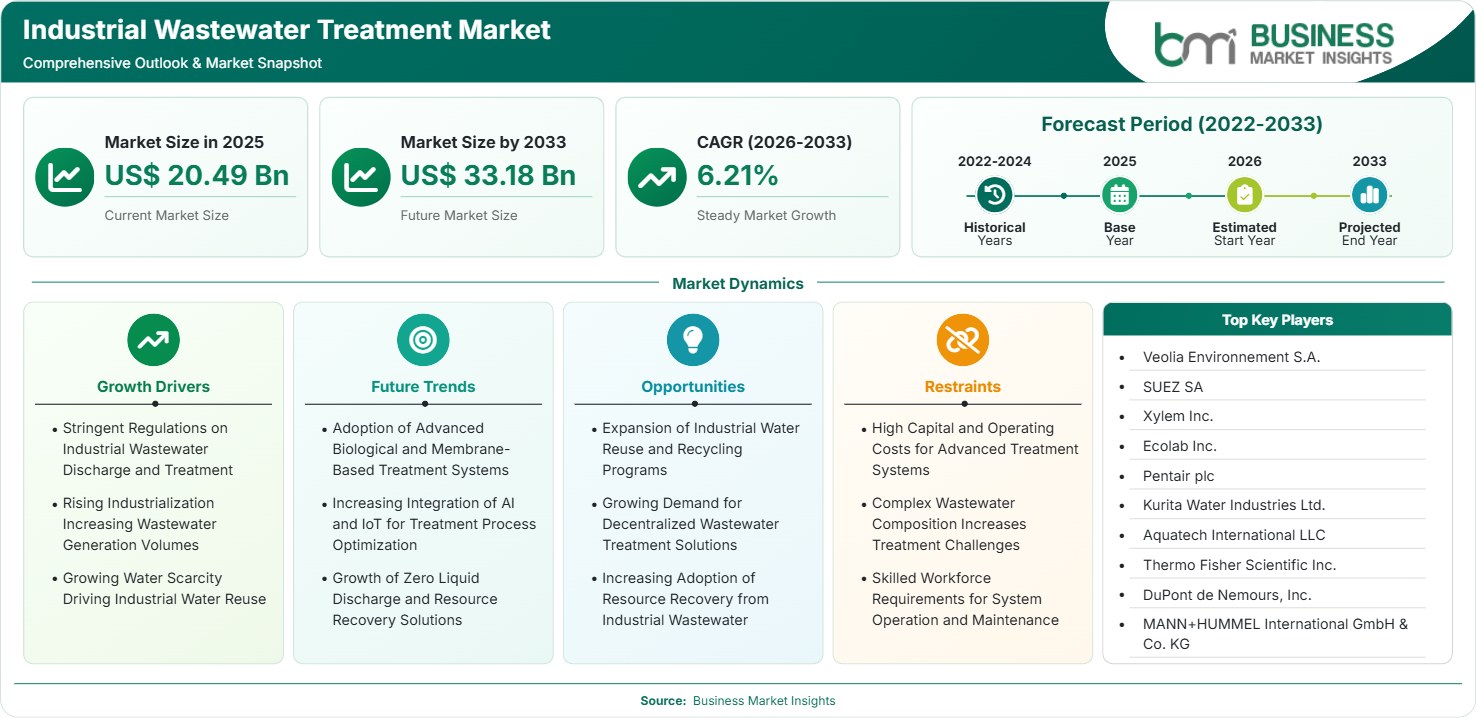
Industrial Wastewater Treatment Market Outlook: Size, Share, Trends, Growth Analysis, Competitive Landscape & Forecast, 2026–2033

The Industrial Wastewater Treatment market size was valued at US$ 20.49 Billion in 2025 and is projected to reach US$ 33.18 Billion by 2033, growing at a CAGR of 6.21% during 2026–2033, driven by stringent discharge regulations, rising industrial water consumption, increasing water scarcity, and opportunities in water reuse, recycling, and resource recovery solutions.

Report Coverage
  • Type: pH Conditioners, Coagulants & Flocculants, Disinfectants & Biocidal Products, Scale & Corrosion Inhibitors, Antifoam Chemicals, Others
  • End-Use: Food & Beverage, Power Generation, Pharmaceuticals, Pulp and Paper, Petrochemical, Others
US$ 20.49 Bn Market size in 2025
US$ 33.18 Bn Market Size by 2033
6.21% CAGR, 2026 - 2033
2026-2033 Forecast Period

AI Overview

Industrial Wastewater Treatment Market Summary

  • North America Region: North America holds a 28%–31% share in 2025, growing with a CAGR of 6.00%–6.50% during 2026–2033, supported by environmental regulations, industrial compliance requirements, and adoption of advanced wastewater treatment solutions. The U.S. market demonstrates steady expansion with a CAGR of 6.10%–6.60% during 2026–2033, driven by manufacturing modernization, water reuse initiatives, and investments in sustainable industrial infrastructure.
  • Fastest Growing Region: Asia Pacific accounts for a 33%–36% share in 2025, expanding at a CAGR of 6.80%–7.30% during 2026–2033, supported by rapid industrialization, increasing wastewater generation, government-led water management programs, and rising adoption of advanced treatment technologies.
  • Leading Segment: Coagulants & Flocculants represent a 24%–27% share in 2025, growing at a CAGR of 6.10%–6.60% during 2026–2033, driven by widespread industrial usage, effective contaminant removal capabilities, and increasing demand from chemical, food processing, and manufacturing facilities.
  • High Growth Segment: Disinfectants & Biocidal Products account for a 15%–18% share in 2025, expanding at a CAGR of 6.70%–7.20% during 2026–2033, supported by stricter hygiene standards, microbial control requirements, and increasing demand from pharmaceutical and food industries.
  • Key Market Opportunity: Industrial wastewater treatment providers are gaining opportunities through water recycling programs, decentralized treatment systems, digital monitoring platforms, and resource recovery solutions that improve sustainability and operational efficiency.
  • Major Market Players: Veolia Environnement S.A., SUEZ SA, Xylem Inc., Ecolab Inc., Pentair plc, Kurita Water Industries Ltd., Aquatech International LLC, Thermo Fisher Scientific Inc., DuPont de Nemours, Inc., MANN+HUMMEL International GmbH & Co. KG.
Strategic Insights

Industrial Wastewater Treatment Market: Strategic Insights

Industrial Wastewater Treatment Market Strategic Framework
FREE PDF
Request your free sample
Request free sample
Stakeholder View

Key Takeaways

  • Industrial wastewater treatment ecosystems are becoming increasingly integrated, with chemical suppliers, equipment manufacturers, engineering companies, and digital technology providers collaborating to deliver comprehensive treatment solutions.
  • Food processing, pharmaceuticals, power generation, and petrochemical industries represent major growth opportunities due to rising wastewater complexity and increasing compliance requirements.
  • Innovation is shifting toward advanced oxidation processes, membrane technologies, biological treatment improvements, and digital monitoring systems that enhance treatment efficiency and reduce operational costs.
  • Asia Pacific provides strong investment potential due to rapid industrial development, increasing environmental regulations, and government initiatives supporting wastewater infrastructure expansion.
  • Strategic acquisitions and partnerships among water technology companies are strengthening capabilities in chemical treatment, filtration systems, automation, and resource recovery solutions.
  • Industrial users are increasingly prioritizing sustainable treatment models that enable water reuse, minimize waste generation, and support long-term environmental goals.
Geographic Outlook

Industrial Wastewater Treatment Market Regional Highlights

North America Industrial Wastewater Treatment Market

North America accounted for a 28%–31% industrial wastewater treatment market share in 2025 and is projected to grow at a CAGR of 6.00%–6.50% during 2026–2033. The region benefits from strict environmental regulations, advanced industrial infrastructure, and strong adoption of water recycling solutions. Industrial Wastewater Treatment share remains supported by demand from manufacturing, pharmaceuticals, food processing, and energy sectors. The Industrial Wastewater Treatment growth outlook is strengthened by increasing compliance investments and adoption of advanced treatment technologies.

  • The United States represents the largest regional market due to stringent wastewater regulations and increasing investments in industrial water reuse systems.
  • Canada is expanding adoption through mining, manufacturing, and energy sectors requiring efficient wastewater management solutions.
  • Regulatory initiatives focused on reducing industrial discharge are encouraging companies to upgrade existing treatment infrastructure.
  • Technology providers are introducing advanced chemical and membrane-based systems to improve treatment efficiency.

US Industrial Wastewater Treatment Market

The U.S. accounted for a 23%–26% share of the global market in 2025 and U.S. industrial wastewater treatment market forecast to grow at a CAGR of 6.10%–6.60% between 2026–2033. The market is driven by environmental compliance requirements, industrial modernization, and increasing demand for sustainable water management solutions. Industries are investing in advanced treatment systems to reduce wastewater discharge and improve operational resilience. Increasing adoption of automation and digital monitoring technologies is further supporting market development.

  • Manufacturing industries are upgrading wastewater treatment facilities to meet stricter environmental standards and improve water efficiency.
  • Pharmaceutical companies are adopting advanced treatment technologies to manage complex wastewater compositions and regulatory requirements.
  • Food and beverage manufacturers are implementing recycling systems to reduce freshwater consumption and improve sustainability performance.

Europe Industrial Wastewater Treatment Market

Europe Industrial Wastewater Treatment Market represented a 24%–27% share in 2025 and is anticipated to expand at a CAGR of 5.80%–6.30% during 2026–2033. The region is influenced by strong environmental policies, circular economy initiatives, and industrial sustainability targets. Germany, France, the Netherlands, and the United Kingdom are leading markets, while Italy and Spain are witnessing increased adoption. Regulatory focus on water conservation and pollution control continues to support technology investments.

  • Germany is advancing adoption through industrial modernization and strict wastewater quality requirements across manufacturing sectors.
  • France is increasing wastewater treatment investments through sustainability initiatives and industrial water management programs.
  • The Netherlands is adopting advanced treatment technologies due to water management challenges and environmental protection priorities.
  • European industries are integrating resource recovery solutions to reduce waste generation and improve operational efficiency.
  • Government sustainability policies are encouraging companies to implement advanced wastewater recycling infrastructure.

Asia Pacific Industrial Wastewater Treatment Market

Asia Pacific Industrial Wastewater Treatment Market accounted for a 33%–36% share in 2025 and is projected to achieve a CAGR of 6.80%–7.30% during 2026–2033. Rapid industrialization, urban expansion, and increasing wastewater generation are driving demand for advanced treatment systems. China, India, Japan, South Korea, and Southeast Asian countries are key markets. Government initiatives promoting wastewater management, industrial compliance, and water conservation are accelerating adoption across multiple industries.

  • China is expanding wastewater treatment investments due to large manufacturing activities and increasing environmental regulations.
  • India is witnessing rising demand from industrial sectors implementing wastewater recycling and discharge compliance programs.
  • Japan and South Korea are adopting advanced treatment technologies for high-value manufacturing industries.
  • Southeast Asian countries are developing wastewater infrastructure to support industrial growth and environmental protection.
  • Industrial expansion across Asia Pacific is creating opportunities for global wastewater technology providers.

Rest of World Industrial Wastewater Treatment Market

Rest of World accounted for a 10%–13% share in 2025 and is expected to grow at a CAGR of 5.50%–6.00% during 2026–2033. South and Central America are witnessing increasing adoption due to mining, food processing, and petrochemical activities, while the Middle East and Africa are investing in wastewater infrastructure due to water scarcity. Brazil, Chile, Saudi Arabia, and the UAE are emerging markets supported by industrial expansion and sustainability initiatives.

  • Brazil and Chile are increasing adoption of wastewater treatment solutions due to mining operations, industrial expansion, and stricter environmental compliance requirements.
  • Middle Eastern countries are investing in advanced wastewater treatment infrastructure to improve water reuse and address freshwater availability challenges.
  • Saudi Arabia and the UAE are implementing industrial water management programs supporting advanced treatment technology deployment.
  • African countries are developing wastewater treatment capacity for mining, manufacturing, and municipal-industrial applications.
  • Latin American industries are adopting treatment solutions to improve discharge quality and support sustainable industrial operations.
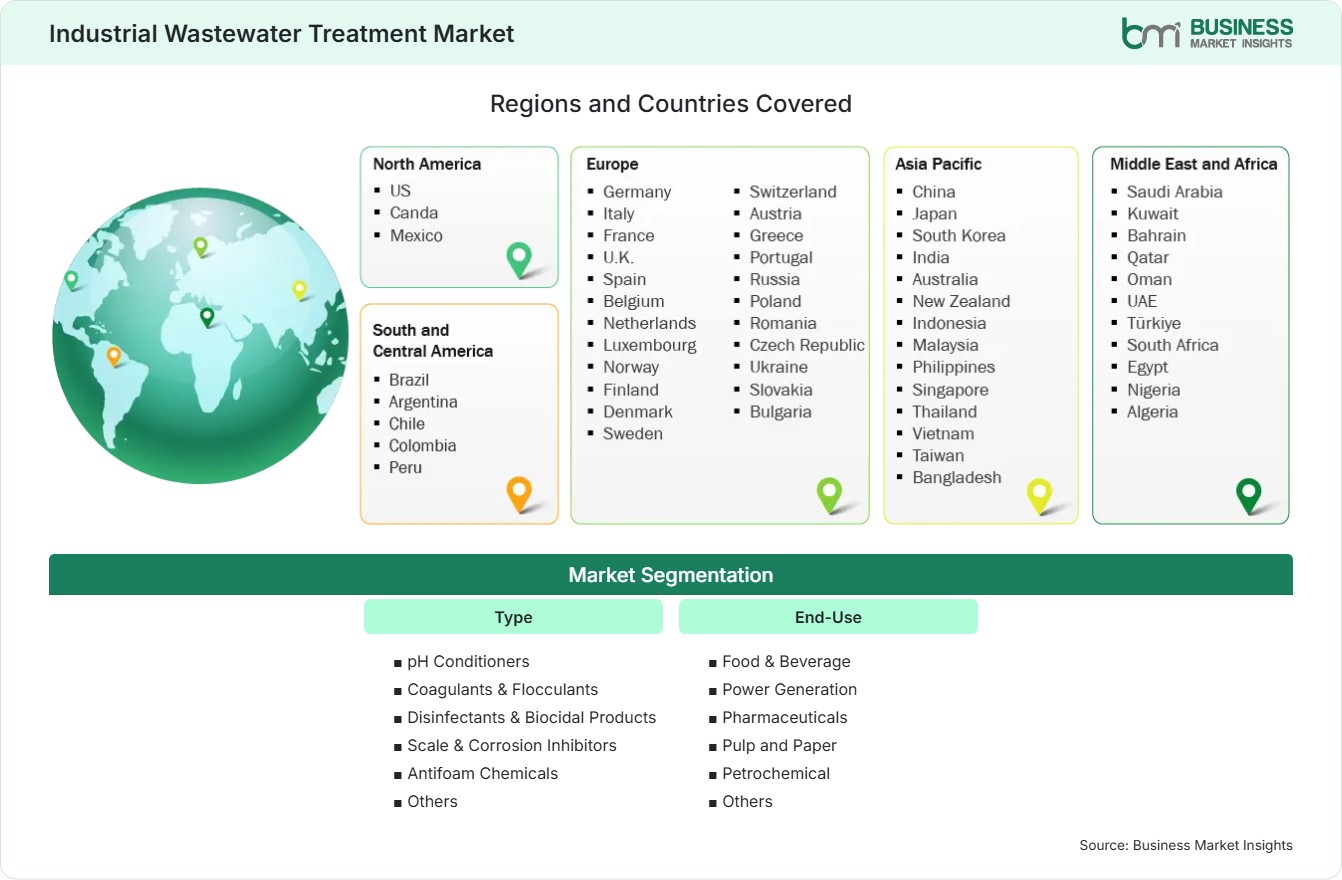
Global Market Geography
FREE PDF
Request your free sample
Request free sample
Segment Analysis

Industrial Wastewater Treatment Market Segmentation

Type

The Type segment accounted for a 58%–61% Industrial Wastewater Treatment Market share in 2025 and is projected to grow at a CAGR of 6.10%–6.60% during 2026–2033. Increasing wastewater complexity across industrial sectors is driving demand for specialized chemical treatment solutions. Industries are adopting treatment chemicals to improve contaminant removal, maintain process efficiency, and comply with environmental regulations. Growing focus on water reuse is further supporting adoption across manufacturing applications.

  • pH Conditioners: pH conditioners are widely used to neutralize acidic or alkaline wastewater streams. Industries utilize these chemicals to optimize treatment efficiency, protect equipment, and ensure compliance with wastewater discharge standards.
  • Coagulants & Flocculants: Coagulants and flocculants support contaminant separation by improving suspended solids removal. Their broad application across industrial wastewater treatment facilities drives adoption in manufacturing, chemical processing, and municipal-industrial operations.
  • Disinfectants & Biocidal Products: Disinfectants and biocidal products control microbial growth in industrial water systems. Increasing hygiene requirements in food processing and pharmaceutical industries are supporting demand for effective microbial management solutions.
  • Scale & Corrosion Inhibitors: Scale and corrosion inhibitors protect industrial equipment from mineral deposits and corrosion-related damage. Their adoption is increasing across power generation, petrochemical, and manufacturing facilities requiring reliable water system performance.
  • Antifoam Chemicals: Antifoam chemicals reduce foam formation during wastewater treatment and industrial processing operations. They improve process stability and are increasingly used in industries handling complex organic wastewater streams.

End-Use

The End-Use segment represented a 72%–75% Industrial Wastewater Treatment Market share in 2025 and is expected to expand at a CAGR of 6.00%–6.50% during 2026–2033. Increasing industrial production and stricter wastewater regulations are encouraging end users to adopt advanced treatment solutions. Industries are investing in chemical treatment, filtration, and recycling systems to manage wastewater complexity, improve compliance, and reduce environmental impact.

  • Food & Beverage: Food and beverage industries generate wastewater containing organic loads, fats, and suspended solids. Treatment solutions help manufacturers achieve discharge compliance and improve water reuse capabilities.
  • Power Generation: Power plants adopt wastewater treatment solutions for managing cooling water discharge, ash handling wastewater, and process streams while improving operational sustainability.
  • Pharmaceuticals: Pharmaceutical companies require advanced treatment technologies due to complex chemical compositions and strict environmental standards governing wastewater disposal.
  • Pulp and Paper: Pulp and paper industries utilize treatment chemicals to manage high organic loads, improve effluent quality, and support compliance with environmental regulations.
  • Petrochemical: Petrochemical facilities adopt wastewater treatment solutions to handle hydrocarbon contamination, chemical residues, and complex industrial effluents generated during processing activities.
Market Forces

Industrial Wastewater Treatment Market Dynamics

Key Market Drivers

Stringent Regulations on Industrial Wastewater Discharge and Treatment

The increasing stringency of environmental regulations governing industrial wastewater discharge is driving the adoption of advanced wastewater treatment techniques. Stricter rules and regulations regarding chemical waste, heavy metals, and organic compounds being discharged in water bodies have been imposed by regulatory agencies all over the world. Various industries, such as the pharmaceutical, petrochemical, electricity generation, and food processing industries, are investing in wastewater treatment systems to meet stringent environmental regulations and improve their water quality performance.

Rising Industrialization Increasing Wastewater Generation Volumes

The rapid growth of industrialization in developed and emerging countries is leading to an increase in the amount of wastewater being produced in manufacturing processes and energy-intensive industries. Industries like the chemicals industry, textile industry, pulp and paper industry, food processing industry, and pharmaceutical industry have been producing increasingly complex forms of wastewater that need to be treated through specific treatment. Expansion of production facilities, urban industrial growth, and the development of industrial clusters is increasing the demand and considered to be a major Industrial Wastewater Treatment Market trend.

Growing Water Scarcity Driving Industrial Water Reuse

Increasing freshwater scarcity is encouraging industries to implement wastewater recycling and reuse strategies to reduce dependence on external water sources. Water-intensive sectors including power generation, mining, food and beverage, and petrochemicals are adopting advanced treatment technologies to recover and reuse process water. Rising water stress in regions such as Asia Pacific, the Middle East, and parts of North America is accelerating investments in industrial water management solutions. Growing adoption of closed-loop water systems and resource-efficient processes is expected to strengthen demand for industrial wastewater treatment technologies during the forecast period.

Key Market Opportunities

Expansion of Industrial Water Reuse and Recycling Programs

Growing adoption of industrial water reuse and recycling programs is creating significant opportunities for wastewater treatment technology providers. Industries are increasingly implementing closed-loop water management systems to reduce freshwater consumption and improve operational sustainability. Water-intensive sectors such as power generation, food processing, pharmaceuticals, and chemicals are investing in advanced treatment solutions that enable wastewater recovery and reuse. The expansion of industrial recycling initiatives is creating demand for chemical treatment solutions, filtration technologies, and integrated wastewater management systems.

Growing Demand for Decentralized Wastewater Treatment Solutions

The increasing need for flexible and localized wastewater management systems is driving demand for decentralized treatment solutions. Industries operating in remote locations or areas with limited infrastructure are adopting modular wastewater treatment systems to improve efficiency and reduce transportation costs. Decentralized solutions provide faster deployment, operational flexibility, and customized treatment capabilities for specific industrial requirements. The growing focus on distributed water management approaches is expected to create new opportunities for wastewater treatment providers across emerging markets.

Increasing Adoption of Resource Recovery from Industrial Wastewater

Resource recovery from industrial wastewater is emerging as a key opportunity area as industries seek to transform waste streams into valuable resources. Advanced treatment systems enable recovery of chemicals, nutrients, metals, and reusable water from industrial effluents. Mining, chemical, and manufacturing industries are exploring recovery technologies to improve resource efficiency and reduce disposal requirements. Increasing adoption of circular economy models is encouraging companies to invest in wastewater solutions that deliver both environmental and economic benefits. Growing demand for sustainable industrial operations is expected to accelerate investment in resource recovery-focused wastewater treatment solutions.

Market Restraints and Challenges

High Capital and Operating Costs for Advanced Treatment Systems

Factor: The development of advanced industrial wastewater treatment processes requires substantial costs because of specialized equipment and installation, energy use, and maintenance. Impact: The costs involved may limit the adoption of such processes by smaller industrial companies due to their lack of funding. Even though innovations in technology have lessened cost-related obstacles, initial costs remain an issue for many firms.

Complex Wastewater Composition Increases Treatment Challenges

Factor: Industrial wastewater streams often contain complex mixtures of chemicals, heavy metals, organic pollutants, and variable contaminant levels that require customized treatment approaches. Impact: Treatment complexity increases system design requirements, operational challenges, and maintenance costs for industrial users. Companies must invest in advanced monitoring, process optimization, and specialized treatment technologies to manage changing wastewater characteristics effectively.

Company Analysis

Competitive Landscape

The Industrial Wastewater Treatment market analysis indicates a competitive environment featuring international water technology firms, chemical treatment players, filtration vendors, and engineering solutions firms. Firms have been targeting integration of chemical dosing, filtration, digital surveillance and water recycling systems in treating industrial wastewater issues.

Company Name

Overview

Products and Services relevant to this market

Veolia Environnement S.A.

Global environmental services company providing industrial water, wastewater, and resource management solutions across multiple sectors.

Industrial wastewater treatment, water reuse systems, chemical treatment solutions, desalination, and advanced filtration technologies.

SUEZ SA

Global water management company delivering sustainable wastewater treatment and industrial water solutions.

Industrial wastewater management, biological treatment, filtration systems, water recycling, and digital water solutions.

Xylem Inc.

Water technology company specializing in equipment, analytics, and solutions for efficient water management.

Pumps, monitoring systems, wastewater treatment equipment, smart water solutions, and industrial treatment technologies.

Ecolab Inc.

Provider of water, hygiene, and industrial process solutions serving manufacturing-intensive industries.

Water treatment chemicals, chemical dosing systems, digital monitoring platforms, and industrial water optimization services.

Pentair plc

Water technology company providing filtration and water management solutions globally.

Filtration systems, water treatment equipment, process solutions, and industrial wastewater management technologies.

Kurita Water Industries Ltd.

Japanese water treatment company specializing in industrial water management and chemical solutions.

Water treatment chemicals, scale inhibitors, corrosion control solutions, and industrial wastewater treatment services.

Aquatech International LLC

Engineering company focused on industrial water purification, reuse, and wastewater treatment systems.

Zero liquid discharge systems, membrane technologies, evaporation systems, and industrial water recycling solutions.

Thermo Fisher Scientific Inc.

Global scientific technology company providing analytical solutions for environmental monitoring applications.

Water analysis instruments, monitoring technologies, laboratory testing solutions, and contamination measurement systems.

DuPont de Nemours, Inc.

Materials science company offering advanced separation and filtration technologies for water treatment.

Reverse osmosis membranes, ultrafiltration solutions, ion exchange technologies, and industrial water purification systems.

MANN+HUMMEL International GmbH & Co. KG

Filtration technology company providing sustainable separation solutions across industrial applications.

Membrane filtration, wastewater filtration systems, particle removal technologies, and industrial water treatment solutions.

Trust & Transparency

Research Methodology

The market analysis combines proprietary research with secondary data from government agencies, company disclosures, regulatory filings, industry databases and expert interviews. Market estimates are validated through data triangulation, cross-market benchmarking and analyst review.

View Full Research Methodology

Questions Answered

Frequently Asked Questions

What factors will influence the Industrial Wastewater Treatment Market Report outlook?

The Industrial Wastewater Treatment Report outlook will be shaped by regulatory changes, industrial expansion, water scarcity challenges, technology innovation, and increasing demand for circular water management solutions.

Why is decentralized wastewater treatment gaining importance?

Decentralized systems provide flexible, scalable, and cost-effective treatment options for industries operating in remote locations or requiring customized wastewater management solutions.

What technologies are improving industrial wastewater treatment efficiency?

Advanced chemical treatment, membrane filtration, automation, biological processes, and digital monitoring technologies are improving treatment performance and operational efficiency.

How do industrial wastewater treatment systems support sustainability goals?

These systems reduce freshwater consumption, minimize wastewater discharge, improve resource recovery, and help industries achieve environmental compliance through efficient water management practices.

Which industries are the major users of Industrial Wastewater Treatment Market solutions?

Food and beverage, pharmaceuticals, power generation, petrochemical, pulp and paper, and chemical industries are major users due to strict discharge requirements and increasing water reuse needs.

Access the Full Industrial Wastewater Treatment Market Report

Get segment-level forecasts, regional estimates, competitive benchmarking, company profiles and downloadable Excel datasets.

Access the full Industrial Wastewater Treatment Market Report
350 pages PDF & Excel | 2026-08-25