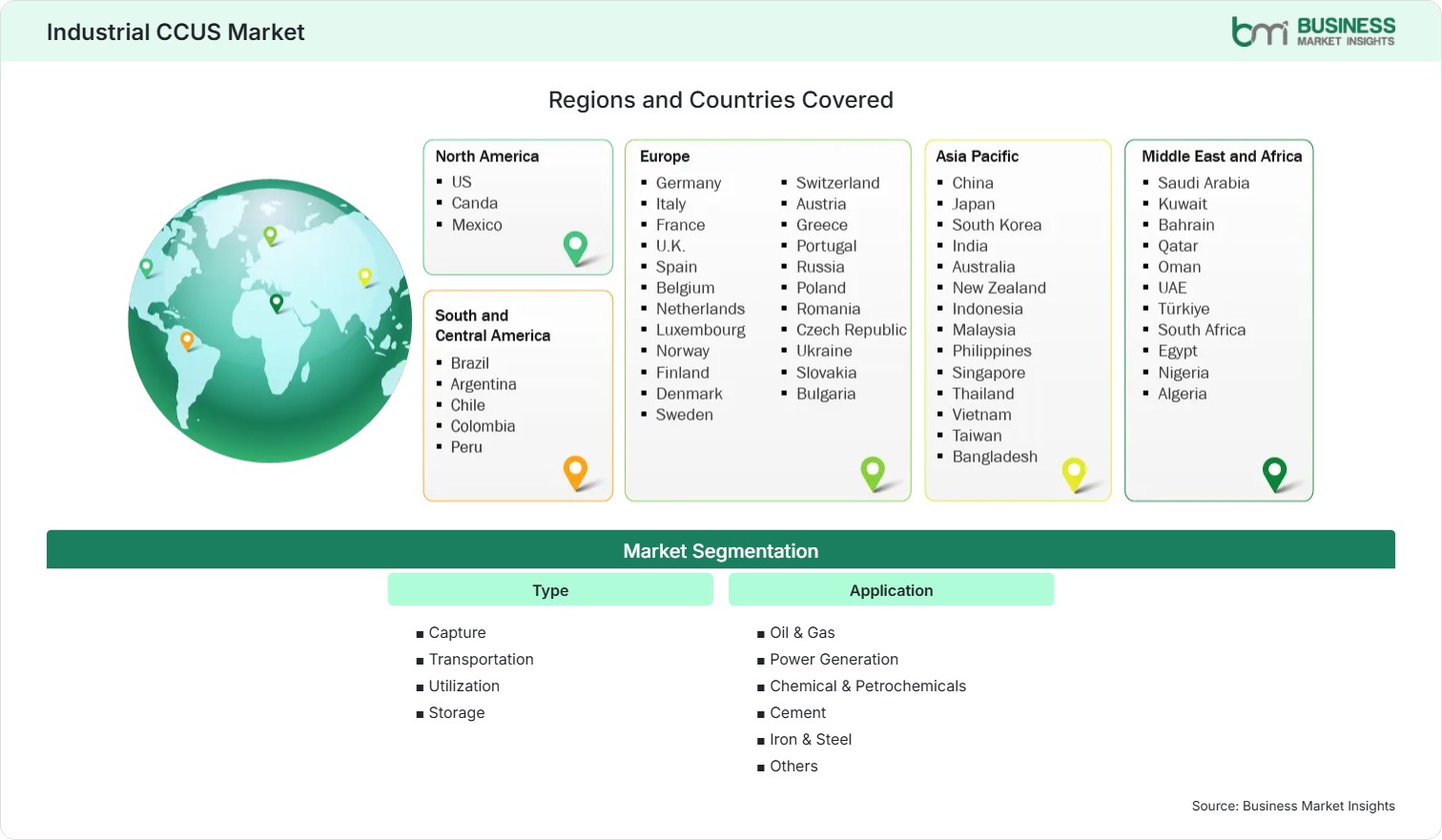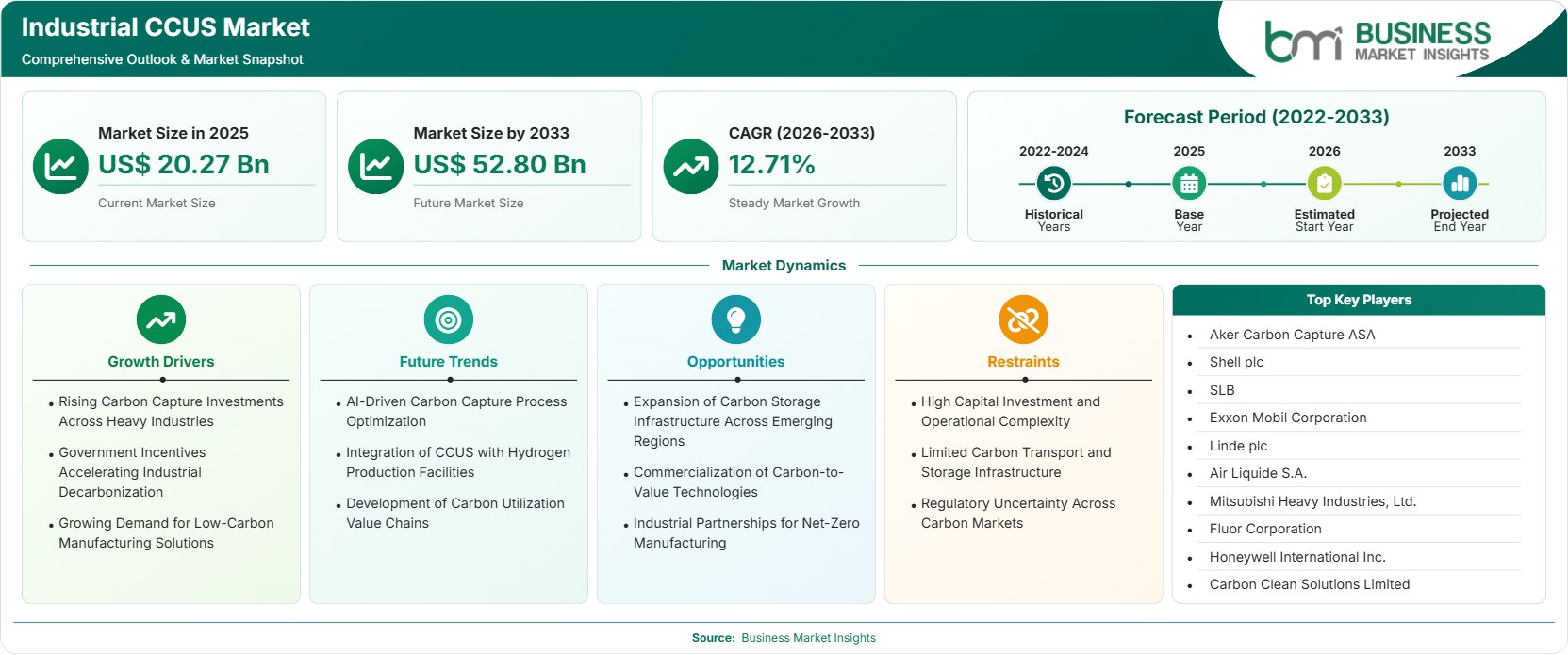
Industrial CCUS Market Regional Highlights
North America Industrial CCUS Market
North America accounted for 36%–40% of the Industrial CCUS Market share in 2025 and is projected to expand at a CAGR of 12.20%–12.80% during 2026–2033. The region leads global deployment due to strong policy support, commercial-scale carbon capture projects, and extensive geological storage resources. The United States and Canada remain major contributors through large carbon capture hubs, pipeline infrastructure, and integrated storage projects supporting heavy industries and energy-intensive manufacturing.
- Federal tax incentives and carbon reduction policies continue encouraging investments in industrial carbon capture facilities across multiple manufacturing industries.
- Energy, cement, refining, and petrochemical sectors are expanding CCUS deployment to achieve emission reduction targets while maintaining production efficiency.
- Development of shared carbon transportation pipelines and geological storage hubs is reducing infrastructure costs and improving commercial feasibility.
- Technology developers are collaborating with industrial manufacturers to commercialize advanced capture solutions with higher efficiency and lower operating costs.
- Carbon management partnerships among governments, engineering companies, and industrial operators are accelerating commercialization of large-scale integrated CCUS projects.
US Industrial CCUS Market
The U.S. represented 30%–34% of the North American market in 2025 and is projected to grow at a CAGR of 12.40%–13.00% during 2026–2033. Strong federal funding, expanding carbon storage capacity, supportive tax incentives, and increasing industrial decarbonization initiatives continue strengthening deployment. Investments from public and private sectors are supporting expansion of carbon transportation infrastructure and long-term geological storage facilities.
- Expansion of industrial carbon hubs is supporting multiple emitters through shared transportation and storage infrastructure.
- Growing investments in hydrogen production are increasing demand for carbon capture technologies across industrial facilities.
- Engineering companies are deploying modular carbon capture systems to improve installation flexibility and reduce project timelines.
- Public-private partnerships continue accelerating commercialization of next-generation carbon management technologies.
Europe Industrial CCUS Market
Europe accounted for 28%–32% share in 2025 and Europe Industrial CCUS Market forecast to register a CAGR of 12.00%–12.60% during 2026–2033. Strict emission reduction regulations, carbon pricing policies, and industrial decarbonization strategies are driving market expansion. Norway, the United Kingdom, the Netherlands, Germany, and Denmark are leading regional deployment through cross-border carbon transport projects and permanent offshore storage initiatives. Increasing investments in industrial clusters and clean hydrogen production continue supporting regional market growth.
- Norway remains the regional leader through development of large-scale offshore carbon storage projects supporting multiple European industries.
- The United Kingdom is expanding industrial CCUS clusters across manufacturing and energy-intensive sectors to achieve long-term climate targets.
- Germany is increasing investments in industrial decarbonization technologies for steel, cement, and chemical manufacturing facilities.
- The Netherlands is strengthening carbon transport infrastructure supporting cross-border storage and industrial emission reduction initiatives.
- European collaboration on shared storage infrastructure is reducing deployment costs while accelerating commercialization of carbon management projects.
Asia Pacific Industrial CCUS Market
Asia Pacific accounted for 24%–28% of the Industrial CCUS Market share in 2025 and is projected to grow at a CAGR of 13.20%–13.90% during 2026–2033, making it the fastest-growing regional market. Rapid industrialization, expanding manufacturing capacity, increasing energy demand, and government commitments toward carbon neutrality are accelerating CCUS deployment across the region. China, Japan, South Korea, India, and Australia are investing in commercial-scale carbon capture facilities, hydrogen production projects, and carbon storage infrastructure..
- China is expanding carbon capture deployment across steel, cement, power generation, and chemical manufacturing sectors through large-scale industrial decarbonization initiatives.
- Japan is investing in advanced carbon capture technologies and international carbon storage partnerships to achieve long-term carbon neutrality objectives.
- South Korea is increasing CCUS adoption through hydrogen economy initiatives and industrial emission reduction programs.
- India is witnessing rising investments in industrial carbon management technologies supported by manufacturing expansion and sustainability initiatives.
- Australia is strengthening carbon storage projects and geological sequestration capabilities to support domestic industries and international carbon management opportunities.
Rest of World Industrial CCUS Market
The Rest of World accounted for 6%–8% of the Industrial CCUS Market share in 2025 and is expected to expand at a CAGR of 11.80%–12.40% during 2026–2033. The Middle East, Latin America, and Africa are gradually increasing investments in industrial decarbonization, carbon capture technologies, and storage infrastructure. Oil-producing nations are integrating CCUS into energy transition strategies, while mining, cement, and refining industries are exploring commercial carbon management projects.
- Middle Eastern countries are integrating CCUS into low-carbon industrial development and blue hydrogen production strategies.
- Brazil is exploring carbon capture deployment across bioenergy, refining, and industrial manufacturing sectors.
- GCC countries are investing in carbon storage infrastructure to support decarbonization of energy-intensive industries.
- South Africa is evaluating CCUS technologies to reduce emissions from mining, cement, and power generation facilities.
- International collaboration is improving technology transfer and financing opportunities across emerging markets.