
Hypersonic Naval Weapons Market Outlook: Size, Share, Trends, Growth Analysis, Competitive Landscape & Forecast, 2026-2033

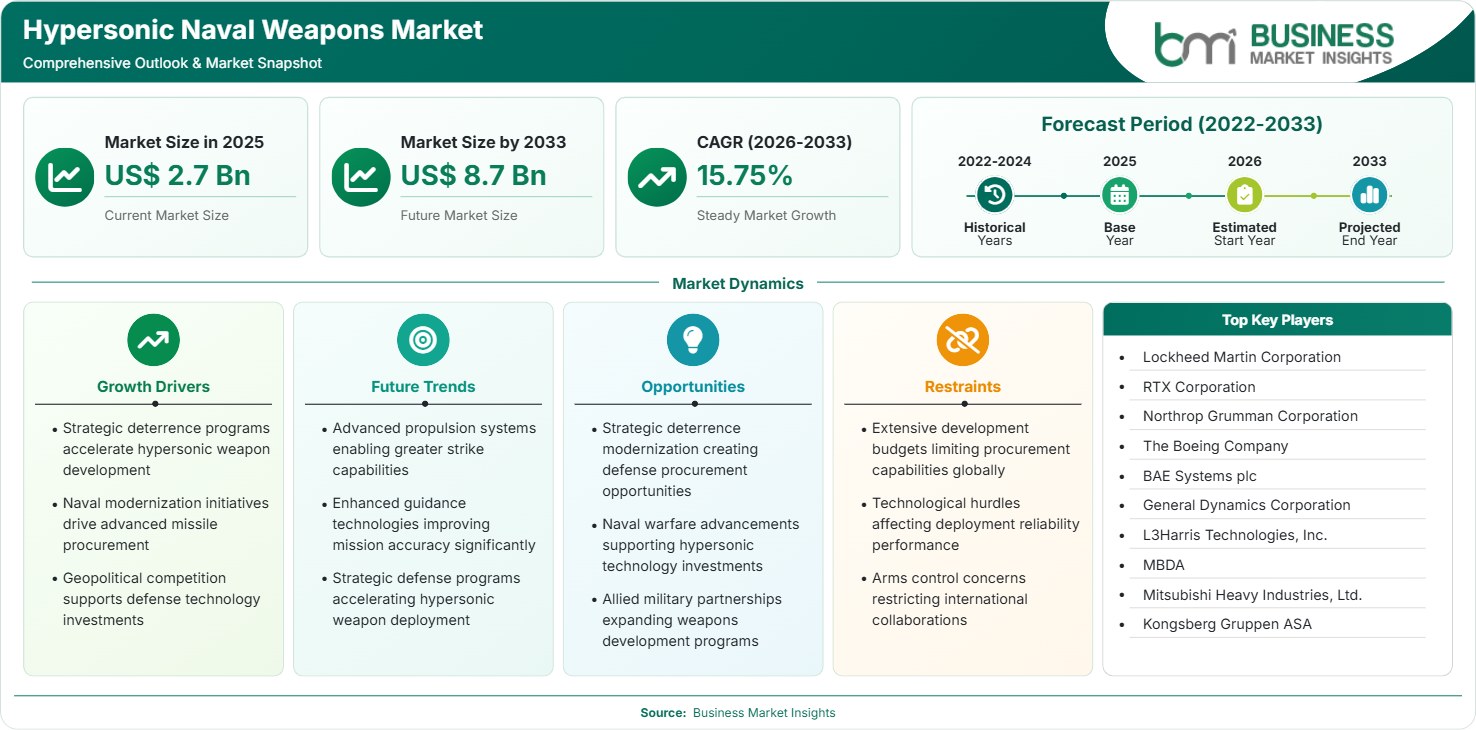
The Hypersonic Naval Weapons Market size was valued at US$ 2.7 Billion in 2025 and is projected to reach US$ 8.7 Billion by 2033, growing at a CAGR of 15.75% during 2026–2033, driven by naval modernization, strategic deterrence, rapid-response strike requirements, survivability, and investments in advanced propulsion, guidance, and thermal protection technologies.

Report Coverage
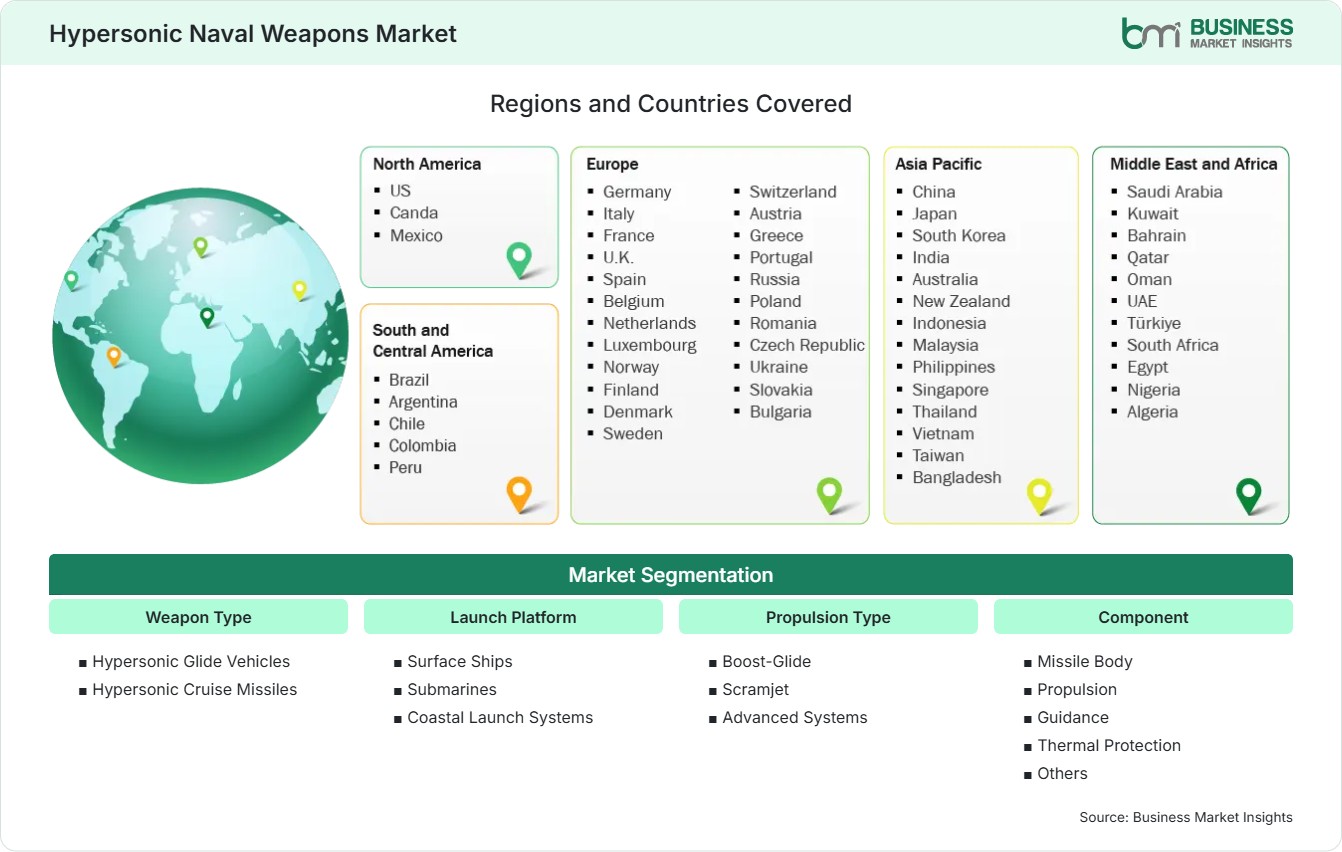
  • Weapon Type: Hypersonic Glide Vehicles, Hypersonic Cruise Missiles
  • Launch Platform: Surface Ships, Submarines, Coastal Launch Systems
  • Propulsion Type: Boost-Glide, Scramjet, Advanced Systems
  • Component: Missile Body, Propulsion, Guidance, Thermal Protection, Others
  • Application: Anti-Surface Warfare, Land Attack, Strategic Deterrence, Time-Sensitive Targeting, Others
US$ 2.7 Bn Market size in 2025
US$ 8.7 Bn Market Size by 2033
15.75% CAGR, 2026 - 2033
2026-2033 Forecast Period

AI Overview

Hypersonic Naval Weapons Market Summary

  • North America Region: North America holds a 39%–43% Hypersonic Naval Weapons Market share in 2025, growing at a 14.8%–16.2% CAGR, supported by naval modernization, Conventional Prompt Strike deployment, submarine integration, industrial capacity expansion, advanced testing, and sustained government investment in survivable long-range precision strike capabilities.
  • Fastest Growing Region: Asia Pacific holds a 24%–28% share in 2025, expanding at a 17.2%–19.0% CAGR, driven by maritime competition, coastal defense modernization, indigenous hypersonic programs, submarine development, strategic deterrence requirements, and expanding regional missile technology investments.
  • Leading Segment: Hypersonic Glide Vehicles hold a 55%–59% share in 2025, expanding at a 15.0%–16.3% CAGR, supported by long-range strike requirements, maneuverability, survivability, common missile architectures, submarine compatibility, and continuing investments in boost-glide technologies.
  • High Growth Segment: Scramjet propulsion holds a 21%–25% Hypersonic Naval Weapons Market share in 2025 and advances at a 18.0%–20.0% CAGR, supported by sustained hypersonic cruise, compact weapon architectures, reusable testing technologies, advanced materials, thermal management, and improved mission flexibility.
  • Key Market Opportunity: Expanding ship and submarine integration creates opportunities for modular launch architectures, compact propulsion systems, advanced thermal protection, networked targeting, secure guidance, and scalable production supporting distributed maritime operations.
  • Major Market Players: Lockheed Martin Corporation, RTX Corporation, Northrop Grumman Corporation, The Boeing Company, BAE Systems plc, General Dynamics Corporation, L3Harris Technologies, Inc., MBDA, Mitsubishi Heavy Industries, Ltd., and Kongsberg Gruppen ASA.
Strategic Insights

Hypersonic Naval Weapons Market: Strategic Insights

Hypersonic Naval Weapons Market Strategic Framework
FREE PDF
Request your free sample
Request free sample
Stakeholder View

Key Takeaways

  • The value chain is becoming more vertically integrated around missile designers, propulsion manufacturers, thermal-material suppliers, guidance specialists, test infrastructure providers, shipbuilders, and naval combat-system integrators, increasing the importance of secure component availability.
  • Hypersonic glide vehicles remain central to long-range naval strike architectures, while scramjet-powered cruise concepts provide additional opportunities for sustained atmospheric flight, flexible routing, and tactical maritime missions.
  • Research priorities are shifting toward higher-temperature materials, improved aerodynamic control, compact propulsion, digital engineering, autonomous guidance, advanced sensors, and manufacturing methods capable of reducing production bottlenecks.
  • Asia Pacific provides an expanding procurement environment because maritime security requirements increasingly intersect with coastal defense, long-range precision strike, submarine modernization, and indigenous missile development programs.
  • Capital is concentrating around propulsion, advanced materials, missile electronics, hypersonic testing, and space-based tracking technologies, encouraging partnerships between prime contractors and specialized technology companies.
  • The market increasingly depends on integrated detection, targeting, command-and-control, launch, and battle-management networks, making interoperability and real-time targeting as important as missile speed alone.
Geographic Outlook

Hypersonic Naval Weapons Market Regional Highlights

North America Hypersonic Naval Weapons Market

North America accounts for 39%–43% of 2025 demand in the Hypersonic Naval Weapons Market and is projected to expand at a 14.8%–16.2% CAGR through 2033. The United States dominates regional procurement through the development of shipboard and submarine Conventional Prompt Strike capabilities. The region benefits from mature defense manufacturing, extensive testing infrastructure, advanced propulsion expertise, and substantial government funding. Integration with destroyers and future submarines is increasing the importance of modular launch systems, missile production capacity, thermal protection, and common components. North American demand also reflects a growing emphasis on resilient maritime deterrence and distributed precision-strike architectures.

  • United States: Holds the dominant regional position, with procurement focused on Conventional Prompt Strike, Zumwalt-class integration, Virginia-class submarine planning, propulsion maturation, and industrial-base expansion supporting future production requirements.
  • Industrial ecosystem: Major contractors are expanding hypersonic manufacturing, digital engineering, propulsion, materials, guidance, and testing capabilities, strengthening domestic supply chains while addressing production-rate and qualification constraints.
  • Defense integration: Naval weapons are increasingly connected with sensors, command networks, targeting systems, and missile-defense architectures, requiring interoperability across surface ships, submarines, aircraft, and space-based tracking assets.
  • Technology direction: Investment emphasizes boost-glide performance, thermal management, advanced propulsion, maneuverability, and production affordability, with testing programs increasingly focused on repeatability and operationally representative conditions.

US Hypersonic Naval Weapons Market

The United States Hypersonic Naval Weapons Market accounts for about 34% - 38% of the worldwide 2025 market demand and is estimated to expand at a CAGR of 14.5% - 16.0%. Naval acquisition involves Conventional Prompt Strike, the development of hypersonic missiles for common use, integration into Zumwalt-class ships, and plans to deploy them from submarines. Key initiatives include survivability, fast reaction capability, long-range conventional strike, and expansion of the industrial base. The cold-gas launch technique demonstrated by the US Navy during its sea-based test in May 2025 will be used to launch CPS from naval platforms.

  • Surface fleet: Zumwalt-class modernization is creating a specialized launch pathway for hypersonic strike, although ship integration, schedule, testing, and production-rate issues remain important execution considerations.
  • Submarine pathway: Virginia-class integration expands the potential operating envelope by enabling concealed underwater launch, strengthening survivability, and complicating adversary detection and response planning.
  • Industrial base: Production capacity remains a strategic issue, with shared missile architectures creating opportunities for common components, higher manufacturing throughput, qualification efficiency, and supply-chain resilience.

Europe Hypersonic Naval Weapons Market

Europe Hypersonic Naval Weapons Market accounts for 14%–18% of 2025 demand and grows at a 13.8%–15.8% CAGR. France, the United Kingdom, Germany, Italy, and other NATO members are increasing attention to advanced missile defense, long-range precision strike, and maritime survivability. France and the United Kingdom provide major naval technology capabilities, while multinational programs encourage common architectures. France and Italy are also developing advanced counter-hypersonic capabilities, increasing demand for tracking, guidance, and interceptor technologies. The European market is therefore shaped by both offensive technology development and the requirement to defend naval assets against maneuvering high-speed threats.

  • France and Italy: Multinational missile programs and advanced naval platforms create opportunities for high-performance propulsion, seekers, command systems, and counter-hypersonic technologies.
  • United Kingdom: Naval modernization supports demand for advanced missile integration, maritime sensors, air-defense systems, and technologies capable of operating within increasingly contested electromagnetic environments.
  • Germany: Growing emphasis on precision strike and European defense cooperation can broaden opportunities for missile electronics, propulsion components, software, and advanced manufacturing.
  • High-growth markets: France is modelled at 14.8%–16.2% CAGR, while Germany is modelled at 15.0%–16.5%, reflecting modernization priorities and collaborative procurement.

Asia Pacific Hypersonic Naval Weapons Market

Asia Pacific Hypersonic Naval Weapons Market accounts for 24%–28% of 2025 demand and records the fastest regional expansion at a 17.2%–19.0% CAGR. China, Japan, India, South Korea, and Australia are strengthening long-range precision-strike and maritime defense capabilities. Japan's hypersonic development includes the Hyper Velocity Gliding Projectile program, supported by U.S. cooperation and technology assistance. Regional procurement is increasingly influenced by maritime surveillance, island-defense requirements, submarine modernization, coastal launch systems, and the need to counter sophisticated missile threats.

  • China: Indigenous hypersonic development and naval modernization support regional technological competition, encouraging investments in propulsion, guidance, launch systems, and maritime targeting networks.
  • Japan: Indigenous glide-vehicle development and expanded defense cooperation create opportunities for advanced materials, propulsion, testing, guidance, and integration with maritime defense architectures.
  • India: Indigenous missile development and expanding naval modernization create opportunities for propulsion, seekers, thermal protection, launch infrastructure, and high-speed precision-strike technologies.
  • Australia: Long-range strike modernization and allied technology cooperation support demand for advanced missile systems, targeting networks, maritime surveillance, and interoperable launch architectures.

Rest of World Hypersonic Naval Weapons Market

Rest of World Hypersonic Naval Weapons Market accounts for 15%–19% of 2025 demand and expands at a 14.0%–16.0% CAGR. South and Central American markets remain smaller but increasingly emphasize coastal surveillance, maritime security, and precision strike. Brazil provides the region's largest technology base, while Chile and Colombia offer opportunities for modernization. The Middle East and Africa offer a broader opportunity set driven by naval modernization, strategic deterrence, coastal defense, and demand for advanced missile technologies. Saudi Arabia, the United Arab Emirates, and Israel are modelled as important high-technology adopters.

  • South America: Brazil leads regional industrial potential, while Chile and Colombia provide opportunities for coastal surveillance, precision strike, and maritime command-and-control modernization.
  • Middle East: Saudi Arabia and the United Arab Emirates offer procurement opportunities linked to naval modernization, strategic deterrence, advanced missile defense, and technology-transfer partnerships.
  • Africa: Maritime security requirements around strategic waterways create longer-term opportunities for coastal launch systems, surveillance, targeting, and integrated defensive architectures.
  • Growth markets: Saudi Arabia is modelled at 15.2%–17.0% CAGR, while the UAE is modelled at 15.0%–16.8%, reflecting advanced defense procurement and maritime security priorities.
Global Market Geography
FREE PDF
Request your free sample
Request free sample
Segment Analysis

Hypersonic Naval Weapons Market Segmentation

Weapon Type

Hypersonic Glide Vehicles represent 55%-59% Hypersonic Naval Weapons market share in 2025 and grow at a CAGR of 15.0%-16.3% through 2033, driven by range, maneuverability, survivability, and existing boost-glide technology developments. Cruise missiles are increasingly used where sustained atmospheric flight is important and targeting flexibility is desired.

  • Hypersonic Glide Vehicles: Provide long-range maneuvering after boost, supporting strategic strike, survivable trajectories, and difficult-to-predict flight paths for surface and submarine launch architectures.
  • Hypersonic Cruise Missiles: Use air-breathing propulsion for sustained atmospheric flight, offering flexible routing, compact configurations, and potential tactical applications against maritime and land targets.

Launch Platform

Surface Ships constitute the foremost launch platform, facilitated by vertical launch systems and upgrades of major combatant vessels. The platform accounts for 43%-47% market share in 2025 and records a CAGR of 14.8%-16.0% by 2033. The use of submarines increases strategic survivability and distributed strike.

  • Surface Ships: Integrate hypersonic missiles into vertical launch systems, enabling long-range strike while leveraging established combat-system infrastructure and distributed fleet deployment concepts.
  • Submarines: Provide concealed launch and enhanced survivability, supporting strategic deterrence, time-sensitive targeting, and operations from contested maritime environments.
  • Coastal Launch Systems: Enable land-based maritime strike and distributed defense, particularly where geographic chokepoints, island chains, and coastal denial requirements influence procurement.

Propulsion Type

The boost-and-glide category holds the largest market share in the hypersonic naval weapons market, at 52%-56% in 2025, driven by well-established development projects and strategic strikes, with a 14.8%-16.0% CAGR through 2033. Scramjet design is advancing rapidly because atmospheric flight is technically mature.

  • Boost-Glide: Combines rocket acceleration with atmospheric gliding, supporting long-range trajectories, maneuverability, and high survivability against conventional interception architectures.
  • Scramjet: Enables sustained high-speed atmospheric flight, supporting flexible routing, compact weapon designs, and potential tactical missions requiring persistent hypersonic cruise.
  • Advanced Systems: Incorporate emerging propulsion combinations and thermal technologies, targeting improved efficiency, maneuverability, range, manufacturability, and operational flexibility.

Component

Propulsion is the leading component type, with a market share of 30% to 34% in 2025 and a CAGR of 16.0% to 17.2% through 2033, driven by the high technical sophistication of propulsion systems at high speeds. Thermal protection and guidance are key investments for achieving flight survivability.

  • Missile Body: Requires lightweight, aerodynamically optimized structures capable of tolerating extreme aerodynamic heating, vibration, maneuver loads, and high-speed flight conditions.
  • Propulsion: Determines acceleration, range, speed, maneuverability, and mission endurance, making advanced rocket motors and air-breathing systems central to weapon performance.
  • Guidance: Combines inertial navigation, sensors, mission planning, and control algorithms to maintain accuracy during maneuvering flight and rapidly changing target conditions.
  • Thermal Protection: Protects structures, electronics, sensors, and control surfaces from severe heating, supporting longer-duration hypersonic flight and repeated qualification testing.

Application

The leading applications segment is Anti-Surface Warfare, which will account for 31%- 35% of the total Hypersonic Naval Weapons market share by 2025, with a CAGR of 15.2%–16.5% through 2033, owing to the need for long-range maritime strike capabilities.

  • Anti-Surface Warfare: Enables long-range attacks against high-value maritime targets, emphasizing speed, maneuverability, survivability, and reduced warning time for adversary forces.
  • Land Attack: Extends naval strike reach against land-based targets, creating demand for precise guidance, mission planning, target discrimination, and secure communications.
  • Strategic Deterrence: Provides non-nuclear long-range strike options designed to complicate adversary planning and strengthen layered national deterrence architectures.
  • Time-Sensitive Targeting: Supports rapid engagement of mobile or fleeting targets where conventional weapons may provide insufficient response speed or survivability.
Market Forces

Hypersonic Naval Weapons Market Dynamics

Key Market Drivers

Growing Demand for Survivable Long-Range Maritime Strike

Naval requirements for shorter engagement timelines, greater survivability, and maneuverable long-range trajectories are driving the market growth. One example of this type of development is the U.S. Navy's Conventional Prompt Strike project, which is used for sea-based hypersonic strike missions. During the Navy's May 2025 flight demonstration, the cold-gas launch system was to be deployed on ships and submarines. The Office of Naval Research has identified Aerodynamics, high-speed propulsion, materials, and thermal management to be the key technical areas of concern. This has created a need for sophisticated propulsion technologies, control-surface technologies, thermal protection, guidance systems, and combat systems. The Hypersonic Naval Weapons Market trends increasingly favor architectures that combine missile performance with resilient sensors, targeting networks, and distributed launch platforms.

Advancement of Scramjet and High-Temperature Technologies

Scramjet research is expanding the technological addressable market because sustained atmospheric flight requires combustion, aerodynamics, thermal management, and control. The HAWC program by DARPA showcased the technological path leading to scramjet propulsion based on hydrocarbon fuel, high-temperature materials, low-cost flight testing, and producible design. While HAWC was an air-launched program, the technologies apply to future maritime weapon systems, where sustained hypersonic flight can complement boost-glide systems. Hence, industrial investment in the field is focused on combustion stability, lightweight structures, thermal barriers, CFD, digital engineering, and low-cost manufacturing.

Expansion of Integrated Naval Hypersonic Architectures

Integration among launch platforms, missiles, sensors, targeting networks, command-and-control systems, and defensive structures is becoming essential for naval hypersonic procurement. The need for such an integration process will increase commonality in missile design across departments, helping improve standardization and economies of scale in production. Testing conducted by the U.S. Navy has demonstrated the need to integrate launch devices into overall missile development programs, while missile defense testing tends to focus on detecting maneuvering hypersonic threats. In March 2025, the U.S. Navy and the Missile Defense Agency conducted a test to detect, track, and engage a maneuvering hypersonic target using the Aegis software and the Sea-Based Terminal system.

Key Market Opportunities

Submarine-Based Hypersonic Strike Expansion

The possibility of deploying submarines allows for leveraging the benefits of both concealment and long-range strikes, which could improve survival chances and geographical versatility. The U.S. Navy has envisioned adding Conventional Prompt Strike to some Virginia-class submarines, thus necessitating integration, handling, and firing of missiles from beneath the water, as well as communication and platform changes. This provides a broader scope than just the missiles themselves, since implementing such a plan would require compatible launch tubes, software, mission planning, safety measures, and supporting infrastructure. Similar requirements may emerge in other naval forces pursuing strategic underwater strike capabilities.

Advanced Tracking and Counter-Hypersonic Ecosystems

The Hypersonic Naval Weapons Market forecasts is generating opportunities in tracking, sensing, battle management, and defensive interception. Space-based infrared technology, advanced naval radar, data fusion, and low-latency communication can enhance detection and decision-making in engaging a maneuverable target. BAE Systems bagged a U.S. Space Force contract valued at US$1.2 billion in 2025 for the deployment of ten Epoch 2 satellites that will be able to facilitate missile warning and tracking, which includes maneuverable hypersonic threats.

Modular Manufacturing and Technology Partnerships

The emergence of modular missile designs offers opportunities for specific suppliers in propulsion, heat shields, guidance, materials science, electronics, testing, and manufacturing. Subsystems that can be standardized may serve multiple military services and weapon systems, thereby enabling cost-effective manufacturing processes without duplicating qualification efforts. Collaboration among large contractors and technology companies will ensure the rapid availability of specific capabilities without requiring each contractor to develop capability stacks. The development of common hypersonic missiles for the United States Navy is an example of such a strategy. Future procurement could provide an advantage to suppliers capable of scalable manufacturing and testing.

Market Restraints and Challenges

High Production Complexity and Limited Manufacturing Throughput

Factor: Hypersonic missiles require specially designed engines, heat-resistant materials, precise construction, rigorous testing, and tight component tolerances. Impact: This might affect the manufacturing pace, increase per-unit costs, and slow fleet deployment. IAO stated that CPS's annual production rate remains below the July 2026 Gl target of 12 missile rounds, and there are also quality and production issues. Thus, manufacturing capability is not just a question of quantity but also a strategic constraint. The suppliers need to create an approach for manufacturing hypersonic weapons without compromising safety and reliability.

Platform Integration, Testing, and Schedule Risk

Factor: Incorporation of big hypersonic missiles into current vessels and submarines needs changes to be made to the hulls, compatibility with the vertical launch system, adjustments to fire-control systems, integration of the software, testing, and certification for safety. Impact: Engineering specific to platforms may put pressure on timelines and add to total acquisition costs. According to the GAO, the first modernization of the Zumwalt-class ship for CPS was delayed by 24 months as of 2026, with CPS testing for the class scheduled for 2027, after an initial plan for 2025. This indicates that missile readiness alone is insufficient to establish operability.

Company Analysis

Competitive Landscape

The Hypersonic Naval Weapons Market analysis indicates a competitive environment centered on prime contractors with complementary capabilities spanning propulsion, missile design, thermal protection, guidance, ship integration, advanced electronics, and hypersonic testing. Technology maturity, production scalability, secure supply chains, platform compatibility, and access to government development programs increasingly shape the competitive landscape.

Company Name

Overview

Products and Services relevant to this market

Lockheed Martin Corporation

Major U.S. defense contractor with extensive hypersonic weapon development and naval systems capabilities.

Conventional Prompt Strike, hypersonic boost-glide technologies, missile integration, systems engineering, testing, and advanced defense architectures.

RTX Corporation

Diversified aerospace and defense company with substantial missile, propulsion, sensing, and naval technology capabilities.

Advanced missile systems, propulsion, seekers, guidance, sensors, naval integration, and hypersonic-related research and development.

Northrop Grumman Corporation

Hypersonic technology specialist with capabilities spanning propulsion, materials, warheads, digital engineering, and production.

Scramjet propulsion, boost-glide technologies, advanced materials, warheads, digital engineering, testing, and hypersonic production infrastructure.

The Boeing Company

Major aerospace and defense contractor involved in advanced weapons, missile systems, and high-speed technologies.

Hypersonic weapon development, advanced flight systems, missile integration, aerospace engineering, testing, and manufacturing capabilities.

BAE Systems plc

Global defense company with expertise in naval systems, advanced electronics, simulation, and hypersonic technology.

Naval combat systems, hypersonic simulation, advanced electronics, sensors, command systems, materials, and defense integration.

General Dynamics Corporation

Major defense contractor with extensive naval shipbuilding, combat-system, and submarine integration capabilities.

Naval platforms, submarine technologies, missile integration, combat systems, command networks, and maritime systems engineering.

L3Harris Technologies, Inc.

Defense technology provider specializing in communications, sensing, electronics, and mission systems.

Advanced sensors, secure communications, guidance electronics, mission systems, tracking technologies, and defense networking.

MBDA

European missile systems company serving multiple national armed forces through multinational development programs.

Advanced missiles, naval weapon systems, missile defense, hypersonic threat response, seekers, propulsion, and integrated defense systems.

Mitsubishi Heavy Industries, Ltd.

Japanese industrial and defense company with extensive missile, naval, aerospace, and systems-integration capabilities.

Missile systems, naval platforms, propulsion, aerospace systems, defense electronics, launch infrastructure, and advanced weapons development.

Kongsberg Gruppen ASA

Norwegian technology group supplying defense, missile, naval, sensor, and command-and-control systems.

Naval strike systems, missile technologies, sensors, command systems, fire control, maritime integration, and advanced defense electronics.

Trust & Transparency

Research Methodology

The market analysis combines proprietary research with secondary data from government agencies, company disclosures, regulatory filings, industry databases and expert interviews. Market estimates are validated through data triangulation, cross-market benchmarking and analyst review.

View Full Research Methodology

Questions Answered

Frequently Asked Questions

What factors will influence future procurement?

According to the Hypersonic Naval Weapons Market report, future procurement will depend on demonstrated reliability, production capacity, platform integration, test outcomes, lifecycle cost, survivability, guidance accuracy, and interoperability with naval combat networks. Governments are also likely to evaluate industrial-based resilience because specialized propulsion, thermal materials, electronics, and manufacturing capacity can become limiting factors as procurement volumes increase.

How is the supplier ecosystem changing?

The ecosystem is broadening beyond missile primes to include propulsion companies, materials specialists, electronics suppliers, software developers, sensor manufacturers, testing organizations, and satellite-tracking providers. Common missile architectures and increasingly integrated maritime combat systems are also creating opportunities for suppliers capable of meeting stringent qualification and security requirements.

What technologies are most important for hypersonic naval weapons?

Propulsion, thermal protection, guidance, aerodynamics, high-temperature materials, sensors, and digital engineering are central technologies. Boost-glide systems depend heavily on efficient launch and maneuvering performance, while scramjet weapons require sustained combustion, thermal management, aerodynamic stability, and accurate control throughout atmospheric flight.

Why are submarines important for future hypersonic deployment?

Submarines can provide concealed launch positions and greater geographic flexibility. Integrating hypersonic weapons with underwater platforms can therefore support survivable long-range strike missions while complicating adversary detection and response. The principal challenges involve launch integration, platform modification, storage, fire control, communications, safety, and qualification testing.

What makes naval hypersonic weapons different from conventional long-range missiles?

Naval hypersonic weapons combine extreme speed with maneuverability, reduced response time, and potentially unpredictable trajectories. Their integration also requires specialized launch systems, thermal protection, guidance, targeting networks, and platform modifications. These characteristics make the weapon part of a broader naval combat architecture rather than an isolated missile procurement.

Access the Full Hypersonic Naval Weapons Market Report

Get segment-level forecasts, regional estimates, competitive benchmarking, company profiles and downloadable Excel datasets.

Access the full Hypersonic Naval Weapons Market Report
350 pages PDF & Excel | 2026-10-12
Similar Research

Related Market Reports