
Hypersonic Technologies Market Outlook: Size, Share, Trends, Growth Analysis, Competitive Landscape & Forecast, 2026-2033

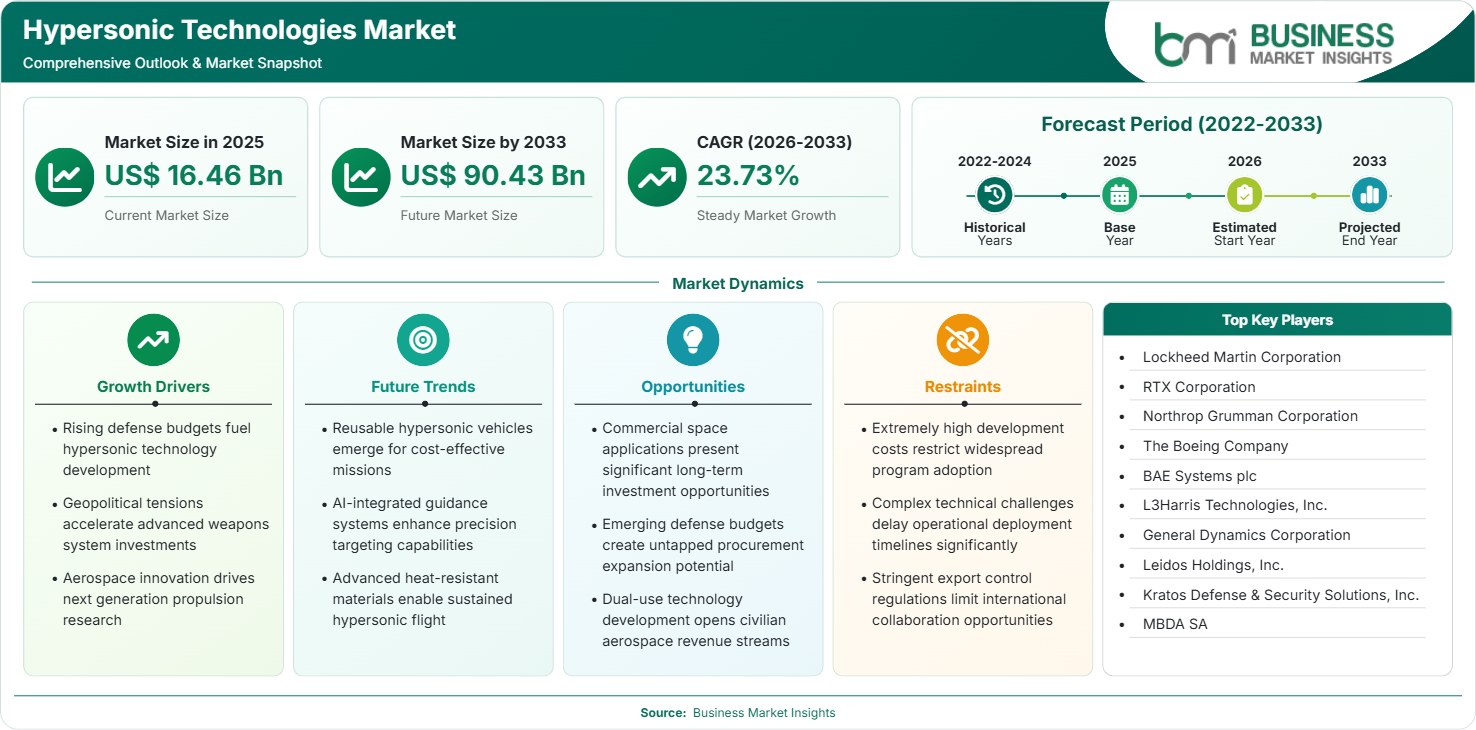
The Hypersonic Technologies Market size was valued at US$ 16.46 Billion in 2025 and is projected to reach US$ 90.43 Billion by 2033, growing at a CAGR of 23.73% during 2026–2033. Key growth drivers include accelerating defense modernization programs, rising great-power competition, expanding hypersonic weapon development budgets, advanced propulsion innovation, and increasing demand for rapid-response strike capabilities across military and strategic security applications.

Report Coverage
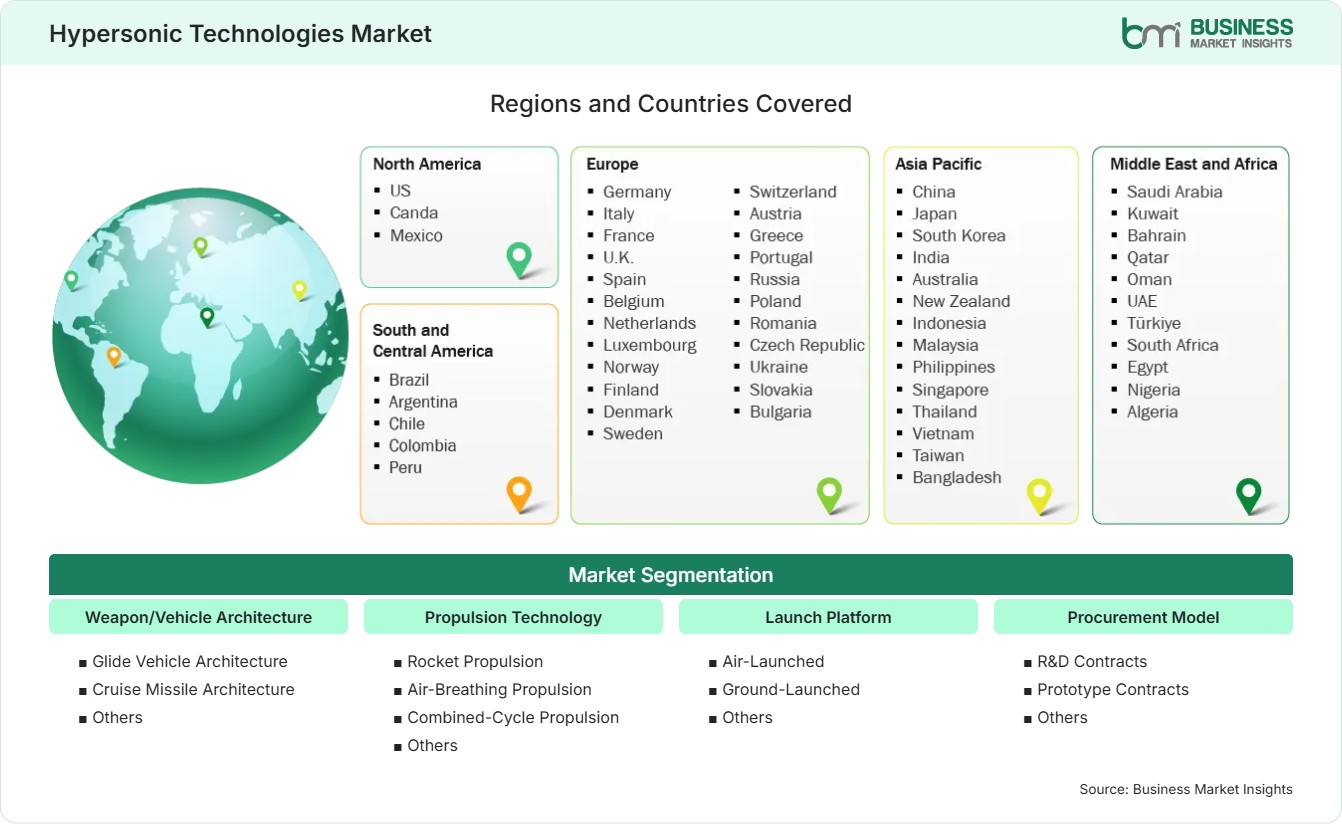
  • Weapon/Vehicle Architecture: Glide Vehicle Architecture, Cruise Missile Architecture, Others
  • Propulsion Technology: Rocket Propulsion, Air-Breathing Propulsion, Combined-Cycle Propulsion, Others
  • Launch Platform: Air-Launched, Ground-Launched, Others
  • Procurement Model: R&D Contracts, Prototype Contracts, Others
  • End User: Military, Defense Agencies, Government Labs, Others
US$ 16.46 Bn Market size in 2025
US$ 90.43 Bn Market Size by 2033
23.73% CAGR, 2026 - 2033
2026-2033 Forecast Period

AI Overview

Hypersonic Technologies Market Summary

  • North America Region: North America holds a market share of 46%–49% in 2025, growing at a CAGR of 22%–24% during 2026–2033. Growth is supported by substantial U.S. defense allocations, testing infrastructure expansion, advanced propulsion research, missile defense modernization, and increased procurement of strategic deterrence platforms. The U.S. market benefits from extensive hypersonic program funding and is projected to expand at a CAGR of 22%–24% through 2033.
  • Fastest Growing Region: Asia Pacific holds a market share of 22%–25% in 2025, growing at a CAGR of 26%–28% during 2026–2033. Growth is driven by defense modernization initiatives, indigenous missile programs, aerospace innovation, regional security priorities, and expanding government support for advanced long-range strike technologies.
  • Leading Segment: Military end users account for 57%–60% share in 2025 and are expected to grow at a CAGR of 23%–25%. Growth is driven by strategic deterrence requirements, precision-strike missions, modernization programs, operational readiness objectives, and increased procurement of advanced high-speed defense systems.
  • High Growth Segment: Air-Breathing Propulsion represents 28%–31% share in 2025 and is expected to grow at a CAGR of 27%–29%. Growth is supported by scramjet development, extended-range capabilities, improved efficiency, reusable high-speed platforms, and expanding investment in next-generation aerospace technologies.
  • Key Market Opportunity: Expanding integration of advanced thermal protection systems, digital engineering tools, reusable flight-testing platforms, and scalable production technologies creates significant opportunities for defense contractors developing next-generation high-speed operational capabilities.
  • Major Market Players: Lockheed Martin Corporation, RTX Corporation, Northrop Grumman Corporation, The Boeing Company, BAE Systems plc, L3Harris Technologies, Inc., General Dynamics Corporation, Leidos Holdings, Inc., Kratos Defense & Security Solutions, Inc., MBDA SA.
Strategic Insights

Hypersonic Technologies Market: Strategic Insights

Hypersonic Technologies Market Strategic Framework
FREE PDF
Request your free sample
Request free sample
Stakeholder View

Key Takeaways

  • The value chain in the industry is becoming more reliant on cooperation between those who develop propulsion systems, suppliers of advanced materials, providers of guidance systems, defence integrators, and government laboratories.
  • Air-breathing propulsion and air-launched platforms offer particularly attractive possibilities for expansion since they provide for longer operational ranges and greater flexibility in terms of deployment.
  • More and more attention is being paid to scramjet engines, reusable testing systems, thermal protection materials, digital twins, and AI-assisted flight control technologies.
  • The Asia-Pacific region provides a highly attractive environment for investment because of the growing indigenous development initiatives in China, India, Japan, and South Korea.
  • Significant capital commitments are still being made throughout the ecosystem as a result of strategic partnerships, long-term defense contracts, and government-funded R&D programs.
  • There is an emerging market that is adjacent to counter-hypersonic defence, offering opportunities for companies which provide sensor, interceptor, and tracking technology.
Geographic Outlook

Hypersonic Technologies Market Regional Highlights

North America Hypersonic Technologies Market

North America accounts for 46%–49% Hypersonic Technologies Market share in 2025 and is expected to expand at a CAGR of 22%–24% through 2033. The region benefits from extensive defense budgets, established aerospace supply chains, advanced test infrastructure, and sustained investment in propulsion technologies. Leadership in flight-testing capabilities and next-generation deterrence initiatives reinforces regional dominance.

  • Funding from the U.S. Department of Defense is still being provided to support large-scale operational testing and procurement preparedness.
  • Putting money into thermal protection materials increases the ability of high-speed systems to survive.
  • The expansion of partnerships between aerospace companies speeds up innovation in subsystems.
  • Research into counter-hypersonic defence is still a major priority in terms of funding.
  • Using digital engineering methods leads to shorter development timelines and lower technical risk.

US Hypersonic Technologies Market

The U.S. represents approximately 78%–82% of North American Hypersonic Technologies Market demand and is projected to grow at 22%–24% CAGR. Strong domestic procurement programs, advanced aerospace manufacturing capability, and extensive hypersonic research infrastructure support market leadership. Significant federal funding continues to support operational deployment efforts.

  • The current conventional prompt strike and other related programs meet that demand.
  • Investments in manufacturing are being expanded to increase industrial capacity.
  • Modern missile defense leads to more work on interceptor development.
  • The more extensive the flight testing, the greater the technology maturity will be.

Europe Hypersonic Technologies Market

Europe holds 18%–21% Hypersonic Technologies Market share in 2025 and is projected to grow at a CAGR of 21%–23%. Regional demand is supported by defense modernization initiatives and collaborative aerospace programs. France and the United Kingdom lead adoption, while Germany demonstrates strong growth potential with a projected CAGR of 22%–24%.

  • The technology investments are supported by NATO's security priorities.
  • Working together on research and development helps companies compete better.
  • The ability to carry out advanced aerospace manufacturing enables the development of subsystems.
  • The increasing emphasis on a nation's ability to defend itself is leading to more domestic procurement.
  • Missile defense initiatives expand market opportunities.

Asia Pacific Hypersonic Technologies Market

Asia Pacific captures 22%–25% Hypersonic Technologies Market share in 2025 and is forecast to expand at 26%–28% CAGR, making it the fastest-growing region. China leads regional spending, while India records one of the strongest growth trajectories at 27%–29% CAGR. Defense modernization remains the primary demand catalyst.

  • Indigenous development programmes are expanding quickly.
  • The government provides funding for research into advanced propulsion.
  • The pursuit of strategic competition leads to faster procurement.
  • The ecosystems involved in the manufacture of aerospace vehicles are still developing.
  • As testing activity increases, so do the technology readiness levels.

Rest of World Hypersonic Technologies Market

The Rest of World region accounts for 8%–11% Hypersonic Technologies Market share in 2025 and is expected to grow at 20%–22% CAGR. Middle Eastern nations prioritize strategic defense capabilities, while selected South American countries focus on aerospace research partnerships and subsystem development.

  • Gulf defense upgrade programs create buying opportunities.
  • Strategic alliances are aimed at promoting technology transfer initiatives.
  • Research partnerships lead to an expansion of engineering expertise.
  • Local industrial participation rules boost local production.
  • The importance of national security promotes long-term investment.
Global Market Geography
FREE PDF
Request your free sample
Request free sample
Segment Analysis

Hypersonic Technologies Market Segmentation

Weapon/Vehicle Architecture

The segment plays a crucial role in determining operational performance, maneuverability, and mission adaptability. It captures an estimated 28%–31% Hypersonic Technologies Market share in 2025 and is expected to grow at 24%–26% CAGR. Demand is closely linked to evolving defense doctrines emphasizing long-range precision engagement and survivable strike capabilities under contested operational environments.

  • Glide Vehicle Architecture: Widely adopted due to exceptional maneuverability during terminal flight phases, enabling enhanced survivability against conventional missile defense systems while supporting strategic deterrence missions.
  • Cruise Missile Architecture: Benefits from sustained powered flight and flexible trajectory management, supporting precision engagement requirements and integration with advanced air-breathing propulsion technologies.

Propulsion Technology

Propulsion systems remain central to performance differentiation and technology innovation. The segment accounts for 31%–34% share in 2025 and is expected to expand at 25%–27% CAGR. Investment remains concentrated on efficiency improvements, thermal management, longer operational ranges, and enhanced mission endurance across both weapons and aerospace vehicle applications.

  • Rocket Propulsion: Maintains strong deployment across existing operational programs owing to proven reliability, established manufacturing capability, and compatibility with strategic strike requirements.
  • Air-Breathing Propulsion: Demonstrates the highest commercial momentum through scramjet advancements supporting longer-duration flight profiles, increased efficiency, and expanded mission flexibility.
  • Combined-Cycle Propulsion: Gains attention for enabling seamless transition between propulsion modes, potentially supporting future reusable aerospace and defense platforms.

Launch Platform

Launch Platform solutions account for approximately 22%–25% market share in 2025 and are expected to advance at a CAGR of 24%–26%. Platform diversification improves deployment flexibility, operational reach, and force readiness. Procurement programs increasingly prioritize launch adaptability to maximize deterrence effectiveness and mission responsiveness.

  • Air-Launched: Supports rapid deployment, geographic flexibility, and extended engagement reach while reducing dependence on fixed infrastructure.
  • Ground-Launched: Continues receiving significant investment through strategic deterrence programs emphasizing operational readiness and reliable deployment capabilities.

Procurement Model

Procurement models shape technology maturation pathways and commercialization opportunities. The segment captures approximately 10%–13% market share and is projected to grow at 24%–26% CAGR. Governments increasingly utilize staged procurement frameworks to accelerate innovation while managing technical and operational risk.

  • R&D Contracts: Remain essential for propulsion research, materials development, flight testing, and advanced guidance technology maturation.
  • Prototype Contracts: Support rapid technology validation, operational assessment, and progression toward large-scale procurement programs.

End User

End-user demand is dominated by strategic defense requirements. Military organizations account for 57%–60% market share in 2025 and are anticipated to grow at 23%–25% CAGR. Expanding geopolitical competition and modernization initiatives continue driving investment in advanced deterrence and strike capabilities.

  • Military: Largest end-user category, supported by operational deployment programs and extensive modernization initiatives.
  • Defense Agencies: Focus on technology evaluation, testing, acquisition management, and capability development priorities.
  • Government Labs: Drive innovation in propulsion systems, thermal protection technologies, guidance systems, and advanced materials research.
Market Forces

Hypersonic Technologies Market Dynamics

Key Market Drivers

Defense Modernization and Strategic Deterrence Investments

Competition between major geopolitical players keeps intensifying the efforts to enhance strike capabilities. Investments in programs for the development of future weapons are growing in countries like the USA, China, Russia, India, and some NATO members. Insecurity about the efficacy of deterrent strategies is prompting the use of technologies that can penetrate modern missile defense systems. Rapid reaction capabilities are becoming a priority for the armed forces to handle new threats. These factors collectively strengthen long-term demand fundamentals and contribute substantially to Hypersonic Technologies Market growth across major defense markets worldwide.

Advancements in Propulsion and Thermal Protection Technologies

The technical difficulties linked to sustained hypersonic flight are being overcome due to advances in material science and propulsion. Scramjet engines, advanced composites, ceramic matrix materials, and thermal protection systems are still showing better operational performance. Research institutions and aerospace contractors are making heavy investments in technologies that allow them to handle extreme temperatures without compromising reliability or mission effectiveness. Better simulation tools and digital engineering systems are speeding up the product development process and, at the same time, lowering testing costs. As a result of these innovations, higher-performance systems can be deployed, industrial competitiveness is enhanced, and wider commercialization opportunities become available in the fields of defense and aerospace.

Expansion of Government-Funded Testing Infrastructure

The amount of money being invested in testing corridors, flight demonstration schemes, wind tunnels, and digital validation platforms is speeding up the maturation of technology. Governments are becoming more aware of how important it is to carry out frequent testing to verify operational readiness, propulsion performance, and guidance accuracy. Greater testing infrastructure helps to reduce development risks and increases the confidence of the organizations responsible for procuring the equipment. The expanded infrastructure also facilitates involvement by suppliers, allows for the qualification of subsystems, and enables technology to be improved through iteration. Since the validation cycles are becoming more efficient, the development programs are able to move more quickly towards deployment, thus strengthening the long-term prospects for market growth and prompting wider participation in the industry.

Key Market Opportunities

Reusable Hypersonic Test Platforms and Demonstrators

Reusable test platforms present substantial investment opportunities as governments seek lower-cost development pathways. Conventional testing remains expensive due to limited flight opportunities and extensive hardware replacement requirements. Reusable demonstrators can significantly improve testing frequency, accelerate subsystem qualification, and reduce overall program costs. Defense agencies increasingly support technologies enabling faster experimentation and iterative design improvements. Companies capable of delivering affordable reusable testing capabilities may secure long-term contracts and strengthen competitive positioning. This opportunity aligns closely with evolving Hypersonic Technologies Market Forecasts, emphasizing scalability and operational efficiency.

Counter-Hypersonic Defense Systems Development

The development of high-speed strike systems has led to a greater need for advanced detection, tracking, and interception technologies. Governments are boosting their spending on space-based sensors, integrated missile defense systems, and programs relating to interceptors. The ability to counter hypersonic threats constitutes an additional source of revenue that goes beyond traditional offensive systems. Companies with expertise in sensors, radar, AI-powered tracking, and advanced command networks are best positioned to capitalize on this. Because of the ongoing concern about strategic vulnerability, there is continued activity in terms of procurement, and this is generating substantial growth opportunities across the wider defense sector.

International Collaborative Development Programs

Cross-border defense partnerships are becoming increasingly important for managing costs, accelerating innovation, and sharing technological expertise. Governments seek collaboration to improve industrial competitiveness while reducing development timelines. International programs enable participants to access broader supplier networks, specialized engineering capabilities, and advanced testing infrastructure. Current Hypersonic Technologies Market Trends highlight that defense contractors involved in multinational initiatives benefit from diversified revenue sources and expanded market access. As strategic alliances continue strengthening across Europe, Asia-Pacific, and North America, collaborative programs are expected to become a significant avenue for future growth.

Market Restraints and Challenges

High Development Costs and Budget Concentration Risks

The development of hypersonic technology demands a great deal of research spending, the use of advanced materials, specialized testing facilities, and multiple flights for validation. As a result, the associated financial cost means that only major defense contractors and organizations supported by the government can get involved. Cost overruns can lead to delays in making procurement decisions, result in a reduction in the scale of the program, or cause priorities to be changed in favor of other technologies. Small suppliers generally find it difficult to obtain the funding they need to keep taking part. Since a small number of programs account for most of the budget, the sector becomes more vulnerable to changes in policy, delays in procurement, and fluctuations in government spending, which in turn causes uncertainty across the entire supply chain.

Technical Complexity and Reliability Validation Requirements

The extreme operating environments subject the systems to severe aerodynamic heating, difficulties in communication, and limitations on propulsion performance. This can lead to technical failures, which in turn greatly delay the development schedule and raise the cost of the program. To confirm reliability, survivability, guidance accuracy, and mission effectiveness under a variety of operational situations, a great deal of testing is necessary. The long qualification procedures delay both commercialization and the timing of deployment. The complexity of the supply chain also makes the certification processes more difficult, especially when it comes to advanced materials and precise components. These technical difficulties are still among the most important obstacles influencing widespread adoption and faster deployment.

Company Analysis

Competitive Landscape

The competitive environment remains shaped by extensive government contracts, strategic partnerships, and continuous propulsion innovation. Current Hypersonic Technologies Market analysis highlights growing emphasis on production scalability, reusable testing assets, advanced materials, and integrated weapon architectures.

Company Name

Overview

Products and Services Relevant to this Market

Lockheed Martin Corporation

Leading defense contractor with major hypersonic strike and missile defense programs.

Glide bodies, missile systems, systems integration, advanced defense technologies.

RTX Corporation

Major aerospace and defense company focused on advanced weapon technologies.

Air-breathing hypersonic systems, guidance technologies, missile solutions.

Northrop Grumman Corporation

Significant participant in propulsion and strategic defense initiatives.

Scramjet propulsion, missile systems, interceptor technologies.

The Boeing Company

Aerospace leader engaged in advanced high-speed aerospace development.

Hypersonic vehicle concepts, aerospace engineering, defense systems.

BAE Systems plc

Global defense contractor supporting advanced military technologies.

Electronics, defense subsystems, mission systems integration.

L3Harris Technologies, Inc.

Supplier of mission-critical defense technologies and sensors.

Communications, sensors, guidance and mission systems.

General Dynamics Corporation

Defense company with expertise in mission-critical military programs.

Strategic systems support and defense integration services.

Leidos Holdings, Inc.

Technology-focused contractor supporting defense innovation.

Modeling, simulation, systems engineering and analytics.

Kratos Defense & Security Solutions, Inc.

Specialized defense technology provider and testing participant.

Hypersonic testing support, aerospace platforms, target systems.

MBDA SA

European missile systems specialist with advanced weapon expertise.

Missile technologies, guidance systems, defense solutions.

Trust & Transparency

Research Methodology

The market analysis combines proprietary research with secondary data from government agencies, company disclosures, regulatory filings, industry databases and expert interviews. Market estimates are validated through data triangulation, cross-market benchmarking and analyst review.

View Full Research Methodology

Questions Answered

Frequently Asked Questions

What does a Hypersonic Technologies Market Report typically evaluate?

A comprehensive report examines market size, technology evolution, regional demand patterns, competitive positioning, procurement trends, investment opportunities, and emerging defense applications.

Who are the major participants in the industry?

Key participants include Lockheed Martin Corporation, RTX Corporation, Northrop Grumman Corporation, The Boeing Company, BAE Systems plc, MBDA SA, and Kratos Defense & Security Solutions, Inc.

Which propulsion technology shows the strongest growth potential?

Air-breathing propulsion demonstrates strong potential because scramjet-based systems can deliver extended range, operational flexibility, and improved efficiency compared with conventional approaches.

Which region leads industry revenue generation?

North America remains the largest regional market due to strong defense spending, mature aerospace infrastructure, and extensive government-backed research and development programs.

What is primarily driving adoption of hypersonic technologies?

Defense modernization initiatives, strategic deterrence requirements, geopolitical competition, and demand for rapid precision-strike capabilities are the principal factors accelerating adoption worldwide.

Access the Full Hypersonic Technologies Market Report

Get segment-level forecasts, regional estimates, competitive benchmarking, company profiles and downloadable Excel datasets.

Access the full Hypersonic Technologies Market Report
350 pages PDF & Excel | 2026-09-23
Similar Research

Related Market Reports