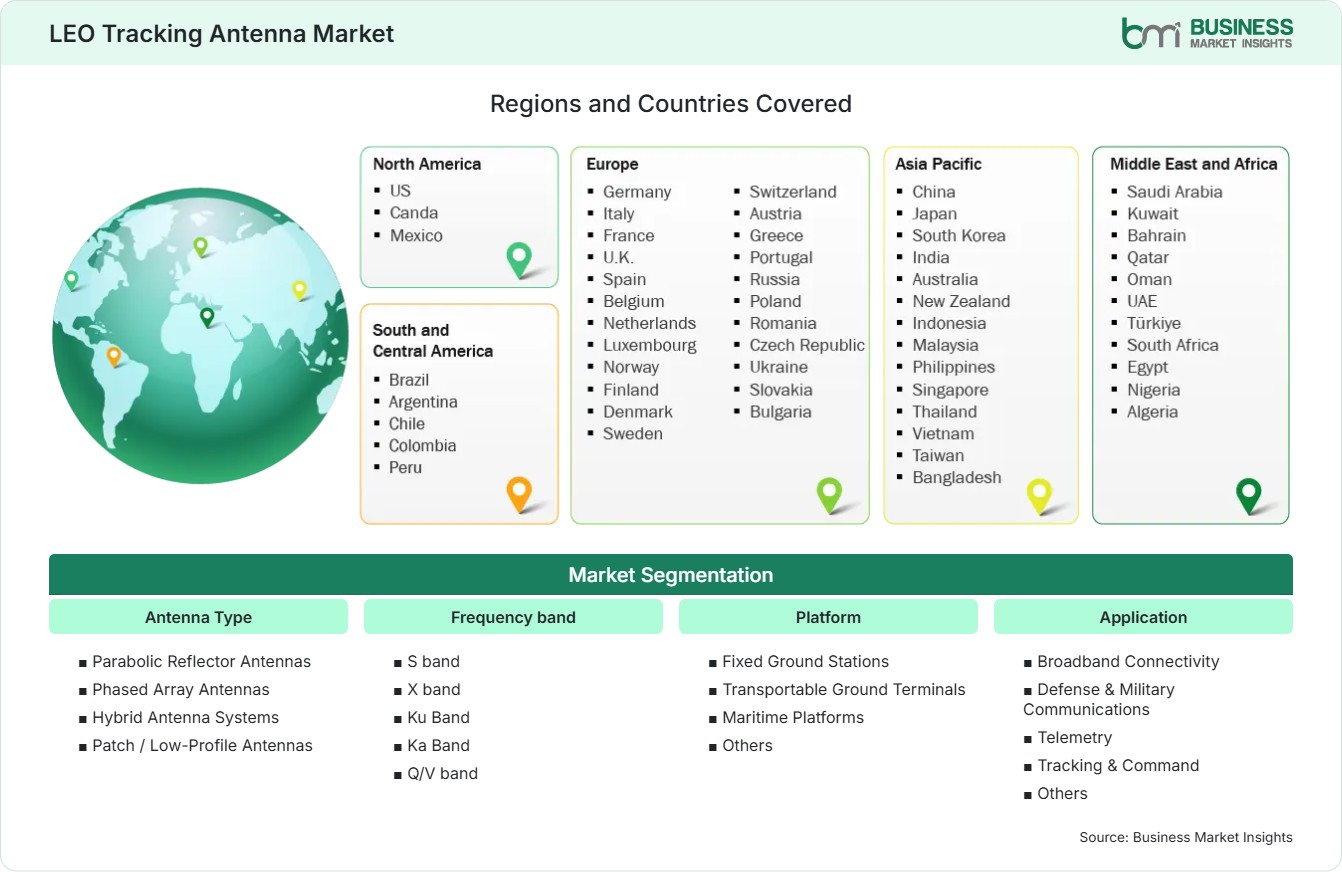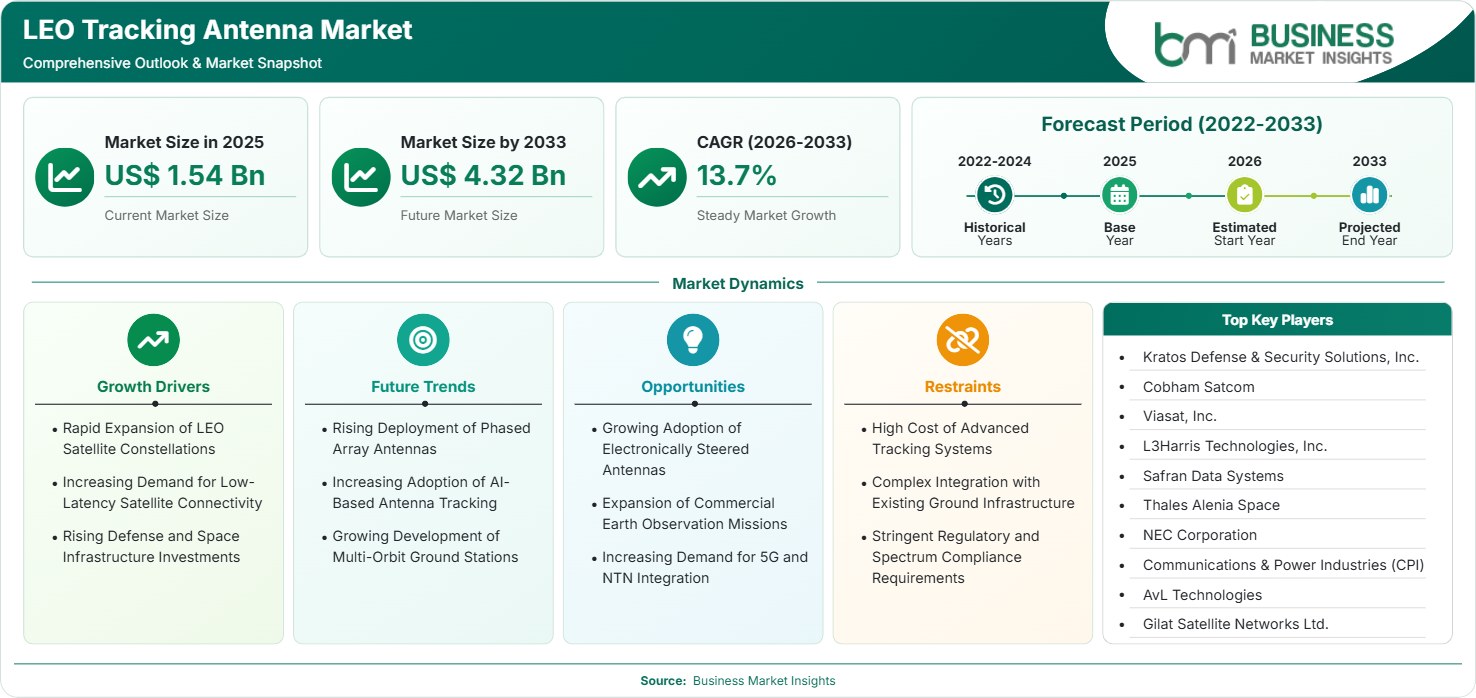
LEO Tracking Antenna Market Regional Highlights
North America LEO Tracking Antenna Market
North America accounted for 40%–42% of the LEO Tracking Antenna Market share in 2025 and is projected to grow at a CAGR of 13.1%–13.5% during 2026–2033. Strong investment in commercial satellite constellations, defense communication networks, and advanced ground station infrastructure continues to support regional leadership. The presence of leading aerospace companies and satellite operators further accelerates technology adoption.
- Commercial broadband satellite deployments continue increasing demand for electronically steered tracking antenna systems capable of supporting continuous multi-satellite connectivity.
- Defense modernization programs are driving procurement of advanced satellite communication terminals for secure tactical communications and intelligence operations.
- Ground station expansion supporting commercial LEO constellations is creating sustained opportunities for high-performance antenna manufacturers.
- AI-enabled network management and digital beamforming technologies continue improving tracking accuracy and communication reliability.
US LEO Tracking Antenna Market
The United States represented 34%–36% of global market revenue in 2025 and is expected to register a CAGR of 13.0%–13.4% during the LEO Tracking Antenna market forecast period. Government space initiatives, defense investments, and commercial satellite deployments continue to strengthen demand for advanced tracking antenna technologies.
- Expansion of commercial LEO broadband constellations continues supporting procurement of next-generation electronically steered antenna systems.
- Defense agencies increasingly deploy advanced satellite communication infrastructure supporting resilient battlefield connectivity.
- Growth in autonomous platforms and unmanned systems is expanding demand for compact low-profile antenna technologies.
- Cloud-enabled ground station modernization continues improving operational flexibility and satellite network management.
Europe LEO Tracking Antenna Market
Europe accounted for 23%–25% of global revenue in 2025 and is projected to grow at a CAGR of 13.3%–13.7% during the forecast period. Investments in sovereign satellite capabilities, Earth observation programs, and secure defense communications continue driving market expansion. France leads the regional market, while Germany is expected to record the fastest growth.
- European satellite operators continue expanding broadband and Earth observation infrastructure using advanced tracking antenna technologies.
- France maintains regional leadership through strong aerospace manufacturing capabilities and satellite communication investments.
- Germany is witnessing rapid growth supported by defense modernization and industrial space technology development.
- Multi-orbit communication platforms are encouraging the adoption of software-defined antenna systems across commercial applications.
Asia Pacific LEO Tracking Antenna Market
Asia Pacific represented 24%–26% of market revenue in 2025 and is forecast to expand at a CAGR of 15.2%–15.7% through 2033, making it the fastest-growing regional market. Expanding national space programs, commercial satellite launches, and defense communication investments continue to support robust demand.
- China remains the largest regional market due to expanding satellite constellations and government-supported space infrastructure.
- India is projected to achieve the fastest regional growth through increasing commercial space activities and satellite communication investments.
- Japan continues advancing electronically steered antenna technologies supporting mobility and defense communication platforms.
- South Korea is increasing investment in low Earth orbit communication infrastructure and next-generation satellite technologies.
- Regional telecommunications providers are accelerating satellite-enabled broadband expansion to improve connectivity across remote areas.
Rest of World LEO Tracking Antenna Market
The Rest of the World accounted for 11%–13% of global market revenue in 2025 and is projected to grow at a CAGR of 14.0%–14.4% during 2026–2033.
South & Central America are gradually expanding satellite broadband infrastructure, while the Middle East & Africa continue investing in secure defense communications, Earth observation, and national satellite programs to strengthen digital connectivity and strategic communication capabilities.
- Brazil leads South & Central America through increasing satellite communication and remote connectivity investments.
- Chile continues expanding satellite infrastructure supporting mining, scientific research, and remote operations.
- The United Arab Emirates is strengthening national satellite communication capabilities through strategic space investments.
- Saudi Arabia continues investing in defense satellite infrastructure and next-generation communication technologies.
- South Africa is expanding satellite-enabled connectivity supporting government, enterprise, and rural broadband initiatives.