
Sustainable Aviation Technologies Market Outlook: Size, Share, Trends, Growth Analysis, Competitive Landscape & Forecast, 2026-2033

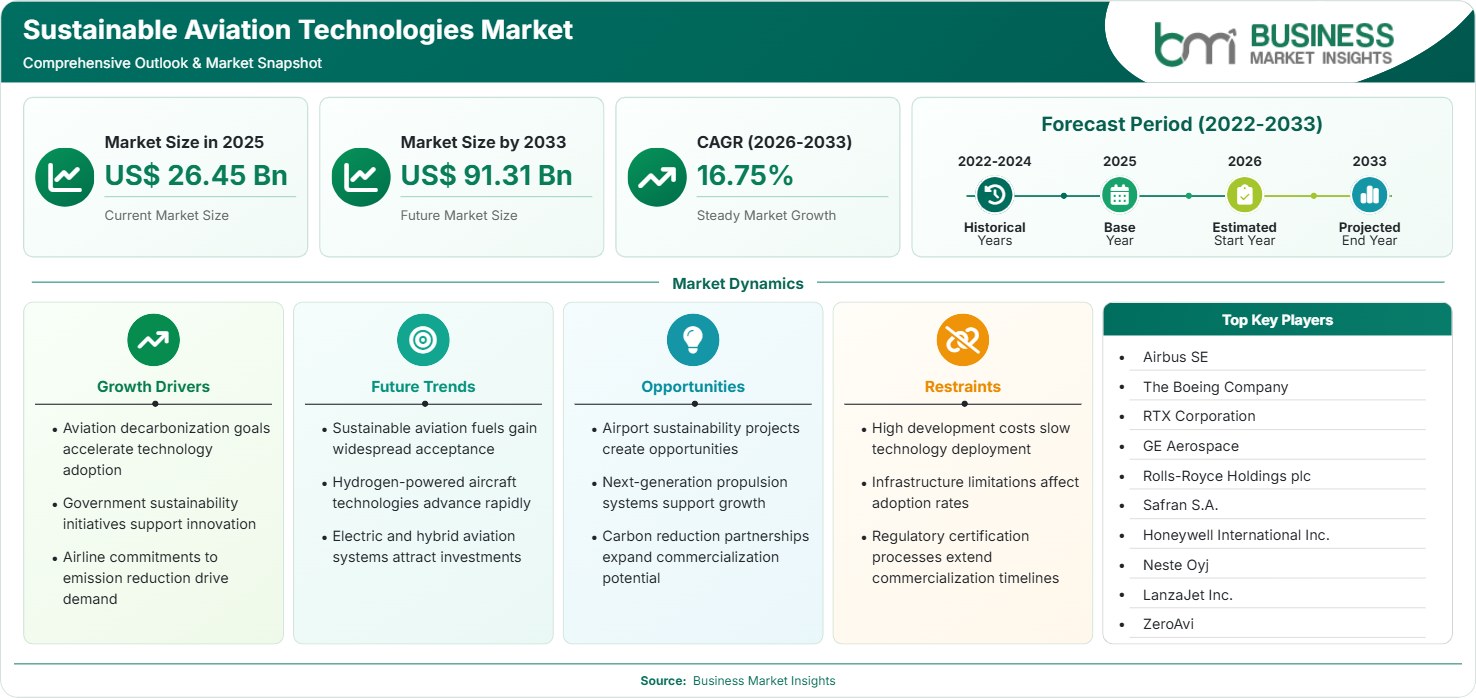
The Sustainable Aviation Technologies Market size was valued at US$ 26.45 Billion in 2025 and is projected to reach US$ 91.31 Billion by 2033, growing at a CAGR of 16.75% during 2026–2033. Rising pressure to decarbonize aviation, increasing investments in sustainable aviation fuel (SAF), growing development of hydrogen-powered aircraft, expansion of electric aviation technologies, and supportive government policies are driving market growth globally.

Report Coverage
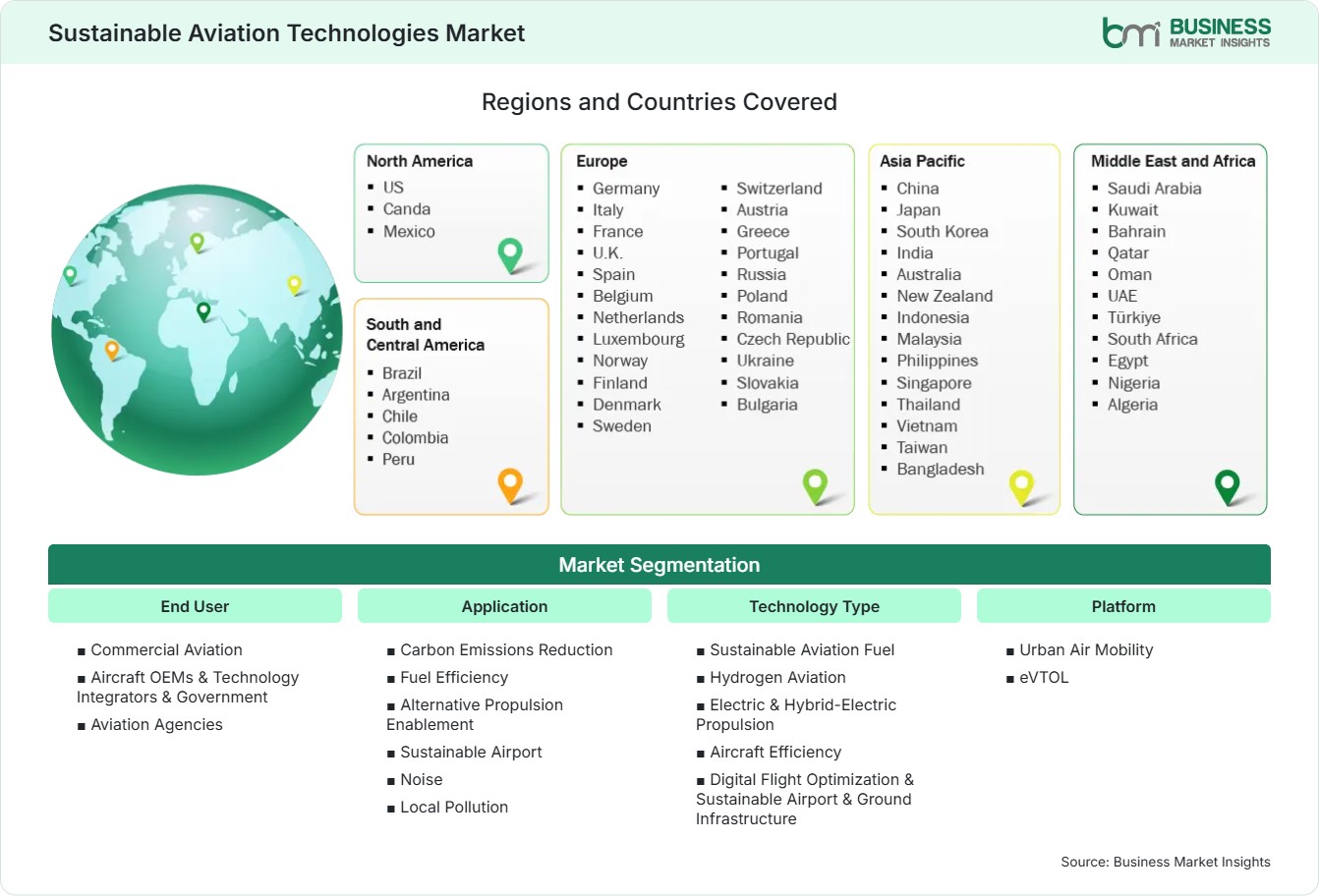
  • End User: Commercial Aviation, Aircraft OEMs & Technology Integrators & Government, Aviation Agencies
  • Application: Carbon Emissions Reduction, Fuel Efficiency, Alternative Propulsion Enablement, Sustainable Airport, Noise, Local Pollution
  • Technology Type: Sustainable Aviation Fuel, Hydrogen Aviation, Electric & Hybrid-Electric Propulsion, Aircraft Efficiency, Digital Flight Optimization & Sustainable Airport & Ground Infrastructure
  • Platform: Urban Air Mobility, eVTOL
US$ 26.45 Bn Market size in 2025
US$ 91.31 Bn Market Size by 2033
16.75% CAGR, 2026 - 2033
2026-2033 Forecast Period

AI Overview

Sustainable Aviation Technologies Market Summary

  • North America Region: North America holds a sustainable aviation technologies market share of 34%–38% in 2025 and is projected to grow at a CAGR of 15.8%–16.5% during 2026–2033. Growth is supported by strong aerospace innovation ecosystems, increasing SAF production capacity, investments in advanced propulsion technologies, government decarbonization initiatives, and growing commercialization of sustainable aviation solutions. The U.S. remains the dominant market, advancing at a CAGR of 16.0%–16.7%.
  • Fastest Growing Region: Asia Pacific accounts for 24%–28% share in 2025 and is expected to register a CAGR of 18.2%–19.0% through 2033. Growth is fueled by increasing air passenger traffic, government sustainability targets, growing airport modernization activities, rising investments in clean aviation technologies, and expanding aerospace manufacturing capabilities.
  • Leading Segment: Sustainable Aviation Fuel accounts for 32%–36% share in 2025 and is anticipated to grow at a CAGR of 17.1%–17.8% through 2033. Demand is supported by immediate compatibility with existing aircraft fleets, regulatory mandates, carbon reduction targets, and increasing investments in SAF production facilities.
  • High Growth Segment: Commercial Aviation captures 44%–48% share in 2025 and is forecast to expand at a CAGR of 17.5%–18.3% during 2026–2033. Growth is driven by airline commitments to net-zero emissions, fleet modernization programs, rising deployment of SAF, and adoption of digital flight optimization technologies.
  • Key Market Opportunity: Growing commercialization of hydrogen-powered aircraft, electric aviation platforms, eVTOL systems, and next-generation sustainable airport infrastructure is creating significant opportunities across the market.
  • Major Market Players: Airbus SE, The Boeing Company, RTX Corporation, GE Aerospace, Rolls-Royce Holdings plc, Safran S.A., Honeywell International Inc., Neste Oyj, LanzaJet Inc., and ZeroAvia Inc.
Strategic Insights

Sustainable Aviation Technologies Market: Strategic Insights

Sustainable Aviation Technologies Market Strategic Framework
FREE PDF
Request your free sample
Request free sample
Stakeholder View

Key Takeaways

  • The sustainable aviation technologies market is expanding rapidly as airlines, OEMs, airports, and governments intensify efforts to achieve net-zero aviation emissions.
  • Sustainable Aviation Fuel remains the dominant technology segment due to its compatibility with existing aircraft fleets and aviation infrastructure.
  • Commercial aviation continues to represent the largest end-user segment as airlines accelerate investments in decarbonization initiatives and fleet modernization programs.
  • Asia Pacific is emerging as the fastest-growing region owing to rising air travel demand, sustainability initiatives, and expanding aviation infrastructure investments.
  • Hydrogen-powered aircraft, electric aviation systems, and eVTOL platforms are creating transformative long-term opportunities across the aerospace industry.
  • Digital flight optimization technologies and sustainable airport infrastructure are becoming important tools for improving operational efficiency and reducing environmental impact.
Geographic Outlook

Sustainable Aviation Technologies Market Regional Highlights

North America Sustainable Aviation Technologies Market

North America accounted for 34%–38% of global revenue in 2025 and is projected to grow at a CAGR of 15.8%–16.5% through 2033. The region benefits from strong aerospace innovation capabilities, advanced research infrastructure, increasing SAF production capacity, and supportive government incentives for aviation decarbonization. The Sustainable Aviation Technologies Market share remains dominant due to significant investments by airlines, OEMs, fuel producers, and technology developers.

  • Major aerospace companies continue investing heavily in sustainable propulsion systems, hydrogen aviation technologies, and next-generation aircraft designs.
  • SAF production capacity is expanding rapidly as governments and industry participants seek scalable pathways for reducing aviation emissions.
  • Airlines are increasingly incorporating sustainability targets into long-term fleet management and operational strategies.
  • Strong venture capital activity is supporting innovation in electric aviation, urban air mobility, and advanced aerospace technologies.
  • Airports are investing in sustainable infrastructure projects focused on energy efficiency and emissions reduction.

US Sustainable Aviation Technologies Market

The United States represents 84%–88% of North American sustainable aviation technologies market demand and is expected to grow at a CAGR of 16.0%–16.7% through 2033. Growth is supported by significant aerospace R&D investments, SAF deployment initiatives, and increasing activity across alternative propulsion technologies.

  • Aerospace manufacturers continue advancing electric, hybrid-electric, and hydrogen aviation technologies to support industry sustainability objectives.
  • Airlines are entering long-term sustainable aviation fuel procurement agreements to reduce lifecycle carbon emissions.
  • Government programs continue supporting commercialization of innovative aviation technologies through funding and regulatory initiatives.
  • Expansion of sustainable airport infrastructure projects is creating opportunities for technology developers and service providers.

Europe Sustainable Aviation Technologies Market

Europe held 28%–32% of global revenue in 2025 and is expected to register a CAGR of 16.3%–17.0% through 2033. Strong climate policies, aggressive aviation decarbonization goals, and increasing investments in sustainable aerospace technologies continue supporting regional growth. Germany remains the leading market, while France represents a strong growth market with a CAGR of 17.1%–17.8%.

  • Regulatory mandates encouraging SAF adoption are accelerating investment throughout the European aviation ecosystem.
  • Aircraft manufacturers continue developing hydrogen-powered concepts and advanced low-emission aircraft technologies.
  • Airports are investing in renewable energy systems, electrified ground operations, and sustainable infrastructure solutions.
  • Governments and industry stakeholders are collaborating to establish robust sustainable aviation supply chains.
  • Growing support for clean aviation innovation continues strengthening commercialization efforts across the region.

Asia Pacific Sustainable Aviation Technologies Market

Asia Pacific accounted for 24%–28% of global revenue in 2025 and is expected to record the fastest CAGR of 18.2%–19.0% through 2033. Rising passenger traffic, expanding airline fleets, increasing sustainability commitments, and government-backed clean aviation programs are driving regional growth. China, Japan, India, and South Korea remain key markets.

  • Airlines are increasingly exploring SAF adoption to address future emissions targets and sustainability requirements.
  • Governments continue investing in airport modernization projects that integrate environmentally sustainable technologies.
  • Rapid aviation sector expansion is creating substantial opportunities for next-generation propulsion and efficiency solutions.
  • Aerospace manufacturers are increasing investments in clean aviation technologies and advanced research capabilities.
  • Urban air mobility initiatives are supporting development of electric aircraft and next-generation transportation systems.

Rest of World Sustainable Aviation Technologies Market

Rest of World accounted for 6%–10% of global revenue in 2025 and is forecast to grow at a CAGR of 15.5%–16.2% through 2033. Market growth is supported by increasing air travel activity, airport development programs, and growing participation in global aviation sustainability initiatives.

  • Airlines are evaluating sustainable fuel solutions and operational efficiency technologies to reduce environmental impacts.
  • Governments are expanding investments in aviation infrastructure while incorporating sustainability objectives into long-term planning.
  • Airport operators are increasingly deploying renewable energy and emissions-reduction initiatives.
  • International partnerships are helping accelerate technology transfer and commercialization efforts.
  • Growing global focus on aviation decarbonization is creating new market opportunities across emerging economies.
Global Market Geography
FREE PDF
Request your free sample
Request free sample
Segment Analysis

Sustainable Aviation Technologies Market Segmentation

End User

Commercial Aviation accounts for 44%–48% share in 2025 and is expected to grow at a CAGR of 17.5%–18.3% through 2033. The segment dominates due to airline commitments toward net-zero emissions, fleet modernization initiatives, increasing sustainable aviation fuel adoption, and regulatory pressure to reduce carbon emissions. The Sustainable Aviation Technologies Market scope continues to expand as commercial airlines increasingly invest in clean aviation technologies, digital optimization systems, and alternative propulsion solutions to achieve long-term sustainability objectives.

  • Commercial Aviation: Leads adoption due to large-scale fuel consumption, sustainability commitments, and continuous investment in emission-reduction technologies.
  • Aircraft OEMs & Technology Integrators: Benefit from increasing investments in sustainable aircraft platforms, advanced propulsion systems, and aerospace innovation.
  • Government & Aviation Agencies: Support market growth through regulations, funding programs, infrastructure investments, and technology demonstration initiatives.

Application

Carbon Emissions Reduction accounts for 34%–38% share in 2025 and is projected to grow at a CAGR of 17.0%–17.8% through 2033. Growth is driven by global decarbonization commitments, regulatory mandates, airline sustainability targets, and increasing investment in low-carbon aviation technologies.

  • Carbon Emissions Reduction: Represents the primary focus area across the aviation ecosystem.
  • Fuel Efficiency: Supported by aircraft modernization, lightweight materials, and flight optimization technologies.
  • Alternative Propulsion Enablement: Benefits from growing research into hydrogen, electric, and hybrid-electric aviation systems.
  • Sustainable Airport: Driven by renewable energy adoption, electrified ground operations, and smart infrastructure development.
  • Noise: Increasingly important as airports and regulators seek to minimize environmental impact on surrounding communities.
  • Local Pollution: Focuses on improving air quality and reducing emissions from airport and aviation operations.

Technology Type

Sustainable Aviation Fuel accounts for 32%–36% share in 2025 and is expected to grow at a CAGR of 17.1%–17.8% through 2033. The technology leads due to immediate compatibility with existing aircraft fleets, increasing production investments, regulatory support, and scalability advantages. Current Sustainable Aviation Technologies Market trends indicate rapid growth in SAF production capacity and adoption as airlines pursue practical pathways to reduce lifecycle carbon emissions.

  • Sustainable Aviation Fuel: Currently represents the most commercially deployable solution for aviation decarbonization.
  • Hydrogen Aviation: Witnessing strong development activity focused on zero-emission aircraft concepts.
  • Electric & Hybrid-Electric Propulsion: Supported by advancements in battery technologies and regional aviation applications.
  • Aircraft Efficiency: Includes lightweight structures, aerodynamic improvements, and advanced engine technologies.
  • Digital Flight Optimization: Utilizes AI, analytics, and operational intelligence to improve flight efficiency and reduce emissions.
  • Sustainable Airport & Ground Infrastructure: Focuses on renewable energy integration, electrification, and smart operational systems.

Platform

Urban Air Mobility accounts for 52%–56% share in 2025 and is expected to grow at a CAGR of 19.2%–20.0% through 2033. Urban Air Mobility solutions are gaining traction due to increasing demand for sustainable urban transportation, congestion reduction initiatives, smart city development, and advancements in electric aviation technologies.

  • Urban Air Mobility: Supports short-distance passenger and cargo transportation through environmentally sustainable aviation platforms integrated into future mobility ecosystems.
  • eVTOL: Represents the fastest-growing platform segment with a CAGR of 20.5%–21.5% through 2033 owing to rapid technological development, increasing investments, certification progress, and growing commercialization of electric vertical takeoff and landing aircraft for urban transportation applications.
Market Forces

Sustainable Aviation Technologies Market Dynamics

Key Market Drivers

Increasing Global Commitment to Aviation Decarbonization

Aviation stakeholders worldwide are accelerating efforts to reduce greenhouse gas emissions and achieve long-term carbon neutrality objectives. Airlines, aircraft manufacturers, airport operators, and governments are introducing ambitious sustainability targets supported by substantial investments in clean aviation technologies. Regulatory requirements and investor expectations are further encouraging industry participants to adopt low-carbon solutions. Sustainable aviation fuel, hydrogen propulsion, electric aviation, and digital optimization technologies are all gaining momentum as practical pathways toward emissions reduction. As environmental accountability becomes increasingly important, demand for sustainable aviation technologies is expected to grow significantly across the global aerospace sector.

Growing Investment in Sustainable Aviation Fuel Production Capacity

Sustainable aviation fuel is emerging as the most immediately deployable solution for reducing aviation emissions. Governments and private sector organizations are investing heavily in expanding SAF production infrastructure to address growing industry demand. Long-term purchase agreements between airlines and fuel producers are providing additional market support. SAF enables substantial lifecycle emission reductions while remaining compatible with existing aviation infrastructure and aircraft fleets. As production technologies mature and supply chains expand, availability is expected to improve significantly. These developments are making SAF a cornerstone of aviation sustainability strategies worldwide.

Advancements in Alternative Propulsion Technologies

Significant progress is being made in hydrogen-powered aircraft, electric propulsion systems, hybrid-electric aviation, and next-generation aerospace engineering solutions. Manufacturers and technology developers are investing heavily in research programs designed to create low-emission flight capabilities. Improvements in energy storage systems, fuel-cell technologies, power management systems, and lightweight materials continue accelerating commercialization efforts. These innovations have the potential to fundamentally transform aviation sustainability over the long term. As testing programs advance and regulatory frameworks evolve, alternative propulsion technologies are expected to play an increasingly important role in the future aviation ecosystem.

Key Market Opportunities

Commercialization of Hydrogen-Powered Aviation Platforms

Hydrogen aviation represents one of the most transformative opportunities in the aerospace industry. Hydrogen-powered aircraft have the potential to deliver significant emissions reductions while supporting long-range flight applications. Aircraft manufacturers, airport operators, and energy companies are investing in hydrogen infrastructure, storage systems, and propulsion technologies. Demonstration projects and prototype development programs continue improving technical feasibility. Growing collaboration between public and private sectors is expected to accelerate commercialization timelines. Successful implementation of hydrogen aviation could reshape the industry's sustainability landscape while creating major opportunities for technology developers and infrastructure providers.

Expansion of Sustainable Airport Infrastructure

Airports are increasingly adopting renewable energy solutions, electrified ground support equipment, advanced energy management systems, and environmentally sustainable infrastructure designs. These initiatives help reduce operational emissions while improving overall efficiency. Investments in sustainable airport technologies are creating opportunities for equipment manufacturers, energy providers, digital solution developers, and infrastructure specialists. As airports seek to align with broader aviation sustainability goals, demand for innovative ground-based solutions is expected to accelerate. This trend creates an attractive growth avenue for organizations serving the aviation infrastructure ecosystem.

Growth of eVTOL and Advanced Air Mobility Ecosystems

Advanced air mobility is emerging as a new market opportunity driven by demand for efficient, low-emission urban transportation solutions. eVTOL aircraft developers are attracting considerable investment from aviation companies, mobility providers, and technology firms. These platforms have the potential to transform urban transportation while supporting sustainability objectives. Sustainable Aviation Technologies Market Forecast analysis indicates that continued investment in electric propulsion, battery systems, and urban mobility infrastructure will create substantial opportunities for manufacturers and technology providers throughout the forecast period.

Market Restraints and Challenges

High Capital Requirements and Technology Development Costs

Factor: Sustainable aviation technologies often require significant investments in research, infrastructure, testing, certification, and commercialization activities.

Impact: High development costs can slow adoption rates, extend return-on-investment timelines, and create financial challenges for smaller market participants. Industry stakeholders must balance innovation objectives with commercial viability considerations.

Infrastructure and Supply Chain Limitations

Factor: Large-scale adoption of sustainable aviation fuel, hydrogen aviation, and electric aircraft requires substantial infrastructure expansion, supply chain development, and operational changes across the aviation ecosystem.

Impact: Limited fuel production capacity, inadequate distribution networks, and infrastructure gaps may constrain technology deployment. Addressing these challenges will require coordinated industry collaboration, regulatory support, and long-term investment commitments from stakeholders worldwide.

Company Analysis

Competitive Landscape

The Sustainable Aviation Technologies Market analysis highlights intense competition among aerospace manufacturers, propulsion technology developers, sustainable fuel producers, airport infrastructure providers, and aviation software companies. Market participants are focusing on sustainable aviation fuel production, hydrogen propulsion systems, electric aviation technologies, digital optimization platforms, and next-generation aircraft designs to support aviation decarbonization and long-term sustainability objectives.

Company Name

Overview

Products and Services Relevant to this Market

Airbus SE

Global aircraft manufacturer actively investing in sustainable aviation technologies.

Hydrogen aircraft concepts, sustainable aviation platforms, aircraft efficiency technologies, and decarbonization initiatives.

The Boeing Company

Aerospace company developing next-generation sustainable aviation solutions.

Sustainable aircraft technologies, SAF initiatives, flight optimization systems, and advanced aircraft platforms.

RTX Corporation

Aerospace and defense company with advanced propulsion and systems capabilities.

Aircraft systems, sustainable propulsion technologies, and aviation efficiency solutions.

GE Aerospace

Aircraft engine and aviation technology provider.

Fuel-efficient engines, hybrid-electric propulsion research, and sustainable aviation technologies.

Rolls-Royce Holdings plc

Aircraft propulsion system developer focused on sustainable aviation.

Advanced engines, hydrogen propulsion programs, and electric aviation technologies.

Safran S.A.

Aerospace systems and aircraft equipment manufacturer.

Sustainable propulsion systems, aircraft efficiency technologies, and aerospace innovation solutions.

Honeywell International Inc.

Aviation technology and industrial systems company.

Sustainable aviation software, flight optimization systems, and airport infrastructure technologies.

Neste Oyj

Leading producer of sustainable aviation fuel.

SAF production, renewable fuels, and aviation decarbonization solutions.

LanzaJet Inc.

Sustainable fuel technology developer.

Alcohol-to-jet fuel technologies, SAF production, and renewable aviation fuel solutions.

ZeroAvia Inc.

Hydrogen-electric aviation technology company.

Hydrogen propulsion systems, fuel cell technologies, and zero-emission aviation platforms.

Trust & Transparency

Research Methodology

The market analysis combines proprietary research with secondary data from government agencies, company disclosures, regulatory filings, industry databases and expert interviews. Market estimates are validated through data triangulation, cross-market benchmarking and analyst review.

View Full Research Methodology

Questions Answered

Frequently Asked Questions

What does this Sustainable Aviation Technologies Market Report evaluate?

The market report evaluates technology developments, application trends, end-user adoption patterns, regional opportunities, competitive developments, growth drivers, market opportunities, and industry challenges through 2033.

Which end-user segment leads the market?

Commercial Aviation leads the market due to airline commitments to net-zero emissions, fleet modernization programs, operational efficiency initiatives, and increasing deployment of sustainable aviation fuel.

Why is Asia Pacific the fastest-growing region?

Asia Pacific benefits from rapidly growing air passenger traffic, increasing aviation infrastructure investments, expanding aerospace manufacturing capabilities, and government-backed sustainability initiatives.

Which technology segment dominates the market?

Sustainable Aviation Fuel dominates the market due to its compatibility with existing aircraft fleets, regulatory support, growing production capacity, and ability to reduce lifecycle carbon emissions.

What is driving growth in the Sustainable Aviation Technologies Market?

Growth is driven by aviation decarbonization targets, increasing adoption of sustainable aviation fuel, advancements in hydrogen and electric propulsion technologies, government policy support, and investments in sustainable airport infrastructure.

Access the Full Sustainable Aviation Technologies Market Report

Get segment-level forecasts, regional estimates, competitive benchmarking, company profiles and downloadable Excel datasets.

Access the full Sustainable Aviation Technologies Market Report
350 pages PDF & Excel | 2026-09-16
Similar Research

Related Market Reports