
Aviation Cloud Market Outlook: Size, Share, Trends, Growth Analysis, Competitive Landscape & Forecast, 2026-2033

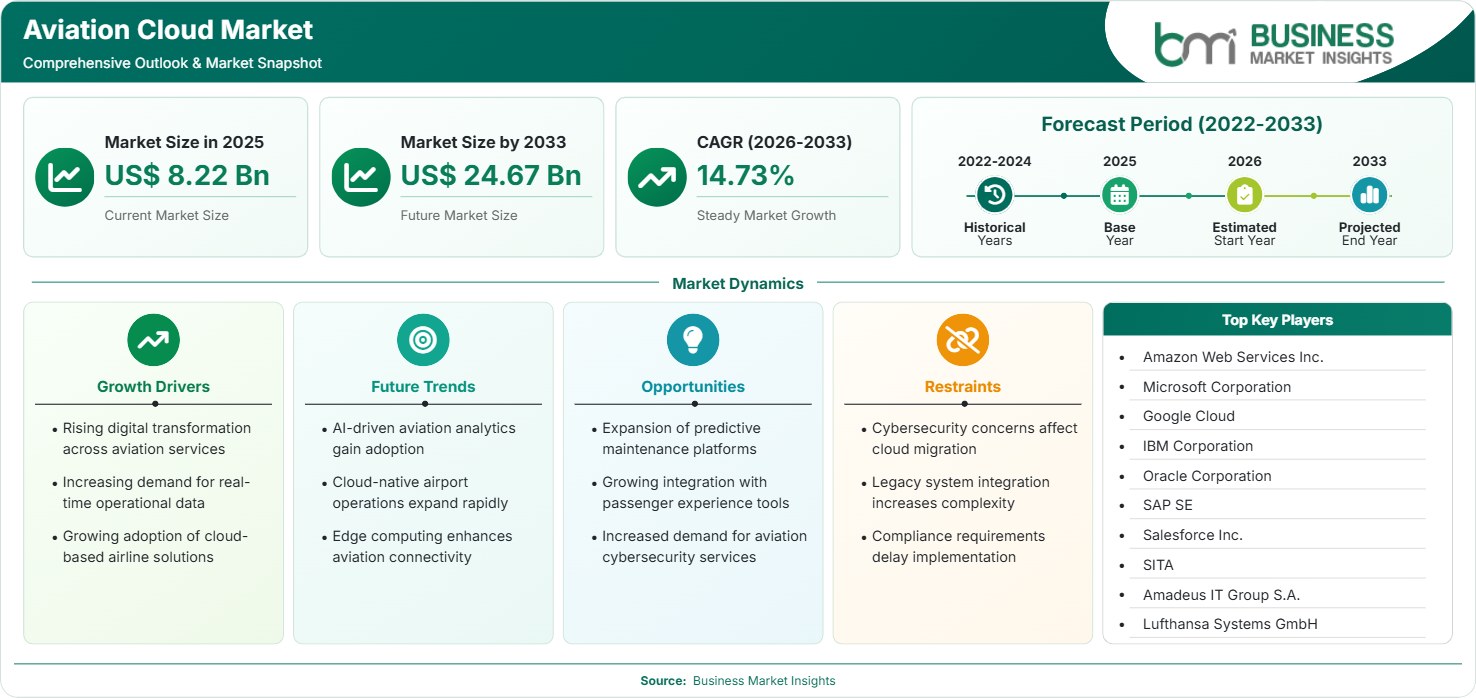
The Aviation Cloud Market size was valued at US$ 8.22 billion in 2025 and is projected to reach US$ 24.67 billion by 2033, growing at a CAGR of 14.73% during 2026–2033. Rising digital transformation across aviation services, increasing demand for real-time operational data, growing adoption of cloud-based airline solutions, and expanding investments in intelligent aviation infrastructure are accelerating cloud technology adoption throughout the global aviation ecosystem.

Report Coverage
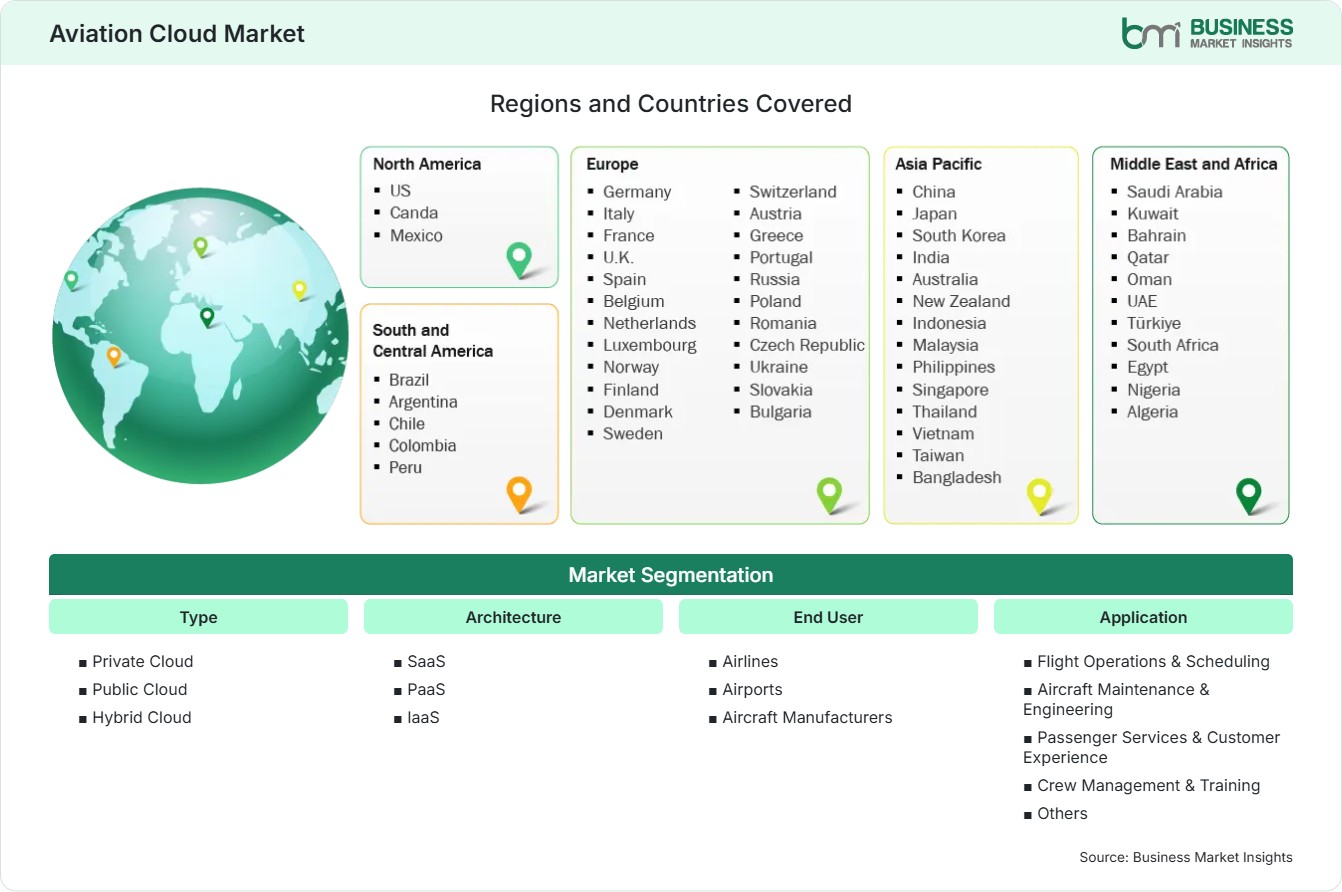
  • Type: Private Cloud, Public Cloud, Hybrid Cloud
  • Architecture: SaaS, PaaS, IaaS
  • End User: Airlines, Airports, Aircraft Manufacturers
  • Application: Flight Operations & Scheduling, Aircraft Maintenance & Engineering, Passenger Services & Customer Experience, Crew Management & Training, Others
US$ 8.22 Bn Market size in 2025
US$ 24.67 Bn Market Size by 2033
14.73% CAGR, 2026 - 2033
2026-2033 Forecast Period

AI Overview

Aviation Cloud Market Summary

  • North America Region: North America holds 38%–41% market share in 2025 and is expected to grow at a CAGR of 14.1%–14.6% during 2026–2033. Strong cloud infrastructure, increasing digital aviation investments, growing deployment of intelligent airport systems, and continuous modernization of airline operations continue supporting regional leadership. The United States remains the largest contributor with an estimated CAGR of 14.2%–14.7%, driven by advanced cloud adoption and extensive aviation technology investments.
  • Fastest Growing Region: Asia Pacific accounts for 24%–27% aviation cloud market share in 2025 and is projected to register a CAGR of 16.2%–16.8% during 2026–2033. Rapid airport expansion, increasing airline digitalization, rising passenger traffic, and growing government investment in smart aviation infrastructure continue driving accelerated market development.
  • Leading Segment: SaaS (Software as a Service) represents 42%–45% market share in 2025 and is forecast to expand at a CAGR of 15.1%–15.6% during 2026–2033. Lower deployment costs, scalability, simplified software management, and increasing demand for cloud-based operational platforms continue supporting segment leadership.
  • High Growth Segment: Aircraft Maintenance & Engineering accounts for 20%–23% market share in 2025 and is expected to grow at a CAGR of 16.4%–16.9% during 2026–2033. Increasing predictive maintenance adoption, connected aircraft technologies, AI-driven diagnostics, and maintenance optimization continue driving rapid segment expansion.
  • Key Market Opportunity: Expansion of predictive maintenance platforms, cloud-enabled passenger engagement solutions, artificial intelligence integration, and cybersecurity innovations are creating significant commercial opportunities across modern aviation operations.
  • Major Market Players: Amazon Web Services, Inc., Microsoft Corporation, Google Cloud, IBM Corporation, Oracle Corporation, SAP SE, Salesforce, Inc., SITA, Amadeus IT Group S.A., and Lufthansa Systems GmbH.
Strategic Insights

Aviation Cloud Market: Strategic Insights

Aviation Cloud Market Strategic Framework
FREE PDF
Request your free sample
Request free sample
Stakeholder View

Key Takeaways

  • The aviation cloud ecosystem is becoming increasingly interconnected as cloud providers, airline operators, airport authorities, software developers, cybersecurity specialists, and aircraft manufacturers collaborate to build scalable digital aviation platforms supporting end-to-end operational efficiency.
  • Aircraft maintenance, operational analytics, and passenger experience applications present substantial commercial opportunities as aviation organizations increasingly prioritize intelligent cloud platforms capable of improving operational reliability, reducing maintenance costs, and enhancing customer satisfaction.
  • Product innovation is shifting toward artificial intelligence, machine learning, predictive analytics, digital twins, edge computing, and cloud-native aviation platforms capable of supporting autonomous operations and real-time decision-making.
  • Asia Pacific continues emerging as an attractive investment destination owing to rapid airport construction, airline fleet expansion, increasing digital infrastructure investment, and government initiatives promoting smart aviation ecosystems across developing economies.
  • Strategic collaborations between cloud service providers, aviation software developers, and airline technology partners are accelerating cloud migration, expanding platform interoperability, and strengthening integrated digital aviation solutions across global markets.
  • Increasing investment in aviation cybersecurity, cloud resilience, regulatory compliance technologies, and secure multi-cloud environments is expected to improve operational continuity while supporting long-term digital transformation across the aviation industry.
Geographic Outlook

Aviation Cloud Market Regional Highlights

North America Aviation Cloud Market

North America accounted for 38%–41% of the Aviation Cloud Market Share in 2025 and is projected to expand at a CAGR of 14.1%–14.6% during 2026–2033. Strong cloud infrastructure, high technology adoption, expanding airport modernization programs, and increasing investments in intelligent airline operations continue supporting regional leadership. Airlines, airports, and aviation technology providers are increasingly deploying cloud-native platforms to improve operational efficiency, real-time decision-making, and passenger service management.

  • Leading airlines continue migrating mission-critical applications to cloud platforms, improving operational agility, infrastructure scalability, and enterprise-wide data accessibility across flight operations and customer service functions.
  • Major airport modernization initiatives support deployment of cloud-enabled passenger processing, baggage management, security operations, and intelligent airport resource planning systems.
  • Collaboration between cloud service providers and aviation software companies accelerates implementation of artificial intelligence, predictive analytics, and operational automation technologies throughout the aviation ecosystem.
  • Increasing investment in aviation cybersecurity solutions strengthens secure cloud adoption while ensuring compliance with evolving aviation safety and data protection regulations.
  • Growing demand for integrated operational platforms continues supporting cloud-based digital transformation across airlines, airports, and aircraft manufacturers.

US Aviation Cloud Market

The United States represented 32%–35% of global revenue in 2025 and is forecast to register a CAGR of 14.2%–14.7% through 2026–2033. Extensive cloud computing infrastructure, advanced aviation technology ecosystems, and continuous investment in digital transformation initiatives continue supporting national market leadership across commercial aviation operations.

  • Major airlines continue investing in cloud-based operational control centers that improve scheduling efficiency, predictive maintenance, and passenger service management.
  • Technology partnerships between aviation companies and hyperscale cloud providers accelerate deployment of artificial intelligence, machine learning, and advanced analytics platforms.
  • Airport operators increasingly implement cloud-enabled digital infrastructure supporting automated passenger processing, real-time operational monitoring, and intelligent airport management.
  • Strong investments in cybersecurity and regulatory compliance continue supporting secure cloud adoption across critical aviation information systems.

Europe Aviation Cloud Market

Europe held 27%–30% aviation cloud market share during 2025 and is anticipated to grow at a CAGR of 13.8%–14.3% through 2026–2033. Continuous digitalization of airline operations, increasing investment in sustainable aviation technologies, and expanding adoption of intelligent airport management systems continue supporting regional development. Germany leads the regional market with a CAGR of 13.9%–14.4%, while Spain is projected to record the fastest growth at 14.8%–15.3% during the forecast period.

  • Germany maintains leadership through advanced aviation software development, strong industrial digitalization, and increasing deployment of cloud-based airline management platforms.
  • Spain continues expanding airport digital transformation projects while investing in smart passenger services, operational automation, and cloud-enabled aviation infrastructure.
  • European aviation organizations increasingly adopt cloud technologies supporting sustainability reporting, operational optimization, and integrated fleet management capabilities.
  • Regulatory emphasis on secure digital infrastructure encourages aviation organizations to strengthen cloud resilience and advanced cybersecurity implementation.
  • Cross-border collaboration between technology providers and airlines supports broader deployment of interoperable aviation cloud platforms.

Asia Pacific Aviation Cloud Market

Asia Pacific accounted for 24%–27% of industry revenue in 2025 and is projected to record the highest CAGR of 16.2%–16.8% during 2026–2033. Rapid aviation infrastructure expansion, increasing airline fleet modernization, growing passenger traffic, and strong government investment in digital aviation continue accelerating regional development. China leads regional demand with a CAGR of 16.1%–16.6%, while India records the fastest growth at 16.8%–17.4%.

  • China continues strengthening smart airport initiatives through large-scale deployment of cloud computing, artificial intelligence, and integrated aviation management systems.
  • India benefits from rapid airport infrastructure expansion, airline digital transformation, and increasing adoption of cloud-based operational management platforms.
  • Japan and South Korea continue investing in intelligent aviation technologies supporting predictive maintenance, passenger analytics, and connected airport operations.
  • Growing investments in digital aviation infrastructure encourage broader adoption of cloud-native enterprise platforms across regional aviation organizations.
  • Increasing passenger volumes continue driving demand for scalable cloud technologies capable of supporting efficient airline and airport operations.

Rest of World Aviation Cloud Market

The Rest of World accounted for 8%–10% market share in 2025 and is expected to register a CAGR of 14.4%–14.9% during 2026–2033. South & Central America continue modernizing airport infrastructure through cloud-enabled operational systems and digital aviation initiatives.

The Middle East & Africa are experiencing increasing investment in smart airports, airline modernization, and aviation technology infrastructure. Brazil leads South & Central America with a CAGR of 14.5%–15.0%, while the United Arab Emirates records the highest regional growth at 15.4%–15.9% owing to significant investment in next-generation aviation technologies.

  • Brazil continues expanding digital aviation capabilities through modernization of airport operations, airline technology platforms, and cloud-enabled passenger management systems.
  • The United Arab Emirates accelerates smart airport investments supported by advanced digital infrastructure, artificial intelligence deployment, and integrated aviation platforms.
  • Regional aviation authorities increasingly prioritize secure cloud migration to improve operational resilience, passenger experience, and data-driven decision-making.
  • Expansion of international airline partnerships encourages deployment of standardized cloud technologies across aviation operations.
  • Continuous investment in intelligent airport ecosystems creates long-term opportunities for cloud service providers and aviation software developers.
Global Market Geography
FREE PDF
Request your free sample
Request free sample
Segment Analysis

Aviation Cloud Market Segmentation

Type

The Type segment accounted for 34%–37% of the overall market in 2025 and is projected to expand at a CAGR of 15.0%–15.5% during 2026–2033. Airlines and airports continue adopting flexible deployment models to improve scalability, operational resilience, and cost optimization. The Aviation Cloud Market Forecasts indicate sustained investment in hybrid cloud environments supporting secure, high-performance aviation operations.

  • Private Cloud: Widely adopted by airlines and airport operators requiring greater data security, regulatory compliance, infrastructure control, and protection of mission-critical aviation applications.
  • Public Cloud: Continues expanding through scalable computing resources, cost-effective deployment models, simplified infrastructure management, and rapid implementation across aviation enterprises.
  • Hybrid Cloud: Increasingly preferred because it combines operational flexibility, secure data management, workload optimization, and seamless integration between public and private cloud environments.

Architecture

The Architecture segment represented 42%–45% market share during 2025 and is expected to register a CAGR of 15.2%–15.7% through 2026–2033. Cloud-native software deployment, digital service delivery, and increasing enterprise modernization continue supporting strong adoption. The Aviation Cloud Market Trends demonstrate growing preference for service-based cloud architectures capable of improving operational efficiency and business agility.

  • SaaS (Software as a Service): Maintains market leadership through subscription-based deployment, simplified software updates, lower operational costs, and rapid implementation across aviation organizations.
  • PaaS (Platform as a Service): Enables aviation software developers to accelerate application development, system integration, and deployment of customized cloud-based aviation solutions.
  • IaaS (Infrastructure as a Service): Supports scalable computing resources, secure storage capabilities, disaster recovery solutions, and flexible infrastructure management for aviation enterprises.

End User

The End User segment generated 39%–42% of total revenue in 2025 and is projected to grow at a CAGR of 14.8%–15.3% through 2026–2033. Continuous digital transformation across aviation organizations is increasing demand for cloud-based operational platforms supporting efficiency, collaboration, and real-time decision-making.

  • Airlines: Continue leading cloud adoption through investments in digital flight operations, passenger engagement platforms, maintenance analytics, and enterprise resource management systems.
  • Airports: Increasingly deploy cloud technologies supporting intelligent infrastructure management, passenger processing automation, operational monitoring, and resource optimization.
  • Aircraft Manufacturers: Adopt cloud platforms for engineering collaboration, digital twins, connected manufacturing, product lifecycle management, and predictive maintenance integration.

Application

The Application segment accounted for 31%–34% market share in 2025 and is expected to register a CAGR of 15.5%–16.0% during 2026–2033. Growing operational complexity and increasing digitalization continue encouraging adoption of cloud-enabled aviation applications capable of improving efficiency, safety, and passenger satisfaction.

  • Flight Operations & Scheduling: Supports real-time flight planning, operational coordination, resource optimization, and intelligent scheduling for enhanced airline efficiency.
  • Aircraft Maintenance & Engineering: Enables predictive maintenance, remote diagnostics, digital maintenance records, and optimized engineering workflows through cloud-enabled analytics.
  • Passenger Services & Customer Experience: Improves reservation systems, personalized services, digital communication, loyalty programs, and seamless passenger journey management.
  • Crew Management & Training: Enhances workforce scheduling, digital learning platforms, compliance management, competency tracking, and operational readiness across aviation personnel.
Market Forces

Aviation Cloud Market Dynamics

Key Market Drivers

Rising digital transformation across aviation services

Airline companies, airports, and aircraft manufacturers have been stepping up their efforts in the implementation of digital transformation projects with the intention of boosting operational efficiency, cutting down costs, and enhancing decision-making ability. Through cloud computing, it becomes possible to centralize data, collaborate in real time, and integrate different operational areas. The IATA reports that airlines have been investing more in digital technology. These developments continue supporting Aviation Cloud Market Growth by encouraging migration from legacy IT infrastructure to scalable cloud-based platforms capable of supporting intelligent aviation operations.

Increasing demand for real-time operational data

The aviation industry increasingly depends on real-time operational intelligence to optimize flight scheduling, aircraft utilization, passenger management, and airport resource allocation. The use of cloud-based analytics systems enables aviation enterprises to manage huge amounts of data and boost their predictive decision-making and resilience. In addition to this, artificial intelligence, Internet of Things (IoT), and analytics help enhance the effectiveness of data-powered operations with the provision of insights that contribute to increased safety, efficiency, and service delivery.

Growing adoption of cloud-based airline solutions

Airlines are rapidly implementing cloud-based enterprise applications supporting reservation systems, maintenance management, crew scheduling, customer relationship management, and financial operations. Cloud-native platforms offer higher scalability, reduced cost of infrastructure, easy deployment of applications, and increased interoperability of operating systems. The increasing need for flexible digital infrastructure prompts airlines to upgrade their business processes and continue innovating through cloud computing technology.

Key Market Opportunities

Expansion of predictive maintenance platforms

Maintenance systems that use the power of cloud computing, artificial intelligence, and machine learning are offering lucrative business possibilities to firms dealing with aviation technology. Monitoring of the aircraft parts can help in detecting faults at an early stage, lowering maintenance expenses, and limiting interruptions. As airlines increasingly prioritize operational efficiency, the Aviation Cloud Market Forecasts indicate growing investment in intelligent maintenance platforms capable of enhancing aircraft reliability and optimizing maintenance planning.

Growing integration with passenger experience tools

Cloud technologies are enabling airlines and airports to deliver highly personalized passenger experiences through integrated booking systems, mobile applications, digital communication platforms, loyalty programs, and real-time travel information. Personalized service delivery along with increased operation coordination can be achieved by means of advanced customer analytics tools. The constantly growing interest in digital travel experiences contributes to investment in cloud-based passenger engagement platforms.

Increased demand for aviation cybersecurity services

Growing dependence on cloud infrastructure increases the need for advanced cybersecurity solutions capable of protecting mission-critical aviation systems and sensitive operational data. Cloud security platforms incorporating artificial intelligence, identity management, continuous monitoring, and threat intelligence help aviation organizations strengthen cyber resilience. Expanding regulatory requirements and increasing cyber threats continue creating attractive business opportunities for cloud security providers serving the aviation industry.

Market Restraints and Challenges

Cybersecurity concerns affect cloud migration

Factor: Aviation organizations manage highly sensitive operational, passenger, and regulatory data that require strong cybersecurity protection throughout cloud environments. Impact: Concerns regarding cyberattacks, ransomware, unauthorized data access, and regulatory compliance may delay cloud migration strategies and increase investment requirements for advanced security technologies. Organizations frequently adopt phased implementation approaches, extending deployment timelines and increasing operational complexity.

Legacy system integration increases complexity

Factor: Many airlines and airports continue operating legacy operational systems that were not originally designed for cloud-native environments. Impact: Integrating older infrastructure with modern cloud platforms requires significant technical expertise, extended implementation timelines, and additional investment. Complex migration processes may temporarily affect operational continuity while increasing deployment costs and limiting the speed of digital transformation initiatives.

Company Analysis

Competitive Landscape

The competitive environment is characterized by strong investments in cloud infrastructure, artificial intelligence, aviation analytics, cybersecurity, and enterprise software integration. Technology providers continue expanding cloud capabilities through strategic partnerships with airlines, airports, and aircraft manufacturers while strengthening digital transformation initiatives. Continuous innovation and platform development continue supporting comprehensive Aviation Cloud Market Analysis across commercial aviation ecosystems.

Company Name

Overview

Products and Services Relevant to this Market

Amazon Web Services, Inc.

Global cloud computing leader providing scalable infrastructure and digital transformation solutions across multiple industries, including aviation.

Cloud infrastructure, analytics, artificial intelligence, storage, cybersecurity, machine learning, and aviation cloud services.

Microsoft Corporation

Leading technology company delivering enterprise cloud platforms supporting digital transformation and intelligent aviation operations.

Microsoft Azure, cloud computing, AI services, cybersecurity, analytics, and enterprise collaboration platforms.

Google Cloud

Global cloud platform provider focused on data analytics, artificial intelligence, and scalable cloud infrastructure.

Cloud computing, AI, data analytics, machine learning, Kubernetes, and aviation digital transformation solutions.

IBM Corporation

Technology company specializing in hybrid cloud, artificial intelligence, enterprise software, and digital transformation solutions.

Hybrid cloud platforms, AI solutions, enterprise integration, cybersecurity, and aviation analytics services.

Oracle Corporation

Enterprise software provider delivering cloud applications and database technologies for aviation organizations worldwide.

Cloud ERP, databases, infrastructure services, analytics, and aviation enterprise management solutions.

SAP SE

Enterprise software company enabling intelligent business operations through integrated cloud applications.

Cloud ERP, enterprise software, analytics, supply chain management, and aviation business platforms.

Salesforce, Inc.

Global provider of cloud-based customer relationship management and digital engagement platforms.

CRM software, customer analytics, digital engagement, cloud applications, and aviation customer experience solutions.

SITA

Aviation technology specialist delivering digital solutions exclusively for airlines, airports, and border management organizations.

Airport management systems, passenger processing, cloud platforms, cybersecurity, and aviation connectivity solutions.

Amadeus IT Group S.A.

Leading travel technology company providing cloud-based solutions for airlines, airports, and travel service providers.

Airline reservation systems, passenger services, airport operations, cloud platforms, and travel technology solutions.

Lufthansa Systems GmbH

Aviation IT company specializing in digital solutions supporting airline operations and business management.

Airline operations software, flight management, cloud services, scheduling systems, and operational analytics.

Trust & Transparency

Research Methodology

The market analysis combines proprietary research with secondary data from government agencies, company disclosures, regulatory filings, industry databases and expert interviews. Market estimates are validated through data triangulation, cross-market benchmarking and analyst review.

View Full Research Methodology

Questions Answered

Frequently Asked Questions

What does the Aviation Cloud Market Report include?

The Market Report provides comprehensive insights into market size, segmentation, regional outlook, competitive landscape, emerging technologies, growth drivers, restraints, opportunities, recent developments, and future industry outlook.

What are the major future opportunities in this market?

Predictive maintenance platforms, AI-enabled passenger experience solutions, cloud cybersecurity services, and intelligent aviation analytics are expected to create substantial growth opportunities throughout the forecast period.

Which architecture segment holds the largest market share?

SaaS (Software as a Service) leads the market because it offers lower deployment costs, simplified software management, faster implementation, and greater scalability for airlines, airports, and aviation enterprises.

Which region dominates the Aviation Cloud Market?

North America maintains the leading position due to its mature cloud infrastructure, extensive airline digitalization, strong presence of leading cloud technology providers, and continuous investment in intelligent aviation systems.

What is driving the Market?

The market is driven by increasing digital transformation across aviation services, growing demand for real-time operational intelligence, expanding adoption of cloud-based airline platforms, and rising investments in smart airport technologies.

Access the Full Aviation Cloud Market Report

Get segment-level forecasts, regional estimates, competitive benchmarking, company profiles and downloadable Excel datasets.

Access the full Aviation Cloud Market Report
350 pages PDF & Excel | 2026-08-05