
Aviation Fuel Market Outlook: Size, Share, Trends, Growth Analysis, Competitive Landscape & Forecast, 2026-2033

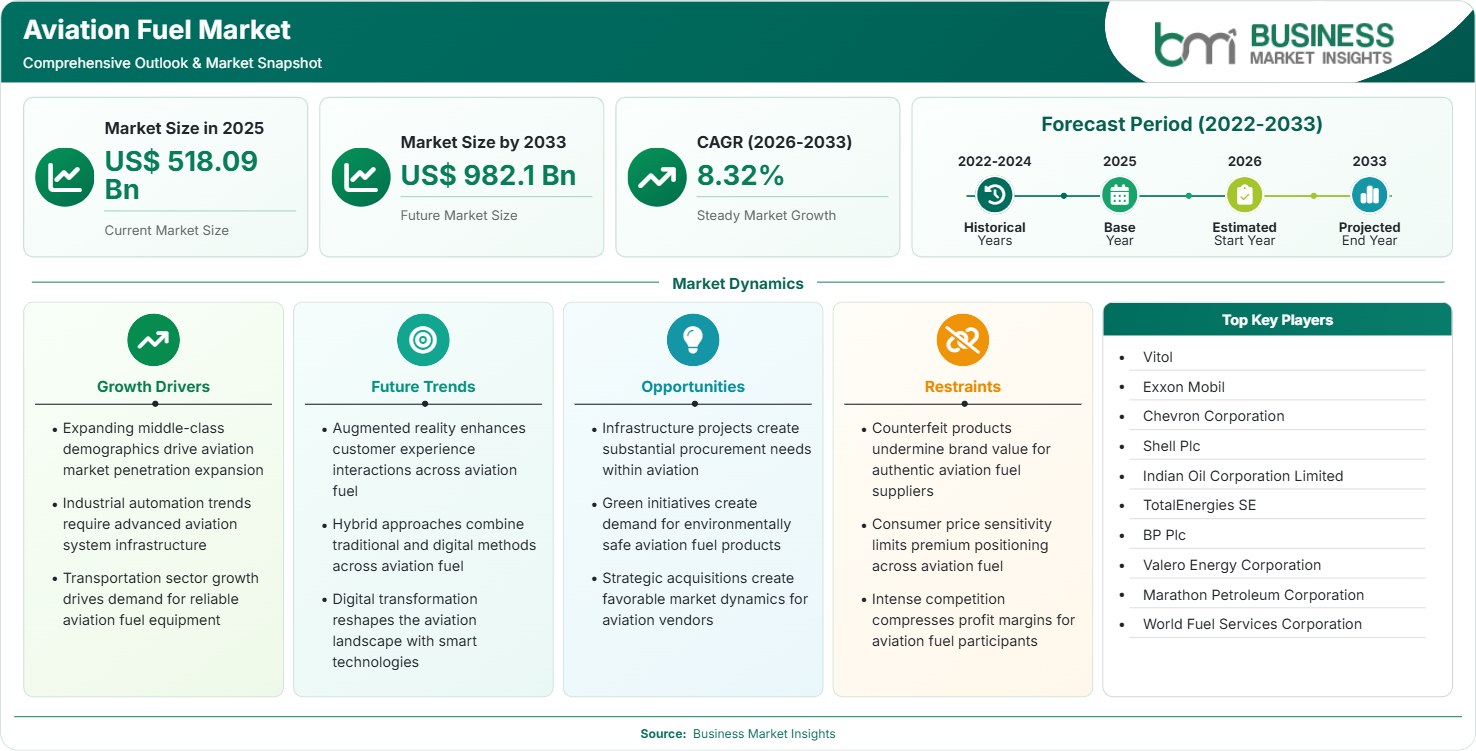
The Aviation Fuel Market size was valued at US$ 518.09 Billion in 2025 and is projected to reach US$ 982.1 Billion by 2033, growing at a CAGR of 8.32% during 2026–2033. Rising global passenger traffic, increasing aircraft fleet expansion, sustainable aviation fuel commercialization, airport infrastructure investments, and government decarbonization initiatives are creating substantial opportunities for fuel suppliers, refiners, distributors, and technology providers across commercial and defense aviation ecosystems.

Report Coverage
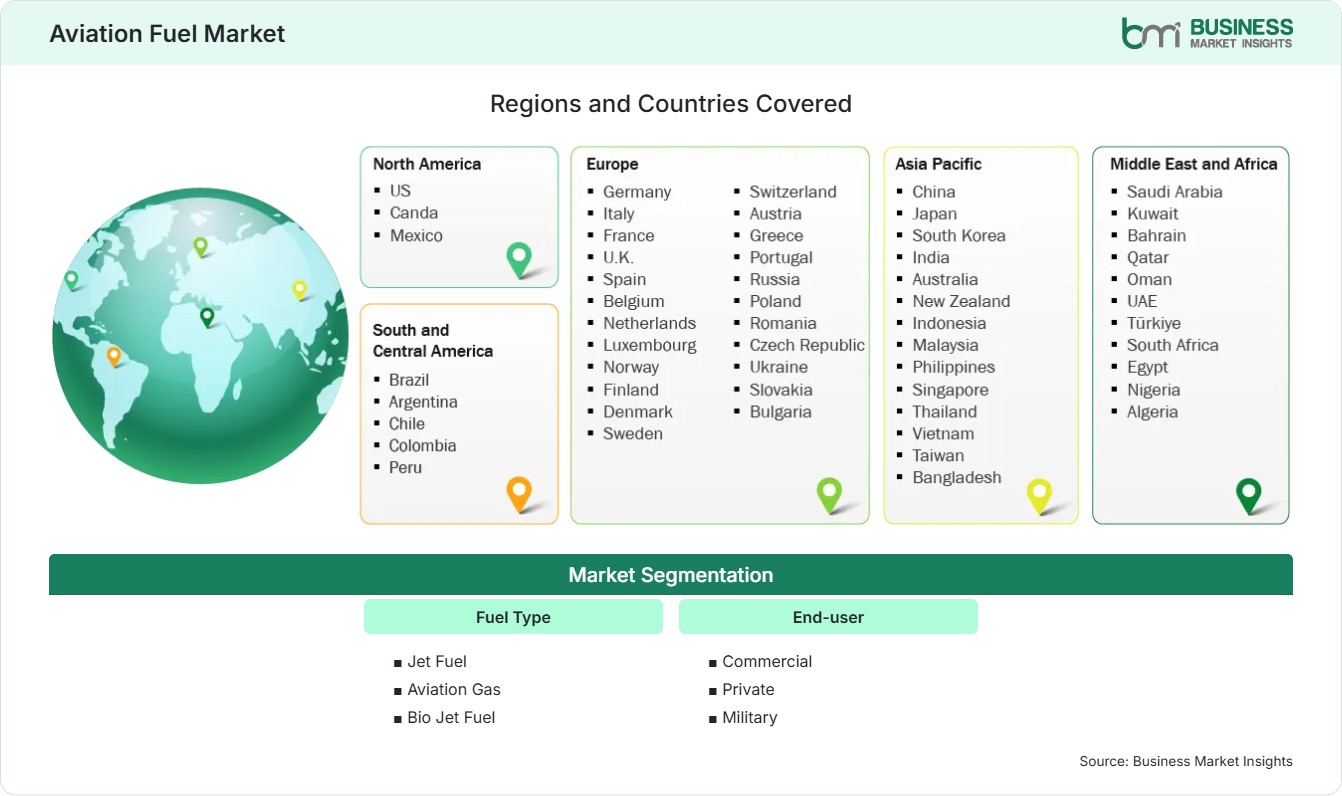
  • Fuel Type: Jet Fuel , Aviation Gas, Bio Jet Fuel
  • End-user: Commercial, Private, Military
US$ 518.09 Bn Market size in 2025
US$ 982.1 Bn Market Size by 2033
8.32% CAGR, 2026 - 2033
2026-2033 Forecast Period

AI Overview

Aviation Fuel Market Summary

  • North America Region: North America holds 34%–37% market share in 2025, growing with a CAGR of 7.6%–8.0% during 2026–2033, supported by mature aviation infrastructure, extensive commercial airline operations, defense aviation demand, refinery modernization, and accelerating sustainable aviation fuel production investments across regional supply chains. The U.S. dominates regional demand through strong airline operations, military aviation spending, expanding SAF projects, and refinery upgrades, advancing at a CAGR of 7.7%–8.1%.
  • Fastest Growing Region: Asia Pacific holds 28%–31% market share in 2025, expanding at a CAGR of 9.5%–9.9% during 2026–2033, driven by airport expansion, increasing middle-class air travel, fleet modernization, regional airline growth, and stronger government investments supporting aviation fuel infrastructure and supply resilience.
  • Leading Segment: Jet Fuel (Aviation Turbine Fuel) accounts for 82%–85% market share in 2025 and is expected to expand at a CAGR of 8.1%–8.5% during 2026–2033, supported by commercial aviation recovery, fleet expansion, international route additions, operational efficiency improvements, and growing long-haul passenger traffic worldwide.
  • High Growth Segment: Bio Jet Fuel represents 5%–8% market share in 2025 while advancing at a CAGR of 19.5%–21.5% during 2026–2033, fueled by aviation decarbonization mandates, airline sustainability commitments, carbon reduction strategies, supportive government incentives, and expanding commercial-scale sustainable fuel production capacity.
  • Key Market Opportunity: Expanding sustainable aviation fuel production through advanced bio-refineries, waste-based feedstocks, synthetic fuels, long-term airline procurement agreements, and supportive policy incentives offers significant opportunities for producers, distributors, refiners, and airport fuel infrastructure developers.
  • Major Market Players: Vitol Holding B.V., Exxon Mobil Corporation, Chevron Corporation, Shell plc, Indian Oil Corporation Limited, TotalEnergies SE, BP p.l.c., Valero Energy Corporation, Marathon Petroleum Corporation, World Fuel Services Corporation, Essar Oil (UK) Limited, Bharat Petroleum Corporation Limited, Rosneft Deutschland GmbH, PJSC LUKOIL, China Aviation Oil (Singapore) Corporation Ltd.
Strategic Insights

Aviation Fuel Market: Strategic Insights

Aviation Fuel Market Strategic Framework
FREE PDF
Request your free sample
Request free sample
Stakeholder View

Key Takeaways

  • The industry value chain is becoming increasingly integrated as refiners, fuel traders, storage operators, airport infrastructure companies, and airlines establish long-term partnerships to improve supply reliability and optimize procurement efficiency.
  • Sustainable aviation fuel production represents the strongest commercial opportunity as governments, airlines, and corporate travel programs pursue measurable carbon reduction targets supported by long-term purchasing agreements.
  • Innovation is shifting toward synthetic fuels, waste-derived feedstocks, advanced refining technologies, digital fuel monitoring systems, predictive supply chain analytics, and carbon lifecycle optimization to improve operational efficiency.
  • Asia Pacific presents one of the most attractive investment destinations due to rapid airport construction, expanding airline fleets, rising passenger traffic, supportive aviation policies, and increasing domestic refining capabilities.
  • Strategic acquisitions, refinery capacity expansion, infrastructure modernization, and collaborative investments between aviation operators and global energy companies continue reshaping competitive positioning throughout the aviation fuel ecosystem.
  • Defense aviation modernization and increasing air cargo activity provide additional demand stability, reducing reliance on passenger aviation cycles while creating diversified revenue opportunities for suppliers and distributors.
Geographic Outlook

Aviation Fuel Market Regional Highlights

North America Aviation Fuel Market

North America accounted for 34%–37% of the global market share in 2025 and is projected to register a CAGR of 7.6%–8.0% during 2026–2033. The region benefits from a dense commercial aviation network, high aircraft utilization, advanced refinery infrastructure, and strong military aviation activities. Accelerating investments in sustainable aviation fuel production, airport fuel storage modernization, and digital fuel management systems continue strengthening supply resilience. The Aviation Fuel Market share remains supported by established airline hubs, favorable regulatory initiatives, and expanding SAF production partnerships across the United States and Canada.

  • Major airlines are entering long-term sustainable aviation fuel procurement agreements with domestic refiners, encouraging production expansion while supporting emission reduction commitments and creating predictable demand across commercial aviation supply chains.
  • Airport infrastructure modernization programs continue expanding storage terminals, hydrant fueling systems, and digital inventory management platforms, improving operational efficiency while reducing turnaround times for high-frequency airline operations throughout the region.
  • Defense aviation expenditure remains a major consumption driver, with military aircraft modernization and strategic fuel reserve programs supporting stable demand regardless of fluctuations in commercial passenger traffic.
  • Refinery upgrades incorporating renewable feedstocks and co-processing technologies are improving production flexibility, allowing suppliers to meet evolving environmental regulations while maintaining dependable aviation fuel availability for domestic and international carriers.
  • Advanced digital fuel monitoring, predictive logistics, and automated quality assurance technologies continue improving operational transparency, reducing supply disruptions, and supporting cost optimization throughout the aviation fuel distribution ecosystem.

US Aviation Fuel Market

The United States represented approximately 79%–82% of North American Aviation Fuel Market demand in 2025 and is forecast to grow at a CAGR of 7.7%–8.1% through 2033. Strong airline networks, global aviation hubs, military operations, and refinery capacity support consistent fuel consumption. Federal clean aviation initiatives and expanding SAF investments continue strengthening domestic production while improving long-term supply security across commercial and defense aviation sectors.

  • Large-scale refinery operators continue investing in renewable fuel conversion projects that increase sustainable aviation fuel production capacity while maintaining conventional jet fuel supply reliability across major airports.
  • Major commercial airlines are expanding fleet renewal programs featuring more fuel-efficient aircraft, lowering operational costs while supporting increasing passenger volumes across domestic and international routes.
  • Public-private partnerships are accelerating airport infrastructure modernization projects, including storage expansion, digital fuel monitoring technologies, and enhanced hydrant fueling systems supporting operational reliability.
  • Federal incentives encouraging sustainable aviation fuel commercialization are stimulating investments across refining, feedstock processing, and distribution infrastructure, strengthening long-term industry competitiveness.

Europe Aviation Fuel Market

Europe captured 24%–27% of the global Aviation Fuel Market in 2025 and is anticipated to expand at a CAGR of 7.9%–8.3% during the forecast period. Regional demand is supported by extensive cross-border air travel, environmental regulations, and ambitious decarbonization targets. The ReFuelEU Aviation initiative, refinery investments, and sustainable aviation fuel mandates are accelerating industry transformation. Germany remains the leading market, while Spain demonstrates the fastest regional growth with a CAGR of 8.8%–9.2%.

  • European airlines increasingly prioritize SAF procurement contracts to comply with emission reduction regulations while improving long-term environmental performance and strengthening sustainable aviation supply chains.
  • Regional refiners are expanding renewable fuel production facilities using waste oils, biomass, and synthetic feedstocks to satisfy rising airline demand and evolving regulatory requirements.
  • Germany maintains regional leadership through advanced refining capabilities, strong airline operations, and established airport infrastructure supporting significant aviation fuel consumption.
  • Spain is experiencing rapid expansion driven by tourism growth, airport capacity additions, and increasing investments in sustainable aviation fuel production and logistics infrastructure.
  • Cross-border collaboration among governments, airports, airlines, and energy companies continues strengthening integrated fuel distribution networks throughout the European aviation sector.

Asia Pacific Aviation Fuel Market

Asia Pacific accounted for 28%–31% of global demand in 2025 and is projected to record the fastest CAGR of 9.5%–9.9% through 2033. Rising passenger traffic, expanding middle-class populations, new airport construction, and rapid airline fleet expansion continue driving consumption. China leads regional demand, while India records the highest regional CAGR of 10.2%–10.6% due to accelerating domestic aviation expansion and airport infrastructure development.

  • China continues investing heavily in airport construction, airline fleet modernization, and refining capacity expansion to support rapidly increasing commercial aviation activity and international connectivity.
  • India is witnessing exceptional demand growth driven by regional connectivity initiatives, expanding airline fleets, rising disposable income, and significant airport infrastructure investments.
  • Southeast Asian economies continue benefiting from tourism recovery, low-cost carrier expansion, and government support for airport modernization and aviation logistics improvements.
  • Regional refiners are expanding production flexibility through renewable fuel projects, improving long-term supply security while supporting emerging sustainable Aviation Fuel Markets.
  • Growing cargo aviation demand linked to e-commerce expansion continues strengthening aviation fuel consumption across major logistics hubs throughout Asia Pacific.

Rest of World Aviation Fuel Market

Rest of World represented 10%–13% of the global Aviation Fuel Market in 2025 and is expected to expand at a CAGR of 8.2%–8.6% through 2033.

South and Central America continue benefiting from airline network expansion, tourism recovery, and airport modernization initiatives, with Brazil leading regional demand and Colombia demonstrating the strongest growth.

The Middle East and Africa remain strategically important due to global transit hubs, expanding airline fleets, and refinery investments. Saudi Arabia leads regional demand, while the United Arab Emirates records the fastest CAGR of 8.9%–9.3%, supported by international aviation expansion and sustainable fuel investments.

  • Brazil continues strengthening domestic aviation connectivity while expanding airport infrastructure and refining capacity to support increasing passenger and cargo aviation demand.
  • Gulf countries remain global aviation hubs, supported by extensive international airline operations, strategic airport investments, and integrated fuel logistics infrastructure serving long-haul routes.
  • African aviation markets continue improving through airport modernization programs, regional airline expansion, and international investment supporting stronger aviation connectivity.
  • Sustainable aviation fuel pilot projects across the Middle East are encouraging long-term diversification strategies while supporting regional carbon reduction commitments and future export opportunities.
  • Tourism recovery, international trade growth, and expanding cargo operations continue creating stable long-term demand across emerging aviation markets outside North America, Europe, and Asia Pacific.
Global Market Geography
FREE PDF
Request your free sample
Request free sample
Segment Analysis

Aviation Fuel Market Segmentation

Fuel Type

The Fuel Type segment accounted for the largest contribution to the market, with Jet Fuel (Aviation Turbine Fuel) holding 82%–85% share in 2025 and the segment expanding at a CAGR of 8.1%–8.5% through 2033. Commercial aviation activity, expanding airline fleets, stricter fuel quality standards, and increasing sustainable fuel adoption continue shaping demand. The Aviation Fuel Market scope is broadening as conventional and renewable aviation fuels coexist to support operational efficiency and long-term decarbonization objectives.

  • Jet Fuel (Aviation Turbine Fuel): Represents the dominant fuel category due to widespread use across commercial and military aircraft, supported by expanding airline operations, international routes, and continuous refinery capacity improvements.
  • Aviation Gas: Primarily serves piston-engine aircraft used in general aviation, flight training, recreational flying, and specialized operations, maintaining consistent demand despite gradual fleet modernization across developed aviation markets.
  • Bio Jet Fuel: Experiences the fastest adoption as airlines pursue carbon reduction commitments through sustainable fuel procurement, government incentives, advanced feedstock technologies, and increasing commercial-scale production facilities worldwide.

End-user

The Commercial segment dominated the market with 71%–74% share in 2025 and is anticipated to register a CAGR of 8.5%–8.9% through 2033. Rising international passenger traffic, airline fleet expansion, airport capacity enhancement, and cargo aviation growth continue driving fuel demand. Long-term procurement agreements, operational efficiency initiatives, and evolving Aviation Fuel Market trends support sustained consumption across commercial aviation ecosystems.

  • Commercial: Accounts for the highest fuel consumption owing to extensive scheduled passenger services, cargo transportation, international route expansion, and growing investments in fuel-efficient next-generation commercial aircraft fleets.
  • Private: Benefits from increasing business aviation activity, high-net-worth traveler demand, charter services, and corporate mobility requirements, encouraging stable consumption across executive and general aviation operations.
  • Military: Supported by continuous defense modernization programs, strategic aviation preparedness, pilot training activities, and expanding aerial surveillance operations, ensuring resilient fuel demand independent of commercial aviation market cycles.
Market Forces

Aviation Fuel Market Dynamics

Key Market Drivers

Rising Global Air Passenger Traffic and Fleet Expansion

Global commercial aviation continues to recover, with passenger demand exceeding pre-pandemic levels across several international markets. According to the International Air Transport Association (IATA), global passenger traffic measured in Revenue Passenger Kilometers (RPKs) has shown sustained year-over-year growth, encouraging airlines to increase aircraft utilization and expand fleet capacity. This trend directly supports Aviation Fuel Market growth by increasing daily fuel consumption across domestic and international routes. Moreover, fleet modernization initiatives with fuel-efficient aircraft have been driving up demand for high quality aviation turbine fuel. The developing countries are investing in airport expansion projects, thereby enhancing their aviation performance. Increased cargo traffic and low-cost carrier operations will collectively boost demand for commercial aviation turbine fuel.

Expansion of Air Cargo and E-commerce Logistics

The rapid expansion of global e-commerce has significantly increased demand for dedicated air freight services. Cargo items of high value, drugs, electronic products, and time-sensitive cargo are increasingly reliant on air transport, resulting in sustained aircraft operations and greater fuel use. Due to the growing trends in global trade, strong logistics chains, and logistics centers, there has been an increase in the use of the air cargo business. Major logistics firms are constantly adding more aircraft and logistics centers at airports, which ensures that there is consistent demand for fuel irrespective of cycles in passenger aviation. Better logistics management through digital technology and aircraft scheduling makes operations efficient without reducing aircraft fuel usage for cargo.

Government Support for Sustainable Aviation Fuel Adoption

Governments across North America, Europe, and Asia Pacific are implementing policies encouraging Sustainable Aviation Fuel (SAF) production to reduce aviation emissions. Financial motivators such as production tax credits, blending requirements, research support, and collaboration between government and private entities help spur investment in renewable refineries. More and more airlines are making contractual arrangements with respect to SAF to comply with their carbon reduction goals amid growing environmental regulatory frameworks. The rising availability of feedstock, improvements in the technology of synthetic fuel creation, and the upgrading of the refineries have been driving the development process.

Key Market Opportunities

Commercial Scale Sustainable Aviation Fuel Manufacturing

Growing investment in commercial-scale sustainable aviation fuel facilities presents one of the industry's strongest expansion opportunities. Airlines are committing billions of dollars through long-term procurement agreements, providing demand certainty for fuel producers. Governments continue introducing supportive incentives that reduce production costs and encourage refinery conversion projects. The emergence of advanced feedstocks including agricultural residues, municipal waste, used cooking oil, and synthetic fuels enhances supply diversity. Aviation Fuel Market Forecasts indicate increasing commercialization will create opportunities across production, logistics, airport storage infrastructure, certification services, and carbon lifecycle management technologies supporting aviation decarbonization objectives.

Digital Fuel Management and Smart Airport Infrastructure

Digital transformation is improving operational efficiency throughout aviation fuel supply chains. AI, IoT sensors, predictive maintenance, automatic inventory tracking, and blockchain-fueled traceability enhance transparency and minimize operational risks. More and more airport owners utilize integrated fueling systems that can conduct real-time monitoring and scheduling. Fuel loss is minimized, quality control is enhanced, and compliance regulations are improved thanks to those innovations. Organizations offering digital fuel logistics, automation, and modern airport infrastructure solutions are in a good position to profit from increased investments in these solutions.

Emerging Aviation Markets and Airport Infrastructure Development

Rapid airport development across Asia, the Middle East, and parts of Africa continues creating long-term opportunities for fuel suppliers and infrastructure providers. There is heavy investment in new terminal buildings, runways, fuel storage areas, and hydrant fuel systems because of increased demand from the passengers. Growth in connectivity, tourism, and business travel leads to increased aircraft numbers and increased fuel usage. Cooperation between refineries, airports, logistics firms, and airlines enhances regional fuel distribution networks. This not only facilitates expansion of markets but also encourages private investments in aviation fuel projects.

Market Restraints and Challenges

Volatile Crude Oil Prices and Refining Margins

Factor: Geopolitical tensions, production quotas, refinery outages, and global supply disruptions create substantial volatility in crude oil markets.

Impact: Airlines have uncertain operating costs, which might necessitate fuel hedging programs that would not necessarily protect them from financial risk. Refineries have uncertain margins that affect their capacity to plan and invest in new production facilities. Prolonged price instability is an aspect that affects airline pricing policies, as well as flight schedules and aircraft usage.

Stringent Environmental Regulations and SAF Supply Constraints

Factor: Sustainable aviation fuel production capacity remains limited compared with rapidly increasing airline demand, while certification processes and feedstock availability continue constraining supply expansion.

Impact: High expenses associated with higher levels of SAF production increase costs of procurement for airlines and result in price disparity with regular jet fuel. Additional costs associated with investments for upgrading infrastructure, refineries, and compliance with regulations impede mass implementation of the solution even with strong government backing.

Company Analysis

Competitive Landscape

The competitive environment is characterized by integrated energy companies, global fuel traders, airport fuel service providers, and regional refiners investing in supply chain optimization, refinery modernization, and sustainable aviation fuel production. The Aviation Fuel Market analysis indicates that long-term airline supply agreements, strategic infrastructure investments, and SAF commercialization initiatives are becoming the primary competitive differentiators across the industry.

Company Name

Overview

Products and Services Relevant to this Market

Vitol Holding B.V.

Global energy and commodities trader with an extensive aviation fuel supply network serving airlines, airports, and commercial aviation customers worldwide.

Aviation turbine fuel trading, fuel logistics, airport fueling solutions, storage management, risk management, and integrated energy supply services.

Exxon Mobil Corporation

One of the world's largest integrated energy companies with significant refining capacity and global aviation fuel distribution operations.

Jet A, Jet A-1, aviation lubricants, sustainable aviation fuel initiatives, refinery services, and global fuel supply agreements.

Chevron Corporation

International energy producer operating advanced refining facilities and supplying aviation fuels across commercial and military aviation sectors.

Aviation turbine fuel, fuel distribution, renewable fuel development, aviation lubricants, logistics, and technical fuel support services.

Shell plc

Leading global energy company investing heavily in sustainable aviation fuel technologies and airport fueling infrastructure worldwide.

Jet fuel, sustainable aviation fuel, fuel quality management, airport fueling operations, digital fuel solutions, and supply chain services.

Indian Oil Corporation Limited

India's largest state-owned oil company supplying aviation fuels through an extensive domestic airport network.

Aviation turbine fuel, airport fuel storage, hydrant fueling systems, logistics services, and aviation fuel quality assurance.

TotalEnergies SE

Global multi-energy company actively expanding renewable aviation fuel production and strategic airline partnerships.

Conventional jet fuel, sustainable aviation fuel, fuel logistics, renewable energy solutions, and airport fueling infrastructure.

BP p.l.c.

International energy company operating one of the world's largest Aviation Fuel Marketing businesses through global airport networks.

Jet fuel, SAF development, aviation fueling operations, supply chain management, and fuel performance solutions.

Valero Energy Corporation

Major independent refiner with advanced refining assets supporting commercial aviation fuel production and distribution.

Aviation turbine fuel, refinery operations, renewable fuel production, logistics, and wholesale fuel marketing services.

Marathon Petroleum Corporation

Large downstream energy company operating extensive refining and transportation infrastructure throughout North America.

Jet fuel production, terminal services, pipeline logistics, bulk fuel supply, and aviation fuel distribution solutions.

World Fuel Services Corporation

Global aviation fuel logistics specialist serving commercial airlines, business aviation, and defense customers across numerous airports.

Aviation fuel procurement, airport fueling, trip support, logistics management, fuel cards, and operational planning services.

Essar Oil (UK) Limited

International downstream energy company operating refining and fuel marketing activities supporting aviation fuel supply.

Jet fuel production, refinery operations, fuel storage, wholesale distribution, and commercial fuel supply solutions.

Bharat Petroleum Corporation Limited

Major Indian energy company supplying aviation fuel across domestic and international airport infrastructure.

Aviation turbine fuel, airport fueling systems, fuel storage, logistics, and quality management services.

Rosneft Deutschland GmbH

German refining and fuel marketing company supplying petroleum products across European transportation sectors.

Aviation fuel production, refinery operations, petroleum logistics, storage infrastructure, and commercial fuel distribution.

PJSC LUKOIL

International integrated energy company with refining and fuel marketing operations across Europe and global markets.

Aviation turbine fuel, refinery products, logistics services, airport fuel supply, and petroleum trading operations.

China Aviation Oil (Singapore) Corporation Ltd

Specialized aviation fuel supplier focused on airport fuel infrastructure and aviation logistics throughout Asia Pacific.

Jet fuel procurement, airport storage, hydrant systems, fuel logistics, aviation fuel trading, and supply chain management.

Trust & Transparency

Research Methodology

The market analysis combines proprietary research with secondary data from government agencies, company disclosures, regulatory filings, industry databases and expert interviews. Market estimates are validated through data triangulation, cross-market benchmarking and analyst review.

View Full Research Methodology

Questions Answered

Frequently Asked Questions

How is sustainability influencing industry development?

Airlines, governments, and fuel producers are accelerating investments in sustainable aviation fuel, renewable feedstocks, carbon reduction technologies, and refinery modernization to achieve long-term aviation decarbonization goals while maintaining fuel supply security.

What are the major opportunities for market participants?

Commercial-scale sustainable aviation fuel production, digital fuel management technologies, smart airport infrastructure, and investments in emerging aviation markets present the strongest long-term business opportunities. This Aviation Fuel Market Report highlights these strategic developments.

Which region is expected to witness the fastest growth?

Asia Pacific is projected to register the highest growth during the forecast period due to rapid airport expansion, increasing disposable income, rising passenger traffic, and strong airline fleet additions across China, India, and Southeast Asia.

hich fuel type dominates the market?

Jet Fuel (Aviation Turbine Fuel) remains the dominant fuel type because it powers the majority of commercial and military aircraft worldwide and benefits from established global supply infrastructure.

What is driving demand in the Aviation Fuel Market?

Demand is primarily driven by increasing global air passenger traffic, expanding airline fleets, air cargo growth, airport infrastructure development, military aviation modernization, and rising investments in sustainable aviation fuel production.

Access the Full Aviation Fuel Market Report

Get segment-level forecasts, regional estimates, competitive benchmarking, company profiles and downloadable Excel datasets.

Access the full Aviation Fuel Market Report
350 pages PDF & Excel | 2026-08-17