
General Aviation Market Outlook: Size, Share, Trends, Growth Analysis, Competitive Landscape & Forecast, 2026-2033

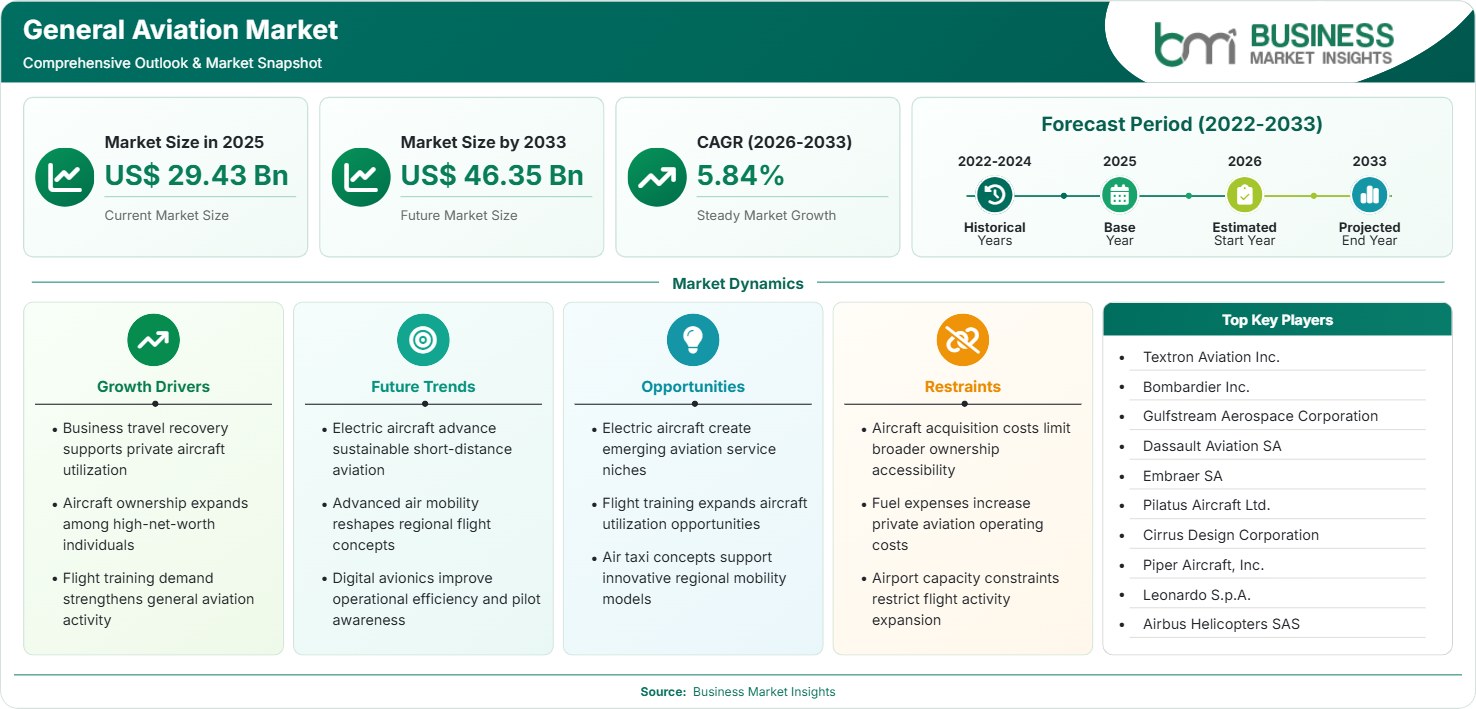
The General Aviation Market size was valued at US$ 29.43 Billion in 2025 and is projected to reach US$ 46.35 Billion by 2033, growing at a CAGR of 5.84% during 2026–2033. Key drivers include fleet modernization, rising business aviation demand, pilot training expansion, and charter activity. Opportunities are emerging from sustainable aviation technologies, fractional ownership adoption, and developing regional air mobility networks.

Report Coverage
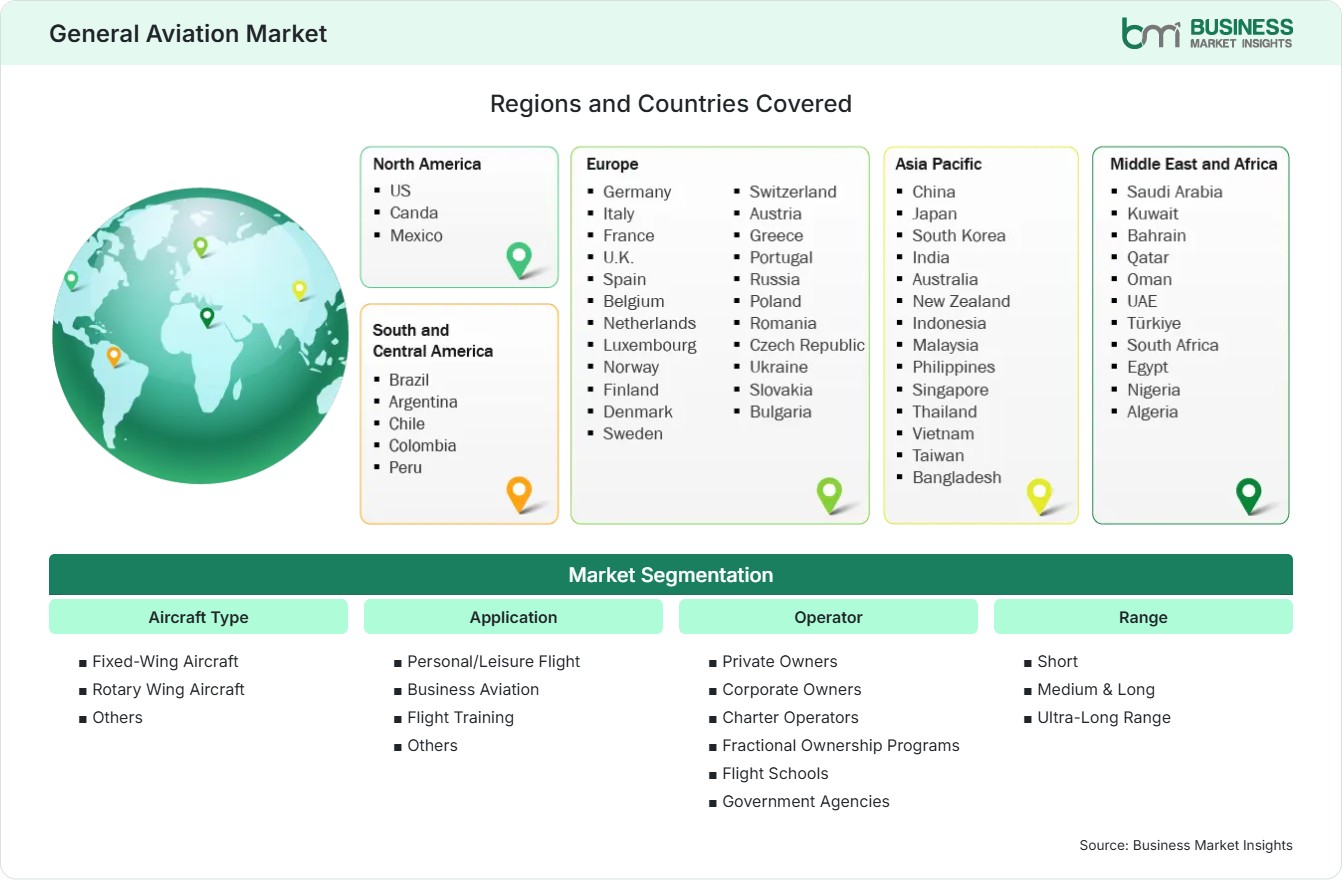
  • Aircraft Type: Fixed-Wing Aircraft, Rotary Wing Aircraft, Others
  • Application: Personal/Leisure Flight, Business Aviation, Flight Training, Others
  • Operator: Private Owners, Corporate Owners, Charter Operators, Fractional Ownership Programs, Flight Schools, Government Agencies
  • Range: Short, Medium & Long, Ultra-Long Range
  • Propulsion: Piston Engine, Turbine Engine, Electric
US$ 29.43 Bn Market size in 2025
US$ 46.35 Bn Market Size by 2033
5.84% CAGR, 2026 - 2033
2026-2033 Forecast Period

AI Overview

General Aviation Market Summary

  • North America Region: Holds a market share of 48%–52% in 2025, growing at a CAGR of 5.1%–5.6% during 2026–2033. Key drivers include large aircraft fleets, business aviation activity, airport infrastructure, and modernization investments. Opportunities arise from sustainable aviation fuel adoption and digital flight operations. The U.S. remains the core revenue contributor, supported by corporate aviation demand and an estimated CAGR of 5.2%–5.7%.
  • Fastest Growing Region: Asia Pacific holds a market share of 20%–24% in 2025 and is projected to grow at a CAGR of 7.0%–7.6% during 2026–2033. Growth is supported by expanding high-net-worth populations, regional airport construction, training academies, and fleet expansion opportunities.
  • Leading Segment: Fixed-Wing Aircraft accounts for 68%–72% share in 2025 and is expected to grow at 5.5%–6.0% CAGR. Demand stems from business aviation missions, training operations, cargo flexibility, and increasing replacement of aging fleets across mature aviation markets.
  • High Growth Segment: Electric Propulsion represents 2%–4% of the General Aviation Market share in 2025 and is anticipated to grow at 12.0%–14.0% CAGR. Battery innovation, sustainability mandates, lower operating costs, and pilot training applications are accelerating commercial development pathways.
  • Key Market Opportunity: Expanding regional connectivity programs, sustainable propulsion development, and digitized flight operations create significant opportunities for aircraft manufacturers, avionics suppliers, training providers, and charter platforms over the forecast period.
  • Major Market Players: Textron Aviation Inc., Bombardier Inc., Gulfstream Aerospace Corporation, Dassault Aviation SA, Embraer SA, Pilatus Aircraft Ltd., Cirrus Design Corporation, Piper Aircraft, Inc., Leonardo S.p.A., Airbus Helicopters SAS.
Strategic Insights

General Aviation Market: Strategic Insights

General Aviation Market Strategic Framework
FREE PDF
Request your free sample
Request free sample
Stakeholder View

Key Takeaways

  • Supply chains are shifting toward vertically integrated manufacturing, with aircraft OEMs increasingly securing long-term agreements for engines, avionics, composites, and maintenance services.
  • Business aviation, charter operations, and pilot training applications present the strongest commercial opportunities due to increasing mobility requirements and persistent pilot shortages.
  • Innovation is moving toward connected aircraft ecosystems featuring predictive maintenance, digital twin technologies, enhanced automation, and sustainable propulsion concepts.
  • India, the United Arab Emirates, Indonesia, and Vietnam offer compelling long-term investment prospects because of airport development and rising private aviation utilization.
  • Strategic investments, joint ventures, aftermarket expansion, and service-center acquisitions remain priority capital allocation strategies among leading aerospace companies.
  • Fractional ownership programs are expanding beyond traditional mature markets and creating new recurring revenue streams for operators and aircraft suppliers.
Geographic Outlook

General Aviation Market Regional Highlights

North America General Aviation Market

North America accounted for approximately 48%–52% of the general aviation market share in 2025 and is forecast to grow at a CAGR of 5.1%–5.6% through 2033. The region benefits from the world's largest installed fleet of general aviation aircraft, extensive airport infrastructure, and robust business aviation demand. Corporate mobility requirements, charter services, pilot training, and fleet replacement spending continue supporting investment activity. Sustainable aviation fuel adoption and digital flight management platforms are improving operational efficiency while creating opportunities for technology providers.

  • The United States represents the dominant revenue contributor due to extensive aircraft ownership and corporate aviation activity.
  • Fleet modernization programs are supporting demand for advanced turboprop and business jet platforms.
  • Aviation academies continue expanding training capacity to address industry pilot shortages.
  • Connected aircraft systems and predictive maintenance technologies are gaining strong adoption.

US General Aviation Market

The U.S. represents approximately 82%–86% share within North America and is estimated to expand at 5.2%–5.7% CAGR through 2033. Business aviation utilization, charter demand, and aircraft financing availability support healthy fleet investments. The FAA's infrastructure and modernization initiatives strengthen long-term competitiveness. Operators increasingly prioritize advanced avionics, enhanced safety systems, and fuel-efficient aircraft. Large corporate fleets and active aftermarket ecosystems continue reinforcing the country's leadership position.

  • Strong corporate aviation demand supports consistent business jet procurement.
  • Charter and fractional ownership operators continue expanding aircraft portfolios.
  • Training academies invest in modern piston and turboprop training fleets.
  • Sustainable aviation initiatives stimulate fleet efficiency improvements.

Europe General Aviation Market

Europe accounted for a 21%–25% share in 2025 and is projected to grow at a 5.4%–5.9% CAGR. Business aviation demand across Western Europe remains significant, supported by cross-border corporate travel and established charter networks. Sustainability regulations encourage replacement of older aircraft with more efficient alternatives. Germany maintains the leading regional position, while Eastern European markets demonstrate higher growth momentum. Fleet modernization and MRO investments continue shaping procurement strategies for operators.

  • Germany remains a leading country driven by manufacturing and business aviation demand.
  • Poland and selected Eastern European countries demonstrate above-regional growth rates.
  • Sustainability regulations encourage fuel-efficient aircraft adoption.
  • MRO network expansion supports long-term fleet utilization.
  • Corporate charter activity remains resilient despite economic fluctuations.

Asia Pacific General Aviation Market

The Asia Pacific region had a 20%-24% General Aviation Market share in 2025 and is projected to grow at a 7.0%-7.6% CAGR, making it the most dynamic region in the world. The factors include wealth generation, investment in airports, the need for pilot training, and increased business mobility. China is the biggest market in the region, while India shows the highest growth dynamics. Growth in aviation infrastructure and regulatory reforms increases the scope for operations.

  • China leads regional demand through infrastructure and fleet expansion programs.
  • India exhibits strong growth supported by airport and aviation ecosystem investment.
  • Pilot training organizations are increasing capacity throughout the region.
  • Regional charter operations continue expanding in key business corridors.
  • Sustainable aviation initiatives create long-term technology opportunities.

Rest of World General Aviation Market

The Rest of World region represents an 8%–12% share in 2025 and is forecast to grow at 5.8%–6.4% CAGR. The Middle East benefits from business aviation concentration, while South and Central American markets gain support from regional connectivity needs. Brazil remains a leading market in Latin America, whereas Saudi Arabia and the UAE anchor Middle Eastern demand. Infrastructure development and tourism-related aviation activity remain important growth contributors across several markets.

  • UAE continues strengthening its position as a global business aviation hub.
  • Saudi Arabia benefits from aviation infrastructure investment programs.
  • Brazil leads Latin American aircraft utilization and ownership activity.
  • Tourism-related aviation demand supports fleet expansion.
  • Charter and special mission applications create additional revenue opportunities.
Global Market Geography
FREE PDF
Request your free sample
Request free sample
Segment Analysis

General Aviation Market Segmentation

Aircraft Type

Fixed-wing platforms remain the dominant category with 68%–72% share in 2025 and expected 5.5%–6.0% CAGR. The General Aviation Market scope within this segment is supported by business jets, training aircraft, and turboprops delivering operational flexibility, efficiency, and broad mission capability.

  • Piston Aircraft: Widely adopted for flight training, recreational flying, and private ownership due to lower acquisition and operating costs.
  • Turboprop Aircraft: Preferred for regional connectivity and short-runway operations, balancing performance, efficiency, and mission versatility.
  • Business Jets: Benefiting from growing corporate travel requirements, productivity advantages, and fractional ownership program expansion.
  • Rotary Wing Aircraft: Utilized across emergency response, offshore transport, law enforcement, and executive mobility applications.

Application

Business aviation is leading the way in applications, with a market share of 34%-38% and a CAGR of 5.8%-6.3%. Increased demand for improved efficiency in executive travel, point-to-point connectivity advantages, and premium charter services supports segment expansion.

  • Personal/Leisure Flight: Supported by recreational aviation participation and increasing accessibility through ownership-sharing arrangements.
  • Business Aviation: Driven by time-sensitive travel requirements, executive productivity, and global business connectivity.
  • Flight Training: Expanding due to growing pilot demand and investment in aviation academies.

Operator

Private owners represent the largest operator category with a 32%–36% share and expected 5.3%–5.8% CAGR. Ownership diversification and managed aviation services support sustained fleet utilization.

  • Private Owners: Continue driving demand for piston aircraft and light business aviation platforms.
  • Corporate Owners: Focus on productivity enhancement and executive mobility requirements.
  • Charter Operators: Expanding fleets to accommodate on-demand travel growth.
  • Fractional Ownership Programs: Improving aircraft accessibility while reducing ownership burdens.
  • Flight Schools: Investing in modern training fleets and digital learning technologies.
  • Government Agencies: Utilize aircraft for surveillance, emergency response, and special missions.

Range

Medium & Long Range aircraft account for the largest revenue contribution with a 42%–46% share and a 5.9%–6.4% CAGR of the General Aviation Market. Demand is linked to corporate travel and international mission requirements.

  • Short: Favored for training, recreational flying, and regional transportation missions.
  • Medium & Long: Support corporate mobility and regional charter networks effectively.
  • Ultra-Long Range: Attract buyers requiring intercontinental connectivity and premium cabin capabilities.

Propulsion

Turbine-powered systems dominate with a 64%–68% share and projected 5.7%–6.2% CAGR. Meanwhile, General Aviation Market trends increasingly reflect electrification and sustainability priorities.

  • Piston Engine: Maintains relevance in training aircraft and entry-level private aviation.
  • Turbine Engine: Delivers reliability, performance, and operational flexibility across multiple applications.
  • Electric: Emerging technology segment benefiting from sustainability investments and certification progress.
Market Forces

General Aviation Market Dynamics

Key Market Drivers

Fleet Modernization and Replacement Demand

A considerable portion of the existing global fleet of business jets and training aircraft is over fifteen years old, thereby increasing the need to replace older platforms with fuel-efficient aircraft. Aircraft manufacturers have been receiving increased orders from clients for advanced avionics, in-flight connectivity, safety solutions, and predictive maintenance for new platforms. The above aspects help lower costs and increase reliability and asset life throughout an aircraft's lifecycle. Also, upgrade activities help achieve sustainable development by reducing emissions and improving fuel efficiency, driving steady aircraft deliveries and long-term aftermarket service revenue opportunities throughout the forecast period.

Expansion of Business Aviation Activity

Corporate travelers increasingly prioritize schedule flexibility, productivity, privacy, and convenient access to secondary airports, making business aviation an attractive transportation option. The sector continues to benefit from these advantages, particularly across North America, Europe, and rapidly growing Asian economies. Rising demand for charter services, along with the expanding popularity of fractional ownership programs, is improving accessibility for a broader customer base. This sustained growth in aircraft utilization is driving new aircraft purchases, increasing maintenance and support expenditures, and encouraging the expansion of service, operational, and infrastructure networks worldwide.

Growing Pilot Training Requirements

Airline fleet expansion and the need to replace retiring pilots continue to drive strong demand for pilot training worldwide. To meet this growing requirement, flight training academies are expanding their infrastructure, increasing training capacity, and investing in modern training aircraft fleets. Governments, aviation authorities, and industry stakeholders are also supporting workforce development programs to address pilot shortages and ensure a steady talent pipeline. These trends are boosting procurement of piston-engine aircraft, flight simulators, turboprops, and a wide range of aviation training and support services across the industry value chain.

Key Market Opportunities

Electric and Sustainable Aviation Technologies

Industries are pouring significant investment into electric propulsion systems, batteries, hybrids, and sustainable aviation fuels. The environmental goals and regulatory demands increase the likelihood of commercial success. While implementation will take time, initial uses in flight training, short-haul flights, and niche applications are becoming more numerous. Long-term General Aviation Market Forecasts increasingly include sustainable propulsion.

Growth of Fractional Ownership Models

Fractional ownership programs have become a major game-changer in the private aviation industry by eliminating financial hurdles associated with aircraft purchases while ensuring customers gain access to quality aviation services. In such cases, customers can buy a portion of an aircraft rather than the entire aircraft. There is currently increased demand from medium-sized businesses seeking more effective solutions. Furthermore, new technology-based fleet management systems enhance scheduling, effectiveness, and efficiency, offering many business opportunities for operators, financiers, and aircraft manufacturers.

Emerging Market Infrastructure Investments

Infrastructure investments in emerging markets have become a part and parcel of the growth seen in the aviation industry. Infrastructure building of airports, airspace infrastructure, development of an ecosystem for training pilots and technicians, and investments in MRO facilities within the Asia Pacific, Middle East, and some chosen African countries have been contributing significantly to the aviation industry. Investments improve efficiency but enable greater use of aircraft and growth in business aviation, charter, and training fleets. With the increase in demand, there is a creation of lucrative investment opportunities within the aviation industry value chain.

Market Restraints and Challenges

High Acquisition and Operating Costs

Aircraft procurement, insurance, maintenance, fuel, and financing costs remain substantial. The high costs of purchasing and operating aircraft continue to pose a significant challenge to market growth. Expenses related to acquisition, insurance coverage, routine maintenance, fuel consumption, and financing can place considerable financial pressure on operators. As a result, many small operators, private owners, and new market entrants may postpone or reduce aircraft purchases. During periods of economic uncertainty, cost sensitivity increases further, leading to slower fleet expansion, reduced investment in new aircraft, and lower overall market adoption rates.

Regulatory Complexity and Certification Timelines

Aviation certification standards, environmental protection laws, and airspace management norms have become quite complex in the global aviation industry. Aviation manufacturers have to meet more rigorous safety, emissions, and operational standards, which is why the testing period has increased. Compliance costs continue to grow, creating an additional financial burden on players in the aerospace industry. Delays in the certification process may delay the introduction of innovations to the market, including next-generation aircraft and propulsion systems.

Company Analysis

Competitive Landscape

The following General Aviation Market analysis highlights major participants across aircraft manufacturing, business aviation, rotary-wing platforms, and support ecosystems.

Company Name

Overview

Products and Services relevant to this market

Textron Aviation Inc.

Leading producer of Cessna and Beechcraft aircraft serving training, utility, turboprop, and business aviation markets.

Business jets, turboprops, training aircraft, aftermarket services, fleet support solutions.

Bombardier Inc.

Major manufacturer focused on large-cabin and ultra-long-range business aircraft worldwide.

Global and Challenger business jets, maintenance services, aviation support.

Gulfstream Aerospace Corporation

Premium business jet manufacturer operating globally through extensive service infrastructure.

Large-cabin jets, ultra-long-range aircraft, support and maintenance services.

Dassault Aviation SA

French aerospace company recognized for high-performance business aviation platforms.

Falcon business jets, digital flight technologies, service solutions.

Embraer SA

Global aircraft manufacturer with a strong presence in executive aviation.

Phenom and Praetor business jets, training, customer support services.

Pilatus Aircraft Ltd.

Swiss manufacturer known for versatile turboprop platforms.

PC-12, PC-24, special mission and business aviation solutions.

Cirrus Design Corporation

Leading producer of technologically advanced piston aircraft.

SR series aircraft, Vision Jet, pilot training ecosystems.

Piper Aircraft, Inc.

Established manufacturer serving training and private aviation markets.

Trainer aircraft, piston-powered platforms, utility aviation solutions.

Leonardo S.p.A.

Significant participant in rotary-wing and special mission aviation.

Helicopters, mission systems, support and maintenance services.

Airbus Helicopters SAS

Global leader in civil and parapublic helicopter segments.

Light and medium helicopters, training, maintenance, digital support.

Trust & Transparency

Research Methodology

The market analysis combines proprietary research with secondary data from government agencies, company disclosures, regulatory filings, industry databases and expert interviews. Market estimates are validated through data triangulation, cross-market benchmarking and analyst review.

View Full Research Methodology

Questions Answered

Frequently Asked Questions

What does a General Aviation Market Report typically include?

A comprehensive Market Report typically covers market size, forecasts, competitive positioning, segment analysis, regulatory developments, technology trends, and investment opportunities.

How are fractional ownership programs affecting the industry?

These programs expand accessibility by lowering ownership costs while allowing customers to benefit from business aviation flexibility, driving utilization and supporting fleet growth.

What is the fastest-growing propulsion category?

Electric propulsion is currently the fastest-growing propulsion category, supported by sustainability targets, battery technology advances, and regulatory interest in lower-emission aviation.

Which region dominates industry revenue?

North America generates the largest revenue contribution because of its extensive aircraft fleet, developed airport infrastructure, and concentration of business aviation operators.

What factors are driving demand for general aviation aircraft?

Corporate mobility requirements, pilot training expansion, charter service growth, fleet replacement activity, and modernization investments are among the primary demand drivers across major aviation markets.

Access the Full General Aviation Market Report

Get segment-level forecasts, regional estimates, competitive benchmarking, company profiles and downloadable Excel datasets.

Access the full General Aviation Market Report
350 pages PDF & Excel | 2026-09-16
Similar Research

Related Market Reports