
Aircraft Landing Gear Market Outlook: Size, Share, Trends, Growth Analysis, Competitive Landscape & Forecast, 2026-2033

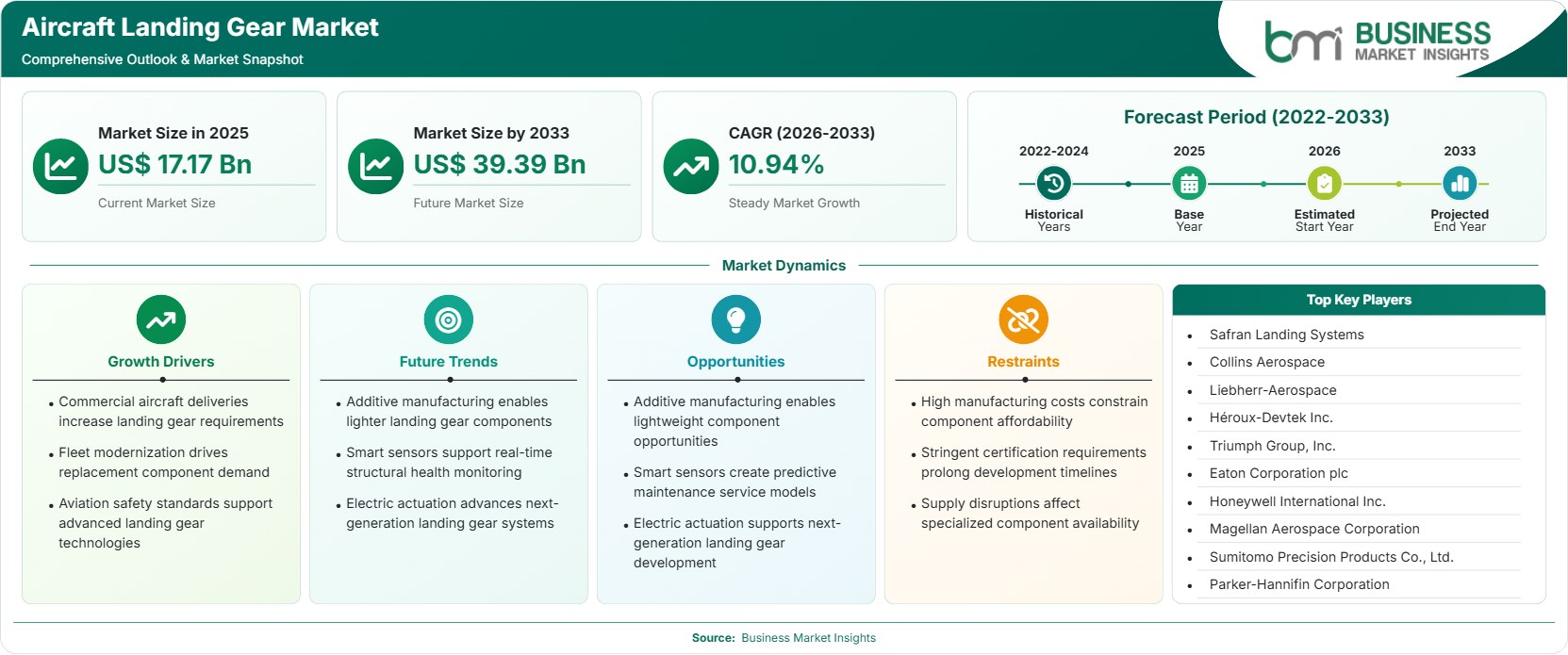
The Aircraft Landing Gear Market size was valued at US$ 17.17 Billion in 2025 and is projected to reach US$ 39.39 Billion by 2033, growing at a CAGR of 10.94% during 2026–2033. Rising commercial aircraft deliveries, fleet modernization programs, military aviation investments, lightweight landing gear technologies, and expanding aftermarket overhaul demand are creating substantial growth opportunities across global aviation ecosystems.

Report Coverage
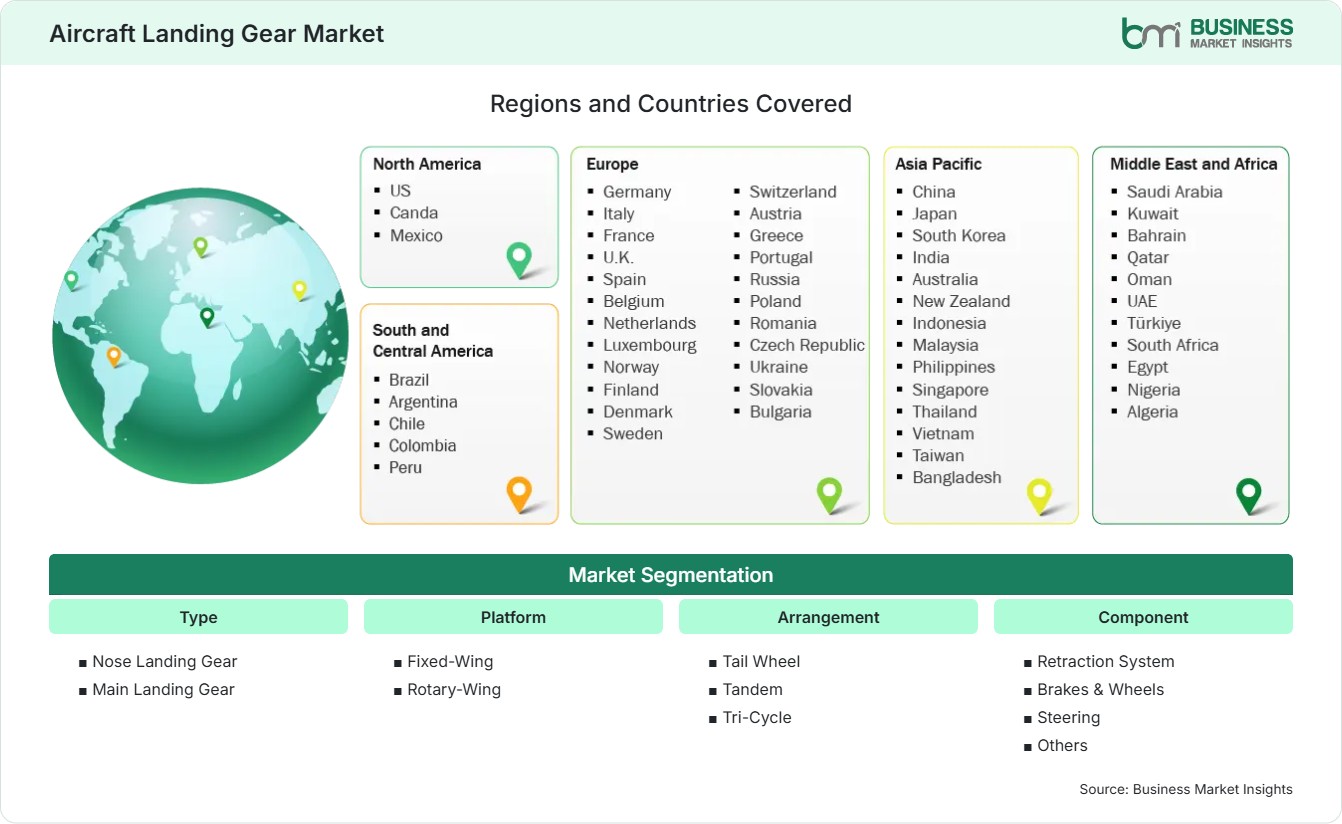
  • Type: Nose Landing Gear, Main Landing Gear
  • Platform: Fixed-Wing, Rotary-Wing
  • Arrangement: Tail Wheel, Tandem, Tri-Cycle
  • Component: Retraction System, Brakes & Wheels, Steering, Others
  • End User: OEM, Aftermarket
US$ 17.17 Bn Market size in 2025
US$ 39.39 Bn Market Size by 2033
10.94% CAGR, 2026 - 2033
2026-2033 Forecast Period

AI Overview

Aircraft Landing Gear Market Summary

  • North America Region: North America holds a market share of 31%–34% in 2025, growing at a CAGR of 9.6%–10.2% during 2026–2033. Strong Boeing production activity, defense procurement programs, landing gear MRO demand, digital maintenance systems, and advanced manufacturing investments support growth. The US benefits from extensive OEM presence, strong defense aviation spending, and a projected CAGR of 9.8%–10.4%.
  • Fastest Growing Region: Asia Pacific holds a market share of 24%–27% in 2025 and is expected to expand at a CAGR of 12.8%–13.5% during 2026–2033. Airline fleet expansion, indigenous aircraft programs, airport investments, and rising aviation maintenance capabilities accelerate market development.
  • Leading Segment: Fixed-Wing accounts for 66%–69% market share in 2025 and advances at 10.3%–11.0% CAGR. High production volumes, commercial passenger traffic growth, military transport procurement, and replacement cycles support sustained demand across aircraft categories.
  • High Growth Segment: Aftermarket represents 33%–36% share in 2025 and records 11.8%–12.6% CAGR. Increasing aircraft utilization, mandatory overhaul intervals, predictive maintenance adoption, aging fleets, and growing MRO networks enhance opportunities globally.
  • Key Market Opportunity: Expansion of electric actuation systems, lightweight composite structures, and digitally enabled predictive maintenance solutions offers stronger operational efficiency, reduced lifecycle costs, improved reliability, and increased airline fleet productivity.
  • Major Market Players: Safran Landing Systems, Collins Aerospace, Liebherr-Aerospace, Héroux-Devtek Inc., Triumph Group, Inc., Eaton Corporation plc, Honeywell International Inc., Magellan Aerospace Corporation, Sumitomo Precision Products Co., Ltd., and Parker-Hannifin Corporation.
Strategic Insights

Aircraft Landing Gear Market: Strategic Insights

Aircraft Landing Gear Market Strategic Framework
FREE PDF
Request your free sample
Request free sample
Stakeholder View

Key Takeaways

  • The value chain is now giving a preference to companies that have integrated capabilities covering design, manufacturing, repair, overhaul, testing, and lifecycle support services.
  • Overhauls and maintenance carried out by third parties offer some of the most profitable opportunities since landing gear systems need to be serviced on a scheduled basis throughout the aircraft's operational life.
  • Innovation is now being directed towards the use of lightweight materials, smart sensors, brake-by-wire designs, and predictive maintenance technologies, all of which enhance operational performance.
  • The investment case for Asia Pacific is attractive because of the growing size of airline fleets, the ongoing airport construction projects, and the aerospace manufacturing initiatives, which are supported by the government.
  • The company's strategic acquisitions and partnerships are helping to strengthen its supplier portfolios, boost its engineering capabilities, and improve its access to long-term aircraft programs arranged by original equipment manufacturers.
  • The modernization of defense aviation is still a promising field for growth since countries are putting money into next-generation fighter, transport, and rotorcraft platforms, which require advanced landing systems.
Geographic Outlook

Aircraft Landing Gear Market Regional Highlights

North America Aircraft Landing Gear Market

North America accounted for approximately 31%–34% Aircraft Landing Gear Market share in 2025 and is projected to expand at a CAGR of 9.6%–10.2% through 2033. The region benefits from strong commercial aerospace manufacturing, large defense budgets, and extensive MRO infrastructure. Presence of Boeing, major tier-one suppliers, and established component ecosystems supports production stability. Federal aviation investments and modernization initiatives continue driving technology adoption. Significant replacement demand from aging fleets and high aircraft utilization further sustain procurement activities.

  • The continued strengthening of growth in the production of commercial aircraft is increasing the demand for advanced wheels, brakes, retraction systems, and digital maintenance technologies.
  • Defense procurement programs keep funding strong landing systems for fighter, transport, and surveillance aircraft.
  • Aerospace suppliers are putting in more effort to automate their operations, to adopt additive manufacturing, and to increase their capacity for processing titanium for critical components.
  • Strong aftermarket networks obtain ongoing revenue from inspections, from the need for overhauls, and from replacement activities.
  • Sustainability goals promote the use of lighter components since these contribute to better fuel efficiency and improved operational economics.

US Aircraft Landing Gear Market

The United States represents approximately 74%–78% of regional Aircraft Landing Gear Market demand and records a CAGR of 9.8%–10.4%. Robust defense spending, commercial fleet expansion, and extensive engineering capabilities maintain market leadership. Aircraft manufacturers continue focusing on production efficiency and supply chain resilience. Growing utilization of predictive maintenance technologies enhances landing gear reliability while reducing downtime. Expansion of advanced mobility and next-generation military aircraft programs creates additional opportunities for component suppliers and service providers.

  • Demand for Boeing-related production continues to be a major factor during both original equipment manufacture and replacement cycles.
  • The Department of Defense's modernization programs aid in the development of advanced and resilient landing systems.
  • The greater the extent to which digital twin technology is deployed, the better maintenance planning becomes and the higher fleet availability reaches.
  • The higher the concentration of expertise in aerospace engineering, the faster innovation and commercialization will take place.

Europe Aircraft Landing Gear Market

Europe holds approximately 27%–30% Aircraft Landing Gear Market share in 2025 and is expected to grow at a CAGR of 9.9%–10.6%. The region benefits from Airbus production programs, strong aerospace engineering heritage, and specialization in advanced landing gear technologies. France remains the leading national market, while Germany and the United Kingdom maintain significant aerospace manufacturing capacity. Spain and Eastern European markets exhibit higher growth rates due to industrial investments and expanding aerospace participation. Regional sustainability initiatives encourage additional innovation in lightweight structures and efficient aircraft systems.

  • The demand for the Airbus platform enables long-term supplier contracts and ensures continued component production volumes.
  • France has the leading regional demand, while Spain is showing faster expansion in aerospace manufacturing.
  • Research into advanced materials enhances competitiveness in all areas of precision-engineered landing gear applications.
  • The fact that regulators are stressing the importance of both safety and efficiency has led to the adoption of intelligent monitoring technologies.
  • Expanding the MRO service enhances the support available to regional and international operators.

Asia Pacific Aircraft Landing Gear Market

Asia Pacific maintains 24%–27% share in 2025 and delivers the fastest CAGR of 12.8%–13.5% through 2033. Rising passenger traffic, expanding airline fleets, airport development, and indigenous aircraft programs generate strong demand. China leads regional revenues, while India demonstrates the highest growth trajectory. Aerospace localization initiatives and increasing MRO investments support long-term industrial development. Manufacturers across the region are strengthening domestic production capabilities to reduce import dependence and improve supply chain resilience.

  • China benefits from large commercial aviation investments and indigenous aircraft development programs.
  • Growth in India is being driven by airline expansion and various government initiatives in aviation.
  • The expansion of regional MRO infrastructure improves possibilities for aftermarket service.
  • Rising defense procurement leads to greater demand in both fixed-wing and rotary-wing areas.
  • Foreign partnerships in the aerospace sector help to transfer technology and develop manufacturing capabilities.

Rest of World Aircraft Landing Gear Market

Rest of World accounts for approximately 11%–14% share and advances at 10.8%–11.5% CAGR. Middle Eastern countries support growth through fleet modernization and aviation hub development strategies. South and Central America benefit from airline recovery and aircraft maintenance requirements. Saudi Arabia and the United Arab Emirates lead regional aerospace investments, while Brazil remains an important aviation manufacturing center. Expansion of aviation infrastructure and fleet renewal activities continue supporting procurement across commercial and defense segments.

  • The Gulf countries are investing more in aviation in order to achieve their tourism and transportation goals.
  • Brazil is still a major centre for the manufacturing and maintenance of aerospace vehicles in the region.
  • The fleet modernization programs enhance component suppliers' visibility into demand.
  • The increasing volume of air traffic is leading to a greater need for aircraft servicing and replacement.
  • The process of defence acquisitions provides further opportunities for advanced landing gear technologies.
Global Market Geography
FREE PDF
Request your free sample
Request free sample
Segment Analysis

Aircraft Landing Gear Market Segmentation

Type

Type segmentation is led by main landing gear systems, benefiting from higher structural complexity and value contribution. The segment holds approximately 56%–60% share in 2025 and expands at a near 10.5%–11.2% CAGR. Aircraft weight-bearing requirements, safety regulations, maintenance expenditure, and modernization programs support demand across commercial and military aviation. The Aircraft Landing Gear Market scope continues to broaden through technology upgrades.

  • Nose Landing Gear: Essential for taxiing, steering control, and directional stability. Growth is supported by new aircraft deliveries, advanced steering technologies, and increasing emphasis on operational reliability.
  • Main Landing Gear: Carries the majority of landing loads and experiences extensive wear, driving replacement demand, engineering innovation, and aftermarket service requirements.

Platform

Platform demand is dominated by fixed-wing aircraft, representing 66%–69% share in 2025 and growing at 10.3%–11.0% CAGR. Commercial passenger traffic growth, cargo aviation expansion, and military modernization programs support segment leadership. Production backlogs among major aircraft manufacturers continue to strengthen long-term procurement demand.

  • Fixed-Wing: Driven by large commercial aircraft fleets, passenger travel demand, military aviation investments, and ongoing replacement requirements.
  • Rotary-Wing: Supported by defense operations, emergency medical services, offshore transport, and expanding multi-role helicopter deployments.

Arrangement

Tri-cycle arrangements maintain dominant adoption with approximately 68%–72% share and 10.7%–11.4% CAGR owing to superior stability, operating efficiency, and compatibility with modern aircraft designs. Fleet modernization activities further reinforce segment demand.

  • Tail Wheel: Common within specialized and legacy aircraft applications requiring maneuverability in specific operational conditions.
  • Tandem: Utilized in selected military and unique aircraft configurations where weight distribution requirements differ.
  • Tri-Cycle: Preferred due to improved ground handling, operational safety, and widespread commercial aviation adoption.

Component

Brakes and wheels constitute the largest component category, accounting for 34%–38% share in 2025 and advancing at 10.8%–11.5% CAGR. Frequent wear cycles, safety requirements, and replacement schedules support continuous demand.

  • Retraction System: Facilitates aerodynamic efficiency and operational functionality through controlled extension and retraction mechanisms.
  • Brakes & Wheels: Critical safety components experiencing recurring maintenance and replacement demand across aircraft lifecycles.
  • Steering: Supports ground maneuverability and increasingly incorporates electronic control technologies.

End User

OEMs hold 64%–67% share in 2025 with CAGR of 10.2%–10.9%, supported by aircraft production growth. However, the aftermarket demonstrates the strongest expansion as fleet utilization levels increase. Aircraft Landing Gear Market trends indicate growing investment in overhaul and predictive maintenance capabilities.

  • OEM: Driven by aircraft manufacturing programs, fleet replacements, and next-generation platform developments.
  • Aftermarket: Benefits from mandatory inspections, overhaul schedules, aging aircraft fleets, and expanding global MRO capacity.
Market Forces

Aircraft Landing Gear Market Dynamics

Key Market Drivers

Rising Commercial Aircraft Production Backlogs

Global airlines continue expanding fleets to meet passenger traffic growth and replacement requirements. Airbus and Boeing order backlogs extend several years, creating sustained demand for landing gear assemblies and subsystem suppliers. Air transport recovery and long-term fleet modernization strategies support procurement across narrow-body and wide-body programs. Aircraft Landing Gear Market growth benefits from increasing production rates, stronger supplier utilization, and greater investment in manufacturing capacity. Higher aircraft deliveries translate directly into demand for nose gear, main gear, steering systems, and wheel assemblies. Long-term visibility provided by order books supports supplier planning and capital expenditure decisions.

Growing Defense Aviation Modernization Programs

Governments worldwide are increasing defense budgets to modernize aircraft fleets and enhance operational readiness. Fighter aircraft, transport platforms, surveillance systems, and rotorcraft all require advanced landing systems capable of operating in demanding conditions. Military programs often demand enhanced durability, performance, and safety standards, generating opportunities for premium suppliers. Aircraft Landing Gear Market growth is reinforced by investments in next-generation aviation capabilities, evolving mission requirements, and expanding procurement cycles. Upgrades of existing military fleets also stimulate aftermarket demand for overhaul activities, replacement components, and engineering services over extended operational lifespans.

Expansion of Global MRO and Lifecycle Services

Landing gear systems undergo scheduled inspections and overhauls throughout aircraft operational life, creating recurring aftermarket demand. Airlines increasingly prioritize fleet availability and maintenance optimization, encouraging adoption of predictive analytics, digital monitoring, and condition-based servicing approaches. Aircraft Landing Gear Market trends reflect broader industry movement toward lifecycle support models. Expansion of MRO facilities across Asia Pacific, the Middle East, and other emerging aviation hubs strengthens overhaul capabilities. Service providers capable of reducing downtime and maintenance costs gain competitive advantages while supporting long-term revenue visibility for manufacturers and repair specialists.

Key Market Opportunities

Lightweight Materials and Electric Actuation Adoption

Aircraft manufacturers are actively pursuing lighter and more energy-efficient systems to improve operating economics. Advanced composites, titanium alloys, and electric actuation technologies create opportunities for suppliers offering next-generation solutions. Weight reduction contributes to fuel savings and lower emissions while maintaining structural performance. Aircraft Landing Gear Market Forecasts increasingly recognize the competitive advantages associated with innovative materials. Companies investing in engineering expertise, certification capabilities, and advanced manufacturing technologies are positioned to benefit as airframe manufacturers prioritize efficiency improvements. Integration of intelligent components and digitally enabled diagnostics further expands value creation opportunities across commercial and military applications.

Growth of Indigenous Aircraft Programs

Many countries are advancing their ability to manufacture aircraft at home to increase their aerospace self-sufficiency. Since indigenous commercial, military, and regional aircraft programs require that components and engineering support be sourced and provided locally, these initiatives offer landing gear manufacturers the opportunity to form strategic partnerships, engage in technology collaborations, and enter into long-term supply agreements. The greater involvement of regional aerospace ecosystems leads to greater diversification of suppliers and less reliance on existing production centers. Companies that meet the certification requirements and achieve the localization goals can secure a place in emerging aircraft platforms and in future procurement programs

Digital Predictive Maintenance Platforms

Maintenance digitalization is creating new value propositions across aviation ecosystems. Systems such as sensor-based landing technology, analysis tools, and predictive maintenance solutions assist operators in minimizing downtime and managing maintenance effectively. Airlines now aim at cutting down their costs and maximize the utilization of their assets. Companies offering integration of hardware, software, and services can distinguish themselves from others in the market. The use of digital twin technology and health monitoring enables proactive decision-making. This is set to become increasingly important as fleet sizes continue to grow.

Market Restraints and Challenges

High Certification Costs and Longer Commercialization Cycles

Landing gear systems are aerospace components which are of vital safety importance and have to meet strict certification and airworthiness standards. The need for thorough testing, validation, and regulatory compliance leads to higher development costs. As a result, the time it takes to commercialize such systems is prolonged, thereby increasing investment risks and reducing the number of smaller suppliers who can participate. The complicated certification procedures also raise the barriers to entry and can delay the introduction of new technologies. Manufacturers are required to devote a large amount of engineering resources to structural testing, fatigue analysis, and performance verification. Although these requirements contribute to the safety of aviation, they do, however, slow the rate at which innovations can be commercialized in both the original equipment manufacturer and the aftermarket sectors.

Aerospace Supply Chain Constraints Impact: Production Delays

The development of advanced landing systems requires specialized materials, precise machining, and highly qualified suppliers. If there are disruptions in the supply chain regarding titanium, forgings, castings, and engineered components, this can reduce the rate at which aircraft can be manufactured. Delays in aircraft production have an impact on revenue across the network of suppliers. Additionally, workforce shortages, logistical challenges, and geopolitical uncertainties compound operational complexity. Long lead times may damage inventory efficiency and reduce the ability to respond to sudden increases in demand for aircraft. As a result, manufacturers are still making investments to diversify their suppliers, plan their inventories, and adopt local production methods to enhance their resilience.

Company Analysis

Competitive Landscape

Aircraft Landing Gear Market analysis indicates a concentrated competitive environment led by established aerospace suppliers with deep OEM relationships and extensive aftermarket capabilities.

Company Name

Overview

Products and Services relevant to this market

Safran Landing Systems

Leading aerospace landing gear specialist serving major commercial and military aircraft programs globally.

Landing gear systems, wheels, brakes, steering systems, maintenance and overhaul services.

Collins Aerospace

Major aerospace systems provider with broad integration capabilities and strong OEM relationships.

Main gear assemblies, nose gear systems, braking solutions, actuation technologies.

Liebherr-Aerospace

Aerospace engineering company supplying flight-critical systems for commercial and military platforms.

Landing gear systems, flight controls, maintenance support, engineering services.

Héroux-Devtek Inc.

Specialized manufacturer focused on aerospace structures and landing gear technologies.

Landing gear manufacturing, repair, overhaul, component engineering services.

Triumph Group, Inc.

Aerospace supplier serving commercial, defense, and rotorcraft programs.

Landing gear assemblies, structural components, lifecycle support solutions.

Eaton Corporation plc

Diversified industrial company with aerospace segment expertise.

Hydraulic systems, actuation components, landing gear subsystems.

Honeywell International Inc.

Global aerospace technology company supporting aircraft performance and safety.

Wheels, braking technologies, avionics integration, support solutions.

Magellan Aerospace Corporation

Aerospace manufacturer serving commercial and defense customers worldwide.

Precision aerospace components, structural systems, engineering support.

Sumitomo Precision Products Co., Ltd.

Japanese aerospace technology company with strong landing gear competencies.

Landing gear manufacturing, heat exchangers, aerospace components.

Parker-Hannifin Corporation

Motion and control technology provider supporting global aerospace programs.

Hydraulic actuation systems, controls, aerospace subsystem solutions.

Trust & Transparency

Research Methodology

The market analysis combines proprietary research with secondary data from government agencies, company disclosures, regulatory filings, industry databases and expert interviews. Market estimates are validated through data triangulation, cross-market benchmarking and analyst review.

View Full Research Methodology

Questions Answered

Frequently Asked Questions

What value does an Aircraft Landing Gear Market Report provide?

An Aircraft Landing Gear Market Report helps stakeholders evaluate demand trends, regional opportunities, competitive positioning, technology developments, and investment priorities across the aerospace value chain.

How is technology changing industry competition?

Lightweight materials, electric actuation, digital monitoring, predictive maintenance, and smart sensor integration are enabling performance improvements and lifecycle cost reductions.

Which end-user segment is expanding fastest?

The aftermarket segment demonstrates the highest growth potential because landing gear systems require recurring inspections, repairs, and overhaul throughout aircraft service life.

Which region offers the strongest future growth potential?

Asia Pacific presents the strongest growth outlook due to airline fleet expansion, airport development projects, aerospace localization initiatives, and rising MRO investments.

What factors are driving demand for aircraft landing gear systems?

Increasing aircraft deliveries, fleet modernization, military aviation procurement, and recurring maintenance requirements are the principal demand catalysts across global aviation markets.

Access the Full Aircraft Landing Gear Market Report

Get segment-level forecasts, regional estimates, competitive benchmarking, company profiles and downloadable Excel datasets.

Access the full Aircraft Landing Gear Market Report
350 pages PDF & Excel | 2026-09-16
Similar Research

Related Market Reports