
Connected Aircraft Market Outlook: Size, Share, Trends, Growth Analysis, Competitive Landscape & Forecast, 2026-2033

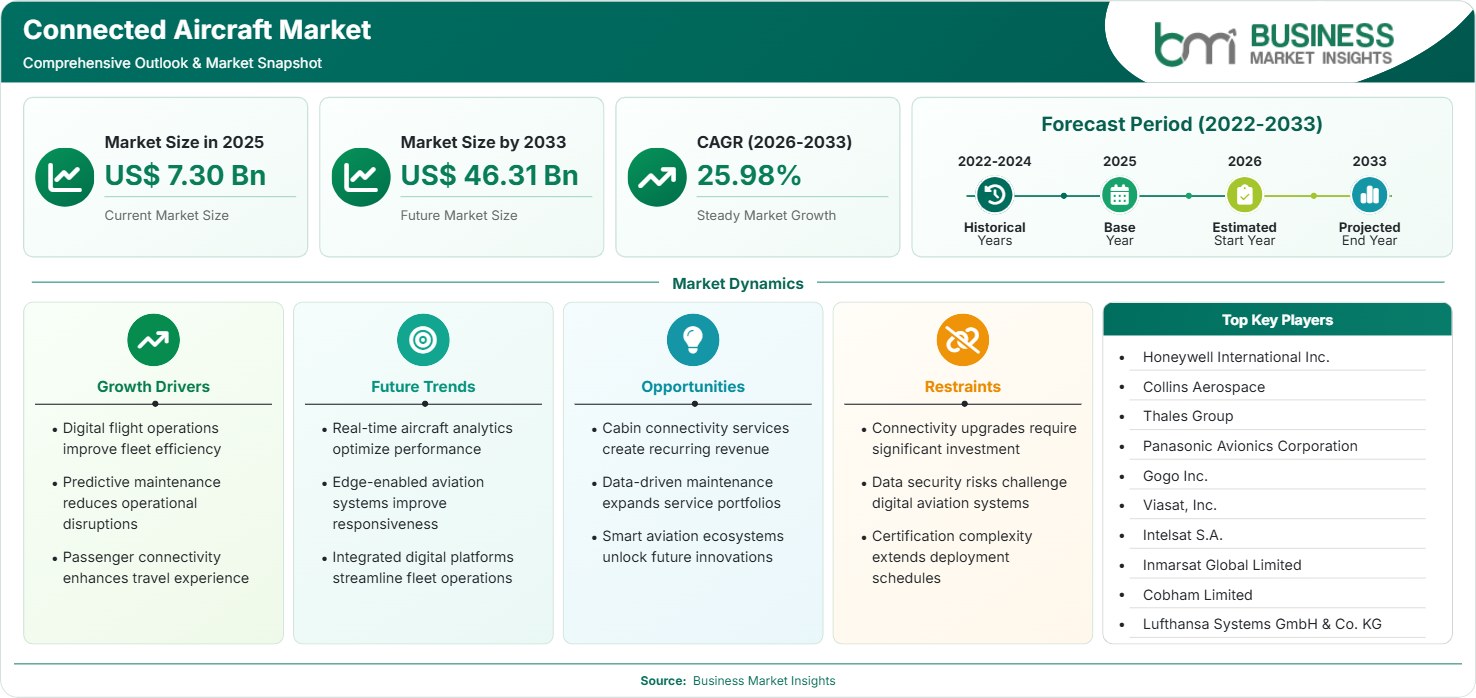
The Connected Aircraft Market size was valued at US$ 7.30 billion in 2025 and is projected to reach US$ 46.31 billion by 2033, growing at a CAGR of 25.98% during 2026–2033. Rising digital flight operations, expanding aircraft connectivity infrastructure, and increasing investments in real-time aviation data solutions are accelerating adoption across commercial and military aviation.

Report Coverage
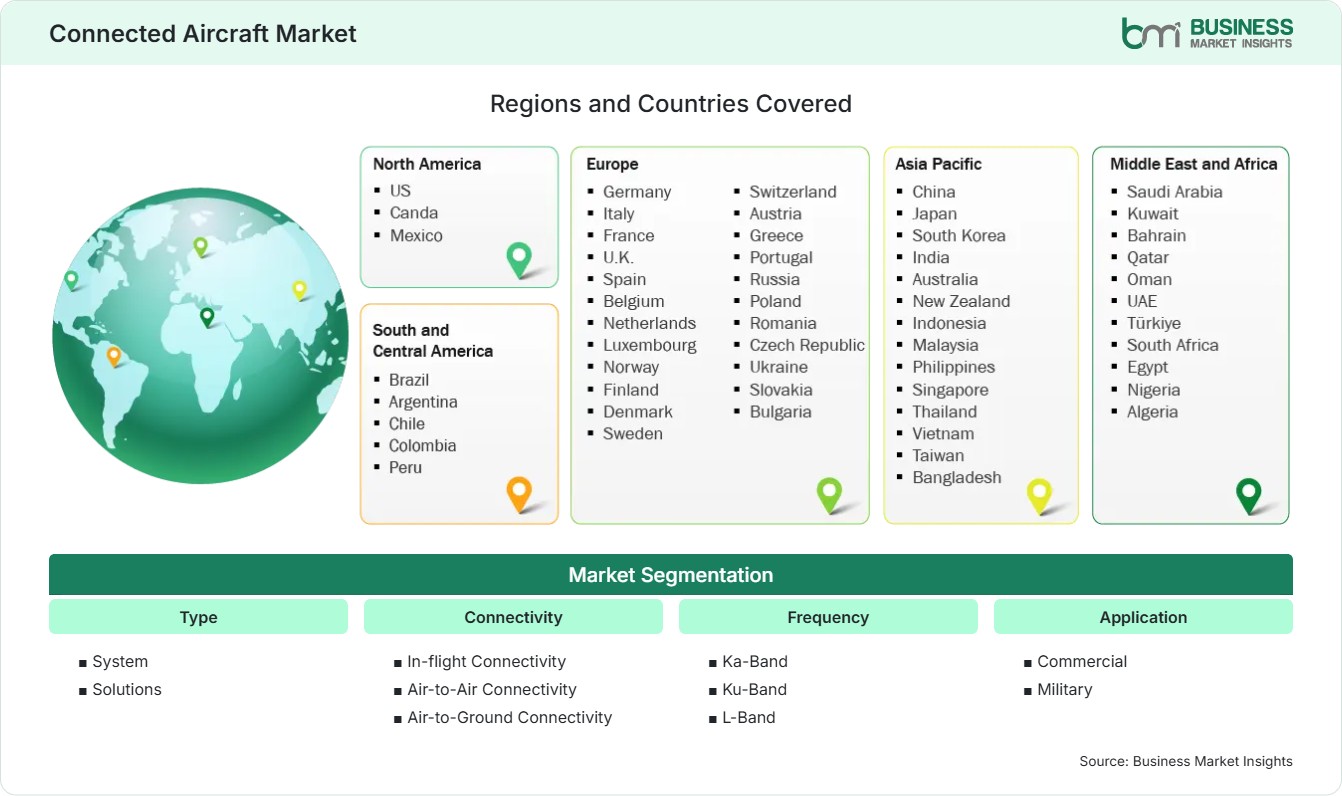
  • Type: System, Solutions
  • Connectivity: In-flight Connectivity, Air-to-Air Connectivity, Air-to-Ground Connectivity
  • Frequency: Ka-Band, Ku-Band, L-Band
  • Application: Commercial, Military
US$ 7.30 Bn Market size in 2025
US$ 46.31 Bn Market Size by 2033
25.98% CAGR, 2026 - 2033
2026-2033 Forecast Period

AI Overview

Connected Aircraft Market Summary

  • North America Region: North America holds 36%–39% market share in 2025 and is projected to grow at a CAGR of 24.8%–25.5% during 2026–2033. Fleet modernization, satellite communication investments, and increasing demand for connected aviation platforms continue supporting regional expansion. The U.S. represents the largest market with a CAGR of 25.0%–25.8%, driven by advanced airline digitalization, defense modernization programs, and growing adoption of connected aircraft technologies.
  • Fastest Growing Region: Asia Pacific accounts for 25%–28% market share in 2025 and is anticipated to register the highest CAGR of 28.4%–29.2%, supported by airline fleet expansion, airport modernization projects, increasing passenger traffic, and government investments in aviation digital infrastructure.
  • Leading Segment: System captures 57%–60% market share in 2025 and is expected to expand at a CAGR of 25.5%–26.2%, driven by increasing deployment of onboard communication, navigation, and aircraft health monitoring systems.
  • High Growth Segment: Commercial accounts for 69%–72% market share in 2025 and is projected to record a CAGR of 26.4%–27.2%, supported by rising airline investments in passenger connectivity, operational efficiency, and predictive maintenance platforms.
  • Key Market Opportunity: Expanding satellite connectivity, real-time aircraft analytics, and intelligent aviation platforms are creating long-term opportunities for service providers, airlines, and aircraft system manufacturers worldwide.
  • Major Market Players: Honeywell International Inc., Collins Aerospace, Thales Group, Panasonic Avionics Corporation, Gogo Inc., Viasat, Inc., Intelsat S.A., Inmarsat Global Limited, Cobham Limited, and Lufthansa Systems GmbH & Co. KG.
Strategic Insights

Connected Aircraft Market: Strategic Insights

Connected Aircraft Market Strategic Framework
FREE PDF
Request your free sample
Request free sample
Stakeholder View

Key Takeaways

  • Aircraft connectivity is evolving into a strategic operational platform that integrates flight operations, predictive maintenance, passenger services, and real-time fleet management across commercial and military aviation.
  • Airlines investing in advanced communication systems and connected services are positioned to improve operational efficiency while generating additional revenue from premium onboard connectivity offerings.
  • Satellite-based communication, cloud analytics, and artificial intelligence are accelerating innovation in aircraft health monitoring and operational decision-making capabilities.
  • Asia Pacific offers substantial investment opportunities through rapid airline fleet expansion, increasing airport infrastructure development, and government-supported aviation modernization initiatives.
  • Strategic partnerships among satellite operators, aircraft manufacturers, and digital aviation solution providers continue driving technology integration and accelerating commercial deployment worldwide.
  • Increasing cybersecurity investments and regulatory compliance initiatives are becoming essential for maintaining secure, resilient, and scalable connected aviation ecosystems.
Geographic Outlook

Connected Aircraft Market Regional Highlights

North America Connected Aircraft Market

North America represents 36%–39% Connected Aircraft Market share in 2025 and is projected to expand at a CAGR of 24.8%–25.5% during 2026–2033. The region benefits from advanced aerospace manufacturing capabilities, high commercial aircraft utilization, defense modernization programs, and widespread adoption of digital aviation technologies. Airlines continue investing in next-generation connectivity platforms that improve operational performance while supporting passenger-focused digital services.

  • Airlines continue deploying high-capacity satellite communication systems to strengthen operational connectivity and onboard passenger experiences.
  • Defense organizations increasingly integrate secure digital communication platforms into next-generation military aircraft programs.
  • Strong aerospace technology investments continue supporting innovation in predictive maintenance and aircraft health monitoring.
  • Cloud-based aviation platforms improve operational visibility and fleet management across commercial aviation networks.

US Connected Aircraft Market

The United States contributes 84%–87% of North American revenue and is expected to register a CAGR of 25.0%–25.8% during the forecast period. Continued investments in commercial aviation, defense modernization, satellite communications, and intelligent flight operations support sustained industry expansion.

  • Major airlines continue expanding high-speed in-flight connectivity services across domestic and international fleets.
  • Aerospace companies strengthen aircraft digitalization through cloud computing and advanced communication technologies.
  • Predictive maintenance platforms improve fleet availability while reducing unexpected operational disruptions.
  • Federal investments in aviation modernization continue supporting long-term connected aircraft deployment.

Europe Connected Aircraft Market

Europe accounts for 27%–30% market share in 2025 and is projected to grow at a CAGR of 25.1%–25.8% through 2026–2033. Regional airlines continue investing in aircraft modernization, digital flight operations, and passenger connectivity services. Germany leads the regional market through aerospace manufacturing strength, while France records the fastest growth supported by aviation technology investments and satellite communication development.

  • Airlines increasingly integrate connected cabin technologies to improve passenger satisfaction and operational efficiency.
  • European aerospace manufacturers continue expanding intelligent aircraft communication capabilities.
  • Digital aviation initiatives strengthen collaboration between airlines, airports, and air traffic management authorities.
  • Growing sustainability initiatives encourage optimized flight operations through real-time operational analytics.

Asia Pacific Connected Aircraft Market

Asia Pacific captures 25%–28% market share in 2025 and is expected to record the highest CAGR of 28.4%–29.2% during the forecast period. Rising passenger traffic, expanding airline fleets, and continuous airport infrastructure development continue strengthening regional demand. China remains the largest regional market, while India demonstrates the fastest expansion through aviation infrastructure investments and airline digital transformation.

  • Commercial airlines continue expanding connected aircraft capabilities to improve operational efficiency and passenger services.
  • Airport modernization programs accelerate adoption of advanced digital aviation infrastructure.
  • Growing aircraft deliveries continue increasing demand for integrated onboard communication systems.
  • Government investments in aviation technology strengthen long-term regional competitiveness.

Rest of World Connected Aircraft Market

The Rest of World region accounts for 7%–10% market share in 2025 and is projected to register a CAGR of 25.6%–26.4% through 2026–2033. Expanding airline fleets, military aircraft modernization, and increasing investment in satellite communication infrastructure continue driving market development across Latin America, the Middle East, and Africa.

  • Gulf countries continue investing in premium airline connectivity and digital aviation platforms.
  • Brazil supports regional growth through commercial aviation fleet modernization initiatives.
  • Military modernization programs increase demand for secure aircraft communication technologies.
  • Rising international air travel strengthens investments in connected aviation infrastructure and services.
Global Market Geography
FREE PDF
Request your free sample
Request free sample
Segment Analysis

Connected Aircraft Market Segmentation

Type

The type segment represents the foundation of connected aviation platforms by integrating onboard hardware with intelligent software capabilities that enable real-time communication and operational efficiency. It accounted for 57%–60% market share in 2025 and is projected to grow at a CAGR of 25.5%–26.2% during 2026–2033. Continuous investments in aircraft digitalization, satellite communications, and integrated avionics are expanding the Connected Aircraft Market scope across commercial and military aviation.

  • System: Represents the dominant sub-segment owing to widespread deployment of onboard communication systems, aircraft health monitoring equipment, connected avionics, sensors, and integrated networking infrastructure supporting modern flight operations.
  • Solutions: Experiences rapid adoption as airlines and defense operators increasingly implement cloud-based analytics, predictive maintenance platforms, operational software, cybersecurity solutions, and real-time fleet management applications.

Connectivity

Connectivity technologies remain central to aircraft digital transformation by enabling uninterrupted communication between aircraft, ground infrastructure, and satellite networks. This segment accounted for 46%–49% market share in 2025 and is anticipated to register a CAGR of 26.2%–26.9% during 2026–2033. Ongoing Connected Aircraft Market trends indicate rising investments in next-generation satellite communication systems that enhance operational efficiency, passenger services, and aircraft performance monitoring.

  • In-flight Connectivity: Leads adoption through growing passenger demand for high-speed internet access, entertainment streaming, operational communication, and cabin connectivity services during commercial flights.
  • Air-to-Air Connectivity: Supports secure aircraft communication, collaborative flight management, weather information exchange, and improved situational awareness for safer and more efficient airspace operations.
  • Air-to-Ground Connectivity: Maintains critical communication between aircraft and ground stations by enabling flight tracking, operational updates, maintenance diagnostics, and real-time performance monitoring throughout flight operations.

Frequency

Frequency bands play a vital role in determining communication capacity, bandwidth availability, coverage, and transmission reliability across connected aircraft systems. This segment holds 39%–42% market share in 2025 and is projected to expand at a CAGR of 26.0%–26.7% during 2026–2033 as satellite communication capabilities continue advancing worldwide.

  • Ka-Band: Gains significant momentum owing to its high bandwidth capacity, faster data transmission speeds, and ability to support premium passenger connectivity and advanced aircraft applications.
  • Ku-Band: Remains extensively deployed across commercial aviation because of its mature infrastructure, reliable global coverage, and compatibility with existing airborne connectivity systems.
  • L-Band: Continues serving mission-critical aviation communications by providing dependable connectivity for cockpit operations, aircraft safety services, and operational data exchange under challenging flight conditions.

Application

Application-specific deployment continues expanding as airlines and defense organizations prioritize operational efficiency, safety, digital communication, and intelligent fleet management. The application segment accounted for 69%–72% market share in 2025 and is forecast to register a CAGR of 26.4%–27.2% during 2026–2033. Increasing aircraft deliveries, digital flight operations, and advanced passenger services continue supporting widespread implementation across global aviation sectors.

  • Commercial: Dominates the market through rising airline investments in passenger connectivity, aircraft operational analytics, predictive maintenance, digital cabin services, and real-time communication platforms supporting efficient fleet operations.
  • Military: Expands steadily as defense organizations strengthen secure airborne communications, mission management capabilities, surveillance operations, and real-time information sharing across modern connected defense aircraft fleets.
Market Forces

Connected Aircraft Market Dynamics

Key Market Drivers

Digital flight operations improve fleet efficiency

Digital flight operations platforms have been widely adopted by airlines to increase fleet efficiency, optimize flight planning and cut down on fuel usage. These aircraft connected systems facilitate instant communication between the aircraft, operations center and maintenance crew, thereby making it easier to make operational decisions using the exchanged real-time information. According to industry aviation digitalization initiatives, airlines continue prioritizing intelligent operational technologies to improve efficiency and reduce operating costs. These developments continue supporting Connected Aircraft Market growth by accelerating investment in advanced onboard communication and digital aviation infrastructure.

Predictive maintenance reduces operational disruptions

Aircraft operators are increasingly implementing predictive maintenance technologies to improve fleet reliability and minimize unexpected maintenance events. The sensor system continuously tracks all aircraft parameters, providing performance information that helps detect faults before failure occurs. It decreases aircraft downtime, enhances maintenance planning, and increases efficiency in operations by reducing costs. The airlines also gain due to optimized spare parts management and maintenance planning based on data analysis. More and more usage of health management platforms of the aircraft creates high demands for connected aviation technologies.

Passenger connectivity enhances travel experience

Requirements from passengers for seamless digital connectivity are driving investment into new technologies that will enable future flight communications. Airlines are increasing the provision of broadband Internet connectivity, live entertainment services, message capabilities, and real-time travel information in order to enhance their customer experience and competitive position. Satellite communication providers are launching high-capacity networks that can meet increasing bandwidth needs of passengers flying on aircraft. These developments continue influencing Connected Aircraft Market trends, encouraging airlines to modernize fleets with advanced connectivity capabilities that enhance passenger engagement and operational performance.

Key Market Opportunities

Cabin connectivity services create recurring revenue

Airline companies are making onboard connectivity a source of sustainable income using services such as premium internet subscriptions, entertainment, online shopping, advertisements, and customized services for passengers. The advanced satellite communication technology allows airline companies to introduce new digital business models and build customer loyalty. Service providers are working together with airline companies to provide more subscription-based services to both domestic and international flights. Connected Aircraft Market Forecasts indicate that growing passenger demand for uninterrupted onboard connectivity will continue creating attractive recurring revenue opportunities throughout the forecast period.

Data-driven maintenance expands service portfolios

Aircraft manufacturers, maintenance providers, and technology companies are increasingly developing advanced digital maintenance services powered by artificial intelligence, cloud analytics, and connected aircraft platforms. The consistent gathering of operational data leads to proactive maintenance planning and component life prediction, as well as remote diagnostics, which enhance the availability of the fleet. Digital maintenance contracts are being offered by service providers that include both predictive analysis and engineering services, forming long-lasting partnerships with their customers.

Smart aviation ecosystems unlock future innovations

The aviation sector continues to advance towards a future where flights, airports, air traffic control systems, and maintenance facilities share operational data in real time within interconnected ecosystems. The use of artificial intelligence, cloud computing, satellite communications, and digital twins has made it possible for intelligent decisions to be made during flight operations. In addition to increasing safety, operational efficiencies, maintenance planning, and customer service, the collaborative ecosystems have generated new revenue streams for connectivity firms, software houses, and aerospace companies.

Market Restraints and Challenges

Connectivity upgrades require significant investment

Modern connected aircraft require advanced satellite communication terminals, onboard networking equipment, software integration, and continuous infrastructure upgrades. Factor: High level of investment needed for upgrading current fleet and integrating new connectivity systems leads to increased cost pressure on airlines. Impact: Smaller carriers and regional fleets would be less willing to adopt technology owing to budget constraints, thus slowing down fleet modernization process despite increased benefits of such integration for operation and business purposes.

Data security risks challenge digital aviation systems

Increasing connectivity across aircraft, airline operations, maintenance platforms, and airport infrastructure expands the cybersecurity landscape for aviation stakeholders. Factor: Connected aviation networks produce a great amount of data that should be protected at all times from any cyber attacks, any breaches to security, and any vulnerabilities to the systems. Impact: Airlines and tech companies will have to invest heavily into the development of their cybersecurity infrastructure, encryption technologies, and regulations.

Company Analysis

Competitive Landscape

The market remains highly competitive as aerospace technology providers, satellite communication companies, and avionics specialists continue investing in digital aviation platforms. Connected Aircraft Market analysis highlights increasing collaboration among aircraft OEMs, connectivity providers, and software developers to strengthen in-flight communication, predictive maintenance, and intelligent fleet management. Product innovation, satellite network expansion, cybersecurity enhancement, and cloud-enabled aviation services remain the primary competitive strategies.

Company Name

Overview

Products and Services Relevant to this Market

Honeywell International Inc.

Global aerospace technology company providing integrated avionics and connected aircraft solutions for commercial and defense aviation.

Aircraft connectivity systems, flight management solutions, aircraft health monitoring, navigation systems, and digital aviation platforms.

Collins Aerospace

Leading aerospace supplier delivering advanced avionics, communication, and connected aircraft technologies worldwide.

Cabin connectivity systems, avionics, communication equipment, aircraft networking, and flight operations solutions.

Thales Group

International technology company specializing in aerospace electronics, secure communications, and digital aviation systems.

In-flight connectivity, avionics, cockpit systems, cybersecurity solutions, and digital flight management technologies.

Panasonic Avionics Corporation

Global provider of in-flight entertainment and connectivity technologies for commercial airlines.

In-flight connectivity, entertainment platforms, passenger communication systems, cabin digital services, and satellite-enabled connectivity.

Gogo Inc.

Aviation connectivity specialist delivering broadband communication services for business and commercial aircraft.

Air-to-ground connectivity, broadband communication, inflight internet, aviation networking, and digital communication services.

Viasat, Inc.

Satellite communications company providing high-capacity connectivity solutions for commercial and government aviation.

Ka-band satellite services, aviation broadband, passenger connectivity, secure communication, and aircraft networking platforms.

Intelsat S.A.

Global satellite network operator supporting aviation connectivity through worldwide communication infrastructure.

Satellite communication services, in-flight connectivity, broadband aviation networks, and mobility communication solutions.

Inmarsat Global Limited

Satellite communications provider delivering global connectivity services across commercial and government aviation sectors.

L-band and Ka-band connectivity, cockpit communications, passenger broadband, and aircraft operational communication services.

Cobham Limited

Aerospace engineering company supplying communication, antenna, and connectivity technologies for aviation applications.

Aviation antennas, communication systems, satellite terminals, radio technologies, and aircraft connectivity equipment.

Lufthansa Systems GmbH & Co. KG

Aviation IT solutions provider supporting airline digitalization, operational efficiency, and connected flight operations.

Airline operations software, flight planning systems, digital maintenance platforms, connectivity integration, and aviation IT services.

Trust & Transparency

Research Methodology

The market analysis combines proprietary research with secondary data from government agencies, company disclosures, regulatory filings, industry databases and expert interviews. Market estimates are validated through data triangulation, cross-market benchmarking and analyst review.

View Full Research Methodology

Questions Answered

Frequently Asked Questions

What does the Connected Aircraft Market Report include?

The Market Report provides comprehensive insights into market dynamics, competitive landscape, regional outlook, segmentation, technology developments, investment opportunities, emerging business strategies, and future industry prospects.

Which region is expected to experience the fastest growth?

Asia Pacific is projected to register the highest growth due to rapid fleet expansion, airport modernization, increasing air passenger traffic, and strong investments in aviation digital transformation initiatives.

Why is satellite connectivity becoming essential for modern aircraft?

Satellite communication enables continuous aircraft connectivity, supports real-time operational data exchange, enhances flight safety, improves passenger internet services, and facilitates predictive maintenance across global flight routes.

Which application segment accounts for the largest market share?

The commercial segment leads the market because airlines continue investing in connected aircraft technologies that improve operational efficiency, passenger experience, aircraft utilization, and maintenance performance.

What factors are driving the Connected Aircraft Market?

The market is driven by digital flight operations, predictive maintenance technologies, increasing passenger demand for onboard connectivity, satellite communication advancements, and expanding investments in intelligent aviation infrastructure.

Access the Full Connected Aircraft Market Report

Get segment-level forecasts, regional estimates, competitive benchmarking, company profiles and downloadable Excel datasets.

Access the full Connected Aircraft Market Report
350 pages PDF & Excel | 2026-08-25