Instrument Landing System (ILS) Market Outlook: Size, Share, Trends, Growth Analysis, Competitive Landscape & Forecast, 2026-2033

Historic Data: 2022-2024   |   Base Year: 2025   |   Forecast Period: 2026-2033
Report Content: Market Scope, Market Segmentation, Market Dynamics, and Competitive Analysis

Report Coverage:
  • Type (CAT I, CAT II, CAT III)
  • Component (Localizer, Glide Slope, Marker Beacons)
  • Application (Commercial Aviation, Military Aviation)

No. of Pages: 400
Report Code: BMIPUB00035628
Category: Aerospace and Defense
Instrument Landing System (ILS) Market

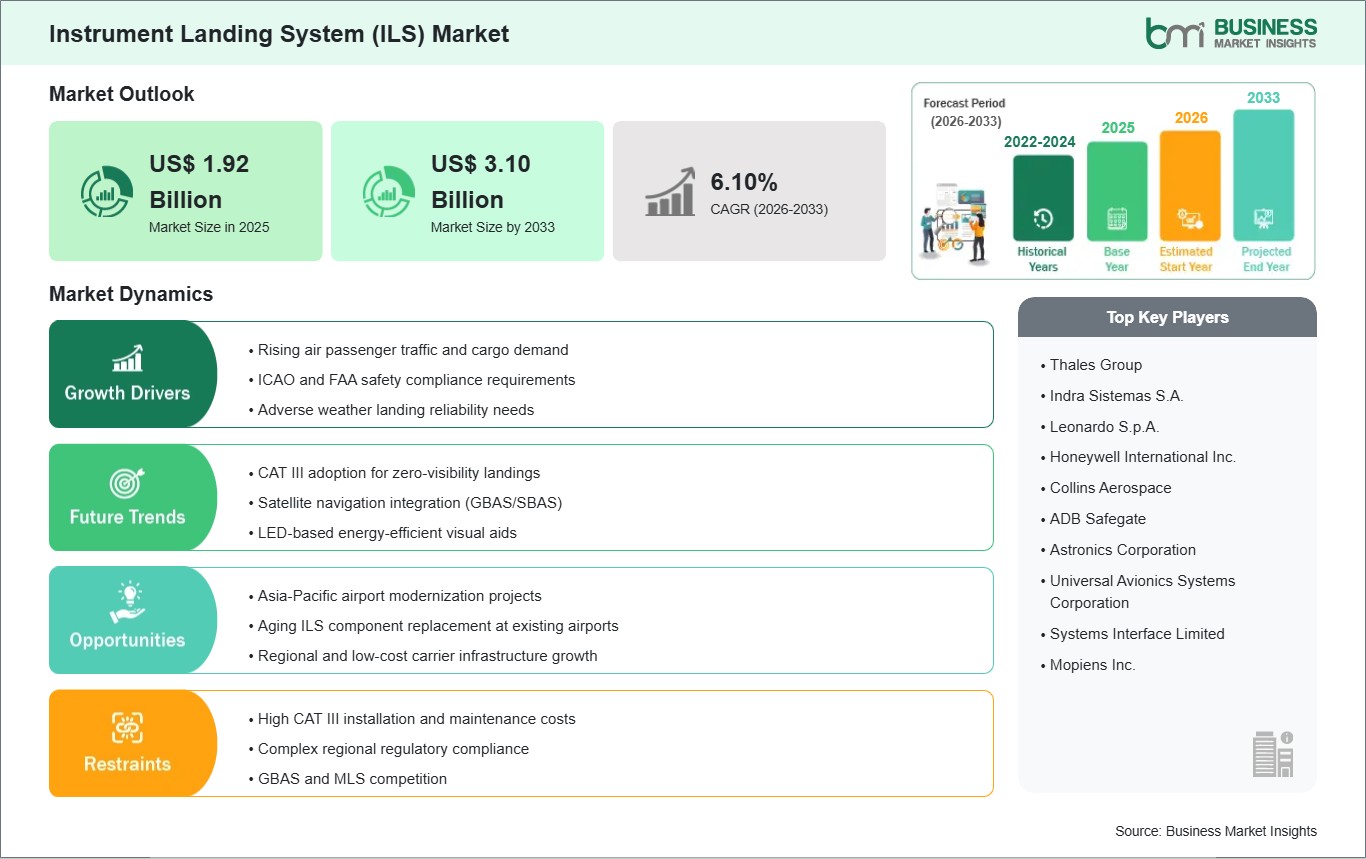
The Instrument Landing System (ILS) market size is expected to reach US$ 3.10 Billion by 2033 from US$ 1.92 Billion in 2025. The market is estimated to record a CAGR of 6.10% from 2026 to 2033.

Executive Summary and Global Market Analysis:

Instrument landing systems are ground-based precision approach solutions that transmit horizontal and vertical guidance to aircraft during final descent under reduced-visibility conditions. The system combines localizer and glide slope functions, with supporting markers or related aids, to keep aircraft aligned with the runway centerline and descent path. Its operational value remains closely tied to air safety, runway availability, and dependable all-weather airport access.

Expansion in airport modernization programs continues to support procurement of precision landing infrastructure across commercial and defense aviation networks. Operators are prioritizing runway systems that reduce disruption during fog, rain, and low cloud ceilings, while aviation authorities maintain strict expectations around navigational reliability. These conditions are reinforcing replacement cycles for aging installations and supporting deployment at airports handling higher movement intensity.

From a segmentation perspective, CAT I systems retain broad relevance across established airport networks, while CAT II and CAT III configurations attract attention where continuity under stricter visibility thresholds is essential. Component demand remains centered on localizer and glide slope subsystems because both determine the precision of runway alignment and descent guidance. Across applications, commercial aviation contributes the larger deployment base, whereas military aviation emphasizes resilience and mission-readiness at strategic airfields.

Technology development within this sector is increasingly shaped by signal stability improvements, remote monitoring capability, lifecycle management tools, and integration with broader air navigation frameworks. Suppliers are focusing on systems that simplify maintenance, strengthen operational integrity, and fit complex runway environments without compromising certification standards. This evolution is making modern installations more adaptable to airport renewal strategies and long-term service planning.

The competitive environment reflects a concentrated supplier base with expertise in certified navigation equipment, airfield integration, and ongoing technical support. Procurement decisions usually balance compliance performance, maintainability, and compatibility with airport modernization objectives rather than short-term equipment cost alone. As a result, the market continues to favor manufacturers and service partners capable of delivering reliable systems across both civil and defense operating contexts.

Instrument Landing System (ILS) Market - Strategic Insights:

global-market-strategic-framework
Get more information on this report

Instrument Landing System (ILS) Market Segmentation Analysis:

The market is segmented by type, component, and application to reflect deployment priorities across airport infrastructure programs.

By Type

  • CAT I: Supports routine precision approaches at airports requiring dependable low-visibility guidance.
  • CAT II: Extends landing capability where stricter operating minima demand enhanced approach assurance.
  • CAT III: Serves airports prioritizing continuity during severe visibility constraints and dense traffic flows.

By Component

  • Localizer: Delivers lateral runway alignment essential for stable final approach performance.
  • Glide Slope: Provides vertical descent guidance that improves landing path precision.
  • Marker Beacons: Supply position reference cues during approach at selected airfield installations.

By Application

  • Commercial Aviation: Accounts for broad runway deployment linked to traffic continuity requirements.
  • Military Aviation: Emphasizes resilient landing support across strategic and expeditionary airfields.

Instrument Landing System (ILS) Market Drivers and Opportunities:

Airport Modernization and All-Weather Operational Reliability

Runway modernization programs are increasing the need for precision approach systems that support safe landings during reduced visibility. Airports handling dense commercial traffic require dependable guidance infrastructure to protect schedule integrity, lower diversion risk, and maintain airfield usability under changing weather conditions. This requirement encourages procurement of certified ILS installations across both replacement projects and selective new runway developments.

The resulting impact is evident in aviation planning priorities that link navigation reliability with airport efficiency and safety assurance. Civil aviation authorities, airport operators, and defense organizations continue to emphasize infrastructure resilience, especially where weather-related disruption carries operational and financial consequences. In this context, ILS remains directly relevant because it supports predictable approach performance within regulated airspace environments and established landing procedures.

Digital Monitoring, System Renewal, and Airfield Capability Expansion

Airports are increasingly adopting digital monitoring architectures to supervise signal integrity, simplify diagnostics, and reduce maintenance interruptions across precision approach infrastructure. This shift is opening opportunities for system renewal programs that replace aging localizer and glide slope assets with modern platforms designed for remote visibility and faster service response. The use case is strongest at airfields seeking dependable low-visibility operations while modernizing runway support systems without introducing unnecessary procedural complexity.

Future scope extends to secondary airports, defense airfields, and runway refurbishment programs where capability expansion depends on reliable landing guidance and manageable lifecycle costs. As operators broaden investment toward resilient airfield infrastructure, suppliers that offer modular upgrades, remote performance oversight, and certification-aligned renewal pathways can strengthen their position. This opportunity carries clear market relevance because it connects modernization budgets with practical improvements in runway availability, maintenance planning, and operational continuity.

Instrument Landing System (ILS) Market Size and Share Analysis:

The Instrument Landing System (ILS) market size is expected to reach US$ 3.10 Billion by 2033 from US$ 1.92 Billion in 2025. The market is estimated to record a CAGR of 6.10% from 2026 to 2033. This trajectory reflects sustained investment in runway guidance infrastructure, with growth shaped by modernization cycles, safety compliance priorities, and the operational requirement for dependable low-visibility landing support across airport networks.

By type, CAT I systems hold the broadest installed base because they align with standard precision approach requirements across many established airports. CAT II and CAT III systems carry stronger strategic value at airports that prioritize continuity under tighter visibility minima and more demanding operating conditions. By component, localizer and glide slope subsystems command primary attention since both are fundamental to lateral and vertical guidance performance during final approach.

By application, commercial aviation represents the dominant deployment environment because passenger traffic continuity, schedule stability, and runway utilization remain central operational priorities. Military aviation also contributes meaningful demand, particularly where airfield readiness, landing assurance, and infrastructure resilience support defense mobility objectives. This application pattern reinforces the market’s dependence on certified systems that perform reliably across both high-throughput civil airports and strategically important military installations.

Instrument Landing System (ILS) Market Report Highlights:

Report Attribute Details
Market size in 2025 US$ 1.92 Billion
Market Size by 2033 US$ 3.10 Billion
Global CAGR (2026 - 2033)6.10%
Historical Data 2022-2024
Forecast period 2026-2033
Segments Covered By Type
  • CAT I
  • CAT II
  • CAT III
By Component
  • Localizer
  • Glide Slope
  • Marker Beacons
By Application
  • Commercial Aviation
  • Military Aviation
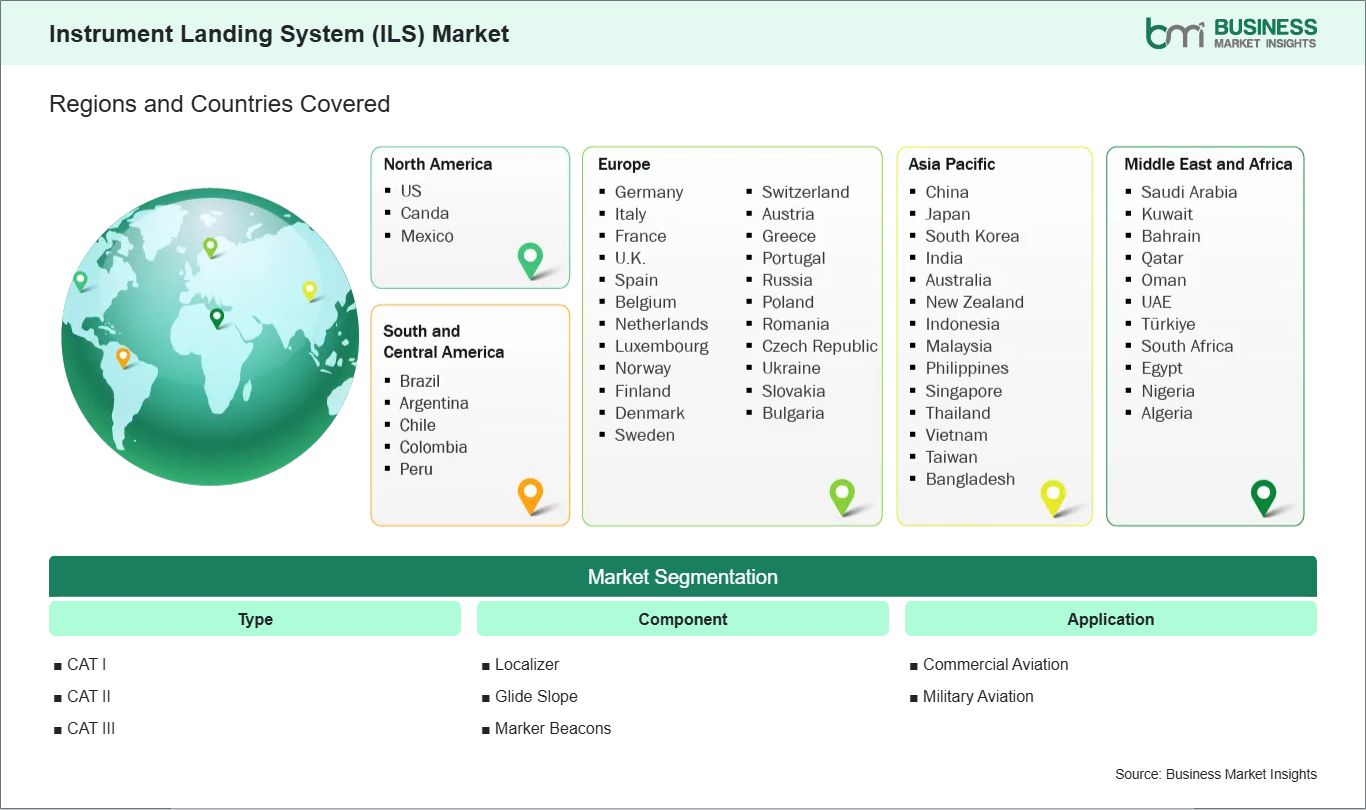
Regions and Countries Covered
North America US, Canada, Mexico
Europe Germany, Italy, France, U.K., Spain, Belgium, Netherlands, Luxembourg, Norway, Finland, Denmark, Sweden, Switzerland, Austria, Greece, Portugal, Russia, Poland, Romania, Czech Republic, Ukraine, Slovakia, Bulgaria
Asia-Pacific China, Japan, South Korea, India, Australia, New Zealand, Indonesia, Malaysia, Philippines, Singapore, Thailand, Vietnam, Taiwan, Bangladesh
South and Central America Brazil, Argentina, Chile, Colombia, Peru
Middle East and Africa Saudi Arabia, United Arab Emirates, Kuwait, Bahrain, Qatar, Oman, Turkiye, South Africa, Egypt, Nigeria, Algeria
Market leaders and key company profiles
  • Thales Group
  • Indra Sistemas S.A.
  • Leonardo S.p.A.
  • Honeywell International Inc.
  • Collins Aerospace
  • ADB Safegate
  • Astronics Corporation
  • Universal Avionics Systems Corporation
  • Systems Interface Limited
  • Mopiens Inc.
Get more information on this report

Instrument Landing System (ILS) Market Report Coverage and Deliverables:

The "Instrument Landing System (ILS) Market Size and Forecast (2022-2033)" report provides a detailed analysis of the market covering the areas below:

  • Market size and forecast at global, regional, and country levels for all the key market segments covered under the scope
  • Market trends, as well as market dynamics such as drivers, restraints, and key opportunities
  • Market analysis covering key market trends, global and regional framework, major players, regulations, and recent market developments
  • Industry landscape and competition analysis covering market concentration, heat map analysis, prominent players, and recent developments for the market
  • Detailed company profiles, including SWOT analysis

Instrument Landing System (ILS) Market Geographic Insights:

The Instrument Landing System (ILS) market shows diverse regional adoption patterns influenced by airport modernization priorities, regulatory operating standards, runway traffic density, and the need for dependable low-visibility landing support. Across the global market, replacement of aging navigation infrastructure remains a central theme, particularly where operators are aligning airfield systems with broader safety, continuity, and lifecycle management objectives. Procurement patterns also reflect differences in runway complexity, weather exposure, and institutional funding structures.

North America maintains a mature operating environment shaped by established airport networks, demanding compliance regimes, and sustained attention to navigation resilience. Investment emphasis in this region often centers on renewal of legacy installations, calibration quality, and integration with wider air traffic modernization programs. Commercial hubs value ILS for operational continuity during weather disruption, while military airfields prioritize deployability, equipment integrity, and dependable landing assurance across fixed and expeditionary settings.

Asia Pacific reflects a more expansion-oriented landscape, supported by airport capacity development, runway additions, and infrastructure upgrades across both established and emerging aviation markets. Regional demand is reinforced by the operational importance of precision approach capability at high-throughput airports exposed to seasonal visibility constraints. The market also benefits from long-term investment in civil aviation networks, creating room for both new installations and selective upgrades that strengthen runway performance and service reliability.

Europe continues to emphasize certified performance, maintenance discipline, and modernization of precision approach systems within complex regulatory environments. Emerging markets across the Middle East, Africa, and South and Central America present a different growth profile, where airport development programs, runway rehabilitation, and air connectivity objectives shape procurement decisions. In these regions, ILS investment is often linked to broader capability expansion, making system reliability, technical support, and long-term maintainability especially relevant.

global-market-geography
Get more information on this report

Instrument Landing System (ILS) Market Research Report Guidance:

  • The report encompasses both qualitative and quantitative data pertaining to the market, categorized by type, component, and application, and geographical regions.
  • Beginning with Chapter 2, the report presents key takeaways that underscore the primary trends and market outlook.
  • Chapter 3 is dedicated to outlining the research methodology employed in this study.
  • In Chapter 4, an ecosystem analysis is provided.
  • Chapter 5 delves into the significant industry dynamics affecting the market, including driving factors, existing challenges, potential opportunities, and emerging trends. This section also includes an impact analysis of these drivers and constraints.
  • Chapter 6 reviews the market scenario, detailing historical revenue figures and forecasts extending to the year 2033.
  • Chapters 7 through 10 analyze market segments based on type, component, and application, and geography, covering regions such as North America, Europe, Asia Pacific, the Middle East and Africa, and South and Central America. These chapters include market revenue data, forecasts, and driving factors.
  • Chapter 11 presents a competitive analysis, featuring a heat map of key players within the market.
  • Chapter 12 offers an industry landscape analysis, detailing business activities such as market initiatives, recent developments, mergers, and joint ventures on a global scale, alongside a competitive overview.
  • In Chapter 13, comprehensive profiles of major companies operating in the market are provided. These profiles include key facts, business descriptions, product and service offerings, financial overviews, SWOT analyses, and significant developments.
  • Finally, Chapter 14, the appendix, includes a brief company overview, a list of abbreviations, and a disclaimer.

Instrument Landing System (ILS) Market News and Key Development:

Recent developments highlight continued investment in runway modernization, calibration, and precision approach capability. The updates below reflect real industry activity relevant to ILS deployment and operational continuity.

  • In February 2025, GMR Hyderabad International Airport Limited (GHIAL) announced the successful installation and commissioning of advanced navigational infrastructure at GMR Hyderabad International Airport (RGIA), marking a significant advancement in the facility's operational capabilities and safety protocols.
  • In October 2023, The Royal Netherlands Air Force has underscored its confidence in Thales, awarding it a contract to upgrade 13 ILS and DME navigation systems. The current components are reaching the end of their service life, and renewal is essential to guarantee the Royal Netherlands Air Force's continued air operations.

Key Sources Referred:

World Bank: Global Trade IndicatorsWorld Trade Organization (WTO)International Monetary Fund (IMF)International Trade Administration (ITA)Company WebsitesCompany Annual Reports
The List of Companies - Instrument Landing System (ILS) Market
  • Thales Group
  • Indra Sistemas S.A.
  • Leonardo S.p.A.
  • Honeywell International Inc.
  • Collins Aerospace
  • ADB Safegate
  • Astronics Corporation
  • Universal Avionics Systems Corporation
  • Systems Interface Limited
  • Mopiens Inc.
Frequently Asked Questions
How big is the Instrument Landing System (ILS) Market?

The Instrument Landing System (ILS) Market is valued at US$ 1.92 Billion in 2025, it is projected to reach US$ 3.10 Billion by 2033.

What is the CAGR for Instrument Landing System (ILS) Market by (2026 - 2033)?

As per our report Instrument Landing System (ILS) Market, the market size is valued at US$ 1.92 Billion in 2025, projecting it to reach US$ 3.10 Billion by 2033. This translates to a CAGR of approximately 6.10% during the forecast period.

What segments are covered in this report?

The Instrument Landing System (ILS) Market report typically cover these key segments-

  • Type (CAT I, CAT II, CAT III)
  • Component (Localizer, Glide Slope, Marker Beacons)
  • Application (Commercial Aviation, Military Aviation)

What is the historic period, base year, and forecast period taken for Instrument Landing System (ILS) Market?

The historic period, base year, and forecast period can vary slightly depending on the specific market research report. However, for the Instrument Landing System (ILS) Market report:

  • Historic Period : 2022-2024
  • Base Year : 2025
  • Forecast Period : 2026-2033
  • Who are the major players in Instrument Landing System (ILS) Market?

    The Instrument Landing System (ILS) Market is populated by several key players, each contributing to its growth and innovation. Some of the major players include:

  • Thales Group
  • Indra Sistemas S.A.
  • Leonardo S.p.A.
  • Honeywell International Inc.
  • Collins Aerospace
  • ADB Safegate
  • Astronics Corporation
  • Universal Avionics Systems Corporation
  • Systems Interface Limited
  • Mopiens Inc.
  • Who should buy this report?

    The Instrument Landing System (ILS) Market report is valuable for diverse stakeholders, including:

    • Investors: Provides insights for investment decisions pertaining to market growth, companies, or industry insights. Helps assess market attractiveness and potential returns.
    • Industry Players: Offers competitive intelligence, market sizing, and trend analysis to inform strategic planning, product development, and sales strategies.
    • Suppliers and Manufacturers: Helps understand market demand for components, materials, and services related to concerned industry.
    • Researchers and Consultants: Provides data and analysis for academic research, consulting projects, and market studies.
    • Financial Institutions: Helps assess risks and opportunities associated with financing or investing in the concerned market.

    Essentially, anyone involved in or considering involvement in the Instrument Landing System (ILS) Market value chain can benefit from the information contained in a comprehensive market report.

    Available Report Formats

    pdf-format excel-format pptx-format
    Buy Now
    Sales Assistance
    +1 646 791 7070 (US & UK)
    Customization Form

    Please tell us your area of interest
    (Market Segments/ Regions and Countries/ Companies)