Market Summary
Executive Summary and Global Market Analysis
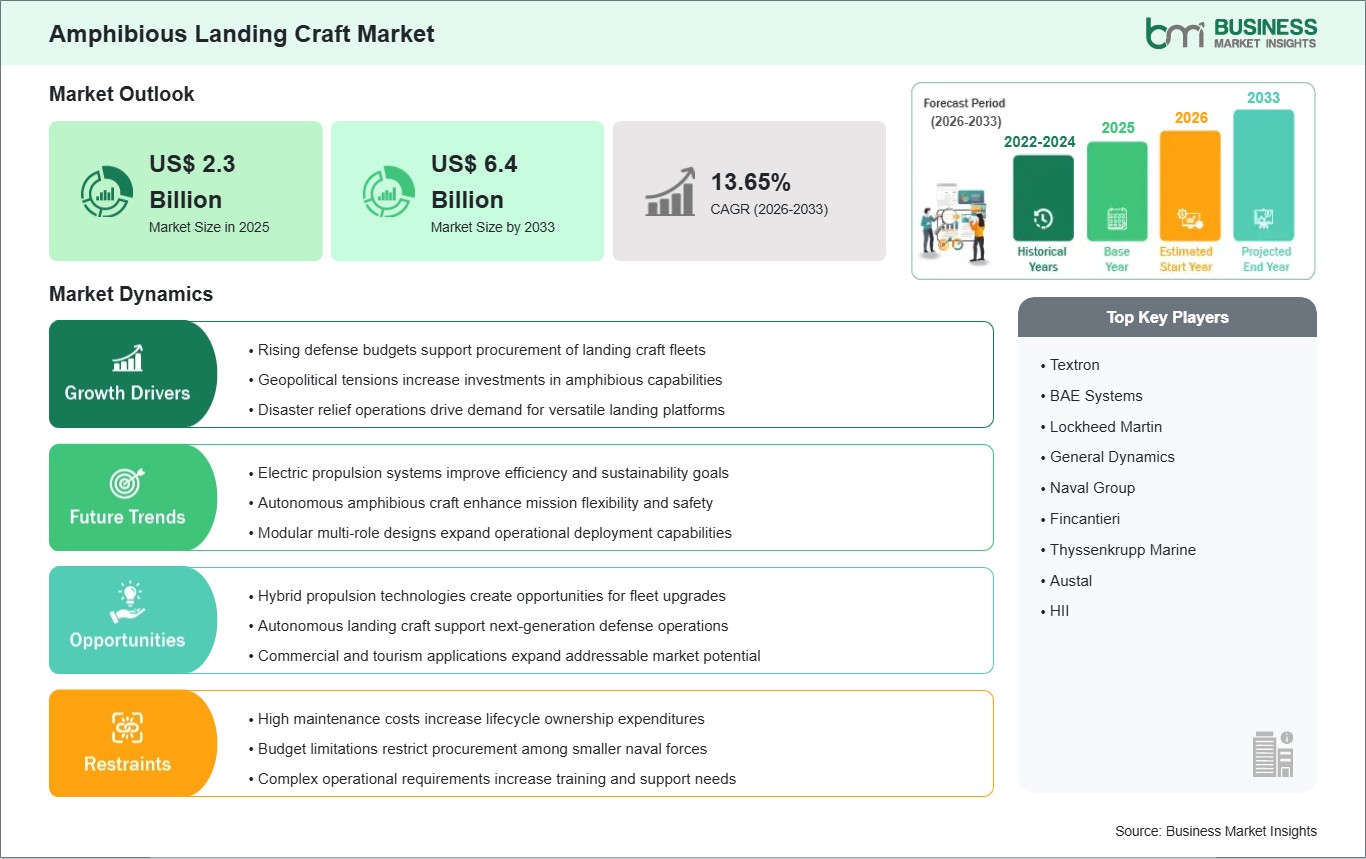
Amphibious landing craft are specialized vessels designed to transport troops, vehicles, equipment, and supplies from ships to shore and across coastal environments. These platforms play a critical role in military operations, disaster relief missions, humanitarian assistance, and maritime security activities. Common types include Landing Craft Utility (LCU), Landing Craft Air Cushion (LCAC), Landing Craft Mechanized (LCM), and Amphibious Assault Vehicles (AAV). The market growth in the Amphibious Landing Craft is primarily driven by increasing investment in modernization efforts by defense agencies, development of coastal defenses, and improving rapid deployment capabilities. There is increased market growth potential in multiple regions due to geopolitical tension and rising maritime security challenges.
There are several challenges that may affect market growth. There is considerable cost involved in the procurement and maintenance of amphibious landing vessels. The introduction of technology in terms of propulsion, navigation, and survivability could lead to higher costs for defense agencies. There are difficulties in maintaining such vessels in harsh marine conditions. Besides, there are delays in modernization programs due to lengthy procurement processes, budgetary limitations, and shifting defense priorities. There are also additional difficulties related to the operation of the vessels.
Despite these challenges, the Amphibious Landing Craft market is expected to witness strong growth as naval forces invest in next-generation amphibious capabilities. Opportunities are emerging through the adoption of autonomous technologies, improved fuel-efficient propulsion systems, and advanced command-and-control integration. Demand is also increasing for versatile platforms capable of supporting both combat and humanitarian missions. Growing emphasis on coastal surveillance, disaster response, and rapid force deployment is encouraging the development of more flexible and technologically advanced amphibious craft, supporting long-term market expansion.
Segment Analysis
Amphibious Landing Craft Market Segmentation
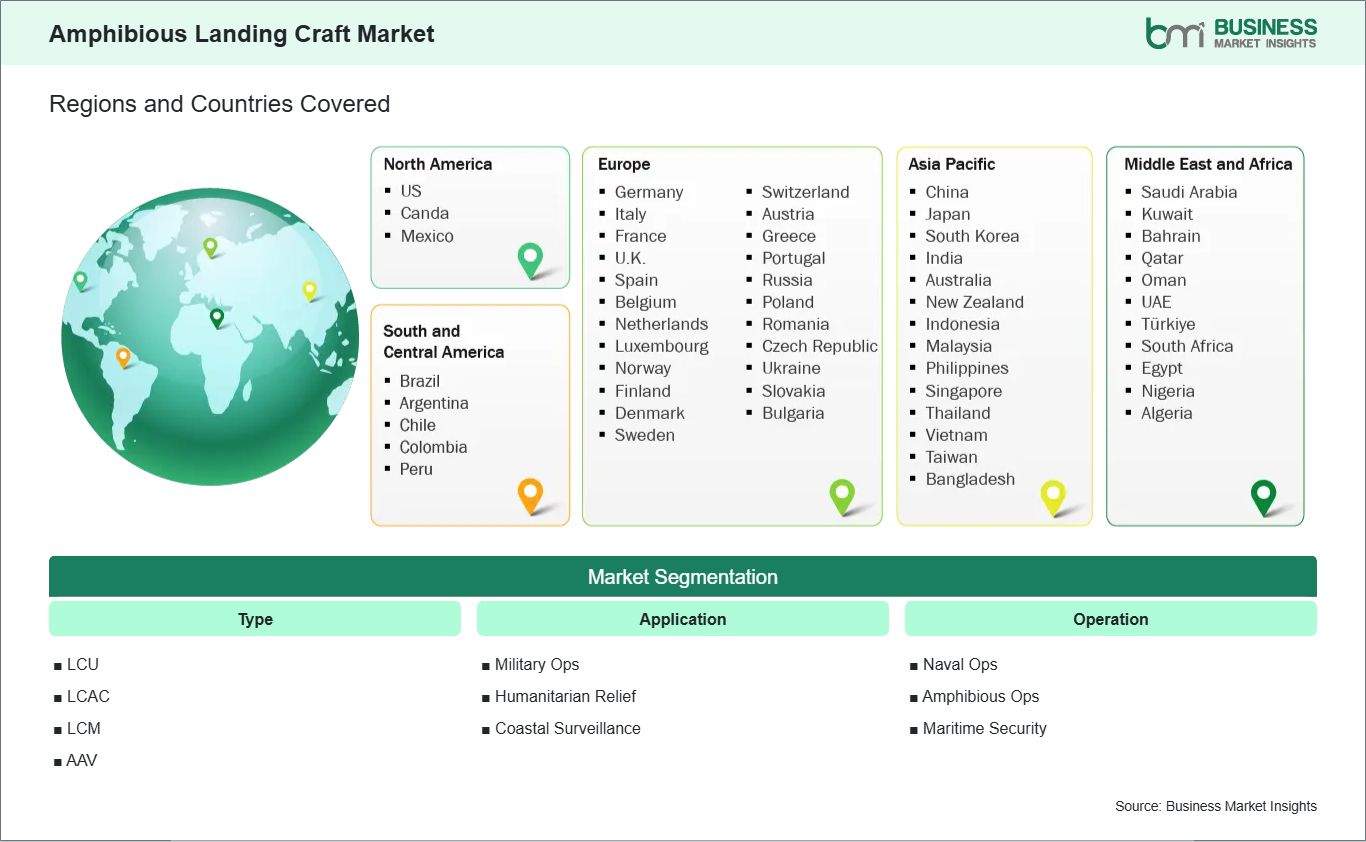
The Amphibious Landing Craft market is segmented based on type, application, and operation. These segments reflect the diverse operational requirements of military and maritime organizations worldwide.
By Type
- LCU: Used for transporting heavy vehicles, equipment, and personnel between ships and shore.
- LCAC: Hovercraft-based systems designed for high-speed amphibious transport across challenging coastal terrain.
- LCM: Medium-capacity landing craft used for logistics support and troop deployment operations.
- AAV: Amphibious vehicles capable of operating both on land and in water during military missions.
By Application
- Military Ops: Primary application segment supporting amphibious assaults, logistics, and force deployment.
- Humanitarian Relief: Used during disaster response and emergency aid delivery operations.
- Coastal Surveillance: Supports monitoring, patrol, and security activities in coastal regions.
By Operation
- Naval Ops: Supports fleet operations and amphibious warfare missions.
- Amphibious Ops: Enables direct movement of personnel and equipment between sea and land.
- Maritime Security: Assists in coastal defense, border protection, and security enforcement activities.
Market Forces
Amphibious Landing Craft Market Drivers and Opportunities
Naval Modernization and Expanding Amphibious Capabilities
Growing investments in naval modernization programs are driving demand for advanced amphibious landing craft across global defense forces. Countries are focusing on strengthening expeditionary warfare capabilities and enhancing operational readiness in coastal and littoral environments. Amphibious platforms enable rapid deployment of troops, vehicles, and equipment during combat operations, humanitarian missions, and disaster response activities.
The increasing demand for highly versatile ships that are able to undertake various missions is on the rise within defense institutions today. The current generation of landing ships is fitted with sophisticated navigation and communications equipment and increased survivability features to enable them to conduct complicated tasks. There is also a rising focus on securing waterways as well as the coastlines due to the impact of politics on defense activities by governments. Another factor contributing to the growth of the market is joint operations, which have led to a higher demand for amphibious craft.
Integration of Advanced Technologies in Amphibious Platforms
Emerging technologies are creating new opportunities for the Amphibious Landing Craft market. The key technologies being pursued by manufacturers include propulsion technology, autonomous navigation systems, digital mission management systems, and increased fuel efficiency. Such technologies are contributing to the improvement of the mission efficiency of operators at lower operating costs. There is an increasing demand for hybrid and autonomous amphibious vessels capable of supporting surveillance, logistics, and combat missions without significant personnel.
Opportunities are also emerging from increasing demand for multi-mission vessels capable of supporting both military and civilian operations. Humanitarian assistance, disaster relief, and maritime security missions require adaptable platforms that can operate effectively in diverse environments. As technological advancements continue to improve vessel performance and mission flexibility, the market is expected to benefit from expanding procurement and modernization initiatives worldwide.
Size and Share Analysis
Amphibious Landing Craft Market Size and Share Analysis
The Amphibious Landing Craft Market size is expected to reach US$ 6.4 billion by 2033 from US$ 2.3 billion in 2025. The market is estimated to record a CAGR of 13.65% from 2026 to 2033.
By type, LCU and LCAC platforms account for a significant share of the market due to their extensive use in transporting heavy equipment, vehicles, and personnel during amphibious operations. LCM platforms continue to support logistics and tactical deployment requirements, while AAV systems are gaining attention for their dual land and water operational capabilities.
By application, military operations dominate the market owing to continuous investments in naval modernization, force projection, and expeditionary warfare capabilities. Humanitarian relief applications are expanding as governments increasingly utilize amphibious assets during disaster response missions. Coastal surveillance is also witnessing steady growth due to rising maritime security requirements and the need to monitor strategic coastal regions effectively.
Report Coverage
Amphibious Landing Craft Market Report Coverage and Deliverables
The "Amphibious Landing Craft Market Size and Forecast (2022-2033)" report provides a detailed analysis of the market covering below areas:
- Market size and forecast at global, regional, and country levels for all the key market segments covered under the scope
- Market trends, as well as market dynamics such as drivers, restraints, and key opportunities
- Market analysis covering key market trends, global and regional framework, major players, regulations, and recent market developments
- Industry landscape and competition analysis covering market concentration, heat map analysis, prominent players, and recent developments for the market
- Detailed company profiles, including SWOT analysis
Geographic Insights
Amphibious Landing Craft Market Geographic Insights
The Amphibious Landing Craft Market shows diverse regional adoption patterns influenced by naval modernization programs, maritime security requirements, and investments in amphibious warfare capabilities.
North America, being a developed region, has a strong naval infrastructure and extensive adoption of advanced amphibious platforms. The region comprises the United States and Canada, where defense organizations continue to invest in fleet modernization and expeditionary warfare capabilities. The region focuses on improving operational readiness, force mobility, and rapid deployment capabilities across multiple mission environments. Well-established shipbuilding industries, advanced defense technologies, and long-term procurement programs support the adoption of amphibious landing craft across military and security operations. Ongoing investments in coastal defense and maritime security further strengthen market growth across the region.
Asia Pacific is growing significantly, driven by increasing maritime security concerns, expanding naval fleets, and rising defense expenditures. The region comprises countries such as China, India, Japan, and Australia, where governments are investing in modern amphibious capabilities to support coastal protection and military preparedness. The region focuses on strengthening maritime security infrastructure and improving operational flexibility in coastal and island environments. Growing naval modernization programs and increasing regional security priorities are creating demand for advanced landing craft capable of supporting a wide range of missions. Investments in indigenous shipbuilding capabilities and defense manufacturing are also supporting market development.
Both regions are contributing significantly to the growth of the Amphibious Landing Craft Market, focusing on naval modernization, maritime security enhancement, and the development of advanced amphibious operational capabilities.
Industry Activity
Recent Developments
The Amphibious Landing Craft Market is analyzed using a mix of primary and secondary research sources, including corporate publications, industry associations, and verified databases. This approach ensures accurate tracking of innovation trends and strategic developments influencing the market.
- In January 2025, the Royal Netherlands Navy received the first two upgraded Landing Craft Utility (LCU) vessels following a comprehensive modernization program conducted by De Haas Shipyards. The upgrades included improvements to sensors, command systems, protection equipment, and onboard operational capabilities. The modernization extends vessel service life and enhances operational effectiveness during amphibious and multifunctional missions.
- In November 2024, Textron Systems secured a contract modification worth approximately US$394 million from the U.S. Navy for the construction of nine LCAC-100 Ship-to-Shore Connector landing craft. These advanced air-cushion vehicles are designed to replace older landing craft and improve amphibious deployment capabilities. The program supports rapid transport of heavy equipment, vehicles, and personnel across challenging coastal environments, strengthening future amphibious operations.
Trust & Transparency
Research Methodology
The market analysis combines proprietary research with secondary data from government agencies, company disclosures, regulatory filings, industry databases and expert interviews. Market estimates are validated through data triangulation, cross-market benchmarking and analyst
review.
View Full Research Methodology
Key Sources Referred:
World Bank - Global Trade IndicatorsWorld Trade Organization (WTO)International Monetary Fund (IMF)International Trade Administration (ITA)Company WebsitesCompany Annual ReportsCompany Investor Presentations